• KGS/USD = 0.01144 0%
  • KZT/USD = 0.00204 0%
  • TJS/USD = 0.10422 -0.1%
  • UZS/USD = 0.00008 0%
  • TMT/USD = 0.28571 0%
  • KGS/USD = 0.01144 0%
  • KZT/USD = 0.00204 0%
  • TJS/USD = 0.10422 -0.1%
  • UZS/USD = 0.00008 0%
  • TMT/USD = 0.28571 0%
  • KGS/USD = 0.01144 0%
  • KZT/USD = 0.00204 0%
  • TJS/USD = 0.10422 -0.1%
  • UZS/USD = 0.00008 0%
  • TMT/USD = 0.28571 0%
  • KGS/USD = 0.01144 0%
  • KZT/USD = 0.00204 0%
  • TJS/USD = 0.10422 -0.1%
  • UZS/USD = 0.00008 0%
  • TMT/USD = 0.28571 0%
  • KGS/USD = 0.01144 0%
  • KZT/USD = 0.00204 0%
  • TJS/USD = 0.10422 -0.1%
  • UZS/USD = 0.00008 0%
  • TMT/USD = 0.28571 0%
  • KGS/USD = 0.01144 0%
  • KZT/USD = 0.00204 0%
  • TJS/USD = 0.10422 -0.1%
  • UZS/USD = 0.00008 0%
  • TMT/USD = 0.28571 0%
  • KGS/USD = 0.01144 0%
  • KZT/USD = 0.00204 0%
  • TJS/USD = 0.10422 -0.1%
  • UZS/USD = 0.00008 0%
  • TMT/USD = 0.28571 0%
  • KGS/USD = 0.01144 0%
  • KZT/USD = 0.00204 0%
  • TJS/USD = 0.10422 -0.1%
  • UZS/USD = 0.00008 0%
  • TMT/USD = 0.28571 0%

Viewing results 1 - 6 of 22

Shell Signs New Exploration Deal in Kazakhstan Amid Legal Disputes

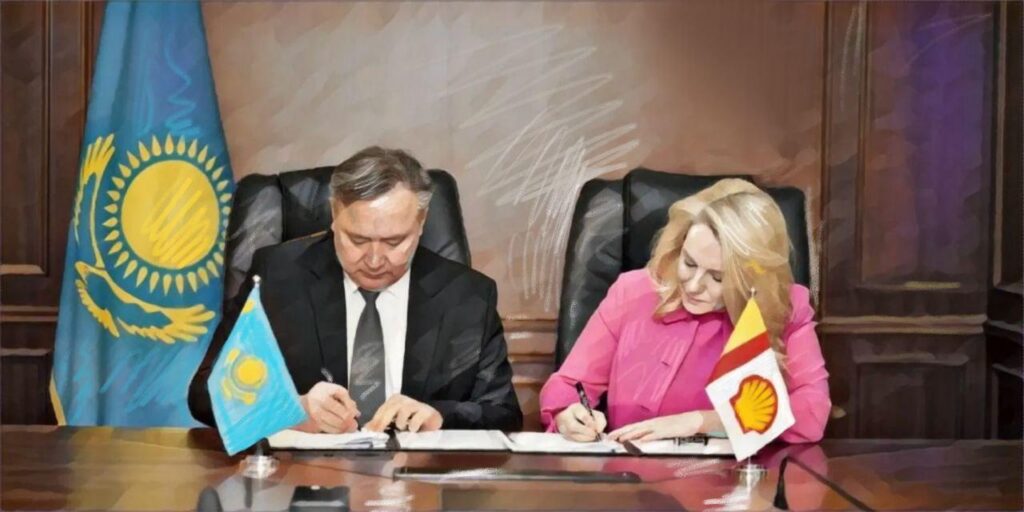
British energy company Shell has launched a new exploration project in Kazakhstan despite previously announcing that it would pause new investments in the country. On March 5, it was announced that Shell had signed a contract for geological exploration in the Aktobe region. The company has been involved in several legal disputes with Kazakhstan over subsoil use and had stated that it did not plan to invest further in the country’s energy sector. Geological Exploration Contract The Zhanaturmys site, which has attracted Shell’s interest, covers an area of 1,377 square kilometers and is located in one of Kazakhstan’s most actively developed oil and gas basins. The document was signed by Kazakhstan’s Deputy Energy Minister, Yerlan Akbarov, and Shell’s Senior Vice President and Chair in Kazakhstan, Suzanne Coogan. The contract provides for seismic exploration, data collection, and technical assessments. “The signing of today’s contract for geological exploration is further confirmation of Shell’s commitment to long-term cooperation with the Republic of Kazakhstan. Drawing on our global experience and advanced technologies, we intend to continue contributing to geological exploration and the expansion of the country’s resource base,” Coogan said. The agreement will remain in force until 2032. The project will be implemented under the terms of an improved model contract. According to Kazakhstan’s Energy Ministry, the company will allocate at least 100 million tenge (about $200,000) to finance socio-economic development in the region where the site is located. Shell is currently involved in three projects in Kazakhstan: the North Caspian Production Sharing Agreement (NCOC, 16.81% stake); the Karachaganak Production Sharing Agreement (29.25% stake); and the Caspian Pipeline Consortium (7.4% stake). Kazakhstan produces around 1.8–1.9 million barrels per day and hosts some of the world’s largest offshore reserves in the Caspian Sea. Western energy majors, including Shell, Chevron, ExxonMobil, and Eni, have operated in the country for decades through complex production-sharing agreements. Legal Disputes In February, Shell CEO Wael Sawan said the company would suspend new investments in Kazakhstan while legal proceedings with the government were ongoing. Numerous lawsuits filed by Kazakhstan, with claims amounting to billions of dollars, have reduced the company’s willingness to invest in the country, he said. “This affects our desire to continue investing in Kazakhstan. Although we see many opportunities for investment in the future, we will wait until we have a clearer picture of how things will turn out,” Sawan stated. Karachaganak and Kashagan Kazakhstan is currently involved in several legal disputes with Western oil companies, both in national courts and international arbitration. The cases concern two major oil and gas projects. One of them is Karachaganak. In 2023, the Kazakh government filed a lawsuit against the field's developers over cost deductions. The initial claim amounted to $3.5 billion but later increased to $6 billion after additional claims were filed. The project is operated by a consortium led by Eni and Shell, each holding a 29.25% stake. Other partners include Chevron (18%), Lukoil (13.5%, which has agreed to sell its stake), and KazMunayGas (10%). In January, it was...
Kashagan and Karachaganak: Will Kazakhstan’s Claims Lead to Changes in the Shareholder Structure?

The beginning of 2026 has been marked by a new round of confrontation between Kazakhstan and the international consortia developing the country’s largest oil and gas fields, North Caspian Operating Company N.V. (Kashagan) and Karachaganak Petroleum Operating B.V. (Karachaganak). Below is an overview of the current situation and the possible scenarios. Arbitration proceedings initiated in early 2023 have expanded from $16.5 billion to more than $170 billion. Over three years, Kazakhstan has secured preliminary victories on several claims, enough, in my view, to suggest that the era of foreign oil consortia dominating Kazakhstan’s strategic projects may be coming to an end. Ecology and NCOC Violations This week, Bloomberg reported in its article “Oil Majors Seek Arbitration Over $5 Billion Kazakh Sulfur Fine” that the NCOC consortium is filing in international arbitration to challenge a Kazakh court decision to collect 2.3 trillion tenge (KZT). The Bloomberg headline, however, presents the issue inaccurately. Environmental violations, including the excessive storage of approximately 1 million tons of sulfur, were identified during an inspection in March 2023, when the exchange rate stood at 451.71 KZT per $1. The rate later rose to 520-540 and currently stands at around 500 KZT per $1. According to investment forecasts, it may reach 600 KZT per $1 by the end of 2026. As a result, the dollar equivalent of the fine has decreased significantly. At the March 2023 rate, 2.3 trillion KZT amounted to approximately $5.1 billion. At 500 KZT per $1, it equals about $4.6 billion. At 600 KZT per $1, it would fall to roughly $3.8 billion, a difference of about $1.3 billion. After my earlier publications arguing that foreign consortia should be fined in foreign-currency equivalent at the exchange rate prevailing at the time of filing, the proposal was also raised in Parliament. Such an approach would be logical: the consortia export their oil and receive revenue in foreign currency, yet fines are imposed in tenge. After several rounds of appeals, the consortium lost what became the largest environmental dispute in Kazakhstan’s history, initially involving more than 20 systematic violations of environmental legislation. Correspondence between consortium members published in Western media indicated they were aware of the violations but considered remediation and compliance financially costly. NCOC’s annual revenue is approximately $10 billion. Media reports also stated that the consortium offered around $110 million, roughly 50 times less than the fine, for regional social programs in exchange for waiving environmental claims. Neither NCOC nor the Kazakh government confirmed such negotiations. In 2010-2011, similar environmental and tax claims against the Karachaganak consortium resulted in Kazakhstan receiving a 10% stake in the project. The current ownership structure of NCOC is: ENI (Italy) - 16.81% ExxonMobil (U.S.) - 16.81% CNPC (China) - 8.33% INPEX (Japan) - 7.56% TotalEnergies (France) - 16.81% Shell (UK) - 16.81% KazMunayGas (Kazakhstan) - 16.88% Total investment in Phase One of Kashagan is estimated at $60 billion. By analogy with Karachaganak, the environmental fine could hypothetically lead to an increase in Kazakhstan’s share by 5-7 percentage...

Why Kazakhstan Is Not Celebrating Its Multi-Billion-Dollar Win in the Karachaganak Oil Arbitration Just Yet

In late January 2026, international media reported that Kazakhstan had won a significant arbitration case against the shareholders of the Karachaganak oil field, with compensation estimated between $2 billion and $4 billion. The Ministry of Energy has not commented on the substance of the ruling, citing confidentiality, though experts say it strengthens Kazakhstan’s position in ongoing legal proceedings related to the Kashagan oil field. According to Bloomberg and Reuters, the Kazakh government initiated legal action in 2023 over what it described as unjustified cost deductions. Originally filed for $3.5 billion, the claim later expanded to include additional allegations, such as inflated expenses tied to corruption. In 2025, the shareholders of Karachaganak Petroleum Operating proposed settling the dispute by financing a domestic gas processing plant in Kazakhstan. The government rejected the proposal, however, and arbitration continued, resulting in a ruling in favor of Kazakhstan. Sources familiar with the proceedings said the consortium, led by Eni and Shell, has been ordered to pay compensation of up to $4 billion. The tribunal has yet to finalize the exact amount. As the arbitration process remains confidential, sources requested anonymity, noting that the Karachaganak consortium still has the option to appeal. While the ruling represents a partial victory, Kazakhstan had originally sought a significantly higher sum; the tribunal accepted the government's core argument: under the production sharing agreement (PSA), the consortium charged the state for unapproved and non-reimbursable expenses. Kazakhstan’s external legal advisers estimate the final payment will range between $2 billion and $4 billion. According to sources familiar with the proceedings, the recovery mechanism will likely involve revisions to the oil distribution formula within the PSA. In its written decision, the tribunal referenced Kazakhstan’s own admission that it had tolerated “corruption and kleptocracy” until 2022. A source familiar with the ruling said Kazakh officials had accepted bribes to approve inflated costs at Karachaganak, expenses that were then inappropriately reimbursed by the state. During the arbitration, Kazakhstan’s legal team presented documents from criminal proceedings in Italy. These revealed that, in 2017, several Italian contractors pleaded guilty to bribing Kazakh officials to secure contracts at both Karachaganak and the Kashagan offshore field. Oil and gas analyst Olzhas Baidildinov said the ruling gives Kazakhstan a stronger position in the Kashagan case. He asserted that Kazakhstan can now “firmly defend its rights in major oil and gas projects,” and that the "decades of privileged status enjoyed by foreign oil and gas majors in Kazakhstan's oil industry are over.” Baidildinov added that the operating models at Karachaganak and Kashagan are likely to be restructured and possibly “de-Italianized”. He also criticized the national oil company, KazMunayGas, for its silence on the Tengizchevroil (TCO) expansion project, whose capital expenditure has surged from $12 billion to $48.5 billion. Drawing comparisons to Uzbekistan, Baidildinov noted that former Uzbekneftegaz head Bahodir Sidikov was dismissed in December 2025 and later detained on corruption charges. In the same month, presidential energy adviser Alisher Sultanov was also removed. “I’m astonished that, while regional Kazakh officials are being...

Shell and Eni Face Up to $4 Billion Payout to Kazakhstan After Arbitration Ruling

Oil and gas majors Shell and Eni, key stakeholders in Kazakhstan’s Karachaganak field, have lost a key stage in an international arbitration case in London and may be required to pay the Kazakh government between $2 billion and $4 billion in compensation. The decision was first reported by Bloomberg. According to the ruling, the arbitration panel upheld Kazakhstan’s argument that the project operators had charged the state under a production sharing agreement (PSA) for unapproved cost overruns and other ineligible expenses. The tribunal found that a significant share of the disputed costs should not have been recovered from the state, siding with Kazakhstan on the central legal question. The arbitration proceedings were conducted behind closed doors, in line with standard practice for PSA disputes. The final compensation amount has yet to be determined, and the ruling remains subject to appeal. However, Bloomberg reported that the tribunal concluded the consortium must return a substantial portion of the contested funds, a decision that could require changes to the PSA’s oil and gas distribution formula. Karachaganak is one of Kazakhstan’s largest oil and gas projects and a cornerstone of the country’s energy sector. The field is operated by the Karachaganak Petroleum Operating consortium, which includes Shell, Eni, Chevron, Kazakhstan’s national oil and gas company KazMunayGas, and Russia’s Lukoil. The Kazakh government initially sought more than $6 billion in compensation, arguing that improper cost recovery had reduced state revenues over several years. The dispute was formally launched in 2023 and followed a broader effort by Kazakhstan to assert stricter oversight over major hydrocarbon projects governed by PSAs. In 2024, international partners reportedly proposed resolving the dispute by constructing a long-delayed gas processing plant at Karachaganak to supply the domestic market, an offer seen as an attempt to reach a negotiated settlement. The plant has long been a point of contention, with Kazakhstan pushing for increased gas processing capacity inside the country rather than exporting raw gas. Kazakhstan’s Ministry of Energy has declined to provide further details on the arbitration, citing confidentiality provisions. In response to an inquiry from BAQ.KZ, the ministry said: “All arbitration materials are subject to the confidentiality of the production sharing agreement and the arbitration agreement between the parties. Until the restrictions are lifted, it is not possible to provide any information.” The ruling marks one of the most significant recent legal setbacks for foreign oil companies operating in Kazakhstan in recent years and could have broader implications for how costs are approved and recovered under PSAs across the country’s energy sector.

U.S. Eases Sanctions on Key Kazakh Oil Projects

The Caspian Pipeline Consortium (CPC), oil producer Tengizchevroil (TCO), and the Karachaganak field have been granted permission to resume services and conduct transactions related to their operational activities, following a United States Treasury Department decision to ease sanctions. The Tengiz and Karachaganak fields are located in Kazakhstan, and Kazakh oil is exported through the CPC system. In October, the U.S. Treasury added Russian oil giants Lukoil and Rosneft, along with 34 of their subsidiaries, to its latest package of sanctions. However, experts now suggest that the exemption of key projects in Kazakhstan could have a stabilizing effect on the country's oil sector and its broader economy. The U.S. Treasury’s Office of Foreign Assets Control (OFAC) issued General License No. 124B, allowing services and other transactions required to maintain the operations of the CPC, Tengizchevroil, and the Karachaganak project, even when sanctioned entities such as Lukoil and Rosneft are involved. The license does not permit any transactions related to the sale or transfer of shares in these projects. Kazakhstan’s Minister of Energy, Yerlan Akkenzhenov, confirmed on November 12 that the government is working to have the Karachaganak field fully exempt from the U.S. sanctions regime. The CPC system links oil fields in western Kazakhstan and parts of Russia with a marine terminal in Novorossiysk on Russia’s Black Sea coast. It remains the main export route for Kazakh oil, carrying more than 80% of the country’s crude. The system has an annual capacity of about 83 million tons. CPC shareholders include Kazakhstan, holding a combined 20.75% through KazMunayGas (19%) and Kazakhstan Pipeline Ventures LLC (1.75%). Other shareholders include Chevron Caspian Pipeline Consortium Company (15%), Lukoil International GmbH (12.5%), Mobil Caspian Pipeline Company (7.5%), Rosneft-Shell Caspian Ventures Limited (7.5%), BG Overseas Holdings Limited (2%), Eni International N.A. N.V. (2%), and Oryx Caspian Pipeline LLC (1.75%). The Russian government and Transneft also hold significant stakes. Tengizchevroil LLP, the operator of the Tengiz field, is a joint venture between Chevron (50%), ExxonMobil Kazakhstan Ventures Inc. (25%), KazMunayGas (20%), and Lukoil (5%). Tengiz is one of Kazakhstan’s largest oil fields, with reserves estimated at 3.1 billion tons. The Karachaganak field is among the world’s largest, with development carried out by the Karachaganak Petroleum Operating consortium. Shell and Eni serve as joint operators, and the partnership also includes Chevron (18%), Lukoil (13.5%), and KazMunayGas (10%). On November 13, it was reported that KazMunayGas is considering acquiring Lukoil’s stake in the Karachaganak project, reflecting efforts to manage shifting ownership dynamics under the sanctions environment.

Kazakhstan Oil Output Projected to Reach 100 Million Tons Annually

Kazakhstan is projected to reach an annual oil production level of 100 million tons in the coming years and sustain that output over the long term, according to Askat Khasenov, Chairman of the Board of the national oil and gas company KazMunayGas (KMG). The Ministry of Energy initially forecast oil production at 96.2 million tons for 2025, later adjusting the estimate to 96 million tons. In 2024, Kazakhstan produced 87 million tons of oil, with growth driven by the Tengiz expansion and the development of the Karachaganak and Kashagan projects in western Kazakhstan and the Caspian shelf. In November 2024, the ministry announced plans to surpass 100 million tons annually starting in 2026. KMG believes this level can be maintained for the foreseeable future. “The government officially plans to produce more than 100 million tons of oil per year, and I believe this plateau will last for a long time. New geological projects will allow us to maintain this level in the long term,” Khasenov said during Kazakhstan Energy Week 2025 in Astana. “Our company is actively developing exploration under a strategy focused on the sustainable replenishment of the country’s mineral resource base. Currently, KMG’s portfolio includes 13 exploration projects, implemented both independently and in partnership with international companies such as Eni, Lukoil, CNOOC, Sinopec, and Tatneft. Our goal is to achieve an increase in reserves of up to 200 million tons of oil in the short term.” Khasenov also noted that KMG is conducting geological studies in underexplored regions of Kazakhstan, with eight new projects already initiated. The overall potential of ongoing exploration is estimated at 800 million tons of oil equivalent. In parallel, the company is applying enhanced oil recovery techniques to sustain production at mature fields. Another strategic priority for KMG is oil refining. The company aims to fully meet domestic demand for gasoline, diesel, and other fuels while expanding its petrochemical footprint to produce polymers and carbamide, boosting Kazakhstan’s non-resource exports. Temirlan Urkumbaev, Director of the Department of Petrochemistry and Technical Regulation at the Ministry of Energy, emphasized that petrochemicals are becoming a cornerstone of economic diversification. “Petrochemistry is not just about new sources of revenue. It brings new jobs, export income, and sustainable development. For Kazakhstan, the transition from a raw-material model to deep processing is a strategic necessity,” Urkumbaev said. The ministry has developed a 2024-2030 Roadmap for the petrochemical industry, which includes six major projects worth approximately $15 billion and expected to create more than 19,000 jobs. Among these is a polyethylene plant with an annual capacity of 1.25 million tons, scheduled to begin operations in 2029. The facility will produce over 20 grades of polyethylene, including premium types, and is projected to account for around 1% of the global market. Other planned projects include the production of butadiene, carbamide, and alkylate. In 2022, Kazakhstan launched one of the world’s largest polypropylene plants KPI Inc. with an annual capacity of 500,000 tons. As previously reported by The Times of Central Asia, the Kazakh...