• KGS/USD = 0.01144 0%
  • KZT/USD = 0.00200 0%
  • TJS/USD = 0.10470 -0.19%
  • UZS/USD = 0.00008 0%
  • TMT/USD = 0.28490 0%
  • KGS/USD = 0.01144 0%
  • KZT/USD = 0.00200 0%
  • TJS/USD = 0.10470 -0.19%
  • UZS/USD = 0.00008 0%
  • TMT/USD = 0.28490 0%
  • KGS/USD = 0.01144 0%
  • KZT/USD = 0.00200 0%
  • TJS/USD = 0.10470 -0.19%
  • UZS/USD = 0.00008 0%
  • TMT/USD = 0.28490 0%
  • KGS/USD = 0.01144 0%
  • KZT/USD = 0.00200 0%
  • TJS/USD = 0.10470 -0.19%
  • UZS/USD = 0.00008 0%
  • TMT/USD = 0.28490 0%
  • KGS/USD = 0.01144 0%
  • KZT/USD = 0.00200 0%
  • TJS/USD = 0.10470 -0.19%
  • UZS/USD = 0.00008 0%
  • TMT/USD = 0.28490 0%
  • KGS/USD = 0.01144 0%
  • KZT/USD = 0.00200 0%
  • TJS/USD = 0.10470 -0.19%
  • UZS/USD = 0.00008 0%
  • TMT/USD = 0.28490 0%
  • KGS/USD = 0.01144 0%
  • KZT/USD = 0.00200 0%
  • TJS/USD = 0.10470 -0.19%
  • UZS/USD = 0.00008 0%
  • TMT/USD = 0.28490 0%
  • KGS/USD = 0.01144 0%
  • KZT/USD = 0.00200 0%
  • TJS/USD = 0.10470 -0.19%
  • UZS/USD = 0.00008 0%
  • TMT/USD = 0.28490 0%

Viewing results 1 - 6 of 7

Uzbekistan Joins a U.S. Critical Minerals Implementation Track

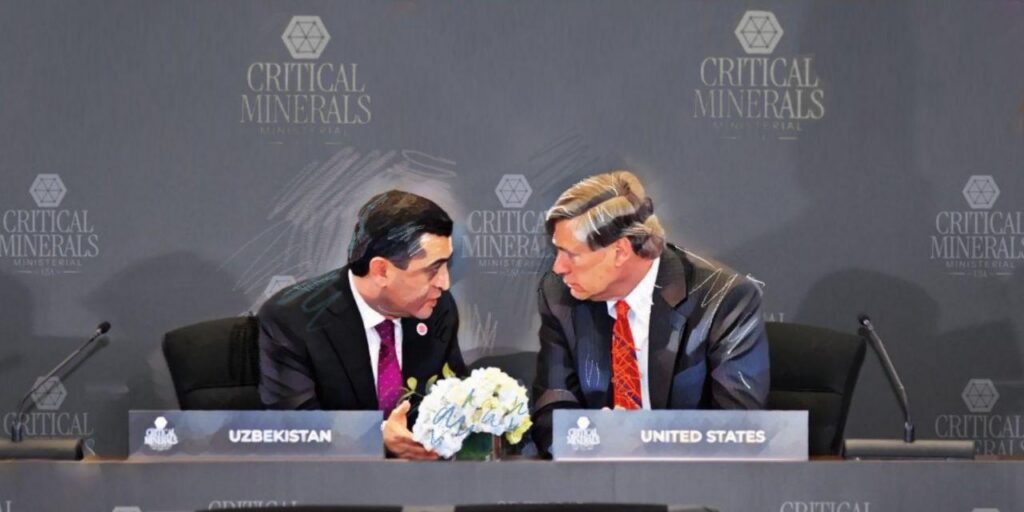
On February 4, 2026, in Washington, D.C., Uzbekistan’s Foreign Minister Bakhtiyor Saidov and U.S. Deputy Secretary of State Christopher Landau signed an intergovernmental Memorandum of Understanding (MoU) on securing supply chains for critical minerals and rare earth elements, spanning both mining and processing. A further agreement signed on February 19 brought implementation and financing to the foreground. The U.S. International Development Finance Corporation (DFC) signed “heads of terms” (i.e., commercial principles and essential terms of a proposed future agreement) for a Joint Investment Framework and outlined a proposed joint holding company. An agreement to establish an “investment platform” was exchanged in the presence of Uzbekistan’s President Shavkat Mirziyoyev. These agreements are not a single mining deal. They combine a political instrument with a financing-and-structuring track that is intended to yield a small set of projects that can be financed and built, and they treat processing capacity and supporting infrastructure not as optional add-ons but as core deliverables. They also provide a path for early projects to full review and financing while connecting them to longer-term offtake structures that match Washington’s newer supply-shock tools, including “Project Vault.” What the MoU Changes The MoU’s immediate purpose is to align government priorities for critical minerals across the value chain while setting expectations that will later shape which financing and partners are feasible. The press agency of Uzbekistan’s foreign ministry emphasized “responsible partnership” and “long-term development” as part of the public framing, placing governance and reputational risk on the same plane as the geological givens. The MoU also leaves several items deliberately unresolved in public form. These include project annexes, deposit designations, and operational timelines. That document design-choice pushes the next phase of bilateral cooperation into working-level scoping and sequencing, where only a small number of candidate projects can be advanced into full review. At the ministerial-level meeting, Washington clarified why it was framed as supply-chain security rather than commodity trade. Secretary of State Marco Rubio noted that critical minerals are inputs for infrastructure, industry, and defense, while Vice President J.D. Vance stressed the expansion of production across partner networks. As previously reported by The Times of Central Asia, this framing is part of a broader repositioning of U.S. engagement in Central Asia, where diplomatic formats are increasingly paired with mechanisms intended to generate trackable transactions and private-sector follow-through. For Uzbekistan, what is attractive about this cooperation is the potential to convert resource endowment into a lever for industrial development, rather than treating extraction as the endpoint. President Shavkat Mirziyoyev has publicly valued the country’s underground wealth at roughly $3 trillion. He has linked rising global demand for technological minerals to the case for higher value-added activity around strategic reserves, including lithium and tungsten. The same logic supports a commercially open posture. For Tashkent’s other investors, buyers, and processing partners, Uzbekistan’s diversification toward U.S.-linked capital signals non-exclusivity. Turning the MoU Into Projects The next phase is practical. A candidate project will advance only if investors and public lenders can transparently evaluate its licensing and...

German Company to Mine and Process Lithium in East Kazakhstan

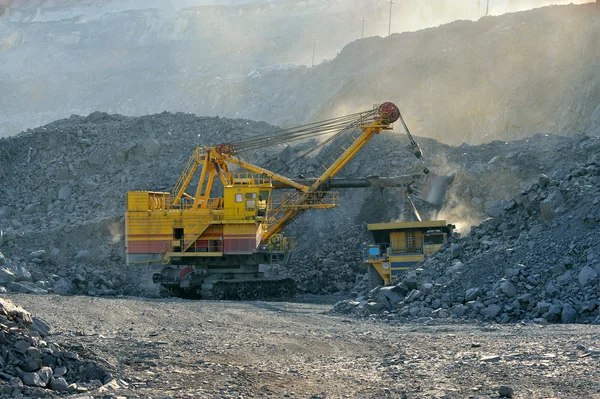
Two new industrial facilities dedicated to the mining and processing of lithium are set to be established in the Ulan district of East Kazakhstan Region by 2029. The announcement was made by Nurymbet Saktaganov, akim of East Kazakhstan Region, who noted that plans are underway for the construction of a mining and processing plant, as well as a pegmatite ore processing facility. $500 Million Investment from Germany The project will be implemented with the participation of HMS Bergbau AG, a German mining company that plans to invest $500 million into the development of a lithium deposit discovered in 2023. The initiative will include both the extraction of raw materials and the production of lithium oxide concentrate, a product in high demand across the global high-tech sector. Germany’s interest in Kazakhstan’s rare earth resources was discussed during a September 2023 meeting between President Kassym-Jomart Tokayev and Dennis Schwindt, Chairman of the Board of HMS Bergbau AG. Tokayev reaffirmed Kazakhstan’s openness to foreign investment and emphasized the country’s intention to become a key player in the supply of strategic raw materials. He highlighted lithium’s growing importance in modern industry, particularly for renewable energy and high-tech manufacturing. Operating in the USA, Singapore, South Africa, Poland, and several other markets, HMS Bergbau AG is considered a major independent force in the global solid minerals sector. Its new facility in East Kazakhstan will serve as a vital link in the international lithium supply chain, amid rising global demand driven by electric vehicles, portable electronics, and energy storage systems. $15.7 Billion Discovery by South Korean Researchers In a parallel development, researchers from the Korea Institute of Geosciences and Mineral Resources (KIGAM) announced in 2024 the discovery of a lithium deposit in East Kazakhstan valued at approximately $15.7 billion. Spanning 1.6 square kilometers, the site was previously mined for tantalum. The research, commissioned by the Kazakh government, was based on geological data indicating frequent co-location of lithium, cesium, and tantalum deposits. “KIGAM has been studying the area since last May at the request of the Kazakh government, given that tantalum usually comes with lithium and cesium,” The Korea Times reported. Lithium: A Cornerstone of the New Economy Globally recognized as one of the most critical and scarce elements, lithium is essential for producing lithium-ion batteries that power everything from smartphones and laptops to electric cars and grid-scale energy storage systems. Kazakhstan’s efforts to harness its lithium reserves in East Kazakhstan are expected to boost the country's role in the global energy transition and significantly enhance investment opportunities in the region.

Kazakhstan Seeks Cooperation with South Korea in Lithium Production

Kazakhstan is ready to expand collaboration with South Korea in the exploration, extraction, and processing of lithium, a strategically vital resource for high-tech industries and sustainable economic development. This was stated by Nurgali Arystanov, Kazakhstan’s Ambassador to the Republic of Korea, during the Investment Dialogue on Critical Minerals between Korea and Kazakhstan, held in Seoul on February 28, according to the Kazakh Foreign Ministry. The event, organized with the support of the Korea Institute of Geoscience and Mineral Resources (KIGAM), brought together leading Korean companies, including Hyundai Development Company, POSCO International, and LX International, as well as scholars from Seoul National University and Pusan National University. KIGAM President Lee Pyeong-Koo encouraged Korean companies to increase investments in Kazakhstan, emphasizing the country’s significant potential in the development of critical minerals. During the event, researchers presented findings on the Bakennoye lithium deposit in the East Kazakhstan region. In March 2024, The Korea Times reported that KIGAM had discovered a lithium deposit in eastern Kazakhstan, in an area previously mined for tantalum. Since tantalum is often found alongside lithium and cesium, KIGAM began studying the site in May 2023 at the request of the Kazakh government. The deposit is estimated to contain resources worth $15.7 billion, according to Kazakh data cited by KIGAM. 

Chinese Company Poised to Develop Lithium Industry in Kazakhstan

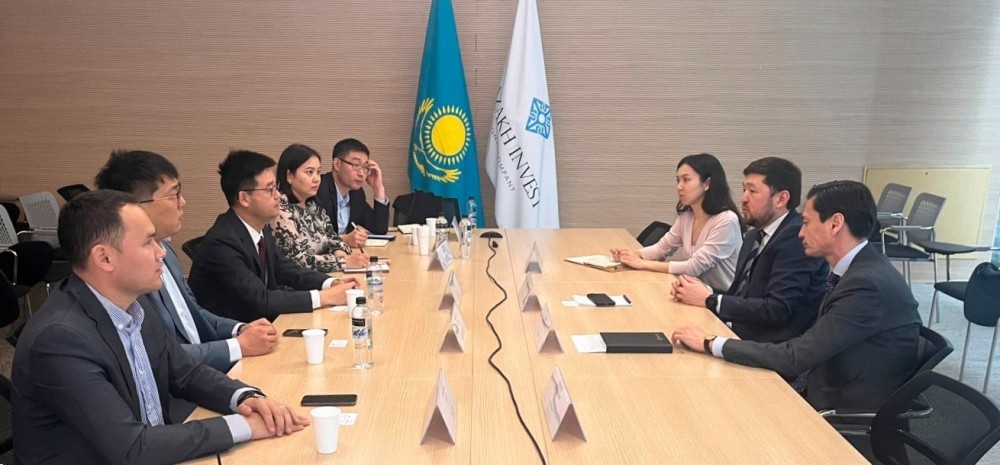
Zhicun Lithium Group, one of China’s largest companies specializing in the full-cycle production of lithium batteries, is engaged in talks with Kazakh Invest on lithium exploration, production, and processing projects in Kazakhstan. The initiative was discussed on April 12 at a meeting between the company's Vice President, Hong Wei, and Kazakh Invest’s project director, Bauyrzhan Aitkulov. With reference to Kazakhstan’s significant geological potential for the mineral, Aitkulov advised Chinese investors of the strategic importance of developing the lithium industry. He also emphasized the potential offered by the Zhicun Lithium Group’s knowledge and experience in furthering exploration and the creation of a production plant for lithium products in Kazakhstan. As reported by Kazakh Invest, both parties are poised to engage in long-term cooperation and technology transfer to create sustainable lithium production chains necessary for the development of processing industries, including green energy.

Korean Geologists Discover Lithium in Kazakhstan

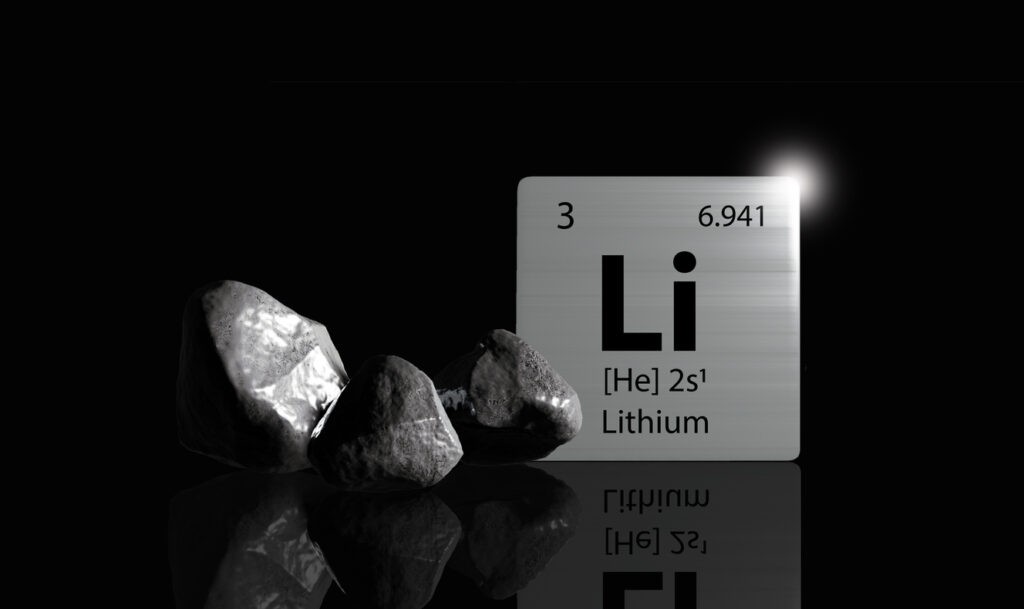
The Korea Institute of Geology and Mineral Resources (KIGAM) has announced that it has discovered a lithium deposit in Kazakhstan following testing in 2023. According to a report by The Korea Times on March 5th, the institute plans to develop this deposit. Lithium is one of the most important minerals for the electric vehicle industry, as it is a key component in their batteries -- along with elements like nickel, manganese, cobalt, aluminum and copper. At the recent International Primary Minerals Forum in Seoul, KIGAM announced that the lithium deposit was discovered over a 1.6 square kilometer area of pegmatites in eastern Kazakhstan. It added that tantalum had previously been mined at this site. Tantalum is usually found together with lithium and cesium, so KIGAM has been exploring the area since May last year at the request of the Kazakh government. According to information provided by KIGAM, citing Kazakh forecasts, resources worth $15.7bn are buried in the area. KIGAM plans to apply for a drilling survey in the area next year with a Korean company to begin mining the lithium. The details of that Korean company weren't made public, The Korea Times reported.