• KZT/USD = 0.00218
  • TJS/USD = 0.10800
  • UZS/USD = 0.00008
  • TMT/USD = 0.29850
  • KZT/USD = 0.00218
  • TJS/USD = 0.10800
  • UZS/USD = 0.00008
  • TMT/USD = 0.29850
  • KZT/USD = 0.00218
  • TJS/USD = 0.10800
  • UZS/USD = 0.00008
  • TMT/USD = 0.29850
  • KZT/USD = 0.00218
  • TJS/USD = 0.10800
  • UZS/USD = 0.00008
  • TMT/USD = 0.29850
  • KZT/USD = 0.00218
  • TJS/USD = 0.10800
  • UZS/USD = 0.00008
  • TMT/USD = 0.29850
  • KZT/USD = 0.00218
  • TJS/USD = 0.10800
  • UZS/USD = 0.00008
  • TMT/USD = 0.29850
  • KZT/USD = 0.00218
  • TJS/USD = 0.10800
  • UZS/USD = 0.00008
  • TMT/USD = 0.29850
  • KZT/USD = 0.00218
  • TJS/USD = 0.10800
  • UZS/USD = 0.00008
  • TMT/USD = 0.29850
20 August 2026

Viewing results 1 - 6 of 175

U.S. Convenes Critical Minerals Dialogue with Central Asian Officials in Kazakhstan

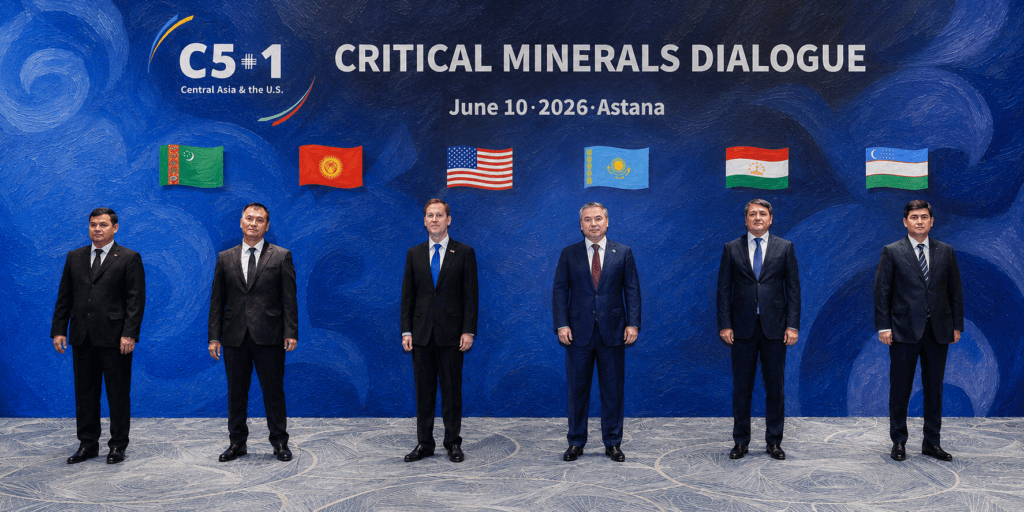
ASTANA — The United States opened a new round of high-level critical minerals talks with Central Asian governments in Astana on June 10, with U.S. Special Envoy for South and Central Asian Affairs Sergio Gor saying Washington is placing new emphasis on a region it sees as central to global commerce, connectivity, and secure supply chains. Speaking at the C5+1 Critical Minerals Dialogue, Gor said Central Asia “has not gotten the attention it deserves from the United States,” and that the Trump administration had decided to change that. “We care about this region, we want to be involved with this region, we want to identify win-win situations for the United States and your nations,” Gor said. The meeting, held at The Ritz-Carlton in Astana, brought together officials from Kazakhstan, Kyrgyzstan, Tajikistan, Turkmenistan, Uzbekistan, and the United States. The program included sessions on geological exploration, surveying and mapping, mining and processing, and global value and supply chains, followed by a government-business networking reception. Gor thanked Kazakhstan for hosting what he described as the first in-person C5+1 Critical Minerals Dialogue and said he had met with President Kassym-Jomart Tokayev shortly before the session. Kazakhstan’s Foreign Ministry said that ahead of the dialogue, Gor and Kazakh Foreign Minister Yermek Kosherbayev had discussed economic and investment partnerships, innovation, artificial intelligence, education, transport, logistics, and critical minerals. The ministry also said the sides discussed the implementation of agreements reached between Tokayev and U.S. President Donald Trump at the White House in November 2025. Gor framed the Astana meeting as part of a broader increase in U.S. engagement with Central Asia following the C5+1 leaders’ meeting in Washington last year. He said critical minerals are now a central part of that engagement because they are essential to infrastructure, advanced technologies, industry, and national defense. “Our economic security depends on our ability to diversify our access to critical minerals,” Gor said. “Ensuring reliable access to these materials requires not only expanding production, but also building resilient, transparent, and market-driven supply chains in close partnership with trusted partners.” He added that the Central Asian states represented at the table were exactly the partners Washington wants to work with. “There’s a reason we’re sitting at this table and not at another table around the world,” Gor said. “It’s because this is where we want to work. This is where we have identified trusted partners.” Gor highlighted the role of U.S. commercial and development-finance tools in supporting investment, saying Washington is prepared to back American companies working in the region. “The United States government stands behind American companies,” Gor said. “There is no such thing as a deal too small.” Gor also pointed to the U.S. International Development Finance Corporation, saying it was preparing to “invest and build” in the region and saw potential in critical minerals, telecommunications, and Trans-Caspian infrastructure. He said DFC saw “potential to transform the region’s rich deposits of critical minerals into the foundation of a new wave of industrialization.” “President Trump understands the importance of...

Uzbekistan Plans $30 Billion Mining Investment Drive Backed by AI and Digital Geology

Uzbekistan is planning a major digital transformation of its mining and geology sector, with artificial intelligence set to play a central role in mineral exploration, resource management, and industrial production. According to the presidential press service, President Shavkat Mirziyoyev reviewed a presentation on June 9 on plans to expand the use of digital technologies and AI across the industry, one of the country’s key economic sectors. Officials said mining and geology enterprises accounted for 20% of Uzbekistan’s industrial output in 2025 and generated 118.5 trillion soums in budget revenues. The government sees technological modernization as a priority for improving efficiency, attracting investment, and expanding the country’s long-term resource base. The presentation pointed to progress already made in digitalization. Major mining enterprises cut operating expenses by 7.3 trillion soums in 2025, while production costs fell by 9.1%. Authorities have also launched the Geomonitoring information system and digitized data on more than 2,000 mineral deposits. Over the next five years, Uzbekistan aims to increase its proven reserves by 879 tons of gold, 510 tons of silver, and 676,000 tons of copper. Officials said AI technologies will be introduced throughout the geological exploration process to speed up the analysis of geological data, improve reserve assessments, forecast promising mineral deposits, and make drilling more efficient. Mirziyoyev instructed officials to take the sector’s technological transformation to a new stage by creating systems capable of managing and analyzing production processes with AI. The industry generates large volumes of information, from geological surveys and drilling results to maps, laboratory analyses, and production data. Integrating these resources into a unified electronic database and applying 3D modeling tools could improve exploration outcomes. According to the presentation, the proposed measures could reduce production costs by 10%, cut the time needed to identify new deposits by half, and increase the number of investment proposals several times over. A key element of the strategy is the creation of a National Geological Database. Authorities plan to digitize more than 36,000 geological reports and primary data records and establish a Center for Technological Transformation. Officials estimate that this will double the speed and quality of geological data processing and accelerate reserve estimation and deposit modeling. The presentation also outlined plans to attract $30 billion in investment to the geology and mining sector by 2030. To support that target, the government plans to implement 32 digital and AI-focused projects from 2026 to 2030 at six major enterprises: Navoi Mining and Metallurgical Company, Almalyk Mining and Metallurgical Complex, Navoiyuran, Uzmetkombinat, Uzbekcoal, and the Uzbekistan Technological Metals Complex. The projects will cover production automation, corporate governance, AI, labor and industrial safety, and geological exploration. Officials said the measures could increase operational efficiency by 7%, improve the reliability of machinery and equipment by 20%, raise energy efficiency by 8%, and reduce human-factor-related errors and risks by 15%. As previously reported by The Times of Central Asia, Uzbekistan and the United States signed agreements earlier this year aimed at securing supply chains for critical minerals and rare earth elements,...

Central Asia Seeks More Local Value From Critical Minerals

Rising demand for critical minerals is drawing Central Asia deeper into global supply chains, but the region’s harder test is not whether it has the deposits. It is whether more value can stay at home. Copper, tungsten, graphite, antimony, rare earths and other metals now sit at the center of battery production, power grids, chips, weapons systems, and renewable energy. Governments across the region want the sector to bring capital, jobs, and technology. The risk is another cycle in which raw materials leave the region, and most of the value is created elsewhere. The scale of the region’s reserves explains why outside interest is rising. An OECD review of critical raw materials in Central Asia says the region holds 39% of global manganese ore reserves, 31% of chromium, 20% of lead, 13% of zinc, 9% of titanium, 6% of aluminum, and 5% each of copper, cobalt, and molybdenum. The same review says Kazakhstan can export 21 of the 34 critical raw materials on the EU list, while Kyrgyzstan has the world’s third-largest antimony reserves, and Uzbekistan has the world’s eleventh-largest copper reserves. Uranium widens the picture: Kazakhstan is the world’s largest uranium producer, accounting for 39% of mined uranium supply in 2024, according to the World Nuclear Association. Kazakhstan has moved fastest in turning this base into policy. The prime minister’s office says the country will spend about $500 million over three years on geological exploration and modernizing infrastructure. The plan includes seismic surveys, new data systems, and a geological cluster in Astana. The government wants to raise geological study coverage to 2.2 million square kilometers. President Kassym-Jomart Tokayev has linked the sector to Kazakhstan’s wider industrial plans. In his 2025 state-of-the-nation address, Tokayev said the mining and metallurgical complex still had “significant growth potential, particularly in the production of high-value-added products.” New discoveries have sharpened that push. Kazakhstan’s industry ministry said in 2025 that geologists had identified the Zhana Kazakhstan rare earth site, with estimated resources of more than 20 million metric tons. The site contains neodymium, cerium, lanthanum, and yttrium. Officials have also cited the Kuirektykol site in the Karaganda Region, where confirmed reserves are estimated at 795,800 tons, with total resources estimated at 935,400 tons. Uzbekistan is making its strongest move in copper and processing capacity. In March, President Shavkat Mirziyoyev launched Copper Concentrator No. 3 at the Almalyk Mining and Metallurgical Complex. The $2.7 billion facility is designed to process 60 million tons of ore and produce about 900,000 tons of copper concentrate per year. Once fully operational, it is expected to raise daily concentrate output at Almalyk from 2,400 tons to 5,000 tons. Uzbekistan’s minerals push has also drawn U.S. support. Uzbekistan and the United States signed a memorandum on critical minerals and rare earth supply chains in February, giving Tashkent a clearer place in Washington’s effort to diversify critical minerals supply chains beyond China. The U.S. International Development Finance Corporation later signed a Joint Investment Framework with Uzbekistan, stating that this would “promote cooperation...

Central Asia Enters the Minerals Race

Central Asia is entering the critical minerals race at a time when deposits alone no longer confer strategic advantage. The Astana Mining & Metallurgy Congress, scheduled for June 11–12 at Hilton Astana, gives the issue operational form: supply chains, investment, and commercial projects. U.S. Under Secretary Jacob Helberg will participate there and in the preceding C5+1 Critical Minerals Dialogue on June 10–11. The Astana agenda also puts Central Asia’s role in global supply chains directly into view. The test is how quickly governments, investors, and industrial buyers can finance, process, move, and purchase minerals before they are locked into industrial supply chains. The G7 is moving in the same direction, but through institutional design rather than industrial action. The group is discussing a permanent critical minerals secretariat to maintain continuity across changing G7 presidencies, possibly at either the International Energy Agency or the OECD. The proposal acknowledges a real deficiency in Western coordination, but it also reveals the larger problem: continuity is useful only if it becomes execution. At the same time, reports have circulated about disagreements over stockpiling and leadership, including European resistance to both a single shared stockpile and a U.S.-led structure. For Central Asia, the practical question is not institutional architecture alone, but whether such coordination produces finance, processing capacity, and long-term offtake. The June dialogue in Astana is part of a wider C5+1 movement from diplomacy toward operational cooperation. Its participants are trying to convert the platform from a talk shop into a vehicle for business transactions. As TCA has reported, U.S. engagement in the region is increasingly tied to business mechanisms, export-credit support, and project finance. Kazakhstan has already moved into this framework track. Kazakhstan and the United States signed a memorandum of understanding on critical minerals cooperation during Tokayev’s November 2025 visit to Washington, and the agreement took immediate shape through the Tau-Ken Samruk–Cove Capital tungsten project. Kazakhstan’s Foreign Ministry later described the MOU as the first agreement of its kind in Central Asia, providing for processing capacity in Kazakhstan, technology transfer, and expanded access for Kazakh products to the U.S. market. In February 2026, Uzbekistan followed with its own U.S. critical minerals track: TCA reported that Tashkent signed a critical minerals MOU on February 4, and that DFC heads of terms for a Joint Investment Framework followed on February 19. Central Asian governments are not passive terrain for outside competition. Kazakhstan, with Central Asia’s most developed mining and metallurgical base, and Uzbekistan, with a rapidly expanding minerals program, are using minerals competition to attract capital and build processing capacity. They are seeking to diversify partners and move beyond dependence on raw material exports. The regional objective is industrial upgrading while preserving room for maneuver between China, Russia, the United States, Europe, and other partners. The minerals question cannot be separated from the larger Eurasian setting. Central Asia is trying to widen its own field of choice before its options are narrowed by what Hudson Institute senior fellow Ken Moriyasu called, in comments to...

Astana Mining Congress to Highlight Kazakhstan’s Role in Critical Minerals

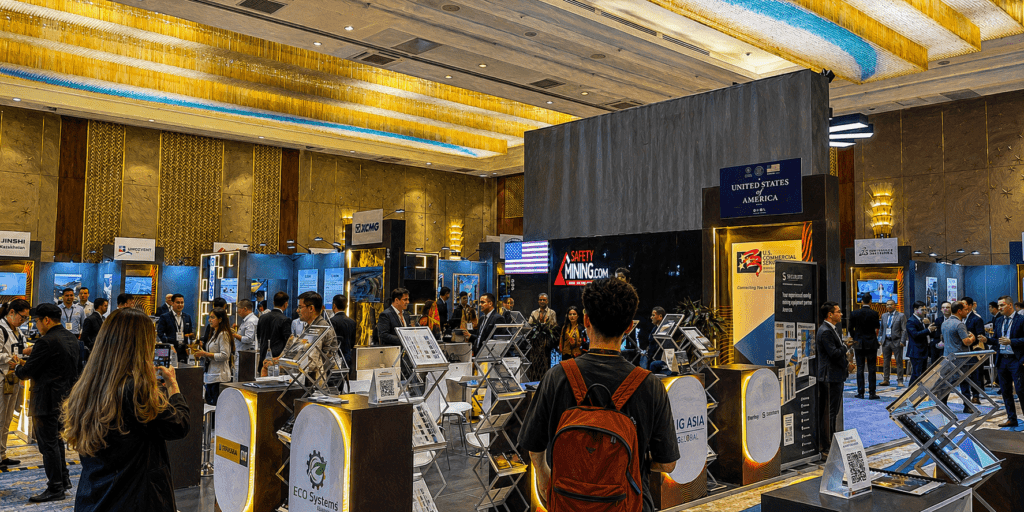
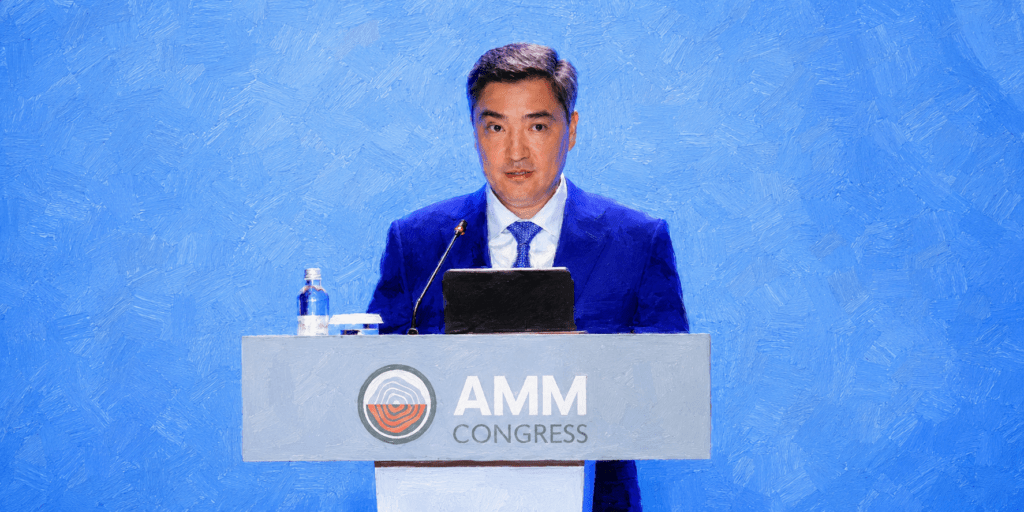
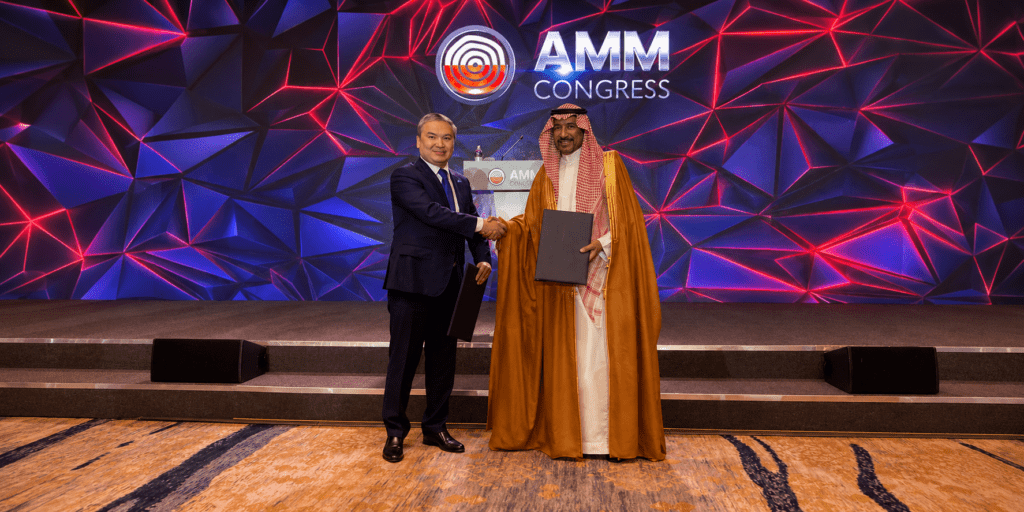
The 16th International Mining and Metallurgy Congress and Exhibition, Astana Mining & Metallurgy (AMM) 2026, will take place on June 11-12 at the Hilton Astana, bringing together mining and metals companies, investors, technology suppliers, government officials, and industry experts. The forum comes as Kazakhstan is trying to strengthen its position in the global critical minerals race. The country already has a large extractive base, but officials and industry groups are increasingly focused on processing, technology, and investment partnerships rather than raw-material exports alone. Kazakhstan’s appeal lies not only in the size of its mineral base, but also in the timing. The U.S. Department of Commerce says the country has substantial reserves of rare earth elements, copper, lithium, tungsten, tantalum, and other materials used in clean energy, advanced manufacturing, and defense technologies. The European Union has also signed a strategic partnership with Kazakhstan on raw materials, batteries, and renewable hydrogen, underscoring Astana’s growing role in efforts to diversify supply chains away from dominant producers. According to Kazakhstan's Bureau of National Statistics, the country's industrial production index reached 107.5% in 2025. Mining and quarrying grew by 9.4%, driven by higher production of coal, crude oil, natural gas, and other minerals. Organizers said the wider mining and metallurgical complex, including related industries such as mechanical engineering, logistics, energy, and industrial services, may account for up to a quarter of Kazakhstan's economy. Against that backdrop, they said the sector needs new investment, technological solutions, and expanded international partnerships. Alongside the congress, an international specialized exhibition dedicated to mining and metallurgical technologies will be held. The exhibition will feature solutions for geological exploration, extraction and processing of raw materials, industrial automation, and workplace safety. Companies from Germany, Kazakhstan, Canada, China, Russia, Saudi Arabia, Finland, France, the Czech Republic, and Sweden are expected to participate. National delegations from Canada, Saudi Arabia, the United States, and Sweden are also expected to attend. Among the new participants announced by organizers are INCO Engineering, ABP Engineering, David Brown Santasalo, and Actuator Service. Last year's event attracted about 2,900 industry professionals, while 50 companies participated in the exhibition. The business program will be held under the slogan “From the Depths of the Earth to the Heights of Intelligence,” with a focus on digitalization and technological transformation in the industry. The first day will include a plenary session on global partnerships in mining and metallurgy, as well as panel discussions on international metals trade, the investment climate, taxation, and critical minerals. Particular attention will be paid to copper's role as a strategic metal. Copper is central to electrification, grid expansion, and data infrastructure, making it one of the metals most closely tied to the energy transition. The critical minerals component gives the event a wider geopolitical significance. Kazakhstan's Foreign Ministry said in April that Astana had invited the U.S. Under Secretary of State for Economic Affairs Jacob Helberg to participate in AMM and the first C5+1 Critical Minerals Dialogue, both scheduled for June in Astana. The C5+1 format brings together the...

U.S.-Kazakhstan Tungsten Venture Advances as Critical Minerals Cooperation Deepens

A U.S.-linked critical minerals venture in Kazakhstan is moving forward with plans to develop one of the world’s largest undeveloped tungsten resources, strengthening cooperation between Washington and Astana at a time of growing demand for secure mineral supply chains and greater Western interest in Central Asia’s strategic minerals base. Skyline Builders Group Holding Ltd. and Cove Kaz Capital Group LLC have announced a merger agreement that would create Kaz Resources Inc., a Nasdaq-listed company focused on tungsten, rare earths, and other critical minerals. The combined company is expected to trade under the ticker symbol “KAZR,” subject to shareholder and regulatory approvals and other closing conditions. The transaction builds on cooperation between Cove Kaz Capital and Kazakhstan’s national mining company, Tau-Ken Samruk. Cove Kaz has acquired a majority interest in Severniy Katpar LLP, which holds licenses for the Northern Katpar and Upper Kairakty tungsten projects in Kazakhstan’s Karaganda mining district, while Tau-Ken Samruk retains a minority stake, giving Kazakhstan’s state mining sector continued participation in the project. The Financial Times has reported that Donald Trump Jr. and Eric Trump held indirect stakes in Skyline Builders, the Nasdaq-listed company that has agreed to combine with Cove Kaz Capital. The reported investments were made through a Dominari-affiliated vehicle before the business combination. The report has drawn scrutiny because of the project’s connection to U.S. critical minerals policy and potential U.S. government-backed financing. The report cites no evidence that the Trump sons influenced the project award or the financing process. A spokesperson for Donald Trump Jr. said he is a passive investor, has no operational role, and does not engage with the federal government on behalf of companies in which he invests or advises. Eric Trump did not respond to requests for comment reported by the Financial Times. The Export-Import Bank of the United States and the U.S. International Development Finance Corporation have issued letters of interest indicating potential financing support for the project. Such letters are preliminary expressions of interest, not final loan approvals, binding commitments, or government contracts, and any financing would remain subject to due diligence, agency approvals, and other conditions. The projects are strategically significant because tungsten is widely used in defense, aerospace, industrial manufacturing, and advanced technologies. The United States has identified tungsten as a critical mineral and has sought to diversify supply chains amid heavy global dependence on China. Kazakhstan’s tungsten deposits hold significant potential, but many remain at an early stage of development, requiring substantial investment and time before production can scale. Even so, the country has begun to emerge as a meaningful producer, with public and industry estimates pointing to Kazakhstan becoming a top-three producer in 2025 after the launch of the Boguty deposit, behind China and Vietnam. The Association of Mining and Metallurgical Enterprises has cited production of around 2,400 tons of tungsten in 2025. The country’s rising role in the global market coincides with a sharp increase in tungsten prices. Following export restrictions imposed by China in February 2025, prices rose sharply through 2025...