Rising demand for critical minerals is drawing Central Asia deeper into global supply chains, but the region’s harder test is not whether it has the deposits. It is whether more value can stay at home. Copper, tungsten, graphite, antimony, rare earths and other metals now sit at the center of battery production, power grids, chips, weapons systems, and renewable energy. Governments across the region want the sector to bring capital, jobs, and technology. The risk is another cycle in which raw materials leave the region, and most of the value is created elsewhere.
The scale of the region’s reserves explains why outside interest is rising. An OECD review of critical raw materials in Central Asia says the region holds 39% of global manganese ore reserves, 31% of chromium, 20% of lead, 13% of zinc, 9% of titanium, 6% of aluminum, and 5% each of copper, cobalt, and molybdenum. The same review says Kazakhstan can export 21 of the 34 critical raw materials on the EU list, while Kyrgyzstan has the world’s third-largest antimony reserves, and Uzbekistan has the world’s eleventh-largest copper reserves.
Uranium widens the picture: Kazakhstan is the world’s largest uranium producer, accounting for 39% of mined uranium supply in 2024, according to the World Nuclear Association.
Kazakhstan has moved fastest in turning this base into policy. The prime minister’s office says the country will spend about $500 million over three years on geological exploration and modernizing infrastructure. The plan includes seismic surveys, new data systems, and a geological cluster in Astana. The government wants to raise geological study coverage to 2.2 million square kilometers.
President Kassym-Jomart Tokayev has linked the sector to Kazakhstan’s wider industrial plans. In his 2025 state-of-the-nation address, Tokayev said the mining and metallurgical complex still had “significant growth potential, particularly in the production of high-value-added products.”
New discoveries have sharpened that push. Kazakhstan’s industry ministry said in 2025 that geologists had identified the Zhana Kazakhstan rare earth site, with estimated resources of more than 20 million metric tons. The site contains neodymium, cerium, lanthanum, and yttrium. Officials have also cited the Kuirektykol site in the Karaganda Region, where confirmed reserves are estimated at 795,800 tons, with total resources estimated at 935,400 tons.
Uzbekistan is making its strongest move in copper and processing capacity. In March, President Shavkat Mirziyoyev launched Copper Concentrator No. 3 at the Almalyk Mining and Metallurgical Complex. The $2.7 billion facility is designed to process 60 million tons of ore and produce about 900,000 tons of copper concentrate per year. Once fully operational, it is expected to raise daily concentrate output at Almalyk from 2,400 tons to 5,000 tons.
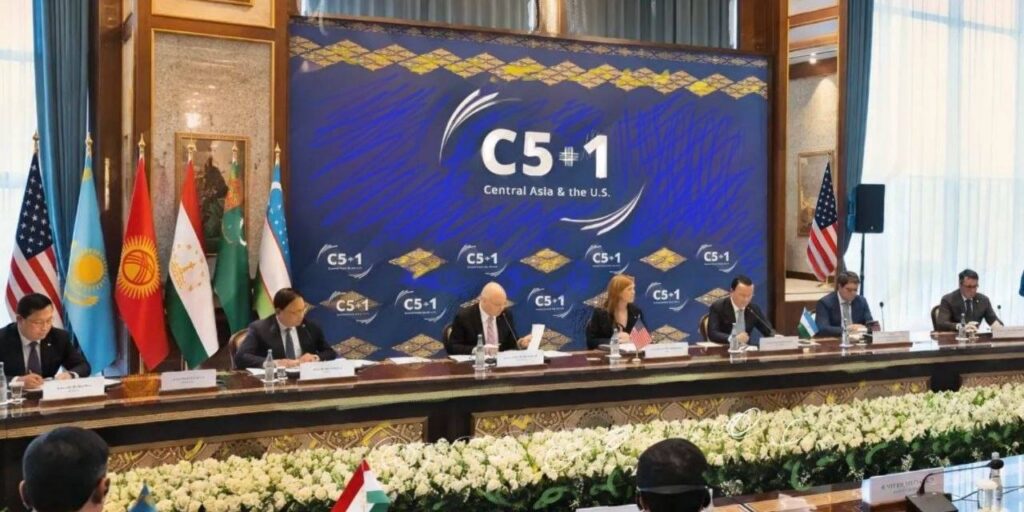
Uzbekistan’s minerals push has also drawn U.S. support. Uzbekistan and the United States signed a memorandum on critical minerals and rare earth supply chains in February, giving Tashkent a clearer place in Washington’s effort to diversify critical minerals supply chains beyond China. The U.S. International Development Finance Corporation later signed a Joint Investment Framework with Uzbekistan, stating that this would “promote cooperation to advance shared economic interests, and encourage joint investment in strategic sectors including critical minerals, infrastructure, and energy.”
Kyrgyzstan has also entered the field, though from a smaller base. The national news agency Kabar reported in March that Bishkek had adopted a state program for critical minerals and identified 22 priority minerals. Kyrgyz business outlet Akchabar said the program runs to 2030 and includes rare earth elements, lithium, aluminum, titanium, copper, and iron.
Tajikistan also has critical minerals potential, especially in antimony, but the sector has moved more slowly than Kazakhstan and Uzbekistan. The EBRD says the country has more than 600 documented deposits of around 50 minerals and some of the largest antimony reserves in the region, while limited private investment reflects governance and regulatory barriers.
The harder question is how much value will stay in the region. A mine can bring wages, taxes and contracts for local firms. A wider industrial chain can add refining, smelting, laboratories, engineering, maintenance, training and exportable skills. That difference will decide how much of the minerals boom remains in Central Asia.
The processing gap is still large. The International Energy Agency says China is the leading refiner for 19 of 20 important strategic minerals, with an average market share of about 70%. In rare earths, China accounted for more than 90% of refining and magnet manufacturing in 2024, according to an IEA review. That gives Beijing influence across supply chains, not just mines, and explains why Washington, Brussels, and development banks are now paying close attention to Central Asia.
The European Union has signed critical raw materials agreements with Kazakhstan and Uzbekistan. The first EU-Central Asia summit endorsed a 2025-2026 roadmap under the EU-Kazakhstan memorandum on critical raw materials, batteries and green hydrogen. In May, the Asian Development Bank launched a Critical Minerals-to-Manufacturing Financing Partnership Facility in Samarkand. The facility aims to support processing, manufacturing, and recycling.
The 16th Astana Mining & Metallurgy Congress, scheduled for June 11-12, will bring together mining companies, investors, technology suppliers, government officials, and industry experts. It will test how far this policy push has moved from strategy papers into financing, technology partnerships, and production plans.
Kazakhstan’s tungsten sector shows how foreign-backed critical minerals projects are moving from deposits into financing, ownership structures and production plans. The Times of Central Asia previously reported that Cove Kaz acquired a majority interest in Severniy Katpar LLP, which holds licenses for the Northern Katpar and Upper Kairakty tungsten projects, while Tau-Ken Samruk retained a minority stake. Development costs are estimated at $1.1 billion, with possible U.S. Export-Import Bank support of $900 million. Meanwhile, the Eurasian Resources Group plans to invest $20 million to launch gallium production in Kazakhstan from bauxite ore, with output aimed at OECD markets.
These projects show the scale of the opportunity, but they also point to the central challenge facing the sector: how quickly Central Asia can expand mining and processing without weakening environmental safeguards. Mining uses water, energy, chemicals, and land, and creates waste rock and tailings that require long-term monitoring. An OECD report on environmental risks says mining and processing in Central Asia can worsen land degradation, greenhouse gas emissions, water and air pollution, and biodiversity loss, while creating hazardous waste that requires long-term management.
In April, Kazakhstan’s Vlast examined uranium mining around Sozak and tested water from an artificial lake near a school. The reported sample showed uranium levels 2.9 times higher than a European standard for drinking water quality. That finding does not prove a sector-wide pattern, but it shows why broader public water data, independent testing, and clear liability rules are essential.
Regional leaders have started to put environmental policy higher on their agenda. At the April 2026 Regional Ecological Summit in Astana, Central Asian states adopted the Environmental Solidarity of Central Asia declaration. The published outcomes refer to biodiversity, chemicals management, waste, air quality, land degradation, and desertification. Those issues now overlap with critical minerals.
Central Asia now has more room to negotiate than it had in earlier cycles. Buyers want secure supplies, and investors need deposits that can move into production. That gives governments a chance to demand more than export volumes.
The next stage will depend on practical choices: clear contracts, public data, stronger water monitoring, safe tailings rules, local processing targets, and training for engineers and technicians. If those terms are met, critical minerals could support factories, skilled jobs, and cleaner growth. If not, the region risks another cycle in which raw materials leave and most of the gains are made elsewhere.
For more on the Astana Mining & Metallurgy Congress and Exhibition 2026, see our special coverage.
See our complete special coverage of the developments strengthening Central Asia’s role in U.S. mineral supply chains.