• KGS/USD = 0.01144 0%
  • KZT/USD = 0.00198 0%
  • TJS/USD = 0.10857 -0.18%
  • UZS/USD = 0.00008 0%
  • TMT/USD = 0.28571 0%
  • KGS/USD = 0.01144 0%
  • KZT/USD = 0.00198 0%
  • TJS/USD = 0.10857 -0.18%
  • UZS/USD = 0.00008 0%
  • TMT/USD = 0.28571 0%
  • KGS/USD = 0.01144 0%
  • KZT/USD = 0.00198 0%
  • TJS/USD = 0.10857 -0.18%
  • UZS/USD = 0.00008 0%
  • TMT/USD = 0.28571 0%
  • KGS/USD = 0.01144 0%
  • KZT/USD = 0.00198 0%
  • TJS/USD = 0.10857 -0.18%
  • UZS/USD = 0.00008 0%
  • TMT/USD = 0.28571 0%
  • KGS/USD = 0.01144 0%
  • KZT/USD = 0.00198 0%
  • TJS/USD = 0.10857 -0.18%
  • UZS/USD = 0.00008 0%
  • TMT/USD = 0.28571 0%
  • KGS/USD = 0.01144 0%
  • KZT/USD = 0.00198 0%
  • TJS/USD = 0.10857 -0.18%
  • UZS/USD = 0.00008 0%
  • TMT/USD = 0.28571 0%
  • KGS/USD = 0.01144 0%
  • KZT/USD = 0.00198 0%
  • TJS/USD = 0.10857 -0.18%
  • UZS/USD = 0.00008 0%
  • TMT/USD = 0.28571 0%
  • KGS/USD = 0.01144 0%
  • KZT/USD = 0.00198 0%
  • TJS/USD = 0.10857 -0.18%
  • UZS/USD = 0.00008 0%
  • TMT/USD = 0.28571 0%
05 December 2025

Viewing results 1 - 6 of 6

Russia Expands Soft Power Through New Cultural Center in Kyrgyzstan

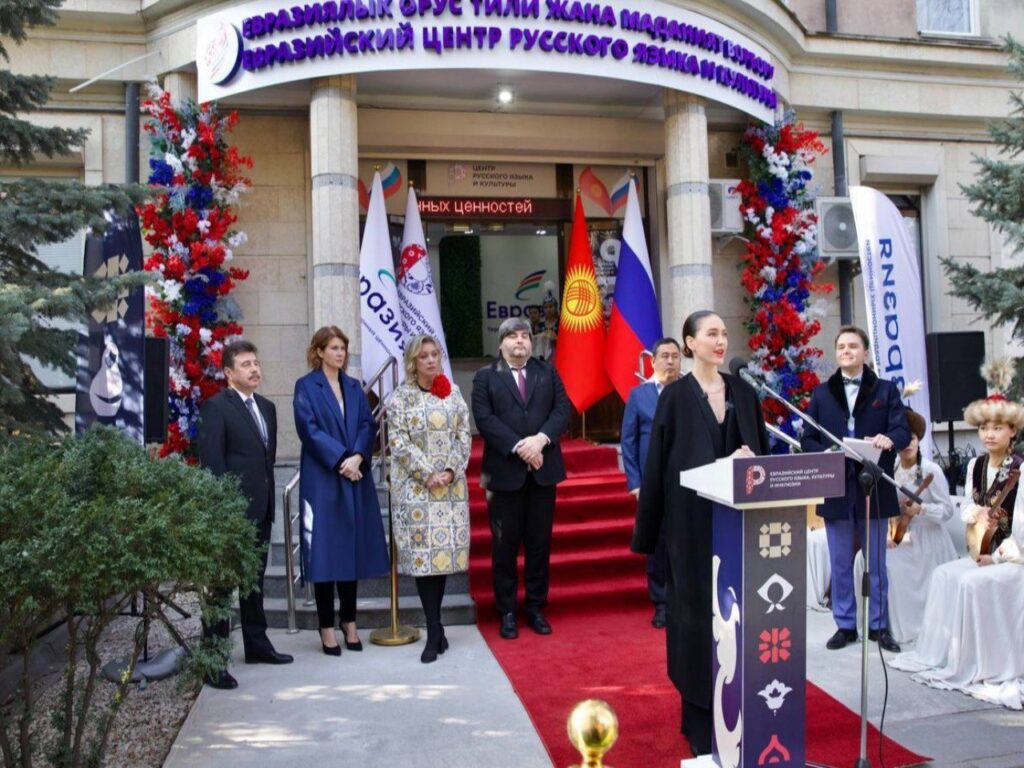
Russia’s international cooperation organization Evraziya has launched Kyrgyzstan’s first Eurasian Center for Russian Language and Culture in Bishkek. The initiative aims to promote the Russian language, support local educators, and advance bilateral humanitarian projects. The center’s opening came just days before Russian President Vladimir Putin’s state visit to Kyrgyzstan, which begins today on November 25. Evraziya, a Russian non-profit, presents itself as a vehicle for deeper integration in the post-Soviet space and is widely viewed as a key instrument of Moscow’s soft power strategy in Central Asia. High-Level Delegation at Launch The opening ceremony was attended by Russian Ambassador to Kyrgyzstan Sergey Vakunov, Russian Foreign Ministry spokesperson Maria Zakharova, Head of the Presidential Executive Office for Strategic Partnership and Cooperation Vadim Titov, State Duma Deputy and Chair of Eurasia’s Coordination Council Alyona Arshinova, and Kyrgyz Deputy Minister of Education and Science Albert Makhmetkulov. Arshinova noted that Evraziya had spent the past year enhancing cooperation with Kyrgyz institutions by offering teacher support, organizing educational forums, and providing professional development programs. “Kyrgyzstan is not just a partner; it is a country with which we share common values and a strategic vision,” she said. “The Russian language remains a foundation that connects our countries and opens opportunities for new educational and cultural initiatives.” Cultural and Educational Programming The new center will run a range of initiatives for schoolchildren and adolescents, including a theater studio, workshops in art and media, digital culture and programming courses, and the "Unboring Russian" project. For adults, the center will offer film clubs, discussion platforms, and a literary lounge. It will also serve as a training center for local teachers and coordinate bloggers focused on language and culture, reinforcing the Russian-language educational and cultural environment in Kyrgyzstan. Deputy Minister Makhmetkulov called the opening “a strategic step for education and interethnic dialogue,” describing the center as a space for both promoting Russian and fostering cultural exchange and professional growth. Evraziya plans to expand its network to other regions in Kyrgyzstan and eventually to other countries in the region. Wider Engagement Strategy Since 2024, Evraziya has intensified its presence in Kyrgyzstan through education, social, and humanitarian projects. In partnership with Russia’s Ministry of Education, the organization has dispatched young Russian teachers to Kyrgyz schools to teach various subjects in Russian. It has also donated 100 school buses to rural areas and financed renovations at schools in Bishkek and Kyzyl-Kyya. On August 28, in cooperation with Kyrgyzstan’s Cabinet of Ministers, Evraziya opened a $35 million amusement park in Bishkek. Two days earlier, the group launched its first social store in the capital, offering discounted essential goods to pensioners, veterans, large families, and people with disabilities. Russian Language as a Strategic Link The Russian language continues to be a central element in Moscow-Bishkek relations. During a July meeting at the Kremlin, Putin praised Kyrgyzstan’s decision to retain Russian as an official language. Russian remains one of Kyrgyzstan’s official languages and is widely used in public administration, education, and interethnic communication. As part of...

Russia to Measure Russian Language Influence Abroad, Focus on Uzbekistan

Russia’s Ministry of Foreign Affairs has commissioned a new research initiative to evaluate the effectiveness of its global Russian language promotion efforts, with a particular focus on Uzbekistan and Azerbaijan. According to the Russian daily Vedomosti, the state-funded All-Russian Public Opinion Research Center (ARPOR) secured the contract, valued at 34.8 million rubles (approximately $390,000). ARPOR Director Valery Fedorov confirmed that the study has not yet begun, as the contract is still being finalized. When asked whether recent diplomatic strains between Russia and Azerbaijan might affect the initiative, Fedorov replied, “Escalations come and go.” While the focus includes several post-Soviet states, the survey will also encompass countries such as India, China, Venezuela, and the United Arab Emirates. ARPOR previously conducted a similar study in 2024 in Israel, Kazakhstan, China, Cuba, Egypt, and India. The current research will survey at least 1,500 people online and a minimum of 1,000 participants via phone or in-person interviews in each country. A ten-member expert team specializing in linguistics, international relations, culture, and media will analyze the results. The initiative will culminate in a roundtable discussion in Moscow. Rossotrudnichestvo, the Russian government agency responsible for promoting cultural and educational ties abroad, told Vedomosti that more than 14,000 individuals studied Russian at its "Russian House" cultural centers across 71 countries in 2024. Uzbekistan remains one of the agency’s core focus areas, alongside Armenia, Belarus, Kazakhstan, Kyrgyzstan, Moldova, Tajikistan, and Turkmenistan. In Uzbekistan, over 1,000 schools offer instruction in Russian or in bilingual formats. In contrast, Kazakhstan has more than 3,600 such schools. Russian retains official language status in Kazakhstan and Kyrgyzstan, while in Tajikistan it is designated as a “language of interethnic communication.” In Uzbekistan and Turkmenistan, however, Russian does not have any official legal status. In Kazakhstan, the use of Russian has been in gradual decline, largely due to demographic shifts. As of January 1, 2024, ethnic Russians made up 14.89% of the population, down sharply from nearly 40% in 1989. Nevertheless, Russian remains widely spoken and is supported by educational institutions and strong bilateral ties with Moscow. Experts cited by Vedomosti noted that conditions for Russian language education are significantly more challenging outside urban centers like Tashkent and Baku. In many schools across Uzbekistan, Russian is taught for just two hours per week, insufficient to meet growing demand, they argue. While interest in the Russian language remains steady, analysts say this is driven more by pragmatic factors, such as aspirations to study at Russian universities or pursue employment with Russian firms, than by cultural affinity or the effectiveness of Moscow’s soft power outreach.

Experts Warn of Rights Violations in Kyrgyzstan’s Language Reform Push

The Jogorku Kenesh, Kyrgyzstan’s parliament, has adopted a sweeping package of 18 bills that overhaul the country’s language policy. The new measures significantly curtail the use of Russian, the official language, across key sectors including education, healthcare, the judiciary, and administrative processes. The legislation has drawn sharp criticism from both experts and the wider public. According to the government, the changes are necessary to align existing laws with the constitutional provisions on the state language, Kyrgyz. All 18 bills passed through parliament in a single session comprising three readings. They now await the signature of President Sadyr Japarov. Parliament Speaker Nurlanbek Turgunbek uulu emphasized the urgency of the reforms, warning that the Kyrgyz language is in a “dangerous” state. “Many of us have children and grandchildren who do not speak Kyrgyz. This is shameful. If we continue to neglect our state language, we risk losing our national identity,” he said. Sweeping Language Reforms The adopted laws stipulate that individuals who do not speak Kyrgyz will be barred from holding a wide range of public positions, including parliamentary seats, government posts, judicial and prosecutorial roles, and employment at the National Bank. The legislation mandates Kyrgyz-language proficiency exams for students at the point of admission and grade-level advancement in schools and kindergartens. Public signage, geographic names, and announcements must now appear in Kyrgyz first, with Russian and other languages allowed only as supplementary. All notarized contracts must be drafted in Kyrgyz, with translation into other languages permitted only when necessary. State institutions, including medical facilities, must maintain records exclusively in Kyrgyz. Mounting Concerns Some lawmakers have voiced concerns over the practicality of these reforms. The deputy Gulya Kozhokulova cautioned that insufficient development of medical terminology in Kyrgyz could jeopardize patient safety due to potential errors in diagnoses and prescriptions. MP Dastan Bekeshev highlighted risks to citizens unfamiliar with Kyrgyz when handling legally binding documents, such as loan agreements. Under the new regulations, initial violations of language norms will result in warnings, with repeat offenses drawing fines of up to 17,000 KGS (approximately $200). Public Backlash The legislation has triggered a wave of criticism on social media and among civil society groups. At a roundtable hosted by the Oi Ordo Center for Expert Initiatives, participants asserted that the measures infringe on the rights of at least 1.5 million citizens. An open letter urging President Japarov to reject the legislation was submitted by members of the public, academia, and Bishkek City Council. “Most of the amendments initiated by the National Commission on the State Language lack public backing and have sparked criticism for sharply limiting the use of Russian in socially vital sectors,” the letter stated. Expert Commentary Speaking to The Times of Central Asia, Igor Shestakov, director of the Oi Ordo Center, warned that the amendments contain internal contradictions and ultimately undermine the Kyrgyz language’s development. “These measures primarily restrict the use of Russian. If implemented, they will have far-reaching consequences for banking, legal services, and education, affecting daily life and bureaucratic procedures....

Kyrgyz Government Defends Russian Language Amid Push for Kyrgyz-Only Policies

Deputy Prime Minister of Kyrgyzstan Edil Baisalov has publicly defended the role of the Russian language in the country’s education system, stating that fluency in Russian should become standard for all schoolchildren. Speaking to journalists in Bishkek, Baisalov rejected recent calls by members of parliament and the National Commission on the State Language to translate all scientific literature into Kyrgyz. He argued that access to educational and methodological materials in Russian and English broadens Kyrgyzstan’s academic and scientific opportunities. “It is important for us that every schoolchild knows Russian. This is necessary not only for internal communication, but also for access to global science, culture, and interaction with the outside world,” Baisalov said. “Of course, we will develop other languages as well, English, Chinese, Arabic, and Turkish. The more languages young people know, the better they will feel in the modern world.” His comments come amid a controversial push by the National Commission on the State Language to mandate Kyrgyz as the sole language of instruction at universities and impose fines on professionals, including civil servants, judges, lawyers, and teachers, who do not know Kyrgyz. A bill to this effect is currently under public review. Melis Murataliyev, head of the Commission, has cited the low level of Kyrgyz proficiency among civil servants as a major issue, pointing to frequent errors in official documents. The Commission claims that 70-80% of Kyrgyzstan’s universities currently use Russian as the primary language of instruction, a situation it argues must change. However, the proposals have drawn widespread criticism from the public and lawmakers. Some members of parliament have urged a more balanced approach. While Murataliyev has proposed revising legislation related to the status of Russian as an official language, Baisalov assured that the government has no intention of doing so.