• KGS/USD = 0.01143 0%
  • KZT/USD = 0.00205 0%
  • TJS/USD = 0.10724 0.09%
  • UZS/USD = 0.00008 0%
  • TMT/USD = 0.28571 0%
  • KGS/USD = 0.01143 0%
  • KZT/USD = 0.00205 0%
  • TJS/USD = 0.10724 0.09%
  • UZS/USD = 0.00008 0%
  • TMT/USD = 0.28571 0%
  • KGS/USD = 0.01143 0%
  • KZT/USD = 0.00205 0%
  • TJS/USD = 0.10724 0.09%
  • UZS/USD = 0.00008 0%
  • TMT/USD = 0.28571 0%
  • KGS/USD = 0.01143 0%
  • KZT/USD = 0.00205 0%
  • TJS/USD = 0.10724 0.09%
  • UZS/USD = 0.00008 0%
  • TMT/USD = 0.28571 0%
  • KGS/USD = 0.01143 0%
  • KZT/USD = 0.00205 0%
  • TJS/USD = 0.10724 0.09%
  • UZS/USD = 0.00008 0%
  • TMT/USD = 0.28571 0%
  • KGS/USD = 0.01143 0%
  • KZT/USD = 0.00205 0%
  • TJS/USD = 0.10724 0.09%
  • UZS/USD = 0.00008 0%
  • TMT/USD = 0.28571 0%
  • KGS/USD = 0.01143 0%
  • KZT/USD = 0.00205 0%
  • TJS/USD = 0.10724 0.09%
  • UZS/USD = 0.00008 0%
  • TMT/USD = 0.28571 0%
  • KGS/USD = 0.01143 0%
  • KZT/USD = 0.00205 0%
  • TJS/USD = 0.10724 0.09%
  • UZS/USD = 0.00008 0%
  • TMT/USD = 0.28571 0%

Viewing results 1 - 6 of 32

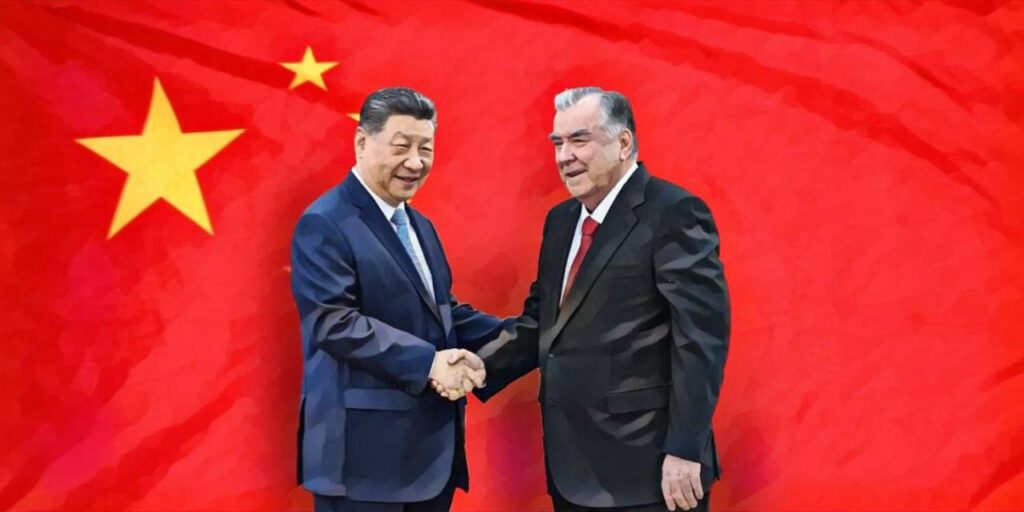
Rahmon Looks to China as Tajikistan’s Options Narrow

Tajikistan’s President Emomali Rahmon just finished a state visit to China. Rahmon has made trips to China many times during the nearly 34 years he has been in power in Tajikistan, but this visit came during a critical period. Simply put, Tajikistan is losing the international importance it once had, and China might now be the most dependable friend remaining for Rahmon and his country. A ‘Sweet’ Start China established diplomatic ties with all five Central Asian countries at the start of 1992. Just months later, a civil war broke out in Tajikistan that would last until June 1997, but that did not deter China from seeking investment opportunities in Tajikistan. China funded the construction of a sugar plant in Kurgan-Tepe in 1992, and later helped build confectioneries in large cities and towns in Tajikistan, as well as providing 10,000 tons of feed for livestock and, in 1994, extending a $50-million loan to Tajikistan. In April 1996, Rahmon and the leaders of China, Russia, Kazakhstan, and Kyrgyzstan met in Shanghai and formed the Shanghai Five, which, after the inclusion of Uzbekistan five years later, would become the Shanghai Cooperation Organization (SCO). China used the SCO to improve economic ties with all the Central Asian members, but while Chinese investment in Tajikistan was far less than in Kazakhstan or Uzbekistan, it was extremely important for Tajikistan, which was, and remains, the poorest country in Central Asia. After the terrorist attacks on the United States on September 11, 2001, and the start of the U.S.-led campaign in Afghanistan, China gave equipment and winter uniforms to Tajikistan’s border guards. Later, China also helped fund the construction of Tajik border posts along the frontier with Afghanistan, and Beijing is set to help finance nine more border posts. Security along Tajikistan’s border with Afghanistan is also in China’s interest. China shares an approximately 475-kilometer border with Tajikistan. Eastern Tajikistan is mountainous, remotely inhabited, and shares a long border with Afghanistan. China is concerned about the ability of potential enemies to move from Afghanistan through eastern Tajikistan and enter China. That is why, less than ten years ago, China built a small, forward observation military post in eastern Tajikistan, not far from the Chinese border. Militant groups such as the Eastern Turkestan Islamic Movement, comprised mainly of Uyghurs from China’s Xinjiang Region, and the Islamic State of Khorasan Province, which has explicitly threatened China, are present in northern Afghanistan. Chinese companies have been building Tajikistan’s infrastructure for some 20 years: roads, power transmission lines, the Dushanbe thermal power plant, hydropower plants, factories, and other objects. In 2025, China finally surpassed Russia to become Tajikistan’s leading trade partner, and Chinese-Tajik trade turnover in the first three months of 2026 increased by more than 52% compared to Q1 in 2025. Changing Times China is likely to remain Tajikistan’s leading trade partner and more for the foreseeable future. The geopolitical situation in Central Asia has changed, and not in Tajikistan’s favor. The biggest change for Rahmon and his country...

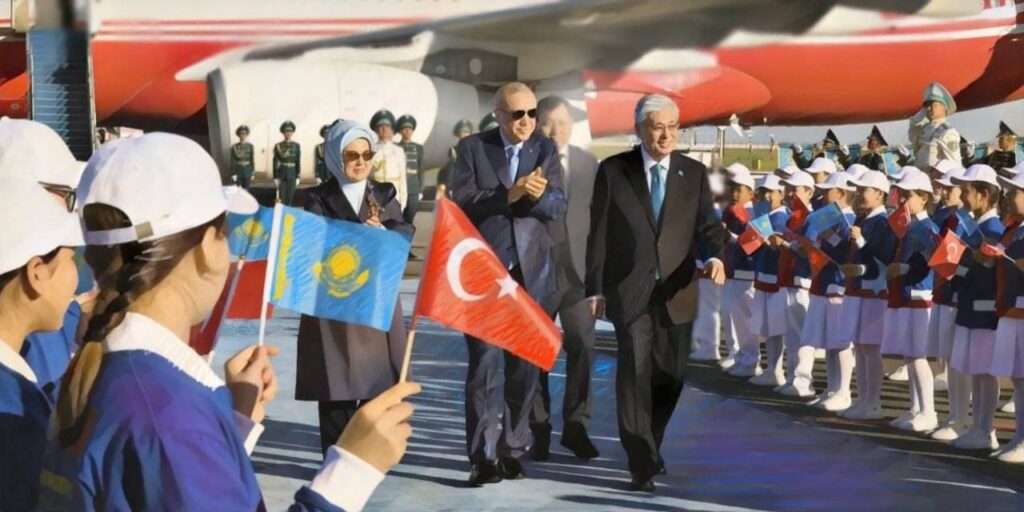
Erdoğan Visit Puts Trade, Transit, and Turkic Economic Integration at Center of Kazakhstan’s OTS Push

Turkish President Recep Tayyip Erdoğan’s visit to Kazakhstan comes as Astana is trying to give the Organization of Turkic States a more practical economic role, linking trade, investment, transport, digital development, and business financing across the Turkic world. The visit centered on three connected events: Erdoğan’s official visit to Astana, the sixth meeting of the Kazakhstan-Turkey High-Level Strategic Cooperation Council, and the informal summit of the Organization of Turkic States in Turkistan. Erdoğan arrived in Astana ahead of talks with President Kassym-Jomart Tokayev, while Turkish media reported that the agenda included transport links through the Middle Corridor, Caspian transit routes, energy security, logistics, defense industry cooperation, trade and investment. The visit also carried strong symbolic staging. According to Akorda, Erdoğan’s aircraft was escorted by Kazakh Air Defense fighter jets after entering Kazakhstan’s airspace. At Astana airport, he was greeted by an honor guard, children waving the flags of Kazakhstan and Turkey, and military helicopters displaying the national symbols of both countries. Erdoğan later said the welcome had brought his delegation “enormous joy,” adding, “We certainly will not forget this.” [caption id="attachment_48862" align="aligncenter" width="1280"] Kazakh aircraft fly over Astana during the ceremonial welcome for Erdoğan. Image: Akorda[/caption] The OTS summit is being hosted by Kazakhstan on May 15 in Turkistan under the theme “Artificial Intelligence and Digital Development.” According to the organization, the summit is intended to advance cooperation on artificial intelligence, digital innovation, emerging technologies, public services, sustainable economic growth, and regional connectivity. The digital theme reflects Kazakhstan’s effort to give the OTS a more practical economic role, beyond its cultural and diplomatic foundations. Ahead of the summit, Astana hosted a business forum on May 13 under the title “Economic Integration and Cooperation of the OTS Countries: New Opportunities in Industry, Agro-Industrial Complex, Logistics and Digitalization.” Kazakhstan’s prime minister’s office said the forum brought together state bodies, financial institutions, chambers of commerce, international organizations, and business representatives from OTS countries. Kanat Sharlapayev, chairman of the Union of Chambers of Commerce and Industry of Turkic States and of the presidium of Kazakhstan’s Atameken National Chamber of Entrepreneurs, urged Turkic countries to move toward deeper industrial and digital integration. He said the task was to create a unified digital environment, reduce the distance between producers and consumers, increase transparency, and speed up transactions. The forum also discussed plans for joint industrial facilities and manufacturing zones along transport corridors, an idea that would push OTS cooperation beyond transit toward processing and value-added production. Deputy Prime Minister and Minister of National Economy Serik Zhumangarin used the forum to frame OTS cooperation as one of Kazakhstan’s foreign economic priorities. He said the OTS countries form a market of more than 170 million people and have significant industrial, transport, agricultural, and human potential. He also said the main task was to move from declarations to joint projects, new production, technology alliances, and mutual investment. Silk Way TV reported that Murat Karimsakov, chairman of the Kazakh Chamber of International Commerce, said trade turnover among OTS countries increased...

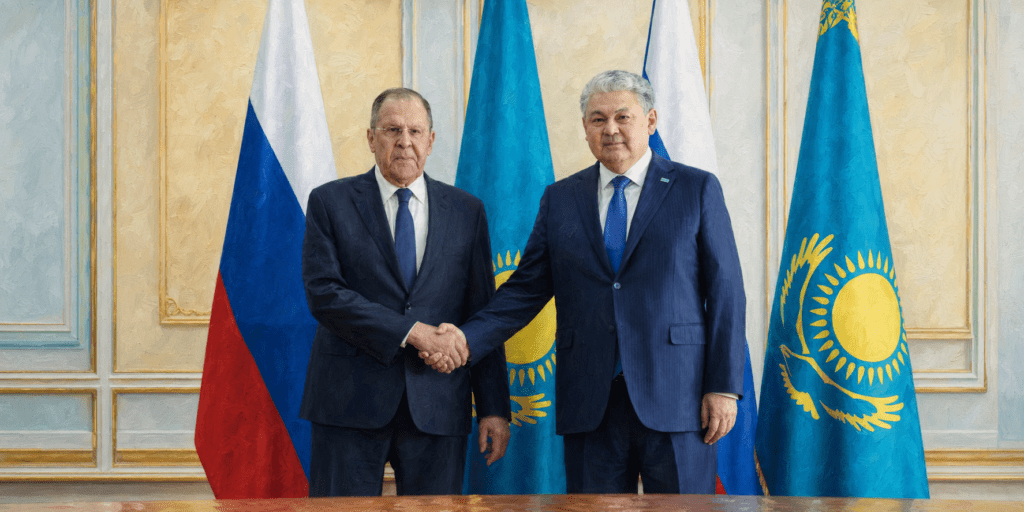
Lavrov in Astana as Kazakhstan Prepares for Putin State Visit

Russian Foreign Minister Sergey Lavrov has visited Astana for talks with Kazakhstan’s leadership, as the two countries prepare for a planned state visit by Russian President Vladimir Putin in late May. Lavrov arrived in Kazakhstan on April 29. The main working part of the visit took place on April 30, with meetings with President Kassym-Jomart Tokayev and Foreign Minister Yermek Kosherbayev. Russia’s Foreign Ministry said the agenda covered political, trade, economic, cultural, and humanitarian ties, as well as cooperation in the Eurasian Economic Union, the Collective Security Treaty Organization, the Commonwealth of Independent States, and the Shanghai Cooperation Organization. At expanded talks in Astana, Kosherbayev said Russia remains one of Kazakhstan’s key trade partners. Bilateral trade exceeded $27 billion last year, and the two governments are working toward a target of $30 billion. Kosherbayev said the talks covered energy, transport, logistics, industry, digitalization, cultural ties, and international issues. The foreign ministers signed a cooperation plan between the two ministries for 2027-2028 during the visit. Kosherbayev said the plan reflected close coordination between Astana and Moscow on bilateral and international issues. The visit also comes ahead of Putin’s expected trip to Kazakhstan. The Kremlin said in February that Putin had confirmed his participation in the Supreme Eurasian Economic Council meeting in Astana in late May and accepted Tokayev’s invitation to make a state visit linked to the event. For Kazakhstan, relations with Russia remain a central part of its multi-vector diplomacy, alongside growing ties with China, the European Union, Turkey, the Gulf states, and the United States. The two countries share a long border, have deep trade links, and work together through several regional organizations. Russia also remains central to Kazakhstan’s energy export network. The Caspian Pipeline Consortium terminal near Novorossiysk handles roughly 80% of Kazakhstan’s crude exports. That gives Astana a strong reason to keep stable ties with Moscow, but it also explains why Kazakhstan is pushing to diversify transport routes. The government has promoted the Trans-Caspian International Transport Route, also known as the Middle Corridor, as a way to move freight between China, Central Asia, the Caspian Sea, the South Caucasus, and Europe with less reliance on Russian territory. The war in Ukraine has made that approach harder to sustain. Kazakhstan has kept ties with Moscow, but Tokayev has also stressed the importance of the UN Charter, sovereignty, and territorial integrity. In a phone call with Ukrainian President Volodymyr Zelenskyy on August 10, 2025, Tokayev said Kazakhstan supported the UN Charter, the inviolability of sovereign borders, and the territorial integrity of sovereign states. Economic pressure has also grown. Western governments have increased scrutiny of trade routes that could be used to bypass sanctions on Russia. Kazakhstan has tried to protect its own trade from that pressure while avoiding a direct break with Moscow. Energy adds another dimension. Any disruption to the CPC route can quickly become a national economic issue for Kazakhstan. In April, Kazakhstan’s energy ministry said CPC exports through the Black Sea remained stable after Russia reported...

Uzbekistan and Tajikistan Launch 10 Joint Projects During Rahmon’s State Visit

Uzbekistan's President Shavkat Mirziyoyev welcomed his Tajik counterpart Emomali Rahmon to Tashkent on March 26 for a state visit marked by high-level talks, and the launch of joint economic projects. Talks between the presidents followed, first in a one-on-one format and then during the inaugural meeting of the Supreme Interstate Council, a new platform aimed at deepening bilateral cooperation. Mirziyoyev described the visit as a landmark in bilateral relations, noting that the council would elevate cooperation and provide a mechanism for implementing joint initiatives. Both sides highlighted the increasing frequency of contacts between government institutions, parliaments, and agencies. In the lead-up to the visit, a series of events took place, including an intergovernmental commission meeting, an industrial exhibition, and forums involving regional leaders, academics, and youth. Uzbekistan also hosted Days of Tajik Culture and Cinema. During the discussions, Mirziyoyev and Rahmon reviewed opportunities to expand cooperation across key sectors, including trade, industry, transport, and water and energy security. Bilateral trade approached $1 billion last year, driven largely by the exchange of finished goods. The two countries aim to double this figure to $2 billion by 2030. Planned measures include accelerating the establishment of the Oybek-Fotekhobod border trade center, introducing digital certification systems and “E-Permit” mechanisms, and modernizing border infrastructure. The sides also agreed to adopt an industrial cooperation program covering mining, energy, agriculture, construction, and manufacturing. Following the council meeting, Mirziyoyev and Rahmon attended a ceremony to launch 10 joint projects. These include new enterprises producing furniture and leather goods, expanded household appliance manufacturing, textile production facilities in Tajikistan, and construction projects in Tashkent. Additional initiatives include food processing plants in Uzbekistan's Fergana region, dairy production in the city of Andijan, and facilities for making fruit juice and metal briquettes in the country's Surkhandarya region. A ceremony was also held to name a street in New Tashkent after Dushanbe, underscoring symbolic ties between the two capitals. The visit also featured the opening of a new building for Tajikistan’s embassy in Tashkent. The complex includes administrative offices, a consular section, a residence for the ambassador, and housing for diplomatic staff and their families. Cultural diplomacy formed another key part of the visit. Mirziyoyev and Rahmon attended a joint concert at the International Forums Palace featuring performers from both countries, with a program highlighting shared cultural heritage and longstanding ties between the Uzbek and Tajik peoples. The leaders also discussed regional and international issues, reaffirming their commitment to continued dialogue and cooperation within Central Asia. They agreed to strengthen coordination on security matters and expand interregional ties, as well as humanitarian, educational, and scientific exchanges. Given the presence of large diaspora communities in both countries, a proposal was put forward to adopt a five-year program aimed at strengthening cultural and humanitarian connections. At the conclusion of the visit, both sides agreed to develop a comprehensive roadmap to ensure implementation of the agreements reached, signaling continued efforts to expand cooperation across political, economic, and cultural spheres.

Tokayev’s U.S. Visit Advances Kazakhstan’s Economic Agenda

The visit of Kazakh President Kassym-Jomart Tokayev to the United States provided an opportunity for targeted negotiations with major international corporations and financial institutions, centered on long-term investment, production localization, and Kazakhstan’s integration into global value chains. One of the key outcomes was the signing of an investment agreement worth approximately $180 million between Kazakhstan’s Ministry of Agriculture and Mars, Incorporated. The company plans to build a pet food production plant in the city of Alatau. The project will focus on the deep processing of agricultural raw materials and the production of high-value-added goods. Mars CEO Poul Weihrauch noted that the Kazakhstan facility will serve as a base for expanding the company’s presence in Central Asia and neighboring regions. A separate round of negotiations focused on healthcare. During talks with Ashmore Group, discussions centered on a proposal to build an international clinic in partnership with Ashmore Healthcare International and Samruk-Kazyna Invest, with the involvement of the Mount Sinai Health System as the operator. The initiative aligns with Kazakhstan’s strategy to develop medical infrastructure and medical tourism, as well as the Open Investment Partnership program targeting high-tech sectors of the economy. Aviation was another major component of the visit. At a meeting with Boeing executives, Tokayev confirmed the interest of Kazakh carriers Air Astana, SCAT Airlines, and VietJet Qazaqstan in expanding cooperation. Air Astana expects to receive Boeing 787 Dreamliner aircraft in the second half of 2026, which could pave the way for the launch of direct flights between Kazakhstan and the U.S. SCAT, meanwhile, is considering both the acquisition of additional aircraft and the establishment of its first maintenance and repair center at Shymkent Airport in partnership with an American company. The visit concluded with negotiations involving the U.S. International Development Finance Corporation (DFC). Its CEO, Ben Black, said Washington views Kazakhstan as a key partner in Eurasia. The discussions focused on projects in the mining sector and the development of transport and transit infrastructure critical for regional and interregional trade. According to the World Investment Report 2025 (UNCTAD), Kazakhstan overwhelmingly dominates foreign direct investment (FDI) in Central Asia. In 2024, Kazakhstan’s inward FDI stock stood at about $151 billion, far exceeding Turkmenistan (about $45 billion), Uzbekistan (about $17 billion), and Kyrgyzstan and Tajikistan (around $4 billion each). The negotiations in Washington point to Kazakhstan’s focus on building long-term institutional partnerships rather than pursuing isolated investment deals, a signal intended to reassure international investors about the stability and openness of the market. As previously reported by The Times of Central Asia, Tokayev also took part in the inaugural meeting of the Board of Peace in Washington, where Kazakhstan signaled its willingness to contribute to Gaza’s reconstruction and broader stabilization efforts, including potential financial support and participation in peacekeeping initiatives.

Uzbekistan, Pakistan Set $2 Billion Trade Target Following High-Level Talks in Islamabad

Uzbek President Shavkat Mirziyoyev arrived in Islamabad on a state visit on February 5, marking a new chapter in Uzbekistan-Pakistan relations. According to official sources, the Uzbek leader’s aircraft was escorted by Pakistan Air Force fighter jets upon entering the country’s airspace. At Nur Khan Airbase, Mirziyoyev was received by President Asif Ali Zardari, Prime Minister Shehbaz Sharif, and senior Pakistani officials. Shortly after his arrival, Mirziyoyev visited the headquarters of Global Industrial & Defence Solutions, where he met with Pakistan’s Chief of Army Staff, Field Marshal Asim Munir. The two sides discussed strengthening the strategic partnership, with an emphasis on military and military-technical cooperation. Areas of focus included deepening collaboration between defense industry enterprises, expanding training for military personnel, sharing operational experience, and organizing joint exercises. Both countries agreed to draft a roadmap for future defense cooperation. Later that day, Mirziyoyev held one-on-one talks with Prime Minister Sharif and chaired the inaugural meeting of the High-Level Strategic Cooperation Council. At the meeting’s outset, the Uzbek president extended greetings in advance of the holy month of Ramadan and Pakistan Day. Discussions centered on implementing existing agreements and expanding cooperation across political, economic, and humanitarian spheres. Trade and economic cooperation featured prominently. Bilateral trade reached nearly $500 million by the end of last year, and approximately 230 Pakistani-capital companies are currently operating in Uzbekistan. Air connectivity and banking ties between the two countries are also expanding. Ongoing joint ventures span textiles, pharmaceuticals, chemicals, agriculture, and other sectors. An exhibition of Uzbek industrial products is being held in Islamabad as part of the visit. The two leaders agreed to set a goal of raising bilateral trade turnover to $2 billion in the near future. Key measures include expanding the list of goods under the Preferential Trade Agreement, easing phytosanitary requirements for Uzbek agricultural exports, and increasing the use of Uzbekistan’s trade houses in Lahore and Karachi. A joint project portfolio valued at nearly $3.5 billion has already been developed. Transport and logistics were another central topic. Both sides emphasized the strategic importance of advancing the Trans-Afghan railway and supporting the Pakistan-China-Kyrgyzstan-Uzbekistan transport corridor. They also agreed to establish an Uzbek-Pakistani Forum of Regions, with the inaugural meeting scheduled to take place this year in Uzbekistan’s Khorezm region. Cultural cooperation was also addressed. Plans include hosting Uzbekistan Culture Weeks and Uzbek Cinema Days in Pakistan and exploring the creation of a joint cultural center in Lahore dedicated to the Baburid heritage. The visit concluded with the signing of a Joint Declaration and a series of agreements spanning diplomacy, trade, defense, transport, agriculture, digital technologies, culture, security, and regional cooperation. Mirziyoyev also extended an invitation to Prime Minister Sharif for a return visit to Uzbekistan.