• KGS/USD = 0.01144 0%
  • KZT/USD = 0.00200 0%
  • TJS/USD = 0.10494 0%
  • UZS/USD = 0.00008 0%
  • TMT/USD = 0.28490 0%
  • KGS/USD = 0.01144 0%
  • KZT/USD = 0.00200 0%
  • TJS/USD = 0.10494 0%
  • UZS/USD = 0.00008 0%
  • TMT/USD = 0.28490 0%
  • KGS/USD = 0.01144 0%
  • KZT/USD = 0.00200 0%
  • TJS/USD = 0.10494 0%
  • UZS/USD = 0.00008 0%
  • TMT/USD = 0.28490 0%
  • KGS/USD = 0.01144 0%
  • KZT/USD = 0.00200 0%
  • TJS/USD = 0.10494 0%
  • UZS/USD = 0.00008 0%
  • TMT/USD = 0.28490 0%
  • KGS/USD = 0.01144 0%
  • KZT/USD = 0.00200 0%
  • TJS/USD = 0.10494 0%
  • UZS/USD = 0.00008 0%
  • TMT/USD = 0.28490 0%
  • KGS/USD = 0.01144 0%
  • KZT/USD = 0.00200 0%
  • TJS/USD = 0.10494 0%
  • UZS/USD = 0.00008 0%
  • TMT/USD = 0.28490 0%
  • KGS/USD = 0.01144 0%
  • KZT/USD = 0.00200 0%
  • TJS/USD = 0.10494 0%
  • UZS/USD = 0.00008 0%
  • TMT/USD = 0.28490 0%
  • KGS/USD = 0.01144 0%
  • KZT/USD = 0.00200 0%
  • TJS/USD = 0.10494 0%
  • UZS/USD = 0.00008 0%
  • TMT/USD = 0.28490 0%

Viewing results 1 - 6 of 61

Tokyo Steps Up: Iwaya’s Central Asia Tour Signals Japan’s Long-Term Commitment

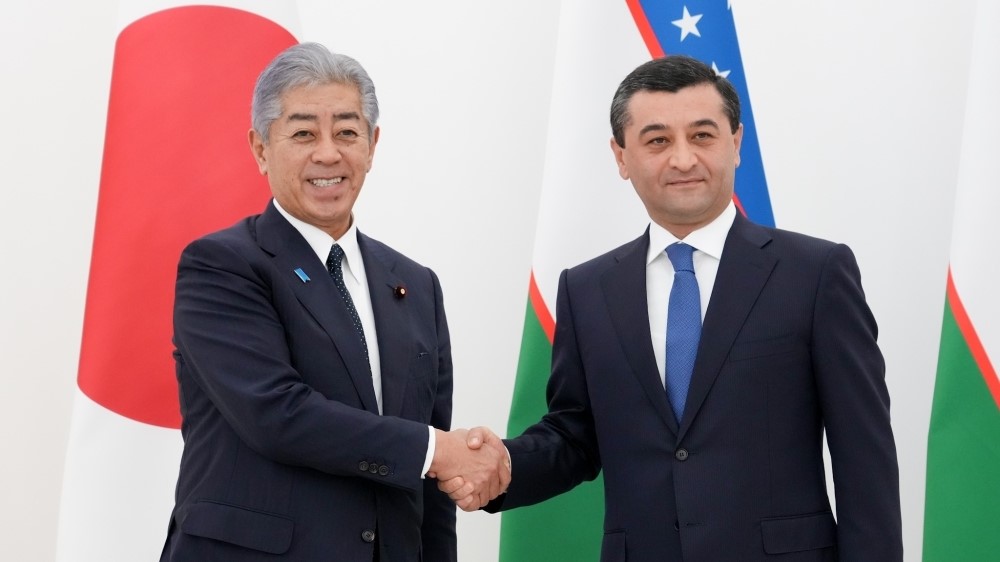
Japanese Foreign Minister Takeshi Iwaya made a landmark trip to Central Asia from August 24–28, 2025, holding talks in Kazakhstan and Uzbekistan. Tokyo framed the visit as a bid to deepen bilateral ties and revive the Central Asia plus Japan leaders’ summits. The visit fulfilled commitments made by then-Prime Minister Kishida, who had planned a similar tour in 2024 before cancelling at the last minute due to a domestic earthquake alert. Strategic Engagement Iwaya’s visit reflects Tokyo’s long-standing, multifaceted approach to Central Asia. Analysts emphasized to The Times of Central Asia that Japan is pursuing “trust-building diplomacy” in the region, focusing on human capital, infrastructure, and governance rather than quick geopolitical wins. Tokyo inaugurated the Central Asia plus Japan Dialogue format in 2004, making it the first outside power to group all five Central Asian republics within a single framework. As Professor Timur Dadabaev of Tsukuba University told The Times of Central Asia, Tokyo is seen “not as a competing hegemon, but as a partner that invests in the region’s human capital, infrastructure, and governance in ways that reinforce independence.” This approach contrasts with what has been characterized as the transactional models of other powers. On August 25, Iwaya met with Kazakhstan’s Deputy Prime Minister and Foreign Minister Murat Nurtleu in Astana, marking his first official visit to the country. The talks underscored both sides’ commitment to strengthening ties as strategic partners and in upholding a “free and open international order based on the rule of law.” The ministers welcomed active exchanges and pledged to expand cooperation in trade, investment, mineral resources, disaster prevention, and nuclear non-proliferation. They also announced plans to accelerate preparations for the long-delayed Central Asia plus Japan summit. [caption id="attachment_35524" align="aligncenter" width="1000"] Japanese Foreign Minister Iwaya with Kazakh Foreign Minister Nurtleu in Astana after their meeting on August 25, 2025; image Japan MOFA[/caption] In Tashkent, Iwaya echoed this message, calling Uzbekistan “an important strategic partner,” and highlighting the first-ever foreign ministers’ strategic dialogue held there. Japanese officials also stressed their policy does not aim to pressure Central Asian partners on sensitive issues. Characterizing Japan as a “catalyst to promote interconnectivity and inter-regional cooperation,” Foreign Ministry spokesman Toshihiro Kitamura stated that Tokyo does not see a zero-sum “competition between Japan and other countries. We would like to see Central Asian countries work together with other parts of the world.” In Tashkent, Kitamura explicitly noted that while Japan condemns Russia’s invasion of Ukraine, it will not pressure Uzbekistan or others to take the same stance. “The relationship between Russia and the Central Asian countries is a very delicate issue. Each country should take into account the relations it establishes with other countries. Even if it is with Russia, such relations do not affect the relations of other countries with Japan,” Kitamura stated. Bilateral Agreements In Kazakhstan, Iwaya held high-level talks with President Kassym-Jomart Tokayev and Foreign Minister Nurtleu. Tokayev welcomed Japan as a “reliable and close partner in Asia” and said ties are “developing dynamically.” The sides agreed to...

Uzbekistan Jordan Relations Advance with Landmark State Visit

King Abdullah II of Jordan paid a state visit to Uzbekistan on August 25-26 at the invitation of President Shavkat Mirziyoyev. The visit, his first since the establishment of diplomatic relations, marked a milestone in bilateral ties and culminated in the signing of 15 agreements spanning politics, trade, investment, education, and culture. A Historic Visit with Symbolic and Strategic Weight Mirziyoyev welcomed King Abdullah with full ceremonial honors in Samarkand, including flag displays, a guard of honor, and performances of national songs and dances. The leaders visited prominent cultural sites, including the Shah-i-Zinda complex, Amir Temur’s mausoleum, and Registan Square, where the Jordanian monarch received an overview of Uzbekistan’s rich historical heritage. King Abdullah also visited the tomb of Qutham ibn al-ʿAbbas, a revered early Islamic preacher in Samarkand. The Jordanian delegation toured the “Eternal City” cultural park, which showcases Uzbekistan’s traditional crafts, architecture, and customs. Expanding Economic and Diplomatic Cooperation The official program commenced on August 26 at the Congress Center in Samarkand. Following the ceremonial welcome, the leaders visited an exhibition of Uzbekistan’s export-oriented products. The showcase featured a range of goods from key industries such as pharmaceuticals, chemicals, mining, textiles, agriculture, IT, and jewelry. King Abdullah praised Uzbekistan’s industrial development and called for increased business-to-business collaboration. During bilateral talks, the two sides agreed to elevate their relationship to a comprehensive partnership. Discussions focused on expanding political dialogue, boosting trade and investment, and strengthening cooperation in science, education, tourism, and culture. To formalize the partnership, the two countries agreed to establish a joint intergovernmental commission and a business council by the end of the year, and to convene an Uzbek-Jordanian business forum. They also outlined plans for cooperation in smart agriculture, geology, healthcare, and the textile industry. Broad-Based Agreements and International Alignment Fifteen agreements and memoranda were signed during the visit, including: An extradition treaty A bilateral investment promotion agreement A visa waiver agreement Cooperation protocols in higher education, scientific research, agriculture, veterinary medicine, tourism, and standardization The two leaders also reiterated their commitment to close coordination within international organizations, including the United Nations and the Organization of Islamic Cooperation. Honoring Partnership and Future Prospects In recognition of his role in strengthening bilateral ties, Mirziyoyev was awarded Jordan’s highest state honor, the Order of Al Nahda (“Renaissance”), presented personally by King Abdullah II. “I accept this award with great honor, as a recognition of our joint efforts to expand multifaceted cooperation and a sign of friendship and respect for the people of Uzbekistan, who are laying the foundations for the Third Renaissance in our country,” Mirziyoyev said. The visit concluded with a joint statement and mutual invitations for future high-level exchanges, reaffirming both countries’ shared ambition to elevate Uzbekistan-Jordan relations to a new strategic level.

Uzbekistan, India Boost Strategic Partnership in High-Level Call

Uzbek President Shavkat Mirziyoyev spoke with Indian Prime Minister Narendra Modi on August 12, 2025, in a telephone conversation aimed at deepening the strategic partnership between Uzbekistan and India. The two leaders discussed expanding cooperation across trade, connectivity, healthcare, technology, and cultural exchanges, with Modi describing their conversation as “fruitful.” Posting on X, Modi stated that “We reviewed the progress achieved in key areas of our bilateral cooperation and reaffirmed our shared resolve to further advance the India-Uzbekistan Strategic Partnership.” Ahead of India’s 79th Independence Day, Mirziyoyev highlighted the longstanding friendship between the two nations. The talks underscored Uzbekistan’s growing role as a vital partner in Central Asia for India, as both countries seek to bolster regional stability and their economic development. Since Uzbekistan’s independence in 1991, the country has steadily built ties with India, which was among the first to recognize its sovereignty. The two nations formally established diplomatic relations in 1992 and elevated their engagement with a Strategic Partnership declaration in 2011. Uzbekistan has hosted several visits by Modi, most recently in September 2022, when he participated in the 22nd SCO summit held in Samarkand. Mirziyoyev has visited India on two occasions. Uzbekistan plays a central role in Central Asian connectivity initiatives such as the China–Kyrgyzstan–Uzbekistan railway project, enhancing trade routes and regional cooperation. It is also exploring collaboration with India in healthcare and technology, alongside efforts to promote cultural and educational exchanges that strengthen ties between their peoples. Bilateral economic ties are steadily growing, with trade between India and Uzbekistan reaching approximately $756.6 million in 2023, up from $444.2 million in 2020. Indian exports include pharmaceuticals, machinery, and food products, while Uzbekistan supplies fruits, fertilizers, and textiles. More than 300 Indian companies now operate in Uzbekistan, encouraged by a new Bilateral Investment Treaty signed in 2024, which is aimed at boosting joint ventures in healthcare, IT, and tourism. Both governments have signaled their intent to diversify into renewable energy, agriculture, and hospitality. Connectivity is a key pillar of the partnership. Uzbekistan is working with India on projects like the International North–South Transport Corridor and seeking operational access to Iran’s Chabahar Port, which would give Tashkent a direct route to the Indian Ocean. Security and defense cooperation have intensified since the creation of the Joint Working Group on Defense in 2019. The two countries hold the annual Dustlik military exercises, alternating between India and Uzbekistan, to strengthen counter-terrorism and urban warfare capabilities. The sixth edition was held in Pune from April 16–28, 2025, underscoring growing interoperability between the two militaries. Uzbek forces regularly train at Indian military academies, and discussions are underway on defense industry collaboration. Cultural and educational ties also remain vibrant. Bollywood and Indian music enjoy enduring popularity in Uzbekistan. Around 10,000 Indian students now study across Uzbek institutions, particularly in medicine. On the tech side, ministers agreed this year to launch an India–Central Asia Digital Partnership Forum, with Uzbekistan offering to host the inaugural meeting, linking India’s digital public infrastructure experience with Central Asia’s modernization...

EU–Kazakhstan Relations: Strategic Cooperation Amid Geopolitical Shifts

In a recent podcast discussion, EU Ambassador to Kazakhstan Aleška Simkić and Kazakhstan’s Ambassador to the EU and NATO, Roman Vassilenko, discussed the evolving relationship between the European Union and Kazakhstan and broader Central Asia. Their exchange offered insight into the shared strategic interests driving EU–Kazakhstan cooperation across trade, energy, critical raw materials, connectivity, and mobility. Trade and Investment: A Stable Foundation Trade and investment continue to underpin the relationship; the European Union remains Kazakhstan’s largest trading partner and top foreign investor. Bilateral trade reached $49.7 billion in 2024, with the majority comprising energy exports from Kazakhstan, highlighting its role as a key supplier to European markets. The EU collectively accounts for a significant share of Kazakhstan’s FDI, equal to €54.8 billion in 2022, representing approximately 50–55% of Kazakhstan’s total FDI. The Enhanced Partnership and Cooperation Agreement (EPCA), in effect since 2020, underpins the EU–Kazakhstan bilateral relationship, providing a legal framework for cooperation across 29 sectors. As noted by both ambassadors, it enables structured dialogue on trade, energy, governance, and sustainability. While political engagement has increased, both sides acknowledge that deeper implementation is needed to fully leverage the EPCA in line with the EU’s broader strategy for Central Asia. Roman Vassilenko acknowledged the recent momentum: “I think the relationship between Kazakhstan and the EU has strengthened tremendously over the past three and a half years. With a relatively new Commission in place in Brussels, and with the President of Kazakhstan committed to strengthening ties with the European Union as part of our balanced and pragmatic foreign policy, we are at a moment where we can truly advance, deepen, and strengthen our relations in many ways.” [caption id="attachment_34435" align="aligncenter" width="1431"] EU Ambassador to Kazakhstan, Aleška Simkić (left) with Kazakhstan’s Ambassador to the EU and NATO, Roman Vassilenko (right); Image: EU Delegation to Kazakhstan.[/caption] Energy and Raw Materials: Strategic Realignment While energy has long anchored EU–Kazakhstan ties, both ambassadors emphasized a shift toward broader, forward-looking cooperation. Ambassador Vassilenko identified critical raw materials and green hydrogen as emerging areas of strategic importance, offering Kazakhstan opportunities to diversify its economy while supporting the EU’s green transition. Kazakhstan, with its mineral wealth and renewable energy potential, is well-positioned to contribute to Europe’s supply chain resilience in clean technologies. The country’s abundant reserves of critical minerals—such as rare earths, copper, lithium, and cobalt—align with Europe’s need to diversify sources for its green transition. Coupled with growing investment in renewable energy and deepening cooperation with European partners, Kazakhstan stands out as a strategic supplier for clean-tech industries. Both envoys stressed the importance of moving from basic resource exports toward long-term industrial partnerships — including local processing, infrastructure development, and regulatory alignment — as a means of ensuring mutual benefit. Connectivity: The Middle Corridor and Infrastructure Links Connectivity also features prominently. The Trans-Caspian International Transport Route, or “Middle Corridor,” is increasingly viewed as a viable overland route connecting China to Europe via Kazakhstan. Cargo volumes have risen, and both the EU and regional stakeholders are investing in capacity...

China Steps Into the Central Asian Power Vacuum

China’s footprint in Central Asia is growing rapidly, with the number of joint projects and strategic initiatives expanding across the region. Analysts attribute this shift to the waning influence of both Russia and the United States. Kazakhstan: From Agriculture to Atomic Energy In recent months, China has significantly deepened its cooperation with Kazakhstan. As The Times of Central Asia recently reported, on July 24, the Kazakh Ministry of Finance announced a pilot project with China involving unmanned freight trucks crossing the Bakhty (Kazakhstan) and Pokitu (China) border points. The initiative, known as "Smart Customs," will employ autonomous guided vehicles (AGVs) and implement a unified electronic customs declaration system recognized by both countries. Further institutional cooperation had earlier emerged on July 23, with the launch of the China-Central Asia Poverty Reduction Cooperation Center and the China-Central Asia Education Exchange and Cooperation Center in Urumqi, Xinjiang. These centers aim to deepen collaboration on poverty alleviation and education, priorities reaffirmed during the second China-Central Asia Summit in Astana, where 24 bilateral agreements were signed during President Xi Jinping’s visit. Meanwhile, China is asserting itself in Kazakhstan’s energy sector. On June 14, the China National Nuclear Corporation (CNNC) was announced as the leader of a consortium to build a new nuclear power plant in Kazakhstan. Although Russia's Rosatom is slated to construct the country's first nuclear plant, logistical and financial setbacks at its Akkuyu project in Turkey have led some experts to suggest that CNNC may ultimately be responsible for Kazakhstan’s inaugural facility. Meanwhile, as previously reported by The Times of Central Asia, transit routes through Russia are seeing multiple problems, with Kazakhstan temporarily suspending oil exports via the Black Sea ports of Novorossiysk and Yuzhnaya Ozerovka due to newly enforced Russian regulations. At land borders, new entry procedures for foreign citizens, including Kazakhs, have led to massive traffic jams. China’s Strategic Pivot According to sociologist Gulmira Ileuova, China's assertive role is a response to the diminishing presence of both Russia, distracted by the war in Ukraine, and the United States, which has scaled back developmental efforts. In March, President Donald Trump signed an executive order curtailing the global operations of the United States Agency for International Development (USAID), leading to the suspension of several NGO and media initiatives in Central Asia. “China is rapidly filling the vacuum,” Ileuova noted in an interview with The Times of Central Asia. “Beijing is transitioning from economic engagement to ideological influence, promoting narratives of social harmony and a shared future.” Ileuova anticipates that a broad ideological campaign, comparable to the "One Belt, One Road" infrastructure initiative, may follow, amplifying China’s soft power in the region. Rather than emphasizing democratic values, Chinese cooperation projects often focus on poverty alleviation, which finds greater resonance among Central Asian populations. Xi Jinping’s Repeated Visits Signal Priority As previously stated, Chinese President Xi Jinping visited Kazakhstan on June 16 for the Second China-Central Asia Summit in Astana, during which leaders signed the Astana Declaration and a treaty on “eternal good-neighborliness.” According to political...

Kyrgyzstan and Russia Reaffirm Strategic Partnership in Moscow Talks

Kyrgyzstan and Russia have reaffirmed their commitment to deepening bilateral cooperation across diverse sectors following a high-level meeting between President Vladimir Putin and Kyrgyz President Sadyr Japarov at the Kremlin on July 2. President Putin welcomed President Japarov to Moscow with praise for the positive trajectory of economic ties between the two countries. “Last year, bilateral trade increased by over 11%, and in the first four months of this year, it grew by more than 17%,” Putin noted during the reception. He emphasized that Russia remains one of Kyrgyzstan’s key trade and economic partners, highlighting the role of the Russian-Kyrgyz Development Fund, which continues to support industrial and agricultural initiatives in Kyrgyzstan. Putin also noted the expanding footprint of Russian businesses in the country. Cultural and educational cooperation featured prominently in the discussions. Putin pointed out that approximately 200 Russian teachers are currently working in 43 schools across Kyrgyzstan. “We have launched new school construction projects and plan to expand the number of Russian-language schools,” he said, expressing gratitude to Japarov for maintaining the official status of the Russian language in Kyrgyzstan. Russian remains one of Kyrgyzstan’s official languages and continues to function as a key medium of communication in the country’s multi-ethnic society. President Japarov echoed the strong political alignment between Bishkek and Moscow. “There is full mutual understanding and trust between our countries. There are no political differences or contradictions,” he stated. Japarov also highlighted the potential for further cooperation in sectors including energy, transport, industry, and agriculture, reinforcing the enduring strategic partnership between the two nations.