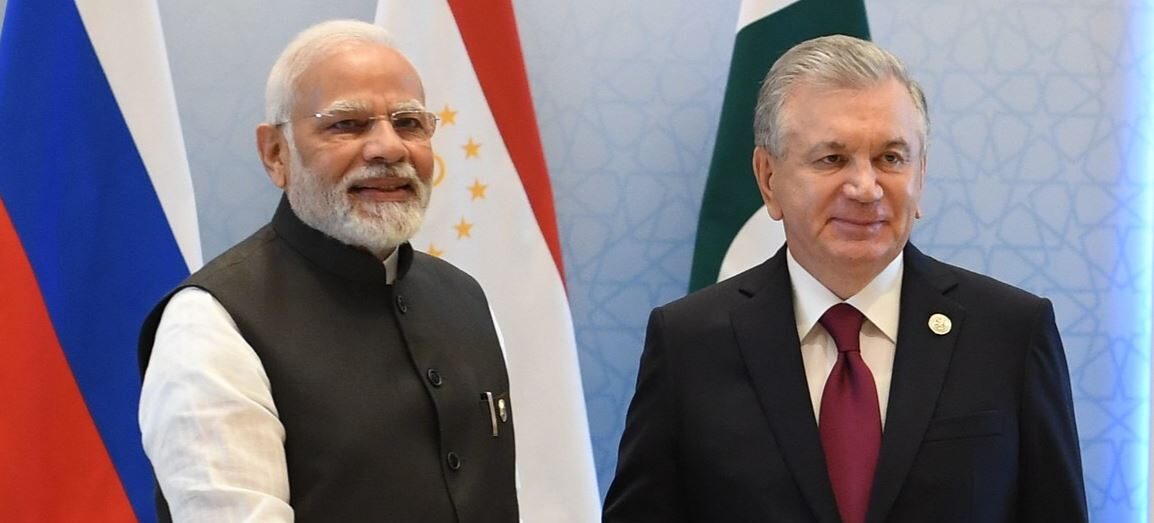
Uzbek President Shavkat Mirziyoyev spoke with Indian Prime Minister Narendra Modi on August 12, 2025, in a telephone conversation aimed at deepening the strategic partnership between Uzbekistan and India. The two leaders discussed expanding cooperation across trade, connectivity, healthcare, technology, and cultural exchanges, with Modi describing their conversation as “fruitful.” Posting on X, Modi stated that “We reviewed the progress achieved in key areas of our bilateral cooperation and reaffirmed our shared resolve to further advance the India-Uzbekistan Strategic Partnership.”
Ahead of India’s 79th Independence Day, Mirziyoyev highlighted the longstanding friendship between the two nations. The talks underscored Uzbekistan’s growing role as a vital partner in Central Asia for India, as both countries seek to bolster regional stability and their economic development.
Since Uzbekistan’s independence in 1991, the country has steadily built ties with India, which was among the first to recognize its sovereignty. The two nations formally established diplomatic relations in 1992 and elevated their engagement with a Strategic Partnership declaration in 2011. Uzbekistan has hosted several visits by Modi, most recently in September 2022, when he participated in the 22nd SCO summit held in Samarkand. Mirziyoyev has visited India on two occasions.
Uzbekistan plays a central role in Central Asian connectivity initiatives such as the China–Kyrgyzstan–Uzbekistan railway project, enhancing trade routes and regional cooperation. It is also exploring collaboration with India in healthcare and technology, alongside efforts to promote cultural and educational exchanges that strengthen ties between their peoples.
Bilateral economic ties are steadily growing, with trade between India and Uzbekistan reaching approximately $756.6 million in 2023, up from $444.2 million in 2020. Indian exports include pharmaceuticals, machinery, and food products, while Uzbekistan supplies fruits, fertilizers, and textiles. More than 300 Indian companies now operate in Uzbekistan, encouraged by a new Bilateral Investment Treaty signed in 2024, which is aimed at boosting joint ventures in healthcare, IT, and tourism. Both governments have signaled their intent to diversify into renewable energy, agriculture, and hospitality.
Connectivity is a key pillar of the partnership. Uzbekistan is working with India on projects like the International North–South Transport Corridor and seeking operational access to Iran’s Chabahar Port, which would give Tashkent a direct route to the Indian Ocean.
Security and defense cooperation have intensified since the creation of the Joint Working Group on Defense in 2019. The two countries hold the annual Dustlik military exercises, alternating between India and Uzbekistan, to strengthen counter-terrorism and urban warfare capabilities. The sixth edition was held in Pune from April 16–28, 2025, underscoring growing interoperability between the two militaries. Uzbek forces regularly train at Indian military academies, and discussions are underway on defense industry collaboration.
Cultural and educational ties also remain vibrant. Bollywood and Indian music enjoy enduring popularity in Uzbekistan. Around 10,000 Indian students now study across Uzbek institutions, particularly in medicine. On the tech side, ministers agreed this year to launch an India–Central Asia Digital Partnership Forum, with Uzbekistan offering to host the inaugural meeting, linking India’s digital public infrastructure experience with Central Asia’s modernization drive.
This latest dialogue marks another step in Uzbekistan’s journey to diversify partnerships and assert its strategic importance in the region.