• KGS/USD = 0.01144 0%
  • KZT/USD = 0.00198 -0%
  • TJS/USD = 0.10903 0.18%
  • UZS/USD = 0.00008 0%
  • TMT/USD = 0.28571 0%
  • KGS/USD = 0.01144 0%
  • KZT/USD = 0.00198 -0%
  • TJS/USD = 0.10903 0.18%
  • UZS/USD = 0.00008 0%
  • TMT/USD = 0.28571 0%
  • KGS/USD = 0.01144 0%
  • KZT/USD = 0.00198 -0%
  • TJS/USD = 0.10903 0.18%
  • UZS/USD = 0.00008 0%
  • TMT/USD = 0.28571 0%
  • KGS/USD = 0.01144 0%
  • KZT/USD = 0.00198 -0%
  • TJS/USD = 0.10903 0.18%
  • UZS/USD = 0.00008 0%
  • TMT/USD = 0.28571 0%
  • KGS/USD = 0.01144 0%
  • KZT/USD = 0.00198 -0%
  • TJS/USD = 0.10903 0.18%
  • UZS/USD = 0.00008 0%
  • TMT/USD = 0.28571 0%
  • KGS/USD = 0.01144 0%
  • KZT/USD = 0.00198 -0%
  • TJS/USD = 0.10903 0.18%
  • UZS/USD = 0.00008 0%
  • TMT/USD = 0.28571 0%
  • KGS/USD = 0.01144 0%
  • KZT/USD = 0.00198 -0%
  • TJS/USD = 0.10903 0.18%
  • UZS/USD = 0.00008 0%
  • TMT/USD = 0.28571 0%
  • KGS/USD = 0.01144 0%
  • KZT/USD = 0.00198 -0%
  • TJS/USD = 0.10903 0.18%
  • UZS/USD = 0.00008 0%
  • TMT/USD = 0.28571 0%
05 December 2025

Viewing results 1 - 6 of 12

Greening Campaign in Bishkek Targets Air Quality Improvement

A citywide greening campaign was launched in Bishkek on October 15, with plans to plant more than 10,000 tree and shrub saplings across the capital. The initiative is part of a broader effort to combat environmental degradation and improve air quality in one of Central Asia’s most polluted cities. According to the Bishkek City Administration, priority will be given to areas surrounding educational institutions. The plan includes the creation of green zones around every school in the city. The tree-planting campaign is designed to help reverse decades of urban deforestation, a consequence of rapid development that has significantly reduced Bishkek’s tree cover. Once regarded as one of the greenest cities in the former Soviet Union, Bishkek has lost much of its vegetation due to unchecked construction and infrastructure expansion. Environmental experts have urged city planners to prioritize the planting of tall, broadleaf deciduous trees, valued for their shade and noise-reducing qualities, over coniferous species, which currently dominate urban landscaping. The campaign aligns with Kyrgyzstan’s nationwide “Jashyl Muras” (“Green Heritage”) initiative, launched by President Sadyr Japarov in March 2022. The program aims to plant between five and six million saplings each year. In 2024, the Ministry of Natural Resources, Ecology and Technical Supervision reported that more than 8.1 million saplings were planted across the country. Additional Measures to Reduce Pollution On the same day, during a meeting of the Interdepartmental Commission for Improving Air Quality, Bishkek Mayor Aibek Junushaliev detailed other municipal efforts to reduce pollution. He noted that more than 1,500 diesel-powered minibuses have been removed from central city streets. The municipal transport fleet now consists of 1,449 environmentally friendly buses, 1,329 running on liquefied natural gas and 120 electric buses purchased in 2025. According to the Ministry of Natural Resources, Ecology and Technical Supervision, motor vehicle emissions contribute approximately 30% of Bishkek’s air pollution. Further efforts include the installation of a desulfurization system at the Bishkek Thermal Power Plant (TPP), which supplies heat and hot water to most of the capital. The plant’s emissions are estimated to account for around 15% of the city’s air pollution. The new system captures up to 96.6% of sulfur dioxide (SO₂) generated during coal combustion, marking a major step toward improving air quality in the city.

Opinion: Turning Deserts Into Fields of Hope

Desertification is a global crisis threatening the livelihoods of 3.2 billion people worldwide. From China’s vast green belt along its largest desert to Central Asia’s unified efforts to halt land degradation on arid plains, the fight against encroaching sand continues. These initiatives offer hopeful examples of human endeavor in restoring degraded lands and safeguarding the future of our planet. In the heart of southern Xinjiang lies the Taklamakan Desert, a vast expanse known as the “sea of death” for its extreme arid and inhospitable conditions. Covering 330,000 square kilometers - an area almost the size of Finland - it is China’s largest desert and the world’s second-largest shifting desert. Here, dunes stretch endlessly, and sandstorm days comprise one-third of the year. For generations, the Taklamakan Desert has threatened surrounding villages, farmlands, and transportation routes, squeezing the living space of those who dwell on its edges. Nearly 80% of the desert sands are in constant motion, while seasonal floods from melting snow on the mountains add further instability, leaving homes and livelihoods at risk. The danger is long-term: at one point, the Taklamakan risked merging with the nearby Kumtag Desert, placing even greater pressure on human settlements. How To Contain The Sands Faced with the challenge, China launched an ambitious initiative: building a shield of vegetation to encircle the Taklamakan Desert, planting desert-tolerant species such as desert poplar, red willow, saxaul, and even roses. This massive project took more than 40 years to complete. By the end of 2023, 2,761 kilometers (about 1,716 miles) of the belt had been established. A year later, the final 285 kilometers - the most challenging section - was closed through the dedicated efforts of 600,000 people. On November 28, 2024, in Yutian County on the desert’s southern edge, the last seedlings were planted into the sands, completing a 3,046-kilometer green belt. This vast ecological barrier stabilizes the Taklamakan Desert’s edge, prevents sandstorms, and protects the fragile ecology. In addition, the green belt provides wild animals in the desert with safe conditions for survival, breeding, and migration. A Bold Green Strategy Against Desertification The Taklamakan Desert control project is a part of China's Three-North Shelterbelt Forest Program, or TSFP, the world's largest afforestation program aimed at curbing desertification. Launched in 1978, this ambitious program seeks to slow the progress of desertification and reduce the frequency of sandstorms by planting vast stretches of trees and resilient plant species across the arid and semi-arid regions in northern China, where sandstorms pose a constant threat to local farmlands and residents. Official data shows that forest coverage in areas covered by the TSFP has risen from 5% in 1977 to 13.8% today. More than 60% of regions prone to soil erosion have been effectively controlled, and roughly 30 million hectares of farmland have been safeguarded from desert expansion. Turning Lands of Despair into Fields of Hope: A Shared Mission The challenges faced in northern China echo across the globe. From the Sahel in Africa to the Middle East and Central...

Bishkek Launches “Living Wall” Project to Tackle Heat and Pollution

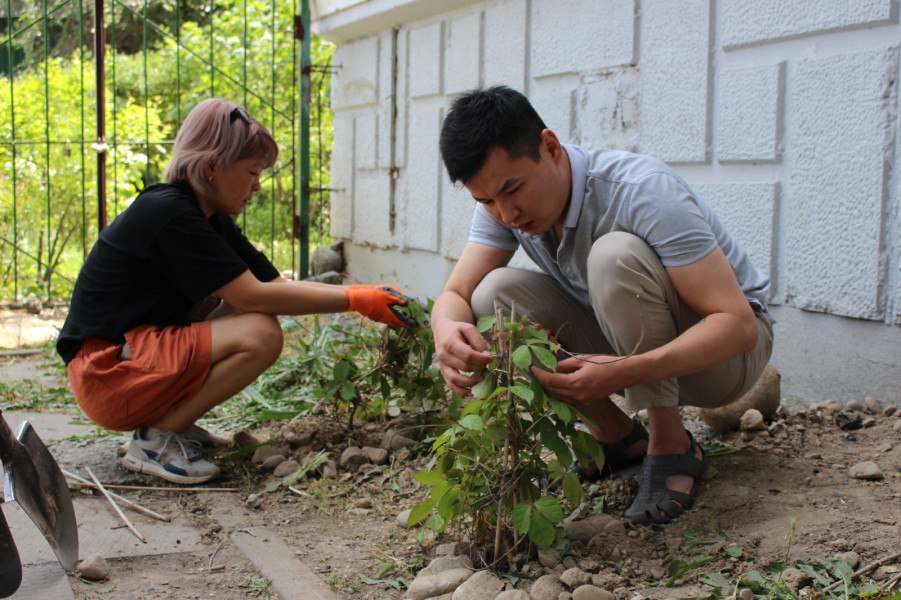
Bishkek has launched a pilot project to green the facades of buildings as part of a broader effort to adapt to climate change and mitigate growing heat and air pollution in Kyrgyzstan’s capital. In June, vertical greenery was installed on the facades of three schools and one apartment building under the “1000 Green Walls” program. The initiative is jointly implemented by the environmental organization MoveGreen and the Bishkek municipality, with support from the United Nations Environment Programme (UNEP) and the development agency Bread for the World. More Than Just Aesthetic Green facades, also known as living walls, offer both visual and environmental benefits. They reduce building surface temperatures, absorb carbon dioxide, release oxygen, and filter dust and pollutants from the air. These vertical gardens also improve sound insulation, protect buildings from temperature extremes, and support urban biodiversity, providing habitat for birds, insects, and butterflies. Two species were selected for the pilot phase: maiden grapes and ivy. Maiden grapes are fast-growing, frost- and drought-resistant vines that create dense green coverage. In addition to insulating buildings, they absorb dust and exhaust emissions, improving local air quality. Their vibrant red foliage in autumn also enhances the city’s visual appeal. Ivy, an evergreen perennial, retains its foliage year-round and provides consistent thermal and acoustic insulation. It is effective in trapping airborne pollutants and helps create a more temperate and pleasant microclimate around buildings. A Scalable Urban Solution The Bishkek municipality views this as a sustainable and scalable urban solution. “These green facades contribute to a more comfortable, ecological, and aesthetically pleasing urban environment,” officials said. The city plans to expand the 1000 Green Walls program to include more schools, kindergartens, and residential buildings in the coming months.

Kazakhstan Plants Over 1 Billion Trees as Reforestation Drive Extends to 2027

Between 2021 and 2024, Kazakhstan planted a total of 1.15 billion tree saplings, according to the Ministry of Ecology and Natural Resources. The effort forms part of a sweeping national campaign aimed at reversing deforestation and mitigating climate impacts. Initially, President Kassym-Jomart Tokayev had set a target of planting two billion trees by 2025. However, the government has now extended the deadline to the end of 2027 and re-approved its Comprehensive Plan for Reforestation and Afforestation. As part of the initiative, one and two-year-old saplings of both deciduous and coniferous species are being planted across various ecosystems. Currently, 251 forest nurseries operate across the country on 3,178 hectares of land, producing more than 280 million saplings for future planting. Urban greening is also a key focus. Under the presidential initiative to plant 15 million trees in cities and villages nationwide, 14.3 million have already been planted between 2021 and 2024. The plan calls for more than three million trees to be planted annually through 2025. To support this effort, the government has approved detailed landscaping and green zone development plans for Kazakhstan’s regions, as well as for its three major cities, Astana, Almaty, and Shymkent. Another priority is the afforestation of the dried bed of the Aral Sea, a critical environmental concern in Central Asia. Over the past three decades, trees and shrubs have been planted on more than 600,000 hectares of the former seabed, including 413,000 hectares over the last four years alone.

Kazakhstan to Plant Nearly Half of Its Dried Aral Seabed with Saxaul

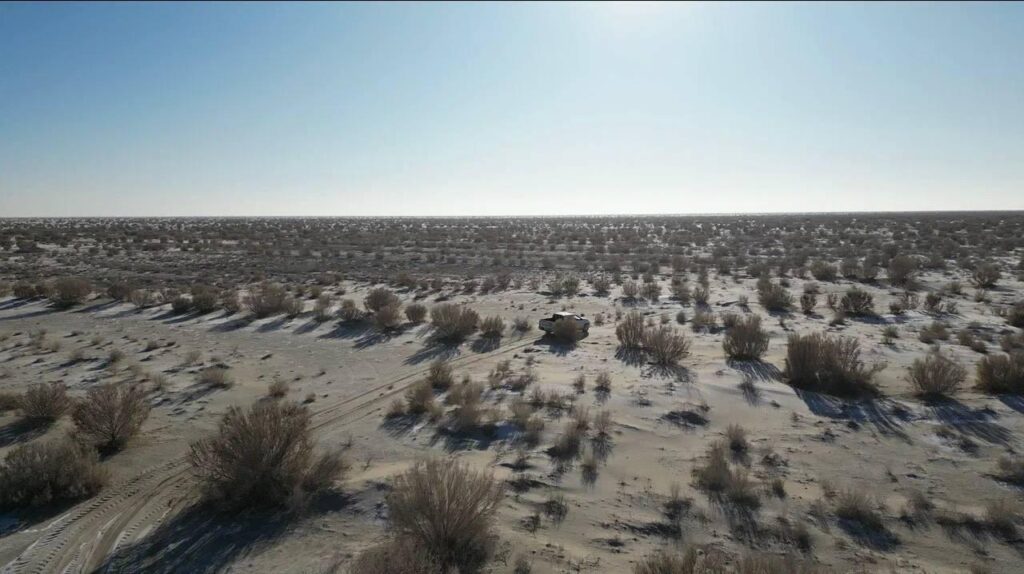
By the end of 2025, saxaul forests will cover approximately 40% of Kazakhstan's portion of the dried-up Aral Seabed, according to Azamat Abuov, head of the Department of Reproduction and Use of Forests and Flora at the Ministry of Ecology and Natural Resources. Afforestation efforts in the former Aral Sea, once the world’s fourth-largest inland body of water, aim to restore the region’s fragile ecosystem. Both public and private entities are participating in the project, which seeks to establish a “green belt” to stabilize the soil and curb the spread of more than 100 million tons of salt, sand, and dust from the exposed seabed to surrounding areas each year. Saxaul has been selected as the primary species for reforestation due to its suitability for the region’s arid conditions. “Currently, work on the Kazakh section has been carried out across 475,000 hectares, with additional efforts focused on natural regeneration. If we consider all initiatives together, afforestation has already covered 612,000 hectares. Plans for 2025 include an additional 428,000 hectares, bringing the total to 1.1 million hectares by the end of the year, ultimately covering about 40% of the dried-up area with saxaul,” Abuov said at a press conference in Astana. He added that approximately 300 local residents are actively involved in the project, collecting and planting saxaul seeds. Ruslan Akhmetov, director of the Almaty branch of the Kazakh Research Institute of Forestry and Agroforestry, highlighted that planting in the dried-up Aral Sea basin presents challenges due to high soil salinity, making saxaul the optimal choice as a salt-resistant plant. To support the initiative, a nursery has been established at the site to cultivate seedlings adapted to local soil conditions. Alibi Gaziz, general director of the Republican Forest Breeding and Seed Center, announced that two wells will be drilled in the dried seabed. “These will serve as oases, providing watering holes for animals and nurseries nearby. Water will be drawn from depths of 500 - 600 meters, with moderate salinity, making it suitable for irrigating plants and sustaining wildlife,” he explained. According to Gaziz, wildlife has already begun returning to the saxaul plantations in Kazakhstan’s section of the former Aral Sea, with hares, foxes, and gerbils spotted in the area, signaling the ecosystem’s gradual recovery. At its peak in the mid-20th century, the Aral Sea spanned 68,000 square kilometers along the Kazakhstan-Uzbekistan border. However, large-scale water diversion from its two main tributaries, the Amu Darya and Syr Darya rivers, for cotton irrigation in the 1960s triggered its rapid decline. By 2007, the sea had shrunk to just 10% of its original size, marking one of the planet’s worst environmental disasters. As The Times of Central Asia previously reported, Uzbekistan is also implementing afforestation measures to restore its portion of the dried-up Aral Sea, while broader regional efforts continue to improve water inflow to the Northern Aral Sea.

Kazakhstan Continues Afforestation Efforts on the Aral Sea

Kazakhstan is pressing ahead with a large-scale afforestation project aimed at restoring the ecosystem on the dried bed of the Aral Sea. The initiative brings together KATCO - a joint venture between the French state-owned company Orano and Kazakhstan’s national atomic company Kazatomprom - and other state and private entities to create artificial forests, combat land degradation, and improve environmental conditions in the Aral region. The Decline of the Aral Sea Once the world’s fourth-largest inland body of water, the Aral Sea spanned 68,000 square kilometers, straddling Kazakhstan and Uzbekistan. However, starting in the 1960s, extensive water diversion from its feeder rivers - the Amu Darya and Syr Darya - for cotton irrigation caused the sea to dry up rapidly. By 2007, the Aral had shrunk to just 10% of its original size. The environmental fallout has been catastrophic. Over 100 million tons of salt, sand, and dust are carried annually by winds from the exposed seabed, damaging nearby ecosystems and posing significant health risks to residents of the surrounding areas. Progress in Afforestation According to Kazakhstan's Ministry of Ecology and Natural Resources, significant strides have been made in afforestation efforts. Between December 16 and 30, 2024, sowing was completed on 12,000 hectares of the former seabed. Efforts are continuing, with plans to sow seeds across 108,000 hectares in January and February 2025. By March 2025, an additional 16,492 hectares will be planted with saxaul shrubs, a hardy plant well-suited to the region’s arid conditions. The ultimate goal is to plant saxaul shrubs on 1.1 million hectares of the dried-up Aral Seabed. Between 2021 and 2024, afforestation was completed on 475,000 hectares, including 127,000 hectares in 2024 alone. For 2025, Kazakhstan plans to plant saxaul on an ambitious 428,000 hectares. Nationwide Tree-Planting Initiative Kazakhstan’s efforts to restore the Aral Sea ecosystem are part of a broader national afforestation program. The country aims to plant 2 billion trees by 2027. From 2021 to 2024, 1.1 billion seedlings were planted over a total of 736,800 hectares, including 306 million seedlings planted in 2024 on 205,200 hectares. For 2025, the goal is to plant 336.5 million seedlings across 494,000 hectares. Beyond rural afforestation, 15 million trees are planned for urban and village areas, with more than 12 million already planted between 2021 and 2024. A Step Toward Environmental Recovery Kazakhstan’s afforestation efforts represent a critical step toward mitigating the environmental damage caused by the desiccation of the Aral Sea. By stabilizing the exposed seabed with saxaul shrubs and increasing tree cover nationwide, the country aims to reduce airborne pollutants, improve regional biodiversity, and enhance the quality of life for affected communities. The project is not only an environmental undertaking but also a testament to Kazakhstan's commitment to sustainable development and ecological restoration on a massive scale.