AI in Kazakh universities is rapidly transforming higher education, but many institutions appear unprepared for how quickly such tools are becoming normalized in the academic process. While authorities increasingly urge educators to treat AI as a professional tool for the future workforce, universities continue spending tens of thousands of dollars on systems designed to detect texts generated by ChatGPT and similar AI models.
By the spring of 2026, the use of generative AI in Kazakh universities had effectively become a new academic norm. Students now routinely use AI systems to write coursework, dissertations, and analytical papers. However, instead of fundamentally reconsidering how knowledge and competencies are assessed, universities are attempting to fit new technologies into an outdated, control-based educational model.
Kazakhstan’s Ministry of Science and Higher Education has officially rejected the idea of banning generative AI outright. The ministry states that AI usage is acceptable as long as students adhere to principles of academic integrity and transparency.
“Conceptually, the Ministry does not advocate for a complete ban on generative neural networks,” the Committee for Higher and Postgraduate Education said in its official position.
This approach was formalized through the “Inter-University Standard for the Use of AI,” adopted in 2024. In 2025, authorities further reaffirmed their commitment to integrating AI into the education system, emphasizing that AI tools should be viewed primarily as instruments rather than threats.
Universities Spend Tens of Thousands of Dollars on AI Detectors
Despite the ministry’s position, universities across Kazakhstan have begun purchasing AI-detection systems. In the spring of 2025, the company Antiplagiat.Kazakhstan introduced an algorithm designed to detect AI-generated text, which state and national universities have subsequently begun to acquire on a large scale.
According to Kazakhstan’s public procurement portal, Kazakh National Medical University signed a contract worth approximately $27,000, while Toraighyrov University conducted several procurements totaling around $19,000. Most contracts were awarded through single-source procurement procedures, strengthening the market position of one dominant supplier in the field of academic verification systems.
At the same time, AI detectors do not produce definitive results and instead operate on probabilistic models. Kazakhstan’s Ministry of Education has separately stated that such tools cannot serve as indisputable proof of academic misconduct.
“The development of artificial intelligence requires not a mechanical prohibition of AI, but an improvement of assessment systems,” the ministry noted.
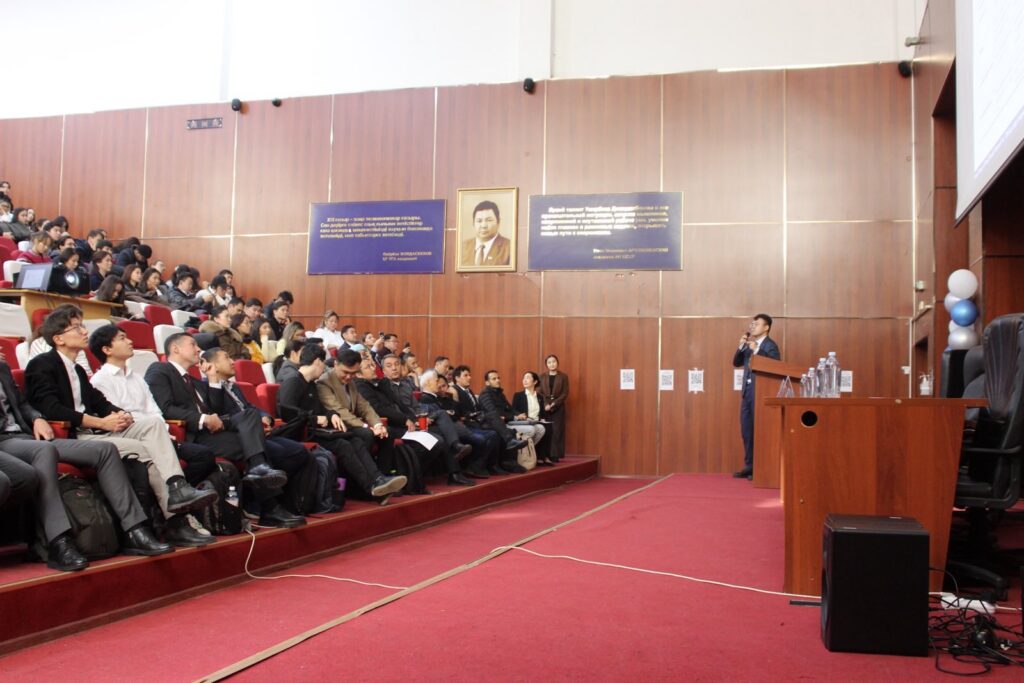
A talk on AI at Al-Farabi University. Image: Joe Luc Barnes
University Regulations Lag Behind Technological Reality
The problem is compounded by outdated university regulations. Many rules and academic policies were written before the mass adoption of generative AI.
Documents from Yessenov University and Narxoz University, for example, contain no references to terms such as “AI,” “neural networks,” or “text generation.”
Even recently updated regulations often preserve the old logic of evaluation through text originality percentages. In the “Academic Policy of Al-Farabi Kazakh National University for 2025-2026”, AI usage is now formally regulated, yet the university simultaneously retains a requirement that diploma theses maintain a minimum originality level of 75%.
This creates a legal contradiction: students may use ChatGPT without directly violating traditional plagiarism rules because generative text is not technically the same as copying someone else’s work. Experts warn that disciplinary measures based solely on AI-detection systems could eventually lead to legal disputes between students and universities.
Diplomas Are Beginning to Lose Their Meaning
Against the backdrop of rapidly advancing AI, the traditional concept of a diploma thesis is gradually losing relevance. If AI systems are capable of producing academic texts faster and often more effectively than average students, then evaluating dozens of pages of written material no longer accurately reflects real-world competencies.
Some universities are already attempting to adapt. The Ministry of Science and Higher Education points to the International Information Technology University as an example, where students have officially been allowed to use AI and defend fully developed startup projects instead of traditional diploma papers.
Under such a model, the key issue is no longer the origin of the text or code itself, but rather the student’s ability to explain the work, defend the project before a commission, and demonstrate practical skills.
Experts believe Kazakhstan’s universities are currently in a transitional phase in which attempts to preserve outdated systems of knowledge assessment through expensive AI detectors are becoming increasingly ineffective.
In the long term, universities will likely face a choice: either create examination formats in which AI use is impossible, such as oral defenses and practical assignments, or formally recognize AI systems as an essential tool in the training of modern professionals.