• KZT/USD = 0.00224
  • TJS/USD = 0.10800
  • UZS/USD = 0.00009
  • TMT/USD = 0.29760
  • KZT/USD = 0.00224
  • TJS/USD = 0.10800
  • UZS/USD = 0.00009
  • TMT/USD = 0.29760
  • KZT/USD = 0.00224
  • TJS/USD = 0.10800
  • UZS/USD = 0.00009
  • TMT/USD = 0.29760
  • KZT/USD = 0.00224
  • TJS/USD = 0.10800
  • UZS/USD = 0.00009
  • TMT/USD = 0.29760
  • KZT/USD = 0.00224
  • TJS/USD = 0.10800
  • UZS/USD = 0.00009
  • TMT/USD = 0.29760
  • KZT/USD = 0.00224
  • TJS/USD = 0.10800
  • UZS/USD = 0.00009
  • TMT/USD = 0.29760
  • KZT/USD = 0.00224
  • TJS/USD = 0.10800
  • UZS/USD = 0.00009
  • TMT/USD = 0.29760
  • KZT/USD = 0.00224
  • TJS/USD = 0.10800
  • UZS/USD = 0.00009
  • TMT/USD = 0.29760
18 September 2026

Viewing results 1 - 6 of 2

Learning to Live With the Aral Sea’s Changed Landscape

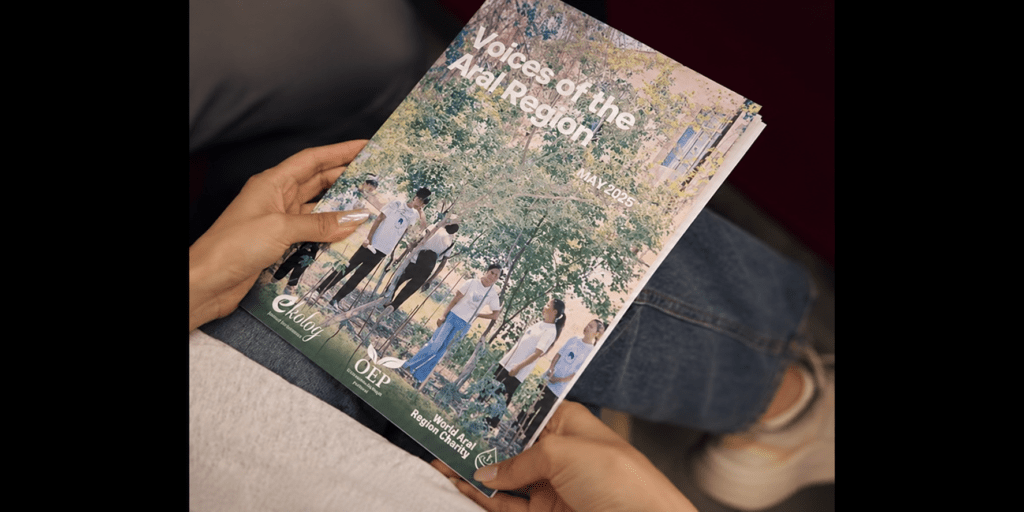
In February, participants from a new school in Nukus joined local foresters on the dried bed of the Aral Sea to plant saxaul. The shrubs can take root in salty ground and help hold down dust blowing across Karakalpakstan. Foresters from the Karauzyak State Forestry Department guided the work, drawing on years of experience in the region. The planting exercise, organized with the United Nations Development Programme, offered an early indication of how the Aral School intends to teach. Its participants work alongside people already responding to the sea’s retreat, learning from the landscape and those who live with its consequences. Now, the school is preparing for a second intake with a six-month residency in Nukus from January to June 2027. Architect and curator Joseph Grima will lead the program, which will focus on climate and landscape. Applications are open until October 25. Based in the capital of Uzbekistan’s autonomous republic of Karakalpakstan, the school brings international practitioners together with participants from the region. The Uzbekistan Art and Culture Development Foundation (ACDF), which established it, announced the new intake and Grima’s appointment during an assembly at the Savitsky Museum in Nukus. The museum owes its remarkable collection to Igor Savitsky, who rescued thousands of works rejected by the Soviet authorities, finding them a refuge in remote Nukus. Gayane Umerova, chair of ACDF, and Grima spoke to The Times of Central Asia about the school’s long-term goals and how local people will help shape its work. “The Aral School was never conceived as a single cohort or a single event. It’s a long-term commitment by the Uzbekistan Art and Culture Development Foundation (ACDF) in line with the Government’s plan for Karakalpakstan,” she told The Times of Central Asia. “The programme is designed from the ground up to avoid simply taking knowledge without giving anything back. The cohorts live in Nukus for half a year, not for a two-week field trip, precisely so that the landscape and the people in it are teachers, not subjects.” “Participants would also work directly with local professional bodies and institutions,” Umerova said. “Local experts sit inside the programme’s design, not as guest lecturers brought in to validate conclusions already reached,” she said. [caption id="attachment_56453" align="aligncenter" width="1774"] Group discussion with local community members - Aral School Assembly at the Aral School. Photo courtesy of ACDF.[/caption] Once the world’s fourth-largest lake, the Aral Sea shrank as Soviet irrigation projects diverted water from the Amu Darya and Syr Darya to grow cotton and other crops. The retreat devastated fishing communities and exposed a seabed contaminated by agricultural chemicals. Wind carried salt and dust across the surrounding land. In Moynaq, once a fishing port, fishermen dug channels through the sand to reach the retreating water. Eventually, they abandoned their grounded boats, leaving rusting hulls on what had been the seabed. [caption id="attachment_56373" align="aligncenter" width="2048"] Abandoned boats on the former Aral Sea bed at Moynaq. Photo: Stephen M. Bland[/caption] The consequences differ across the former sea. In Kazakhstan, the Kokaral Dam...

Samarkand’s Sher-Dor Madrasah Restoration Reaches First Milestone With U.S. Support

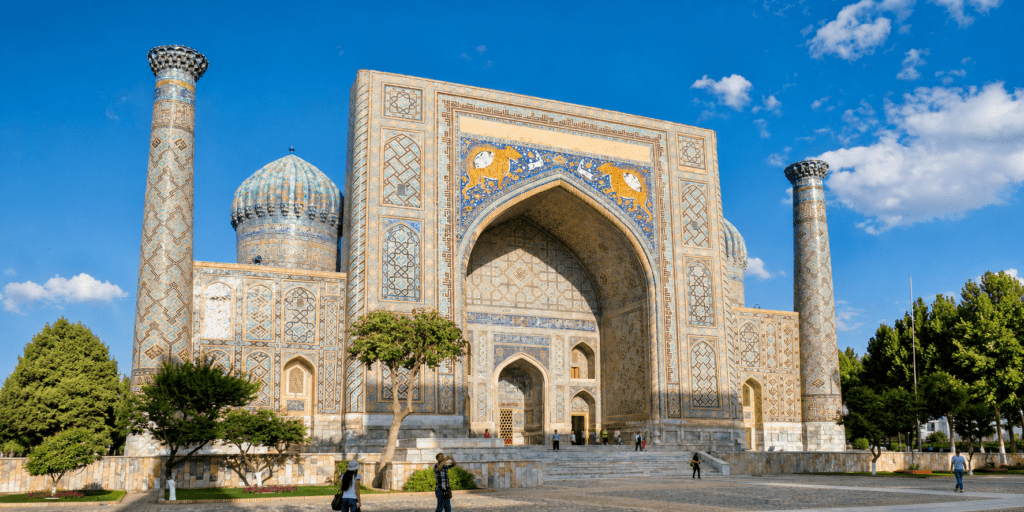
A major international effort to preserve one of Central Asia’s most iconic architectural monuments has reached a new milestone, with officials in Samarkand marking the completion of the first phase of restoration work on the façade of the Sher-Dor Madrasah, part of the historic Registan Square complex. According to a June 3 report from the Uzbekistan Art and Culture Development Foundation (ACDF), the ceremony was attended by Sarah Rogers, the United States under secretary of state for public diplomacy and public affairs, ACDF Chairperson Gayane Umerova, and U.S. Ambassador to Uzbekistan Jonathan Henick. The restoration project focuses on the conservation of the Sher-Dor Madrasah’s historic façade, including its mosaics, majolica decorations, ornamental elements, and Kufic inscriptions. The work forms part of a three-phase program supported by the U.S. Ambassadors Fund for Cultural Preservation (AFCP). During the event, ACDF and the U.S. Embassy in Uzbekistan also signed a five-year roadmap for cooperation aimed at expanding joint initiatives in cultural heritage preservation and cultural exchange. The project is one of the largest cultural heritage grants awarded to Uzbekistan by the U.S. government. According to the U.S. Embassy, the Cultural Heritage Agency of Uzbekistan secured a $500,000 AFCP grant after its proposal was selected through a global competition. The award was both the largest in that year’s competition and the largest AFCP grant ever received by Uzbekistan. The initiative is being implemented by the Cultural Heritage Agency with technical support from the International Institute for Central Asian Studies. Local craftsmen and restoration specialists are carrying out the work, while international experts are providing consultation and access to scientific documentation and conservation resources. During the ceremony in Samarkand, Henick and Umerova exchanged a letter of intent reaffirming their commitment to advancing the action plan and expanding bilateral cooperation in the field. Umerova, who is also head of the Department of Creative Economy and Tourism of the Administration of the President of Uzbekistan, said the project is about more than preserving a historic building. “We are grateful to the United States Embassy and the Ambassadors Fund for Cultural Preservation for their partnership and shared commitment to safeguarding cultural heritage. Together, we are preserving not only one of the world’s most remarkable architectural ensembles, but also the traditions and craftsmanship that give it meaning,” Umerova said. She noted that the Registan has served as a symbol of learning and cultural exchange for centuries and described the restoration project as an example of international cooperation built on mutual respect and a shared responsibility to protect cultural heritage. “We are thrilled to be part of the restoration efforts of the beautiful and iconic Sher-Dor Madrasah in the historic Registan Square,” Henick said. “These efforts will help preserve this important monument for many generations to come and for all humanity.” The Sher-Dor restoration forms part of a 2023 cultural property agreement between Uzbekistan and the U.S. The agreement created a framework for cooperation on protecting cultural heritage, including measures to combat the illicit trade in archaeological and ethnological material...