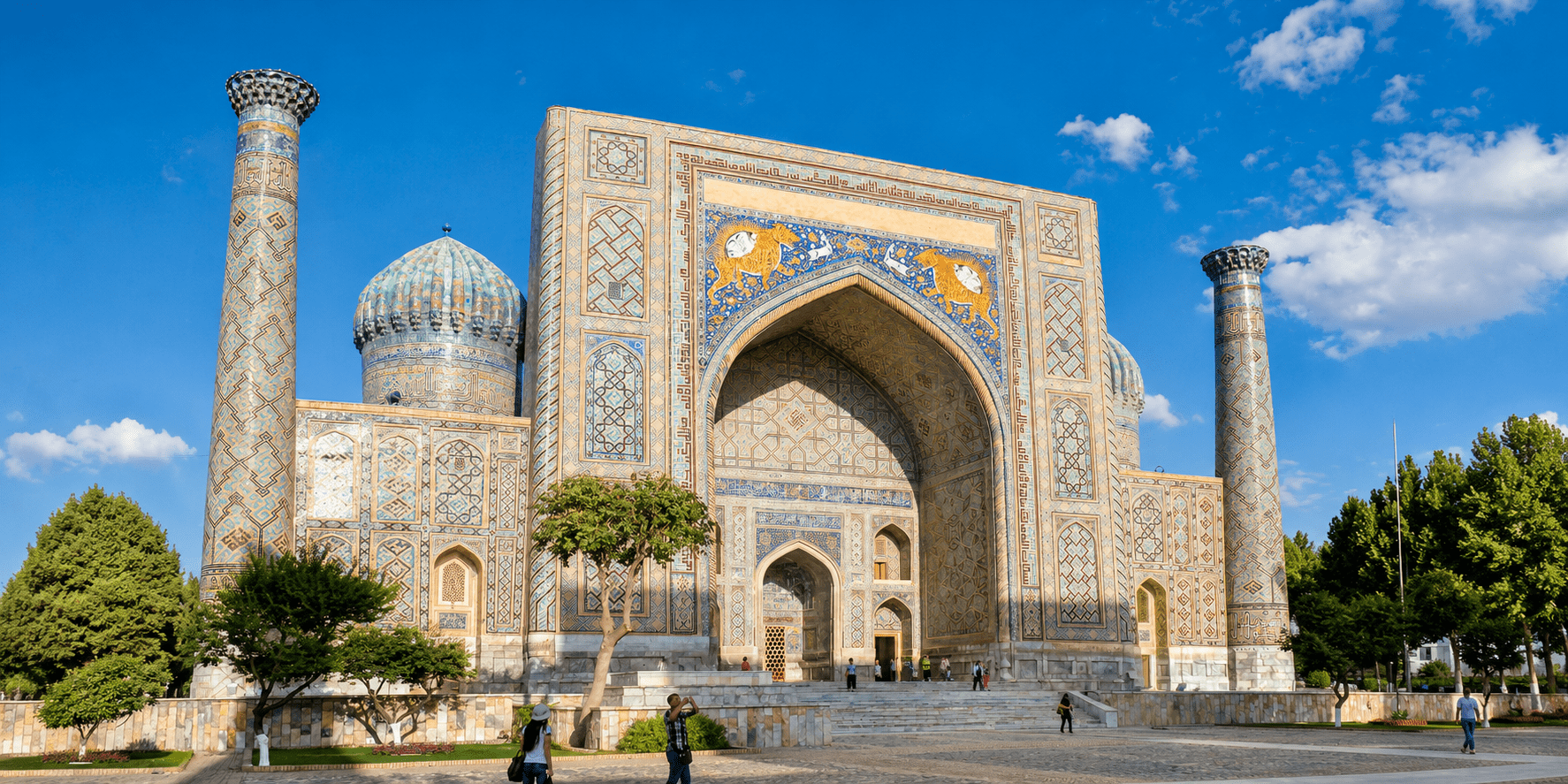
A major international effort to preserve one of Central Asia’s most iconic architectural monuments has reached a new milestone, with officials in Samarkand marking the completion of the first phase of restoration work on the façade of the Sher-Dor Madrasah, part of the historic Registan Square complex.
According to a June 3 report from the Uzbekistan Art and Culture Development Foundation (ACDF), the ceremony was attended by Sarah Rogers, the United States under secretary of state for public diplomacy and public affairs, ACDF Chairperson Gayane Umerova, and U.S. Ambassador to Uzbekistan Jonathan Henick.
The restoration project focuses on the conservation of the Sher-Dor Madrasah’s historic façade, including its mosaics, majolica decorations, ornamental elements, and Kufic inscriptions. The work forms part of a three-phase program supported by the U.S. Ambassadors Fund for Cultural Preservation (AFCP).
During the event, ACDF and the U.S. Embassy in Uzbekistan also signed a five-year roadmap for cooperation aimed at expanding joint initiatives in cultural heritage preservation and cultural exchange.
The project is one of the largest cultural heritage grants awarded to Uzbekistan by the U.S. government. According to the U.S. Embassy, the Cultural Heritage Agency of Uzbekistan secured a $500,000 AFCP grant after its proposal was selected through a global competition. The award was both the largest in that year’s competition and the largest AFCP grant ever received by Uzbekistan.
The initiative is being implemented by the Cultural Heritage Agency with technical support from the International Institute for Central Asian Studies. Local craftsmen and restoration specialists are carrying out the work, while international experts are providing consultation and access to scientific documentation and conservation resources.
During the ceremony in Samarkand, Henick and Umerova exchanged a letter of intent reaffirming their commitment to advancing the action plan and expanding bilateral cooperation in the field.
Umerova, who is also head of the Department of Creative Economy and Tourism of the Administration of the President of Uzbekistan, said the project is about more than preserving a historic building.
“We are grateful to the United States Embassy and the Ambassadors Fund for Cultural Preservation for their partnership and shared commitment to safeguarding cultural heritage. Together, we are preserving not only one of the world’s most remarkable architectural ensembles, but also the traditions and craftsmanship that give it meaning,” Umerova said.
She noted that the Registan has served as a symbol of learning and cultural exchange for centuries and described the restoration project as an example of international cooperation built on mutual respect and a shared responsibility to protect cultural heritage.
“We are thrilled to be part of the restoration efforts of the beautiful and iconic Sher-Dor Madrasah in the historic Registan Square,” Henick said. “These efforts will help preserve this important monument for many generations to come and for all humanity.”
The Sher-Dor restoration forms part of a 2023 cultural property agreement between Uzbekistan and the U.S. The agreement created a framework for cooperation on protecting cultural heritage, including measures to combat the illicit trade in archaeological and ethnological material from Uzbekistan.
Henick said the project is designed to conserve a historic monument and also to develop local restoration expertise.
“The Sher-Dor site has stood for four centuries as a testament to the ingenuity and artistry of the people of Central Asia, particularly Uzbekistan,” Henick said. “Our role here is not to define that legacy, it is to help protect it.”
He added that Uzbek craftsmen participating in the project are acquiring skills and techniques that will allow them to preserve the country’s historic monuments long after the current restoration is completed.
“That is the kind of partnership the United States believes in: one that builds capacity, respects local expertise, and delivers lasting results,” Henick said.
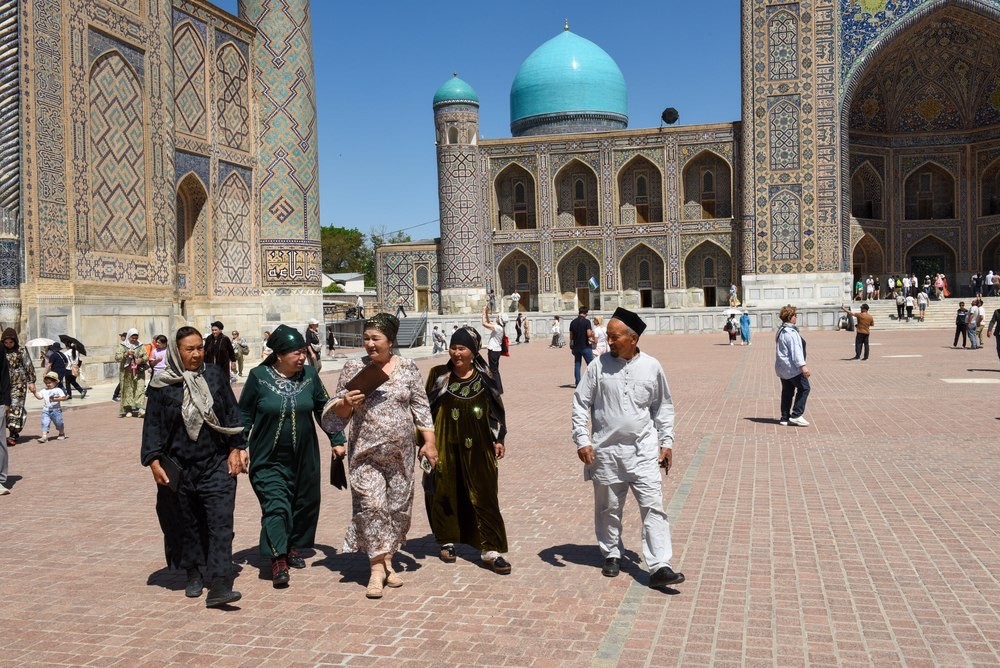
Sher-Dor Madrasah is one of the three monumental buildings surrounding Registan Square, the historic heart of Samarkand and part of a UNESCO World Heritage Site. Constructed in the 17th century, it is renowned for its intricate tilework and distinctive façade featuring tiger-like creatures, an unusual motif in Islamic architecture.
Bakhodir Abdikarimov, director of the Cultural Heritage Agency, described the project as evidence of expanding cultural cooperation between Uzbekistan and the U.S. He thanked the U.S. Embassy for its support and expressed confidence that similar initiatives would continue in the future.
The Sher-Dor project is the 14th initiative funded in Uzbekistan through the AFCP, which has allocated nearly $1.35 million to heritage projects across the country. Previous fund-supported initiatives include conservation work at the historic Tash-Hauli Palace in Khiva and the restoration of the 15th-century Langar Ota Complex in Kashkadarya region.
A new AFCP-backed initiative scheduled to launch in 2026, known as the “Eternal Registan” project, will combine cultural heritage preservation with digital technologies. The project plans to use U.S.-developed artificial intelligence and virtual reality tools to create detailed three-dimensional models of the Registan ensemble, allowing visitors to experience the site through immersive virtual tours while supporting long-term conservation efforts.