• KGS/USD = 0.01143 0%
  • KZT/USD = 0.00206 0%
  • TJS/USD = 0.10811 -0.09%
  • UZS/USD = 0.00008 0%
  • TMT/USD = 0.28571 0%
  • KGS/USD = 0.01143 0%
  • KZT/USD = 0.00206 0%
  • TJS/USD = 0.10811 -0.09%
  • UZS/USD = 0.00008 0%
  • TMT/USD = 0.28571 0%
  • KGS/USD = 0.01143 0%
  • KZT/USD = 0.00206 0%
  • TJS/USD = 0.10811 -0.09%
  • UZS/USD = 0.00008 0%
  • TMT/USD = 0.28571 0%
  • KGS/USD = 0.01143 0%
  • KZT/USD = 0.00206 0%
  • TJS/USD = 0.10811 -0.09%
  • UZS/USD = 0.00008 0%
  • TMT/USD = 0.28571 0%
  • KGS/USD = 0.01143 0%
  • KZT/USD = 0.00206 0%
  • TJS/USD = 0.10811 -0.09%
  • UZS/USD = 0.00008 0%
  • TMT/USD = 0.28571 0%
  • KGS/USD = 0.01143 0%
  • KZT/USD = 0.00206 0%
  • TJS/USD = 0.10811 -0.09%
  • UZS/USD = 0.00008 0%
  • TMT/USD = 0.28571 0%
  • KGS/USD = 0.01143 0%
  • KZT/USD = 0.00206 0%
  • TJS/USD = 0.10811 -0.09%
  • UZS/USD = 0.00008 0%
  • TMT/USD = 0.28571 0%
  • KGS/USD = 0.01143 0%
  • KZT/USD = 0.00206 0%
  • TJS/USD = 0.10811 -0.09%
  • UZS/USD = 0.00008 0%
  • TMT/USD = 0.28571 0%

Viewing results 19 - 24 of 127

Heads Roll After Surprise School Visit by Tajikistan’s Education Minister

Several education officials in Tajikistan have been dismissed following an unannounced inspection by Minister of Education and Science Rahim Saidzoda, according to the ministry’s press service. On September 19, the minister conducted surprise visits to schools in the Yavan and Rudaki districts, inspecting teaching quality, student and staff discipline, classroom attendance, foreign language proficiency, and readiness for the autumn-winter season. At School No. 16 in Yavan, only half the students were present, and eighth and ninth-grade classes had been improperly combined. Of 21 available computers, only three were operational. Students were unable to answer basic questions in Russian and English and struggled to define “information technology.” The minister also reported poor discipline, unsanitary conditions, and inadequate winter preparedness. School director Munira Mirzozoda, who had served for over 11 years, was dismissed for what the ministry described as “irresponsible fulfillment of official duties.” At School No. 14 in Rudaki, the director was absent at the time of the visit. Classrooms were in disrepair, the transition to a 10-point grading system was delayed, and foreign language instruction was found lacking. At the kindergarten attached to the same school, the head was also absent, and the teaching staff received criticism for performance issues. On September 22, the ministry announced the dismissal of School No. 14 director Amriddin Rahmonov and kindergarten head Zarragul Faizova. Following the Yavan inspection, the ministry reported that all school computers were repaired, IT usage was improved, attendance increased, and class schedules were brought into compliance with national standards. The unauthorized practice of combining different grade levels was halted. The ministry emphasized that quality education depends on “strict compliance with standards and high responsibility from all employees of the system from management to support staff.” This was not Saidzoda’s first surprise visit. He previously inspected schools in the town of Hisor and kindergartens in Dushanbe, where similar issues were observed, including poor discipline, unsanitary conditions, and low student engagement. Experts continue to highlight long-standing problems in Tajikistan’s education sector, including shortages of qualified teachers, inadequate school infrastructure, and limited access to learning materials. Parents frequently voice concerns over the quality of instruction and are often asked to contribute funds for school maintenance and repairs.

Kazakhstan Recognizes Course Certificates as Equivalent to University Diplomas

Kazakhstan’s National Council for Professional Qualifications, in collaboration with industry experts, has approved a new National Qualifications Framework (NQF) that officially recognizes certificates from professional and advanced training courses as valid proof of education for employment purposes. Previously, only diplomas from universities, colleges, and technical schools were accepted. According to the Ministry of Labor and Social Protection of the Population, the revised system now also includes non-formal and informal learning, skills and knowledge acquired outside traditional educational institutions over a person’s lifetime. The reform is based on the European Qualifications Framework and tailored to meet the evolving demands of Kazakhstan’s labor market. “The updated NQF was developed in line with Kazakhstan’s labor and education legislation and incorporates international practices. It is based on transparency and comparability, which ensures recognition of competencies acquired in different sectors and facilitates labor mobility. The framework supports lifelong learning and is tailored to the real needs of the economy,” said First Vice Minister of Labor and Social Protection Askarbek Yertayev. The framework consists of eight levels, ranked by increasing complexity of tasks, responsibility, and knowledge intensity. Under the new system, not only are diplomas and work experience recognized, but certificates from short-term courses and qualifications verified via the Career Enbek portal are now considered official evidence of skills. The Ministry also clarified labor code provisions regarding multiple employment. Citizens are permitted to work for more than one employer, provided the total working time does not exceed 12 hours per day, up to eight hours at the primary job and four hours in secondary employment. However, minors under 18 and employees in hazardous occupations, excluding healthcare workers, are prohibited from holding multiple jobs. Civil servants may not take on secondary employment, except in teaching, research, or creative roles. As previously reported by The Times of Central Asia, authorities have recently increased pressure on employers who pay “gray wages”, salaries paid off the books without tax or social contributions.

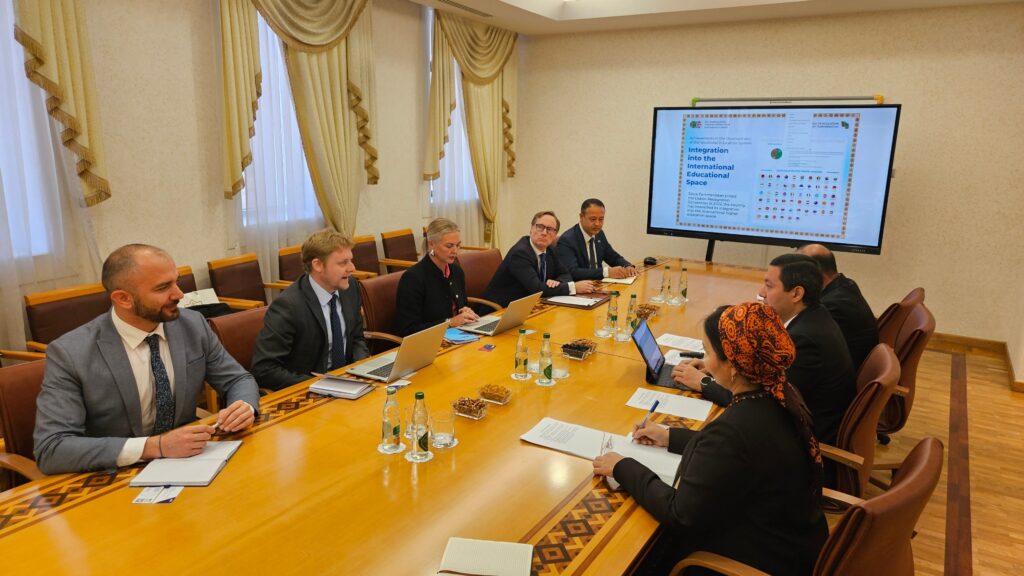
Turkmenistan Expands Educational Partnership with UK’s AQA

The Ministry of Education of Turkmenistan has held an official meeting with representatives of AQA Global Assessment Services, a leading UK-based organization specializing in educational assessment. The AQA delegation included Sean Crowley, Director of International Business Development; Anna Green, Director of Assessment Systems; and regional consultant Vali Huseyn. Deputy Minister of Education Azat Ataev emphasized Turkmenistan’s interest in deepening strategic cooperation with AQA, particularly in introducing modern methods of academic evaluation. “Our key task is to improve the quality of education and ensure it fully meets the needs of the labor market,” Ataev said. Regional Experience AQA has led numerous educational reform initiatives globally, including across Central Asia. In Uzbekistan, the organization contributed to the development of a new model for senior school graduation exams, aligning national assessments with international standards. In Kazakhstan, AQA supported the transition to a criteria-based assessment system, which formed the basis for updated qualification requirements. Experts note that such reforms increase trust in national diplomas, improve transparency, and make education systems more competitive and aligned with labor market demands. Prospects for Cooperation During the meeting in Ashgabat, both sides discussed several areas for collaboration, including: the introduction of modern examination platforms digital analytics of learning outcomes development of qualification standards training of teachers and administrators in examination processes Particular emphasis was placed on methodological support and establishing a systematic approach to educational planning. According to participants, the adoption of international best practices will help Turkmenistan build a sustainable, data-driven model of educational development.

Uzbekistan to Transition to 12-Year School System

Uzbekistan is preparing to transition to a 12-year general education system, Deputy Minister of Preschool and School Education Sardor Radjabov announced in an interview with Uzbekistan-24. The change will incorporate preparatory classes into formal education, extending schooling from the current 11 years to 12. The revised structure will include three stages: One year of school preparation Four years of primary education (grades 1-4) Five years of general secondary education (grades 5-9) Two years of full secondary education (grades 10-11), which may be completed at general schools, academic lyceums, military schools, or technical colleges According to Radjabov, the reform aims to enhance educational quality and eliminate obstacles faced by Uzbek students applying to foreign universities. Currently, graduates are often required to complete a one-year foundation program abroad before qualifying for undergraduate studies. “This means our children lose a year,” he said. “If we implement the 12-year education system, students will no longer need to study foundation courses in several countries and will be able to enter undergraduate programs directly.” He added that aligning Uzbekistan’s education system with international standards would expand opportunities for graduates and narrow the gap between local and global academic systems. The reform builds on earlier changes to Uzbekistan’s school structure. In 2017, President Shavkat Mirziyoyev proposed the reinstatement of an 11-year general education framework, emphasizing its role in improving the connection between schools and colleges. Since then, most schools have operated under the 11-year model.

Cardiff University Opens Campus in Astana

On September 3, Cardiff University in Wales officially inaugurated Cardiff University Kazakhstan in Astana, its first overseas branch campus and the only campus of a Russell Group research university in Central Asia. The event marked a milestone in the growing educational partnership between Kazakhstan and the United Kingdom. At the opening ceremony, Kazakh Minister of Science and Higher Education Sayasat Nurbek emphasized the country’s ambitions: “Kazakhstan is developing as a regional academic hub. This year, more than 31,000 foreign students came to our country. At the initiative of the head of state, a large-scale strategy is being implemented in higher education and science. One of its areas is the opening of branches of leading foreign research universities in our country. Over the past three and a half years, about 40 foreign universities have come to Kazakhstan, five of them have decided to open their campuses.” Cardiff University’s Vice-Chancellor, Professor Wendy Larner, described the launch as a pivotal step in the institution’s global ambitions: “I was delighted to officially open our branch campus in Astana our first international branch campus of Cardiff University. We look forward to welcoming our first cohort of academically excellent students later this month. We are the UK’s first Russell Group university to open a campus in Kazakhstan, marking an important step in our future global ambition.” Beginning in late September, the campus will enroll students in four-year undergraduate programs in computer science, business management, civil engineering, and exploration geology. Courses will be taught in English by faculty from both Cardiff University and its Astana campus, with the branch operating under Cardiff’s direct academic governance to ensure international standards are upheld. The newly appointed British Ambassador to Kazakhstan, Sally Axworthy, also attended the ceremony and welcomed the development: “It is a great honour to be participating in the grand opening of Cardiff University here in Astana as one of my first engagements as British Ambassador to Kazakhstan. The opening marks a new chapter in UK-Kazakhstan educational collaboration, bringing more world-class British academic excellence to Kazakh students and further strengthening the ties between our countries.” The arrival of Cardiff University reflects a broader national initiative to attract world-class institutions. As previously reported by The Times of Central Asia, several other prominent universities are also expanding into Kazakhstan. Russia’s prestigious Moscow State Institute of International Relations (MGIMO) is planning to open a branch in Astana in September 2025. South Korea’s Woosong University is preparing to launch its campus in the Turkestan region this year. Meanwhile, Germany’s Anhalt University of Applied Sciences has already opened a branch in Almaty, and Italy’s Marche Polytechnic University of Ancona has inaugurated its campus at Zhetysu University in Taldykorgan. Looking ahead, France’s Grenoble INP - Phelma, UGA, an elite engineering school, plans to open a branch in Almaty in 2026. In the same year, the United States' Colorado School of Mines is scheduled to launch its first international campus in Zhezkazgan, a key center for Kazakhstan’s geological industry.

Kazakh and Chinese Universities Sign Over 20 New Cooperation Agreements

At the Kazakhstan-China Business Council meeting held in Beijing on September 2, leading universities from both countries signed more than 20 new agreements aimed at deepening cooperation in education, science, and innovation, according to the Kazakh Ministry of Science and Higher Education. The wide-ranging agreements span areas such as artificial intelligence, robotics, water resource management, and dual degree programs, highlighting the growing strategic role of academic and research collaboration in the Kazakhstan-China partnership. Among the most significant developments was the establishment of the Kazakh-Chinese Scientific and Technological Alliance on Spatio-Temporal Artificial Intelligence. The alliance includes the National Academy of Sciences of Kazakhstan, the Kazakh National Agrarian Research University, Zhejiang University of Technology, and Zhejiang Zhonghe Technology Co., Ltd. A joint laboratory will also be launched as part of the Belt and Road Initiative. Al-Farabi Kazakh National University (KazNU) signed an agreement with Chinese investment and development firm Yuan Zhen to jointly design and produce unmanned aerial vehicles. KazNU also partnered with Jiangsu Huibo Robotics Technology Co., Ltd. to inaugurate the International Institute of Digital Technologies and Robotics, along with a Robotics Center dedicated to training the next generation of engineers. In Almaty, the Technological University signed an agreement with Beijing Technology and Business University to create the Kazakhstan-China Center for Technology and Innovation Development. Meanwhile, the Kazakh National University of Water Resources and Irrigation and the North China University of Water Resources and Electric Power (NCWU) agreed to collaborate on sustainable water management. In the digital sphere, Astana IT University signed a memorandum of cooperation with Tus-Holdings, a science park affiliated with Tsinghua University, focusing on information technology, artificial intelligence, and startup incubation. Multiple institutions expanded joint academic offerings. Gumilyov Eurasian National University, Abylkas Saginov Karaganda Technical University, ALT University, and Uzbekali Zhanibekov South Kazakhstan Pedagogical University all signed agreements with top Chinese universities to launch dual bachelor’s and master’s degree programs. In the energy sector, the Atyrau University of Oil and Gas and Liaoning Petrochemical University will establish the Kazakhstan-China International Engineering School and a joint international laboratory. Additionally, Astana International University and Beijing Language and Culture University agreed to open a branch campus of the Chinese university in Kazakhstan. These agreements underscore the strategic role of higher education and scientific cooperation in advancing Kazakhstan-China relations, particularly within the framework of the Belt and Road Initiative.