• KGS/USD = 0.01144 0%
  • KZT/USD = 0.00212 0%
  • TJS/USD = 0.10841 -0.46%
  • UZS/USD = 0.00008 0%
  • TMT/USD = 0.28490 0%
  • KGS/USD = 0.01144 0%
  • KZT/USD = 0.00212 0%
  • TJS/USD = 0.10841 -0.46%
  • UZS/USD = 0.00008 0%
  • TMT/USD = 0.28490 0%
  • KGS/USD = 0.01144 0%
  • KZT/USD = 0.00212 0%
  • TJS/USD = 0.10841 -0.46%
  • UZS/USD = 0.00008 0%
  • TMT/USD = 0.28490 0%
  • KGS/USD = 0.01144 0%
  • KZT/USD = 0.00212 0%
  • TJS/USD = 0.10841 -0.46%
  • UZS/USD = 0.00008 0%
  • TMT/USD = 0.28490 0%
  • KGS/USD = 0.01144 0%
  • KZT/USD = 0.00212 0%
  • TJS/USD = 0.10841 -0.46%
  • UZS/USD = 0.00008 0%
  • TMT/USD = 0.28490 0%
  • KGS/USD = 0.01144 0%
  • KZT/USD = 0.00212 0%
  • TJS/USD = 0.10841 -0.46%
  • UZS/USD = 0.00008 0%
  • TMT/USD = 0.28490 0%
  • KGS/USD = 0.01144 0%
  • KZT/USD = 0.00212 0%
  • TJS/USD = 0.10841 -0.46%
  • UZS/USD = 0.00008 0%
  • TMT/USD = 0.28490 0%
  • KGS/USD = 0.01144 0%
  • KZT/USD = 0.00212 0%
  • TJS/USD = 0.10841 -0.46%
  • UZS/USD = 0.00008 0%
  • TMT/USD = 0.28490 0%

Viewing results 43 - 48 of 2417

Kyrgyz Court Convicts Former Security Chief Tashiyev, Parliamentary Speaker, and Six Others

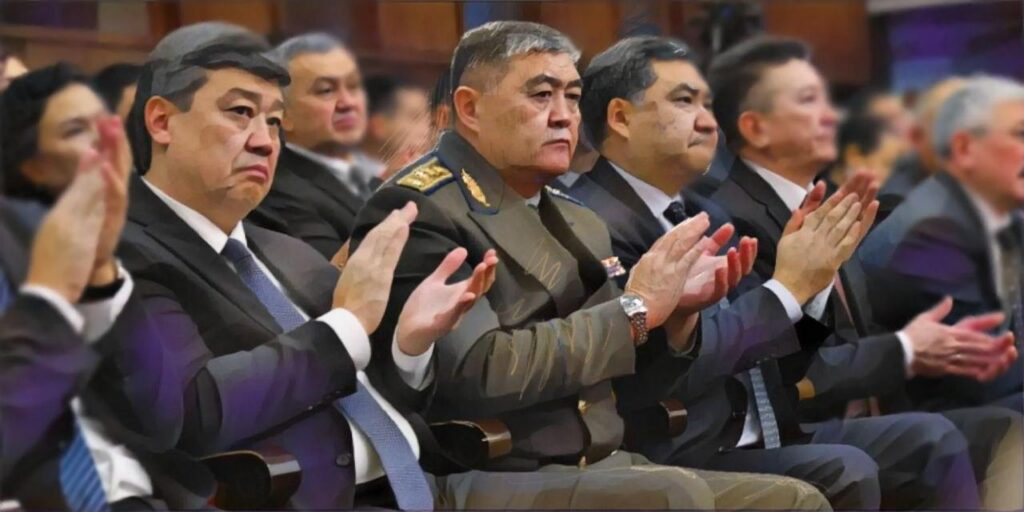
The trial of high-ranking Kyrgyz officials accused of plotting to overthrow the government concluded on July 2. All eight defendants, including the former chief of Kyrgyzstan’s security service and the former speaker of parliament, were found guilty and sentenced to four years in prison. However, none will actually serve any prison time as the court ordered them all placed on probation for the next three years. The Letter of 75 It all started on February 9, 2026, when a group of 75 people, including former state officials, released an open letter calling on President Sadyr Japarov and Speaker of Parliament Nurlanbek Turgunbek uulu to call an early presidential election. Japarov became acting president in the wake of the October 2020 protests that ousted President Sooronbai Jeenbekov. One of his first moves as acting president was to appoint his long-time friend Kamchybek Tashiyev to be the head of the State National Security Service (GKNB). The presidential election of January 2021 resulted in victory for Japarov, with a concurrent vote approving a change from a parliamentary to a presidential form of government. A new constitution was drafted and approved in a referendum in April 2021. Japarov was elected president under the constitution that was scrapped in that referendum. The previous constitution stipulated a president could serve one six-year term in office. The new constitution allowed a president to serve two five-year terms. The open letter the 75 people published said a snap presidential election could clarify Japarov’s term. But Japarov and others saw the letter as an attempt to oust him from power. On February 10, Japarov sacked Kamchybek Tashiyev and several of the authors of the open letter were detained, with Japarov saying this was necessary to “prevent a split in society.” Japarov was evasive about the reason, repeating that he and Tashiyev remained friends. In the days that followed, a series of top GKNB officials were dismissed, as were the governors of Kyrgyzstan’s second and third largest cities, Osh and Manas (formerly Jalal-Abad), respectively. Several ministers and officials in other state bodies were also changed. The government was restructured so that the GKNB was under the control of the president. Tashiyev was in Germany for a medical exam, and Turgunbek uulu was in Turkey when the open letter was released. Turgunbek uulu stepped down from his position and handed in his resignation as a parliamentary deputy directly after his returned to Kyrgyzstan. Tashiyev returned briefly on February 13, but only stayed in Kyrgyzstan for a few days before again leaving the country. He finally came back on March 19 for questioning by the Interior Ministry and has been in Kyrgyzstan since then, though he kept a low profile. It was clear early on that the state prosecutor was building an attempted coup case against some of the 75 authors of the letter. But Japarov and other officials declined to specify which charges Tashiyev might face, or whether he would face any charges at all. The announcement that Tashiyev was dismissed...

Kyrgyzstan’s Water Compensation Push Tests Central Asian Unity

Central Asia’s water diplomacy is entering a contentious phase. Kyrgyzstan, where much of the region’s runoff is formed, is reviving calls for economic compensation from downstream users. Kazakhstan and Uzbekistan have rejected the idea, saying current agreements do not provide for payments for transboundary river water. The dispute comes as the region tries to maintain annual water-allocation deals while adapting agriculture to worsening scarcity and climate pressure. Water has long tied together the region’s upstream and downstream states. The 2021 and 2022 clashes on the Kyrgyz-Tajik border showed how disputes over land, border infrastructure, roads, security posts, and water access can escalate when local tensions are not contained. Yet political will alone does not guarantee agreements between countries. The Central Asian republics cooperate on water issues through two interstate bodies. One is the International Fund for Saving the Aral Sea, established in 1993 by all five Central Asian republics. Kyrgyzstan suspended its participation in IFAS in 2016, and now attends the fund’s meetings as an observer. The second body is the Interstate Commission for Water Coordination, whose meetings are held once a quarter. At its 93rd meeting in Bukhara in early April, the commission confirmed limits for water withdrawal from transboundary rivers, following decisions approved at the 92nd meeting in Dushanbe. For the Amu Darya, the 2026 water allocations set the total withdrawal limit for the water-management year from October 2025 to October 2026 at about 55.4 billion cubic meters. Of this, 15.9 billion cubic meters is allocated for the cold period, from October to April. Tajikistan has been allocated 9.8 billion cubic meters per year, while Turkmenistan and Uzbekistan each receive 22 billion. A significant part of the flow, 44 billion cubic meters, must pass through the adjusted section of the Kerki hydrological post, helping secure the lower reaches of the river. For the Syr Darya, the total water withdrawal limit for the non-growing season is 4.219 billion cubic meters. Kazakhstan will receive 460 million cubic meters through the Dustlik Canal, Kyrgyzstan 47 million, and Tajikistan 365 million, while the largest share will go to Uzbekistan, 3.347 billion cubic meters. The inherited framework is also facing pressure from outside the five-state system. Afghanistan’s Qosh-Tepa Canal, which is being advanced outside the Soviet-era allocation structure, has added uncertainty on the Amu Darya. The Central Asian republics also cooperate in bilateral and trilateral formats. In January, Kazakhstan-Uzbekistan joint working groups met in Turkestan. The sides reaffirmed water cooperation, agreed to continue repairs on the Dostyk canal, and planned automated hydrological posts on the Syr Darya. In May, Kazakhstan, Uzbekistan, and Tajikistan agreed on the operating regime of the Bahri-Tojik Reservoir for the summer of 2026. From June to August, the reservoir is to operate in a coordinated mode to supply irrigation water to farmers in the Maktaaral and Zhetysai districts of southern Kazakhstan. These agreements show that regional mechanisms still work, but experts continue to warn that climate pressure, data gaps, and uneven national interests could overwhelm existing formats. “Forecasting the...

New Study Finds Sharp Decline in Amu Darya Flows

Central Asia’s water woes continue to grow worse. The water flow in the Amu Darya, one of Central Asia’s two great rivers, is slowly but significantly diminishing in Tajikistan, where the river originates. A recently released report shows the Amu Darya’s water flow in the middle and lower reaches in Tajikistan has fallen over the course of recent decades by 54-77%. And the report lays the blame firmly on human activity, not climate change. Up In the Mountains of Tajikistan The study published on ScienceDirect looked at data collected over 90 years and concludes that “streamflow decreased by 54–77% in the middle and lower reaches” of the Amu Darya in Tajikistan. Interestingly, the report mentions that precipitation in the mountains of Tajikistan has actually increased between 6 and 13%, but the Amu Darya’s water level is falling because people are using more water. The expansion of agriculture is the reason, accounting for 92% of the water reduction in Tajikistan, but the recent construction of water reservoirs is also playing a role. Lower flows of water were noted on many of the tributaries in Tajikistan that feed into the Amu Darya, including the “Vakhsh, Kunduz, Kofirnihon, Surkhandarya, Zeravshan, and Kashkadarya (rivers),” which showed streamflow reductions of 4–34%. The report said that areas in the upper reaches of the Amu Darya should see increased water levels, but this is mainly due to climate change hastening the melting of snow and glaciers. Once the glaciers are gone, the water will rapidly decrease. Bad News Downstream Water problems upstream in Tajikistan translate to bigger problems downstream in Uzbekistan and Turkmenistan. Both have already noticed a reduction in the amount of water in the Amu Darya, most visibly that the river has not reached the Aral Sea for about two decades now, contributing to the sea shrinking by some 90% since the 1960s. Every year the river recedes further south, forcing downstream communities suddenly without water to relocate. Climate change is now hastening this process in the arid, desert lands along the Uzbek-Turkmen border, but both countries are preparing for a bigger, impending shock. The Taliban started construction of the Qosh Tepa Canal in 2022, with the project scheduled to be completed in 2028. While Central Asia was liberally taking water from the Amu Darya for agricultural use, Afghanistan was in no position to claim its share until now. The canal will draw water from the Amu Darya at an area across from Uzbekistan and open up new agricultural land in northern Afghanistan, where food has long been in short supply. The 280-kilometer canal is expected to take some 16-20% of the water left in the Amu Darya after it leaves Tajikistan. Upstream Tajikistan’s falling water levels, of course, mean the Qosh Tepa Canal will also be receiving less and less water. The Combination For most of the 2020s, large areas of Central Asia have been experiencing droughts, prompting the governments there to implement water conservation measures. But as they find more ways to save...

Twenty-Five Years Ago, Karimov and Powell Opened a Humanitarian Lifeline. Today, Global Support Wanes

During the first week of June 2026, World Food Programme Afghanistan Country Director John Aylieff, Supply Chain Officer Shukhratmirzo Khodzhaev, and TCA’s Javier M Piedra visited the Termez–Hairatan border crossing and the Termez Free Economic Zone (TFEZ), a logistics hub between Uzbekistan and Afghanistan on the Amu Darya River. The trip was organized by the Institute for Strategic and Regional Studies (ISRS) in connection with Termez Dialogue 2026, a flagship Uzbekistan initiative designed to advance economic integration, trade, and cultural exchange across Central and South Asia. For 25 years, Uzbekistan has maintained the Termez crossing as a key humanitarian gateway, ensuring Afghanistan’s continued access to regional and global supply chains. [caption id="attachment_51321" align="aligncenter" width="850"] Geographical position of the Amu Darya; source: snipview.com/amudarya[/caption] A quarter-century on, the gateway that has saved millions of Afghans from famine remains open, but the funding that makes it so meaningful is on life support. While Central Asia has stepped up, its increased contributions only partially offset the huge shortfall left by wealthier countries. Termez, Uzbekistan Twenty-five years ago, with winter approaching, borders closed, logistics shattered, and five million Afghans in urgent need of food, WFP's Petar Bojilov and Tim Lavelle—on loan to USAID OFDA's DART from USUN Rome—took on an impossible mission: to open a lifeline and get emergency food aid across the Amu Darya River from Uzbekistan into Afghanistan. What began with one barge and a handful of hopelessly underequipped and understaffed personnel in 2001 has become one of the world's most consequential logistics hubs, through which WFP has delivered over 220,000 metric tons of food into Afghanistan in recent years. In 2026, the Bridge of Friendship Marks its 25th Anniversary Once a barely functional border crossing, Termez is now a Free Economic Zone (AIRITOM) with multimodal connectivity and extensive storage, providing WFP with what John Aylieff calls unmatched operational flexibility. “What makes the Termez hub today so strategically important is its reliability and versatility,” says Aylieff. “It offers dependable transshipment through multiple Afghan corridors—a vital lifeline where speed matters – as well as loading and storage. Given current geopolitical tensions, from the closure of the Pakistan–Afghanistan border to the spillover of the Middle East crisis, its role has become even more essential for humanitarian operations.” [caption id="attachment_51320" align="aligncenter" width="761"] John Aylieff and Javier Piedra, Termez (June 7th, 2026). Image: TCA[/caption] Since February 2026, violence along Afghanistan's 2,400-kilometre border with Pakistan has escalated sharply, triggering the displacement of approximately 20,000 families. With heightened instability along the Afghan-Pakistan border and in Iran, forced returns of Afghan refugees have increased sharply; the Termez transit corridor has become all the more critical as a channel for humanitarian food aid. Termez's value extends well beyond WFP's own operations. "The hub not only serves WFP in Afghanistan but also supports numerous humanitarian agencies in the country, including UNHCR, UNFPA, and UNICEF," says Aylieff. "It is the backbone of the northern corridor supply chain into Afghanistan, and more and more agencies are relying on WFP's logistics capabilities to bring their...

Chinese Workers Return to Tajik Highway Under Guard After Afghan Border Attacks

Chinese engineers and workers have returned to a highway site in eastern Tajikistan under armed protection. Their return restarts work on a road toward China that stopped after two attacks from Afghanistan killed five Chinese nationals in November. Tajikistan's Transport Ministry said Chinese specialists came back in April to the Kalai-Khumb to Vanj section of the Dushanbe-Kulma highway in Gorno-Badakhshan. They are advising local crews, pouring concrete, fitting tunnel lighting and completing other works. Ozodi said its correspondent saw Tajik special forces guarding Chinese workers in Darvaz in late May, but security officers did not allow photos or video. The return keeps the China-funded Dushanbe-Kulma corridor moving. The road links Dushanbe with the Kulma Pass on the Chinese frontier through the Pamir. The Kalai-Khumb-Vanj works sit close to the Pyanj River, where attacks from the Afghan side are impacting the cost of Chinese projects. Construction on the Kalai-Khumb-Vanj section began on Sept. 20, 2022, with the contract running until September 20, 2026. The contractor is China Road and Bridge Corporation. China is funding the work with a $230 million grant. Once complete, the road section should shrink from 109 kilometers to 92.3 kilometers. It includes two tunnels, five anti-avalanche corridors and 14 bridges. The route crosses Darvaz, one of Tajikistan's hardest mountain road sections. The Transport Ministry has described it as a route that had gone for years without major repairs. The work is meant to allow year-round movement and lower fuel and travel costs. By January, crews had finished 12 of the 14 bridges. Two bridges, avalanche corridors and tunnel systems remained under construction. Work stopped after the November 30 attack in Shodak, a village in Darvaz district. Tajikistan's Border Troops said an armed group came from Ruzvayak in Afghanistan's Badakhshan province and attacked CRBC employees. Two Chinese citizens were killed and two were wounded. Dushanbe called the attackers members of an armed terrorist group, but did not publicly name the organization. Four days earlier, another attack hit Shamsiddin Shohin district in Khatlon, also from Afghan territory. The Chinese embassy said three Chinese citizens were killed and one Chinese citizen was wounded. TCA previously reported that Tajikistan described the strike as using an unmanned aerial vehicle carrying explosives. China reacted with a rare public warning. On December 1, the Chinese embassy urged Chinese companies and personnel to evacuate the Tajik-Afghan border area. Its latest June 9 public warning still told Chinese citizens not to work or travel in Tajikistan's southern border areas, citing a complex security situation and extreme weather. Afghanistan's Taliban government promised cooperation after the killings. Reuters quoted Afghan Foreign Minister Amir Khan Muttaqi as saying, "The Islamic Emirate is fully prepared to strengthen border security, conduct joint investigations, and engage in any form of coordination… joint measures against malicious elements are a pressing necessity." Taliban officials later said suspects had been detained in Afghanistan's Badakhshan province. The Tajik authorities say the border is stable and under control, while continuing to announce smuggling cases and armed incidents....

Kurchatov: Kazakhstan’s Atomic City Finds New Life After Nuclear Tests

Strong winds, scorching sun, abandoned five-story apartment blocks standing next to occupied homes, crows and horses wandering the streets: this is how Kurchatov appears to visitors today. Once closed to outsiders, the city was the heart of Soviet nuclear science and military power. More than three decades after the closure of the Semipalatinsk Nuclear Test Site, how does this unique corner of Kazakhstan live now? Construction of the test site began on August 21, 1947. It covered 18,500 square kilometers at the intersection of what are now the Abai, Pavlodar, and Karaganda regions. Two years later, on August 29, 1949, the Soviet Union conducted its first nuclear test here. Soviet nuclear scientists helped create the country’s “nuclear shield,” but it was Kazakhstan that decades later brought the tests to an end. On August 29, 1991, by decree of President Nursultan Nazarbayev, the Semipalatinsk test site was officially closed. Over 42 years, at least 456 nuclear tests were carried out at the site, affecting more than 1.5 million people. The history of Kurchatov began as a military garrison. Because of its secrecy, the city changed names several times, including “Moscow-400,” “Nadezhda,” and “Bereg.” It later became known as Kurchatov, after Soviet physicist Igor Kurchatov, although for many years it remained better known by its code name: Semipalatinsk-21. The first builders and military personnel lived in extremely harsh conditions. “At first, many lived in dugouts, and the walls froze through completely,” older residents recall. “In winter, hair froze to the beds, and fingers were often frostbitten.” “I came to serve here from Moldova and thought I was going to a regional center. Instead, they sent us into the steppe, to the dugouts. No electricity, no heating, no gas. Cold, mud, wind. But I stayed anyway. I got married and later brought my parents here,” Viktor Bordei, who has lived in Kurchatov for 47 years, told The Times of Central Asia. [caption id="attachment_51250" align="aligncenter" width="1600"] Viktor Bordei, a resident of Kurchatov; image: TCA[/caption] For many who served at the test site, their work felt like a matter of honor. “We didn’t think about the consequences,” Bordei admits. “We believed we were strengthening the Soviet Union’s nuclear shield. Nobody spoke about the harm until Nazarbayev announced the damage done to nature and people. Of course, it’s painful to realize we were kept in the dark.” Over time, memories of that period have become intertwined with nostalgia. Former residents recall developed infrastructure, well-stocked stores, and strict order. After the military left, Kurchatov took years to recover, losing both people and housing while preserving the spirit of its unusual past. “I remember how the walls shook during the explosions. I also remember the day the military left. It was frightening, and nobody knew what would happen next. Now it hurts to see abandoned buildings and horses wandering the streets, but I don’t want to leave. The city is changing, and I believe in it,” says local resident Elena Kazachuk, who was born in Kurchatov. Zoya Lapshina...