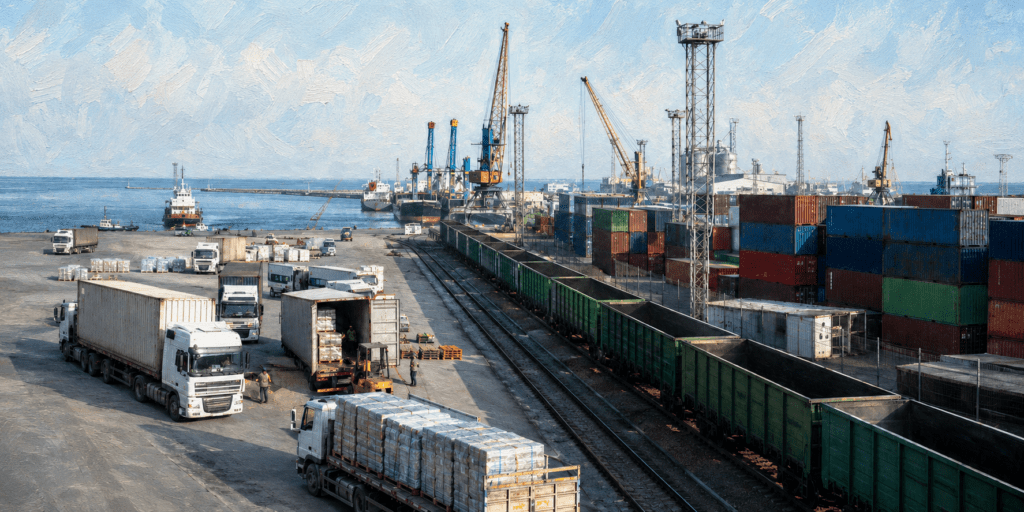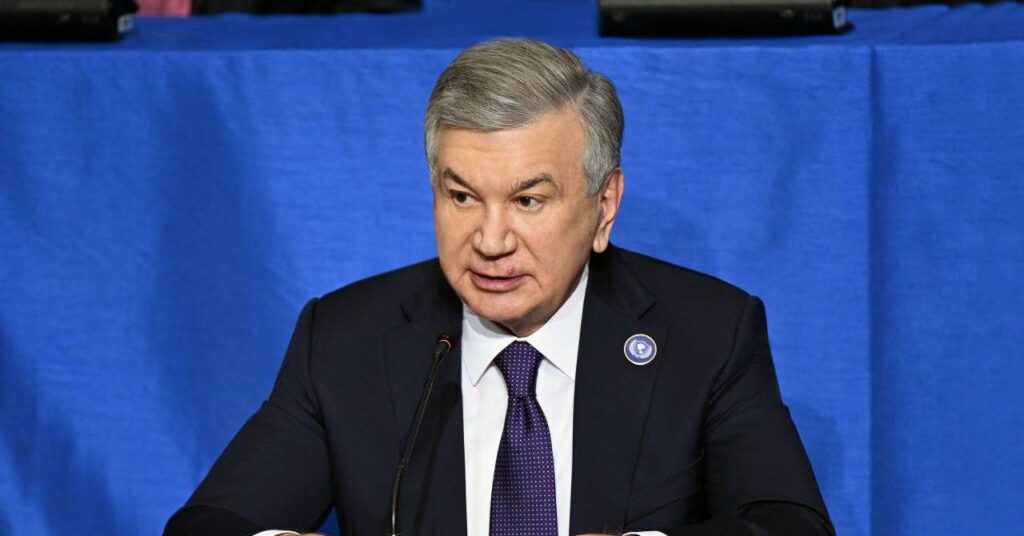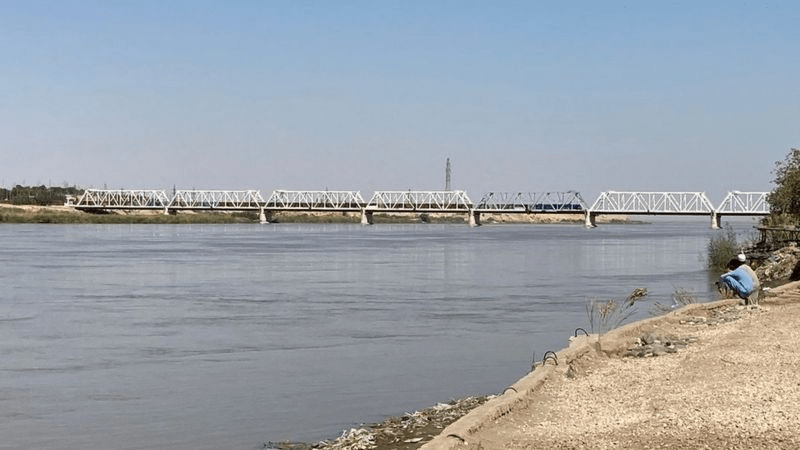
During the first week of June 2026, World Food Programme Afghanistan Country Director John Aylieff, Supply Chain Officer Shukhratmirzo Khodzhaev, and TCA’s Javier M Piedra visited the Termez–Hairatan border crossing and the Termez Free Economic Zone (TFEZ), a logistics hub between Uzbekistan and Afghanistan on the Amu Darya River. The trip was organized by the Institute for Strategic and Regional Studies (ISRS) in connection with Termez Dialogue 2026, a flagship Uzbekistan initiative designed to advance economic integration, trade, and cultural exchange across Central and South Asia. For 25 years, Uzbekistan has maintained the Termez crossing as a key humanitarian gateway, ensuring Afghanistan’s continued access to regional and global supply chains.
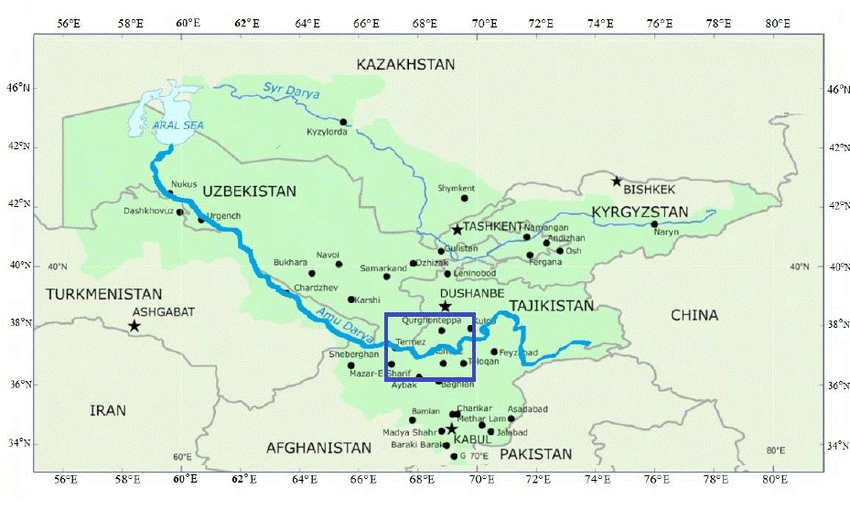
Geographical position of the Amu Darya; source: snipview.com/amudarya
A quarter-century on, the gateway that has saved millions of Afghans from famine remains open, but the funding that makes it so meaningful is on life support. While Central Asia has stepped up, its increased contributions only partially offset the huge shortfall left by wealthier countries.
Termez, Uzbekistan
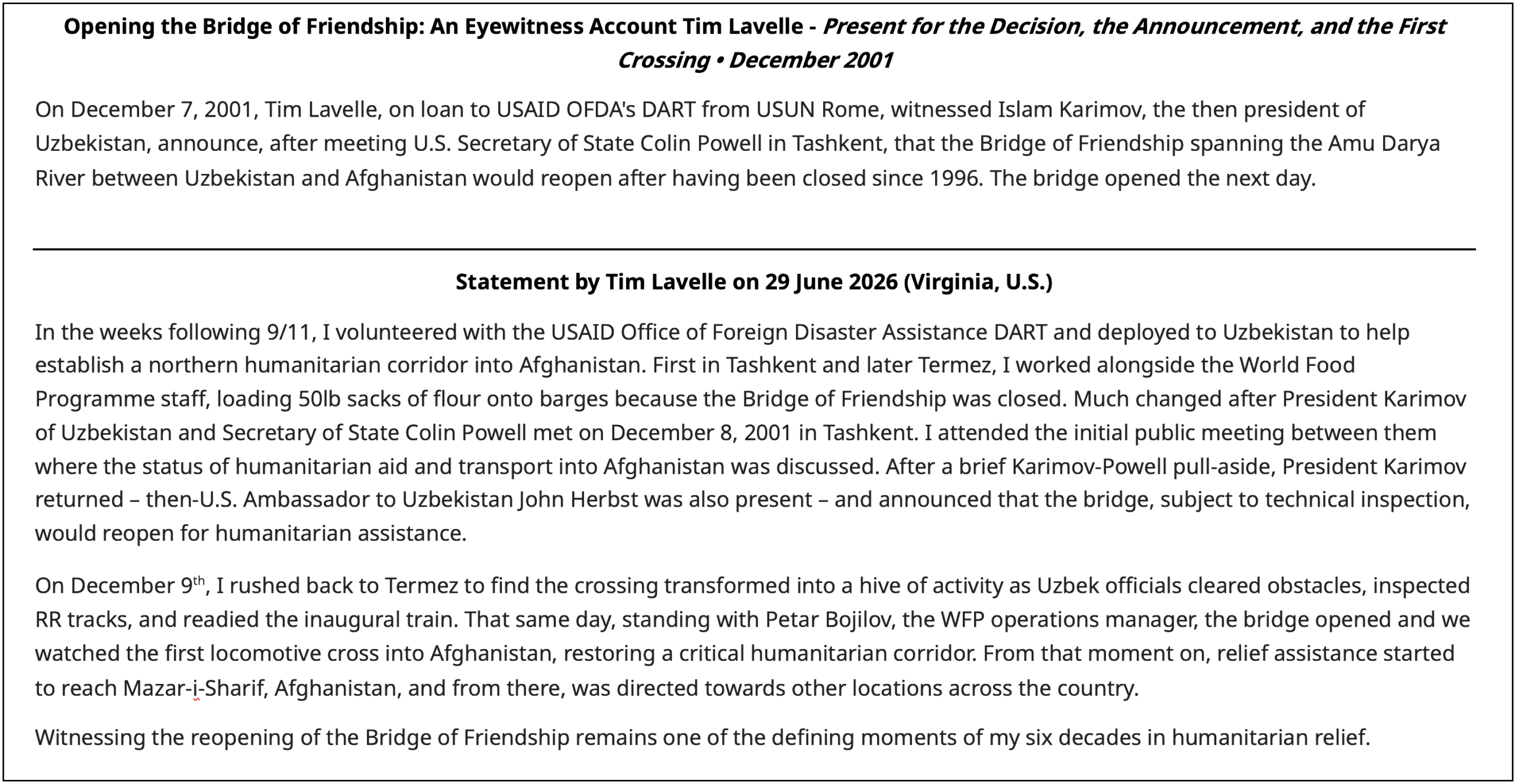
Twenty-five years ago, with winter approaching, borders closed, logistics shattered, and five million Afghans in urgent need of food, WFP’s Petar Bojilov and Tim Lavelle—on loan to USAID OFDA’s DART from USUN Rome—took on an impossible mission: to open a lifeline and get emergency food aid across the Amu Darya River from Uzbekistan into Afghanistan.
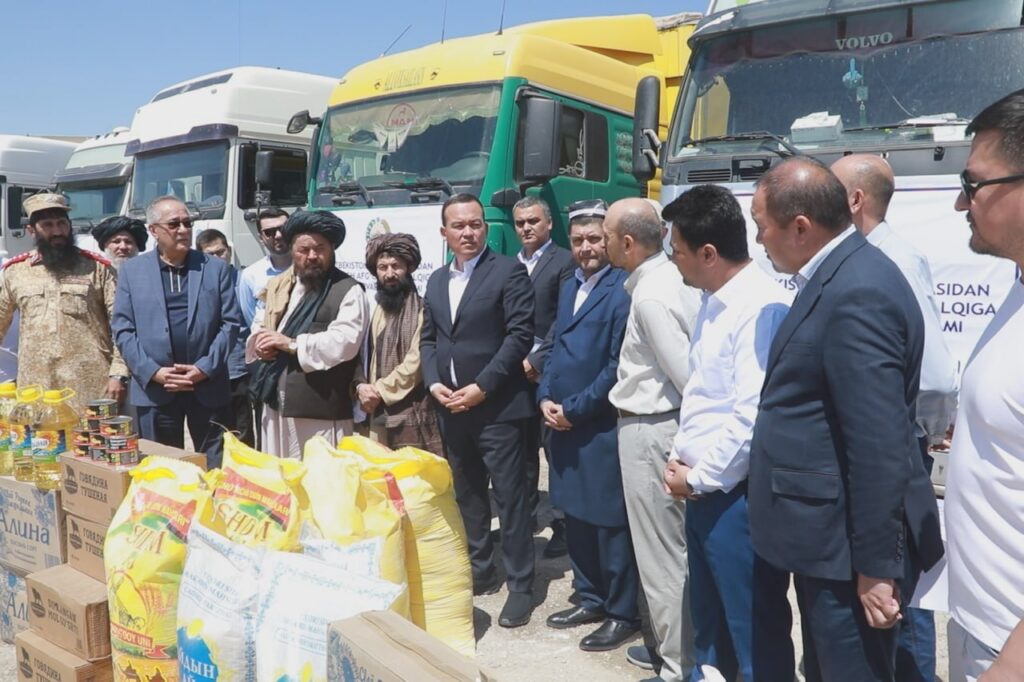
What began with one barge and a handful of hopelessly underequipped and understaffed personnel in 2001 has become one of the world’s most consequential logistics hubs, through which WFP has delivered over 220,000 metric tons of food into Afghanistan in recent years.
In 2026, the Bridge of Friendship Marks its 25th Anniversary
Once a barely functional border crossing, Termez is now a Free Economic Zone (AIRITOM) with multimodal connectivity and extensive storage, providing WFP with what John Aylieff calls unmatched operational flexibility.
“What makes the Termez hub today so strategically important is its reliability and versatility,” says Aylieff. “It offers dependable transshipment through multiple Afghan corridors—a vital lifeline where speed matters – as well as loading and storage. Given current geopolitical tensions, from the closure of the Pakistan–Afghanistan border to the spillover of the Middle East crisis, its role has become even more essential for humanitarian operations.”

John Aylieff and Javier Piedra, Termez (June 7th, 2026). Image: TCA
Since February 2026, violence along Afghanistan’s 2,400-kilometre border with Pakistan has escalated sharply, triggering the displacement of approximately 20,000 families. With heightened instability along the Afghan-Pakistan border and in Iran, forced returns of Afghan refugees have increased sharply; the Termez transit corridor has become all the more critical as a channel for humanitarian food aid.
Termez’s value extends well beyond WFP’s own operations. “The hub not only serves WFP in Afghanistan but also supports numerous humanitarian agencies in the country, including UNHCR, UNFPA, and UNICEF,” says Aylieff. “It is the backbone of the northern corridor supply chain into Afghanistan, and more and more agencies are relying on WFP’s logistics capabilities to bring their supplies into the country.”
Uzbekistan: A Quarter-Century of Open Doors Built on Diplomacy
The Termez hub exists thanks to Uzbekistan’s commitment to long-term engagement at institutional and state-to-state levels. Tashkent’s diplomacy – the practice of building dialogue rooted in a quest for mutual understanding, of upholding human dignity and preventing conflict, and of working to achieve lasting peace – has delivered stable, apolitical assistance to Afghanistan in spite of regional conflict and international meddling.
“Termez stands as proof that Uzbekistan–Afghanistan cooperation, grounded in dialogue and humanitarian commitment, can build bridges where others see borders,” says Arkamjon Nematov, Deputy Director of the Institute for Strategic and Regional Studies (ISRS). “Economic integration and our shared humanity are indispensable to peace, stability, and ensuring no one is left without life’s basic necessities. The WFP’s work is one important manifestation of our diplomacy.”
A Crisis of Catastrophic Proportions
Even by the standards of Afghanistan’s turbulent history, the magnitude of today’s food crisis is staggering. Close to one-third of the population — 13.8 million people — face acute food insecurity. The human toll is also shocking. In 2026, an estimated 3.7 million Afghan children are expected to suffer from malnutrition, while another 1.2 million pregnant and breastfeeding women will need treatment for acute malnutrition. WFP says this is the worst surge in malnutrition the country has ever seen. A child suffering from acute malnutrition faces a mortality risk three times higher than one who is properly fed. Last year, WFP supported more than 12.4 million Afghans with food rations and nutrition assistance; nearly three-quarters of them were women and children.
Aylieff highlighted that despite strong cooperation from Kabul and a fully operational Termez logistics hub, donor funding has declined even as food needs in Afghanistan increase, suggesting that basic human needs appear secondary to geopolitical or market priorities.
WFP and the Numbers
Aylieff appears to argue that it would be important for donors to see the situation in Afghanistan firsthand.
“The decline in international support has not been gradual — it has been catastrophic,” Aylieff points out. “In 2022, WFP’s Afghanistan programme received U$1.6 billion, enabling the organization to reach 23 million people at the height of an economic crisis. Last year, that figure fell to $300 million. In 2026, projected funding stands at just under $200 million — an 87% reduction in four years, even as needs have stayed severe.”
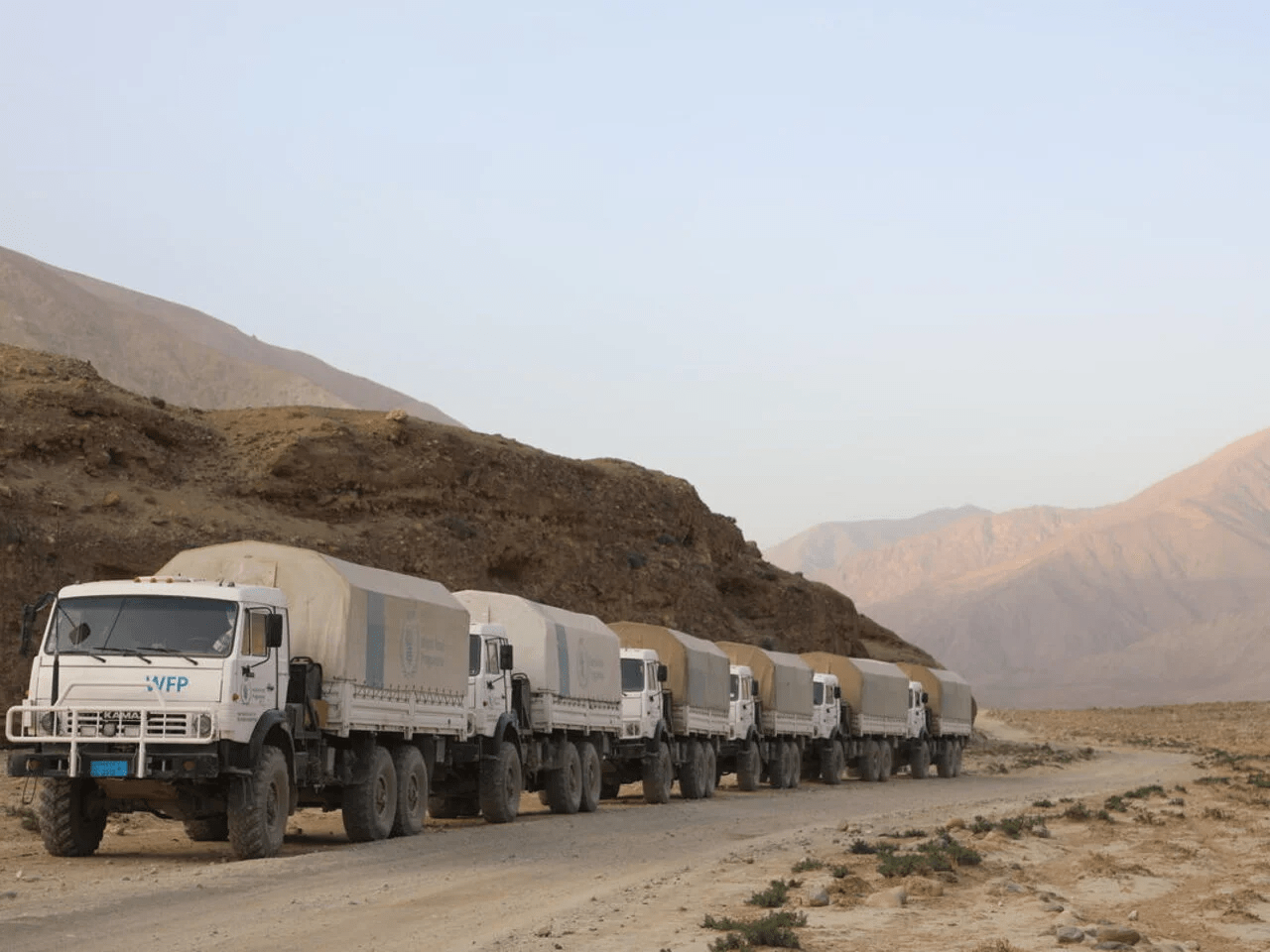
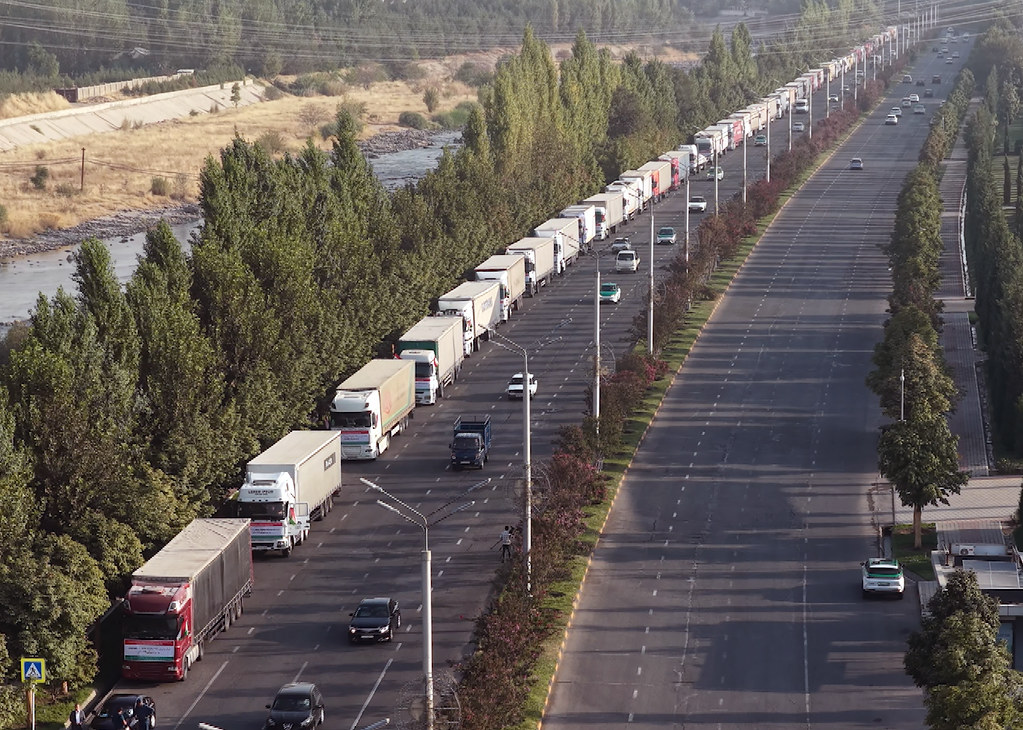
Cargo Trucks (Afghanistan). Image: World Food Programme
“The human cost of that arithmetic is being counted in lives. WFP can currently reach only two million people per month in Afghanistan — down from four million last winter. Due to reduced funding, we are turning away six out of every seven acutely malnourished women and children who come to our clinics seeking treatment. Our famine-prevention programme is due to run out of funds at the end of July 2026. WFP urgently requires $350 million to deliver life-saving food assistance through October 2026.”
“Access to the remotest parts of Afghanistan,” Aylieff insists, “is not the problem. The logistics corridor through Termez functions. The will and the capacity are there. To put it bluntly, what is missing is money. And, if I may suggest, what is also missing among the world’s wealthiest governments is a sufficient sense of empathy towards the suffering of others.”
The Lesson from Central Asia
In Termez, there is an uncomfortable irony in the current moment. As Western governments slash humanitarian budgets for Afghanistan and retreat from commitments made with great fanfare in 2021, the countries of Central Asia — far smaller economies, with far fewer resources — are moving in the opposite direction. Uzbekistan holds the border open as well as providing humanitarian and other assistance. Besides grain and money, Kazakhstan sends doctors, engineers, and scholarships. Turkmenistan supplies energy. Tajikistan manages transit routes. Kyrgyzstan contributes to regional training initiatives. Together, these countries have built something that no single bilateral relationship could have produced: a coherent, multi-country architecture of support for Afghanistan that functions even without the blessing of outside powers.
As our trip to Termez ended, the WFP’s message was clear: stores of food are available, trucks are waiting, and transit corridors are open; the barrier isn’t logistics—it’s political will and indifference.
With a slight tone of frustration in his voice, Aylieff asked: “Will the world honor the promises it made in 2021 after the U.S. withdrew from Afghanistan? At that time, the world pledged unwavering support to Afghan women in the aftermath of the takeover of the country in 2021. Five years later, in 2026, those same women are watching their children succumb to hunger in their arms, as the aid programmes which would have saved them have been cut back dramatically and too many donors have walked away.”
Twenty-five years ago, the world found a way to reach Afghans in their darkest hour. The question for 2026 is not whether the road to Afghanistan is open. It is whether the world still has the conscience to travel it.
The World Food Programme’s 25th anniversary in Termez marks far more than a milestone—it celebrates a quarter century of unwavering commitment to people displaced by conflict and hunger. Uzbekistan’s leadership, together with the dedication of individuals such as Aylieff, Khodzhaev, Bojilov, and Lavelle, reminds us that perseverance, accountability, and compassion can transform lives. Yet compassion alone cannot fill an empty bowl.
With a greater sense of solidarity imbued with empathy and a recognition of the universal dignity of humans, many more lives in Afghanistan could be saved. As Aylieff told me as we left Termez: “After all, what could be more urgent than ensuring that those who are starving through no fault of their own can have at least one meal a day? Is that asking too much? The usual pretexts – bad logistics, dangerous environment, significant diversion, or leakage – have little grounding in reality. If London, Washington, Brussels, Beijing, or New Delhi have any questions, we are here to answer them.”