• KGS/USD = 0.01144 0%
  • KZT/USD = 0.00204 0%
  • TJS/USD = 0.10396 0%
  • UZS/USD = 0.00008 0%
  • TMT/USD = 0.28490 0%
  • KGS/USD = 0.01144 0%
  • KZT/USD = 0.00204 0%
  • TJS/USD = 0.10396 0%
  • UZS/USD = 0.00008 0%
  • TMT/USD = 0.28490 0%
  • KGS/USD = 0.01144 0%
  • KZT/USD = 0.00204 0%
  • TJS/USD = 0.10396 0%
  • UZS/USD = 0.00008 0%
  • TMT/USD = 0.28490 0%
  • KGS/USD = 0.01144 0%
  • KZT/USD = 0.00204 0%
  • TJS/USD = 0.10396 0%
  • UZS/USD = 0.00008 0%
  • TMT/USD = 0.28490 0%
  • KGS/USD = 0.01144 0%
  • KZT/USD = 0.00204 0%
  • TJS/USD = 0.10396 0%
  • UZS/USD = 0.00008 0%
  • TMT/USD = 0.28490 0%
  • KGS/USD = 0.01144 0%
  • KZT/USD = 0.00204 0%
  • TJS/USD = 0.10396 0%
  • UZS/USD = 0.00008 0%
  • TMT/USD = 0.28490 0%
  • KGS/USD = 0.01144 0%
  • KZT/USD = 0.00204 0%
  • TJS/USD = 0.10396 0%
  • UZS/USD = 0.00008 0%
  • TMT/USD = 0.28490 0%
  • KGS/USD = 0.01144 0%
  • KZT/USD = 0.00204 0%
  • TJS/USD = 0.10396 0%
  • UZS/USD = 0.00008 0%
  • TMT/USD = 0.28490 0%

Viewing results 373 - 378 of 3002

Qazaq Air Launches Direct Flights from Astana to Bishkek and Samarkand

Qazaq Air, operating under its new joint venture brand Vietjet Qazaqstan, is expanding its international network with the launch of two new routes from Astana to Bishkek and Samarkand. Direct flights on the Astana-Samarkand-Astana route will begin on November 7, operating twice weekly on Fridays and Sundays. The Astana-Bishkek-Astana route will launch on November 10, with flights every Monday and Thursday. The airline announced that this expansion aligns with President Kassym-Jomart Tokayev’s regional integration initiative, which aims to strengthen ties among Central Asian countries through increased cooperation in tourism, trade, education, and cultural exchange. “These new routes between Astana, Samarkand, and Bishkek offer greater convenience for passengers and support the development of business, tourism, and cultural connectivity across our region,” said Adilbek Umraliev, Chairman of the Board of Qazaq Air. “They also open new opportunities for travelers, entrepreneurs, and students by linking cities rich in both historical heritage and future potential.” With its hub at Astana International Airport, Qazaq Air operates an extensive network of domestic flights and is now expanding further into regional markets. In May 2025, Qazaq Air and Vietnam’s Vietjet formally launched Vietjet Qazaqstan, a strategic partnership designed to bolster connectivity within Central Asia and beyond.

Uzbekistan Emerges as One of Europe and Central Asia’s Fastest-Growing Economies

Uzbekistan is on track to be one of the five fastest-growing economies in the broader Europe and Central Asia region next year, according to the World Bank’s Europe and Central Asia Economic Update, Fall 2025. The report projects Uzbekistan’s gross domestic product will expand by about 6.2% in 2025 - well above the regional average amid an overall slowdown across emerging European and Central Asian markets. Overall regional GDP growth is expected to ease to roughly 2.4% in 2025, down from 3.7% in 2024, as weaker output in Russia drags on the aggregate. Central Asia as a whole continues to stand out. The World Bank notes that countries in the region are collectively growing around 5.9% - making it the fastest-growing part of Europe and Central Asia for the third straight year. Within that group, Tajikistan is also forecast to grow by 7%, Kyrgyzstan by 6.8%, and Kazakhstan by 5.5%. That performance keeps much of Central Asia well ahead of Europe’s advanced economies, which are expected to grow by just over 1% on average. Turkmenistan is excluded from the World Bank’s regional calculations because it does not publish internationally comparable economic data. For Uzbekistan, in particular, inclusion among the region’s top performers marks a sharp turnaround for a country that, less than a decade ago, was largely closed to global markets. By way of comparison, according to the World Bank, Uzbekistan’s economy is about eight times larger than Kyrgyzstan’s and roughly seven times larger than Tajikistan’s. In 2024, Uzbekistan’s gross domestic product was roughly $105 billion, compared with approximately $14 billion for Kyrgyzstan and $15 billion for Tajikistan. Remittances and Investment Fuel Expansion Rising income from abroad and expanding investment at home due to an increasingly investor-friendly climate are the twin engines of Uzbekistan’s boom. The World Bank attributes its upgraded forecast partly to stronger-than-expected remittances and higher capital spending. In the first half of 2025, remittances sent home by Uzbek workers - mainly from Russia, Turkey, and South Korea - jumped 27% year-on-year to reach around $8.2 billion, providing a surge in household consumption. At the same time, both public and private investment are climbing. Government spending on infrastructure and industrial projects remains high, and foreign capital is flowing in at record levels. According to Uzbekistan’s Ministry of Investment, Industry and Trade, foreign direct investment reached about $10 billion in 2024, the highest on record. Projects span energy, agriculture, and information technology, with investors from South Korea, China, the Gulf states, and Europe among the most active. The International Monetary Fund’s 2024 Article IV Consultation observed that “robust investment and resilient consumption” have kept growth well above the overall regional average. Reforms Since 2016 Have Laid the Groundwork This acceleration did not happen by chance. Since President Shavkat Mirziyoyev came to power in 2016, Uzbekistan has pursued a series of market-oriented reforms to dismantle decades of economic isolation and stagnation. The government unified the exchange rate, lifted currency restrictions, and simplified customs and tax rules. It began privatizing state...

Uzbekistan-Turkey Trade Reaches $2.6 Billion as Customs Cooperation Deepens

Uzbekistan and Turkey have significantly expanded their trade partnership, with bilateral trade turnover reaching $2.6 billion, according to the State Customs Committee of Uzbekistan. The milestone was announced during the fifth meeting of the Uzbekistan-Turkey Joint Customs Council, held in the historic city of Khiva. Friendly ties between the leaders of the two countries have laid the foundation for enhanced cooperation across a broad range of sectors, including politics, trade, investment, culture, and humanitarian initiatives. Since the inaugural Joint Customs Council meeting in 2018, trade turnover between the two countries has grown by 35%, rising from $1.9 billion to $2.6 billion by the end of 2024. Officials called this an impressive achievement in the context of ongoing global economic challenges and noted that there is still considerable room for further growth through deeper customs collaboration. One of the most impactful developments has been the 2022 agreement on the exchange of advance information on goods and vehicles. The agreement is currently undergoing preparations for full-scale implementation. Additionally, the two countries have improved mechanisms for foreign trade data exchange and made progress in addressing statistical discrepancies during a bilateral meeting in Samarkand in September. The next round of talks on this issue is scheduled to take place in Turkey. Another key topic at the Khiva meeting was the mutual recognition of authorized economic operators (AEOs), a proposal first introduced at the 11th meeting of customs authorities from Turkic states, held in Kazakhstan. A draft agreement on mutual recognition is currently under review by the Turkish side. Over the past five years, Uzbekistan’s trade volume managed by AEOs has more than doubled, increasing from $1.3 billion in 2020 to $2.7 billion in 2024. Council members also reviewed a joint cooperation plan for 2025-2026, which aims to further strengthen economic relations and streamline customs procedures.

Legal Imports of Chinese Smartphones Surge in Kazakhstan

Mandatory verification of mobile phones imported into Kazakhstan has led to a significant reduction in the shadow market, according to Deputy Minister of Finance Yerzhan Birzhanov. He stated that official imports of many popular Chinese smartphone models have increased 1.5 times and for some models, up to four times. As previously reported by The Times of Central Asia, Kazakh authorities introduced a policy in March 2025 requiring telecom operators to check the IMEI codes of smartphones and disable illegally imported devices. This measure applied to all phones brought into the country after March 24. Parliamentary deputy Ekaterina Smyshlyaeva supported the move, citing that 64% of mobile devices in Kazakhstan were previously brought in through illegal or "gray" channels. In 2024 alone, this led to an estimated loss of nearly 100 billion tenge (approximately $196 million) in unpaid value-added tax (VAT). The Ministry of Digital Development, Innovation, and Aerospace Industry, later reorganized as the Ministry of Artificial Intelligence and Digital Development, reported even higher levels of illicit trade. According to its data, around 5 million smartphones were sold in Kazakhstan in 2024, with up to 75% believed to have been imported illegally. However, there has been no immediate impact in the premium segment. “This was expected, as consumers were awaiting the release of new models from brands like Apple and Samsung. We anticipate growth in legal volumes from these brands as soon as sales data from October becomes available,” Birzhanov added. Under the new system, all smartphones imported into Kazakhstan after March 2025 are categorized based on their IMEI codes into three lists: white, gray, and black. The white list includes legally purchased and customs-cleared devices. The gray list comprises phones with suspicious or duplicate IMEI codes; owners of these devices have 30 days to verify their legitimacy. The black list includes stolen or counterfeit devices, which are barred from network access. In a further step to combat illegal imports, Kazakhstan also introduced personal import limits. As of this year, individuals are permitted to bring in no more than two smartphones and two tablets per year without customs clearance.

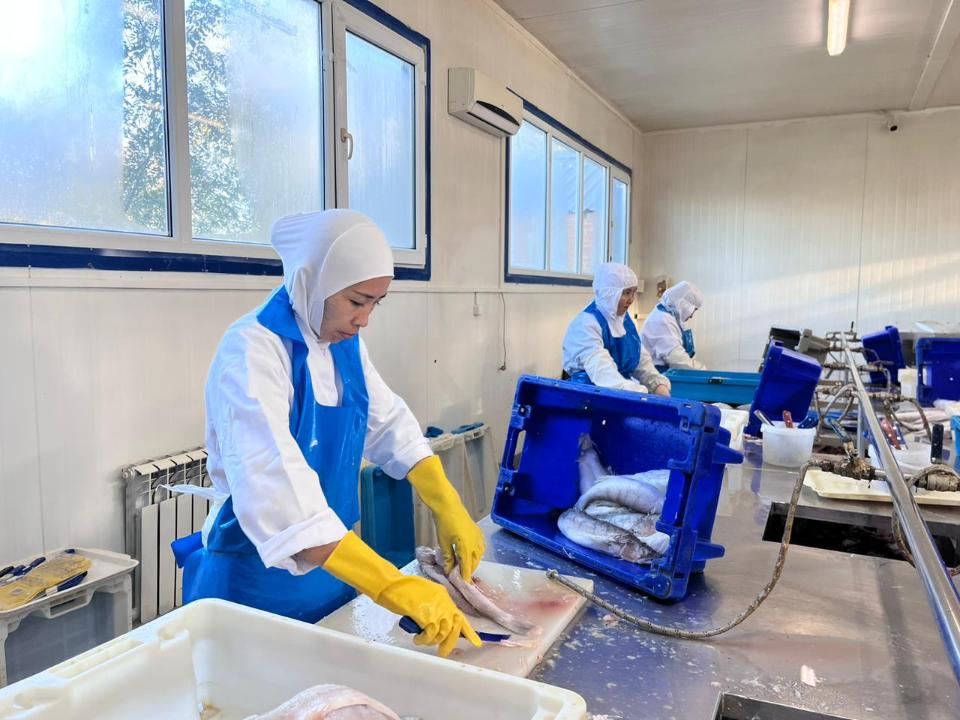
New Kazakh Fish Processing Plant Exports Aral Fish to Europe

A new fish processing plant has opened in Kazakhstan’s Kyzylorda region, signaling continued progress in efforts to revive the fishing industry in the Aral Sea basin, once the site of one of the world’s most devastating environmental disasters. According to the Ministry of Agriculture, the facility, located in the Aral district, has the capacity to process up to 6,000 tons of fish annually. Outfitted with modern equipment, the plant focuses on producing environmentally sustainable fish products that comply with international quality and safety standards. Its primary export, pike perch fillets, is shipped to markets in Germany, Denmark, and Norway. Kazakhstan currently operates 72 fish processing plants, 20 of which are licensed to export to the European Union. The country’s fishing sector has been buoyed by ongoing efforts to restore the Northern Aral Sea. Formed in 1987 during the large-scale desiccation of the original Aral Sea, the northern section has been preserved and partially replenished following the construction of the Kokaral Dam. Earlier this year, The Times of Central Asia reported a record increase in the sea’s water volume. Rising water levels have expanded the surface area, reduced salinity, and facilitated the return of 22 fish species to the ecosystem. The annual catch in the Northern Aral now reaches approximately 8,000 tons, creating new economic opportunities for local communities. Kazakhstan’s fishing industry continues to show steady growth. In 2024, the country produced 94,600 tons of fish products, a 7% increase compared to 2023. Of this total, 45,200 tons came from natural water bodies, while 18,200 tons were farmed. In the same year, Kazakhstan exported 23,400 tons of fish products worth $74.7 million to 21 countries, reflecting rising global demand for sustainable fish from the Aral region.

Tourism at Kyrgyzstan’s Lake Issyk-Kul Shows Steady Growth

Tourism remains a vital sector of Kyrgyzstan’s economy, contributing significantly to regional development and employment. The Issyk-Kul region continues to serve as the country’s premier tourism hub, anchored by Lake Issyk-Kul, its most popular destination for both domestic and international visitors. According to data from the Ministry of Economy and Commerce and the 2GIS mapping service, tourism activity in the Issyk-Kul region has tripled over the past six years. By the end of August 2025, which marked the close of the summer resort season, the volume of tourist services along the lake’s shores had increased threefold compared to 2019. In 2019, the region hosted 627 hotels and guesthouses. By 2025, that number had grown to 1,833. The highest concentration of accommodations is found in Cholpon-Ata (377), the neighboring village of Bosteri (336), the regional capital Karakol (196), and Balykchy (27). Food service establishments have seen similar growth. The number of cafes and restaurants has nearly tripled from 360 in 2019 to 963 in 2025. Karakol leads with 170 establishments, followed by Cholpon-Ata (157), Bosteri (142), and Balykchy (84). Nationwide, Kyrgyzstan received over 3.7 million tourists in 2024, a 1.3-fold increase compared to 2023, according to the National Statistical Committee. Of these, 2.4 million were served by the organized tourism sector, including hotels and resorts, while 1.3 million stayed in the unorganized sector, such as guesthouses and private homes. The Issyk-Kul region accounted for a substantial share of this total. In 2024, approximately 714,000 visitors were accommodated in the organized sector, and over 1.2 million in the unorganized one. Tourism has become a key driver of small and medium-sized enterprises in the region, generating employment and enhancing the investment climate. In 2024, Kyrgyzstan’s tourism industry attracted more than $11 million in foreign direct investment, with Issyk-Kul playing a central role in that growth.