• KZT/USD = 0.00210
  • TJS/USD = 0.10810
  • UZS/USD = 0.00008
  • TMT/USD = 0.29850
  • KZT/USD = 0.00210
  • TJS/USD = 0.10810
  • UZS/USD = 0.00008
  • TMT/USD = 0.29850
  • KZT/USD = 0.00210
  • TJS/USD = 0.10810
  • UZS/USD = 0.00008
  • TMT/USD = 0.29850
  • KZT/USD = 0.00210
  • TJS/USD = 0.10810
  • UZS/USD = 0.00008
  • TMT/USD = 0.29850
  • KZT/USD = 0.00210
  • TJS/USD = 0.10810
  • UZS/USD = 0.00008
  • TMT/USD = 0.29850
  • KZT/USD = 0.00210
  • TJS/USD = 0.10810
  • UZS/USD = 0.00008
  • TMT/USD = 0.29850
  • KZT/USD = 0.00210
  • TJS/USD = 0.10810
  • UZS/USD = 0.00008
  • TMT/USD = 0.29850
  • KZT/USD = 0.00210
  • TJS/USD = 0.10810
  • UZS/USD = 0.00008
  • TMT/USD = 0.29850

Viewing results 25 - 30 of 1815

Tokayev and Trump Put Results at the Center of a Growing Partnership

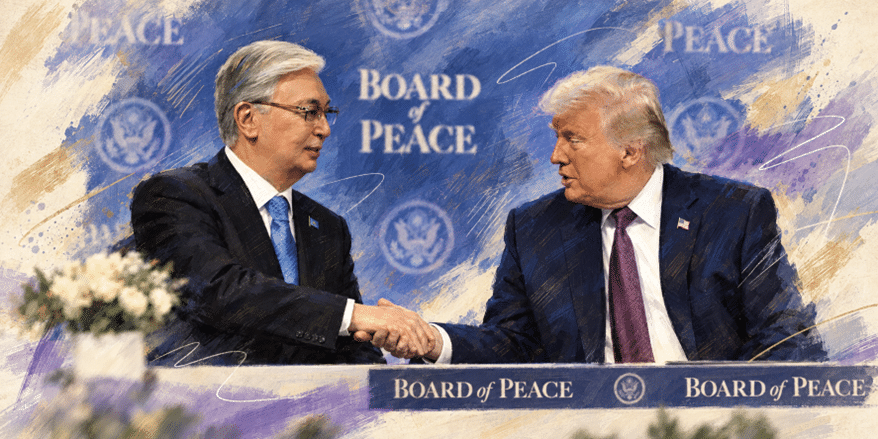
Investment, nuclear security and a possible visit to Kazakhstan featured in a July 10 telephone call between Kazakh President Kassym-Jomart Tokayev and U.S. President Donald Trump. Tokayev began by congratulating Trump on the 250th anniversary of U.S. independence. He noted that the United States had become a global superpower within three generations and expressed support for what Akorda described as the Trump administration’s “common-sense policies”. The Kazakh president also said those policies aligned with his own vision of building a Just Kazakhstan based on law and order. The language reflected the increasingly warm tone of the relationship and Tokayev’s effort to engage Trump through themes of national strength, order and economic achievement. The discussion soon turned to results. Tokayev reported progress in implementing agreements reached during his November 2025 visit to Washington. During that visit, Kazakh and U.S. partners announced 29 deals and cooperation initiatives worth nearly $17 billion, according to Kazakh officials. They included a planned $1.1 billion tungsten project involving U.S.-based Cove Capital. Kazakhstan’s scale gives the relationship wider strategic weight. By far Central Asia’s largest economy, it accounted for 56.4% of the combined GDP of the region’s five states in 2025, based on World Bank data. Kazakhstan also held 66.4% of Central Asia’s inward foreign direct investment stock at the end of 2025, according to UNCTAD. Its importance to the United States and its allies is equally concrete. Kazakhstan-origin material accounted for 24% of foreign-origin uranium deliveries to U.S. civilian nuclear-power operators in 2024, second only to Canada, according to the U.S. Energy Information Administration. Kazakhstan also accounted for 12.7% of the value of the European Union’s crude petroleum-oil imports from outside the bloc in 2025, behind only the United States and Norway, according to Eurostat. That economic and strategic weight helps align the priorities of the two governments. Washington wants dependable sources of critical minerals and more resilient supply chains. Kazakhstan wants American capital and technology to expand processing, manufacturing and higher-value production. The November package provided a framework for moving the relationship from political interest toward concrete commercial projects. Senator Steve Daines has helped sustain that momentum. Akorda specifically mentioned Tokayev’s recent meeting with Daines, alongside his contacts with U.S. Special Envoy for South and Central Asia Sergio Gor, other White House officials and American business leaders. Daines has become one of Washington’s leading advocates for closer engagement with Kazakhstan and the wider Caspian region. In a June speech on U.S. relations with the region, he called for new mines, upgraded infrastructure and artificial-intelligence investment. He also pressed Congress to repeal the Jackson–Vanik restrictions still affecting Central Asia. For Kazakhstan, the lingering Cold War-era measure leaves normal trade relations subject to annual review rather than permanent status. Its removal would provide greater political certainty for long-term American investment. The most strategically significant language in the Akorda readout concerned nuclear non-proliferation. Tokayev reaffirmed Kazakhstan’s commitment to “non-proliferation of nuclear weapons and enriched uranium” and stressed close collaboration with the International Atomic Energy Agency to ensure effective...

U.S., Turkmenistan Draw Closer with Senator’s Visit to Ashgabat

Turkmenistan wants to deepen cooperation with the United States in areas including fuel and energy, transport, finance, banking, and artificial intelligence, President Serdar Berdimuhamedov has told a visiting U.S. senator. Senator Steve Daines, a Montana Republican who is a leading advocate of U.S.-Central Asia collaboration, also met Gurbanguly Berdimuhamedov, Serdar’s father and powerful predecessor, as well as Foreign Minister Rashid Meredov, in Ashgabat on Thursday. “Our country, endowed with rich natural resources, is implementing a strategy of diversifying energy supply routes and stands for the development of mutually beneficial cooperation based on equal consideration of the interests of producers, consumers, and transit countries,” state media said in a report on the meeting between the president and Daines. Turkmenistan has large natural gas reserves, and China is the primary buyer. Although Turkmenistan is one of the most closed countries in the world, it has been taking steps to expand international contacts and develop its role in the so-called Middle Corridor, a trade network that links China and Europe via Central Asia and has grown in importance during the Russia-Ukraine war. The United States, meanwhile, is building closer ties with Central Asian governments, seeking access to critical minerals and energy, and aiming to reduce Chinese and Russian influence in the region. Daines serves on several Senate committees, including energy and natural resources. He has said he won’t seek re-election this year. Commenting on the senator’s visit, state media in Turkmenistan noted that some major American companies, including Boeing, General Electric, John Deere, and Case New Holland, had been involved in projects in the country for years. U.S. goods trade with Turkmenistan was $152.7 million in 2025, according to U.S. government data. U.S. goods exports to Turkmenistan last year were $113.3 million, up 43.6% from the previous year, and U.S. goods imports from Turkmenistan were $39.4 million, up 169% from 2024. While those numbers are low compared to the volume of trade between the United States and bigger trading partners, the annual percentage increase is notable. A day before his meetings in Turkmenistan, Daines was in Kazakhstan, where he discussed trade and diplomatic ties with President Kassym-Jomart Tokayev. Kazakhstan's leader said he looked forward to traveling to Miami in December to participate in the G20 summit.

U.S. Strikes on Iranian Rail and Coastal Infrastructure Put Central Asia’s Southern Routes Under Pressure

U.S. strikes on Iranian rail and coastal infrastructure have put Central Asia's southern transport plans under new pressure. Kazakhstan and Turkmenistan have spent years building routes through Iran to reach the Persian Gulf, the Gulf of Oman, and markets beyond Russia. Public statements so far do not show a confirmed halt in Central Asian freight, but bridge damage near Iran's border with Turkmenistan and strikes along Iran's southern coast have made the security picture more concrete. Reports and a video posted on July 9 showed damage to the Aq Taqeh Khan railway bridge, on Iran's rail link to Turkmenistan and Kazakhstan, after overnight U.S. strikes. Reuters said it verified the location by matching the bridge, riverbank, road, fields, and nearby town with satellite imagery, and found no earlier versions of the video online. Iran's Revolutionary Guard-linked Neynava Corps in Golestan said the area around the Aq Taqeh Khan railway bridge in Aq Qala County was targeted by U.S. cruise missiles early on July 9, with no casualties reported. The bridge sits on the Gorgan-Incheh Borun railway line, which reaches the Incheh Borun border crossing with Turkmenistan and links onward to Kazakhstan. Head of the Islamic Republic of Iran Railways, Jabar-Ali Zakeri, said engineers had rebuilt one damaged track on the Mashhad route and returned it to service in less than 15 hours, according to Fars News Agency. He said work on a second damaged line was continuing and was expected to finish within hours. That statement concerned the Mashhad route, however, and does not confirm the status of the Gorgan-Incheh Borun line. The route sits inside a wider transport effort that Kazakhstan, Turkmenistan, Iran, China, and Russia have all tried to expand. TCA has previously reported on a 2024 test container train on the China-Kazakhstan-Turkmenistan-Iran route, which ran from Xi'an to Tehran. It carried 45 forty-foot containers loaded with auto parts and cut the China-Iran delivery time to 15 days. The Gorgan-Incheh Borun railroad was inaugurated in December 2014, linking Iran to Turkmenistan and Kazakhstan along the eastern side of the Caspian Sea. The wider Uzen-Bereket-Gorgan route runs for more than 900 kilometers from western Kazakhstan through Turkmenistan into northern Iran. It connects Kazakhstan and Turkmenistan’s rail networks to Iran’s system and onward to the Persian Gulf and Asian markets. The U.S. military has framed the latest strikes as a response to Iranian attacks on commercial shipping. U.S. Central Command said on July 8 that its forces had struck about 90 Iranian military targets, including air defense systems, coastal surveillance assets, missile and drone storage sites, naval capabilities, and military logistics infrastructure along Iran's coastline. CENTCOM said the operation was designed “to further degrade Iran's ability to attack commercial shipping and innocent civilian mariners in the Strait of Hormuz.” The coastal security picture also impacts Kazakhstan through Shahid Rajaee Port in Bandar Abbas. On June 28, Kazakhstan and Iran signed a 27-year Build-Operate-Transfer agreement for a Kazakh transport and logistics terminal there. The Kazakh embassy in Tehran said the deal...

Kazakhstan’s Persian Gulf Port Plan Faces New Iran Risk

Kazakhstan has moved a long-planned southern trade project from talks to contract. The move gives Astana a possible foothold on the Persian Gulf, but it comes as a second night of U.S. strikes on Iran and Iranian retaliation around the Gulf states have raised the cost of using that route. On June 28, Kazakhstan and Iran signed a 27-year BOT agreement to build a Kazakh transport and logistics terminal at Iran’s Shahid Rajaee Port in Bandar Abbas. The contract gives the project two years for construction and 25 years for operation, with commercial activity expected in the third year. Aman Malgazhdarov of QazExportPromotion signed for Kazakhstan, and Hossein Abbas Nejad of Hormozgan’s Ports and Maritime Organization signed for Iran. The project is designed to plug Kazakhstan into the International North-South Transport Corridor and widen export access to the Persian Gulf, South Asia, Southeast Asia, and East Africa. The $25 million investment covers a 15-hectare logistics center that could handle 1.5 million tons of goods a year. Mohammad Shakibi-Nasab, the head of Iran’s Ports and Maritime Organization, said it would “create jobs… increase the operational capacity” of Shahid Rajaee and “boost ports along the North-South corridor.” Malgazhdarov called it the “core of a future Kazakh port” within Shahid Rajaee. That ambition now sits beside a worsening security picture. On July 8, U.S. President Donald Trump declared the interim agreement to end the Iran war “over” after attacks on three cargo ships in the Strait of Hormuz. Asked about the deal, Trump said: “It’s over. I don’t want to deal with them.” The U.S. then launched a new round of strikes, and Iran fired on U.S. sites in Bahrain and Kuwait. U.S. Central Command said the attacks were meant to “further degrade” Iran’s ability to threaten navigation in the strait, with Trump warning, “If it happens again, it will get much worse!” By July 9, the U.S. military said it had struck 170 Iranian targets in 48 hours. Iran had fired at U.S. bases in Bahrain, Kuwait and Qatar, and Iran’s health ministry said U.S. strikes on July 7 and 8 killed 14 people and wounded 78. The attacks hit Bandar Abbas, where Shahid Rajaee is located, and other southern coastal areas. Crude oil prices rose by 5% as the risk widened. For Kazakhstan, the timing is uncomfortable. Shahid Rajaee sits near the Strait of Hormuz, the waterway that connects the Persian Gulf to the open sea. The port offers one of Central Asia’s shortest southern outlets, but the approach depends on a zone where security, insurance premiums, and naval risk can change quickly. A terminal can lower handling costs and improve control over cargo, but it cannot remove war risk at the maritime end of the corridor. The risk may not be limited to the Gulf. The Financial Times reported that a railway bridge near Aqqala in Golestan Province was hit with cruise missiles, citing Iran’s Revolutionary Guards. The bridge lies on the Gorgan-Incheh Borun line, which carries passengers and cargo...

As Azerbaijan Pushes Back Against Moscow, Central Asia Watches

The recent diplomatic escalation between Azerbaijan and Russia appeared to have run its course in April, after Moscow agreed to pay compensation over the Azerbaijan Airlines crash in Kazakhstan. Instead, the dispute has entered a new phase, and its implications now reach beyond the South Caucasus. On July 6, Azerbaijan’s Ministry of Foreign Affairs summoned Russian Ambassador Mikhail Yevdokimov and handed him a formal note of protest over what Baku described as a Russian drone strike on a fuel station owned by Azerbaijan’s state energy company SOCAR in Ukraine’s Mykolaiv region on the evening of July 5. The Azerbaijani Foreign Ministry said the attack on SOCAR facilities in Ukraine was not an isolated incident. It cited previous strikes on the company’s gas distribution compressor station and oil depot in Odesa, which caused material damage and injured employees. Baku also pointed to earlier damage to the Azerbaijani embassy building in Kyiv and the honorary consulate in Kharkiv, calling on Moscow to investigate and comply with its obligations to protect civilian infrastructure and diplomatic missions. At the same time, Shusha — known to Armenians as Shushi, retaken by Azerbaijan during the 2020 Karabakh war, and still regarded by many Armenians as occupied — hosted an international conference devoted to what participants described as Russia’s “colonial policy,” the “Circassian genocide,” and the situation of non-Russian peoples within the Russian Federation. The conference declaration called on Moscow to “recognize its historical crimes, abandon its chauvinistic policies, and end the forced recruitment of ethnic minorities into the war against Ukraine.” Experts from Azerbaijan, the United States, France, Lithuania, Poland, the Czech Republic, Germany, Israel, Türkiye, and Georgia attended the conference. None of the Central Asian republics was represented. That absence was telling. Central Asian governments may be distancing themselves from Moscow in certain areas, but they remain reluctant to participate in openly anti-Russian political initiatives. For Astana, Tashkent, Bishkek, Dushanbe, and Ashgabat, the question is not whether Russia’s position has weakened, but how far they can move without provoking pressure from Moscow. For Central Asia, the dispute is not a distant quarrel in the South Caucasus. Azerbaijan is now a central link in the westward routes that Kazakhstan, Uzbekistan, Turkmenistan, and Kyrgyzstan are trying to strengthen as alternatives to Russian territory. The Middle Corridor runs from China through Central Asia, across the Caspian Sea, and onward through Azerbaijan, Georgia, and Türkiye to Europe. Any deterioration in Azerbaijan-Russia relations therefore has practical implications for Central Asian transit, energy, and diplomatic room for maneuver. The first major rupture in relations between Baku and Moscow came after Azerbaijan Airlines Flight J2-8243, traveling from Baku to Grozny, was damaged by Russian air-defense fire over Russian territory on December 25, 2024. The aircraft later crashed while attempting an emergency landing near Aktau, Kazakhstan, killing 38 people. Azerbaijan blamed Russia and demanded an apology, accountability, and compensation. Relations deteriorated further in June 2025 following the detention of ethnic Azerbaijanis in Yekaterinburg and reports of torture. The most prominent victims were the...

Uzbekistan and Georgia Deepen Ties as Tashkent Eyes Black Sea Routes

Uzbekistan and Georgia have elevated their relations to a strategic partnership as Tashkent seeks wider access to Black Sea ports and new routes linking Central Asia with European markets. As The Times of Central Asia previously reported, Mirziyoyev traveled to Georgia on a July 2-3 state visit aimed at expanding cooperation in trade, transport, investment, and regional connectivity. The visit concluded with the signing of a Strategic Partnership Declaration and a series of agreements designed to deepen political and economic ties. Uzbekistan and Georgia established diplomatic relations on August 19, 1994. Their cooperation was formalized a year later with the signing of the Treaty on Friendship and Cooperation. While political dialogue has continued over the years, bilateral engagement has accelerated since 2022 through regular presidential meetings, visits by prime ministers, sessions of the intergovernmental commission, and consultations between the two countries’ foreign ministries. Last year, on March 5, Georgian Prime Minister Irakli Kobakhidze visited Tashkent, where the two sides discussed expanding cooperation. The latest visit built on those discussions. According to the Uzbek presidential press service, the two leaders agreed to strengthen cooperation in politics, trade, investment, transport, tourism, and humanitarian exchanges. Bilateral trade reached $270 million in 2025, and has already exceeded $100 million since the beginning of this year. Both governments adopted the goal of increasing annual trade to $1 billion through a dedicated roadmap, reducing trade imbalances, and expanding exports through reciprocal industrial exhibitions. Transport and logistics featured prominently in the talks. The leaders agreed to expand the use of Georgia’s Poti and Batumi ports for Uzbek cargo and supported plans to establish a logistics hub that would include an industrial zone and a permanent showroom for Uzbek products. Mirziyoyev also proposed linking the future China-Kyrgyzstan-Uzbekistan railway with the Baku-Tbilisi-Kars railway, a move that could create a new transport corridor connecting Central Asia with European markets. The two countries also agreed to establish a joint investment fund and launch new industrial projects in agriculture, electrical engineering, pharmaceuticals, renewable energy, food processing, construction materials, digital technologies, digital banking, and tourism. Uzbekistan will also open an embassy in Georgia, while educational and tourism forums are scheduled to take place later this year. Political analyst Mukhtor Nazirov believes the visit represents more than a routine diplomatic exchange. Speaking to local media, he argued that Georgia is increasingly becoming Uzbekistan’s gateway to Europe as Tashkent seeks to diversify its foreign trade routes. “Today, a country’s economic opportunities are largely determined by its transport corridors and access to foreign markets,” Nazirov said. “The signing of the Strategic Partnership Declaration is therefore an important event in Uzbekistan’s foreign policy.” Nazirov noted that the Trans-Caspian International Transport Route, commonly known as the Middle Corridor, has become increasingly important for Uzbekistan. According to him, the route carried 12% of Uzbekistan’s foreign trade cargo in 2021, but that share has now risen to 28%. Official figures show that 1.2 million tons of cargo were transported along the corridor in 2025, while container train transit times to...