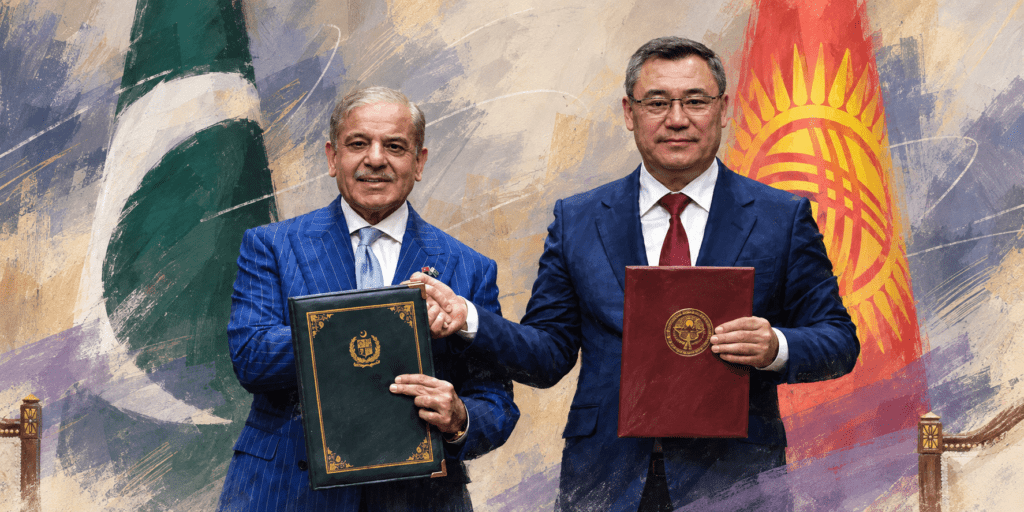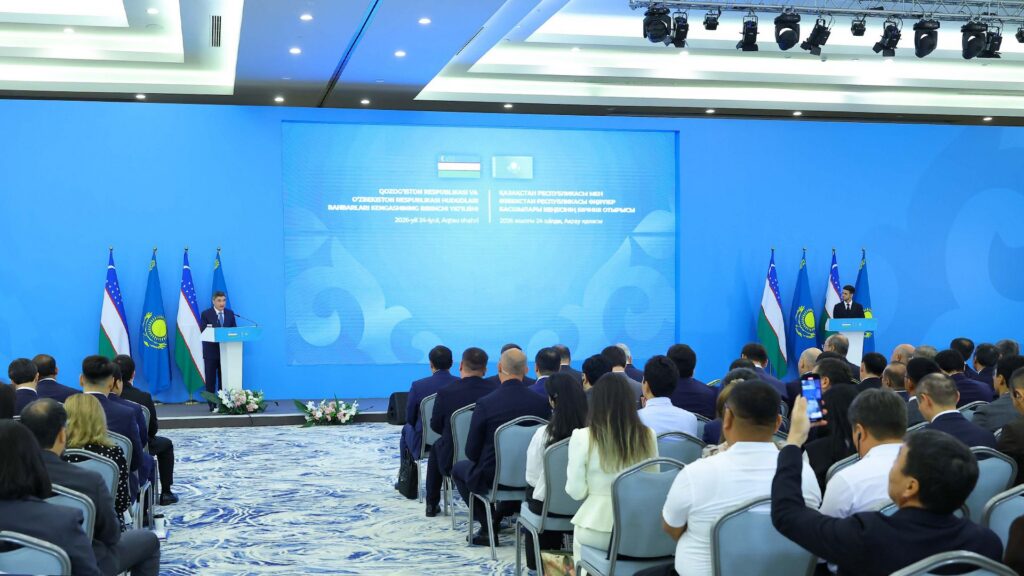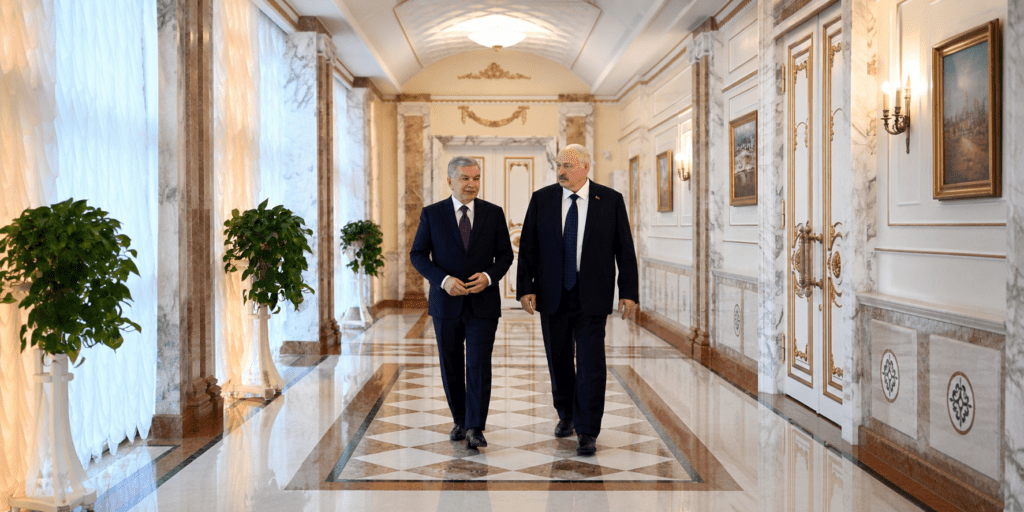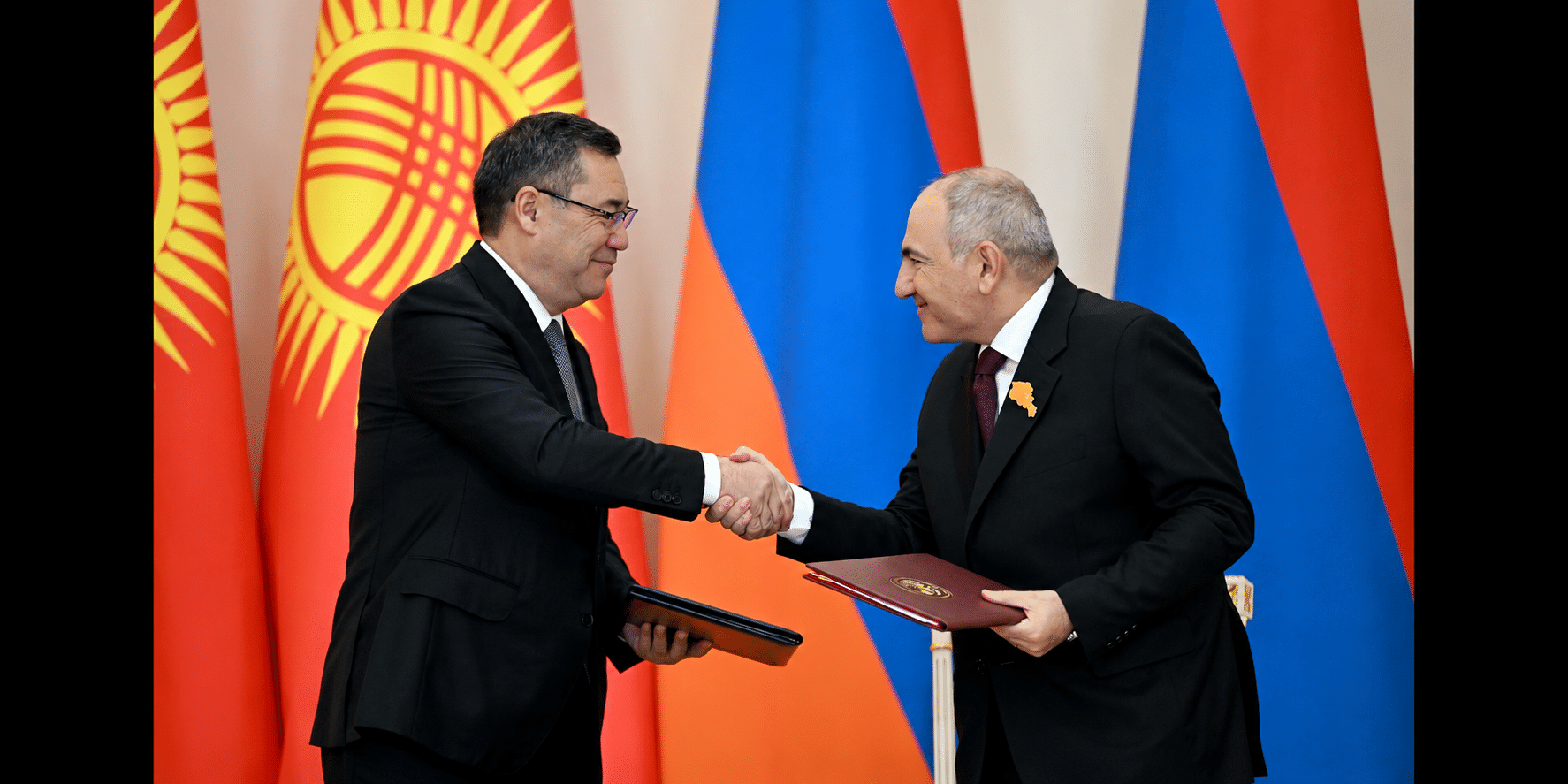
For the first time, a Kyrgyz head of state has made an official visit to Armenia. President Sadyr Japarov arrived in Yerevan on October 15 at the invitation of Prime Minister Nikol Pashinyan and called the three-day trip “historic.” Talks remained firmly bilateral and produced ten signed agreements, a joint commitment to protect Lake Issyk-Kul and Lake Sevan (Armenia), and a stated interest in expanding transit links.
Nothing in Japarov’s statement framed cooperation as directed against any third country. He presented it in terms of trade, cooperation, and friendly relations, with dialogue and peace underpinning regional stability.
Japarov opened his remarks by noting that Pashinyan had visited Kyrgyzstan twice this year, including the Eurasian Intergovernmental Council session in Cholpon-Ata in August. Pashinyan, for his part, said Japarov’s first official visit to Armenia would open a new page in bilateral relations.
Kyrgyzstan and Armenia have been independent since 1991, and both belong to the Eurasian Economic Union (EAEU), a five-nation bloc with a common market for goods, services, capital, and labor. Even so, their leaders have mostly met on the sidelines of multilateral summits.
Quiet to Active Diplomacy
Under Japarov, Kyrgyzstan has abandoned its quiet diplomacy and begun taking a more active role in international affairs. This year, Japarov has traveled to Armenia (October 15-17), Azerbaijan (October 14-15 and May 17), Turkmenistan (October 8-9), the United States (from September 19), South Korea (September 15-18), Kazakhstan (July 29, May 28-29, and May 15) and Russia (April 23). He reached Armenia fresh from the Conference on Interaction and Confidence-Building Measures in Asia (CICA) in Baku, where Central Asian leaders linked trade and security issues.
Bishkek’s shift in foreign policy emphasis owes less to geopolitics than to economic necessity and a practical, non-ideological pursuit of national interests. Its commitment to dialogue, regional stability and good-neighborliness is central to a foreign policy aimed at win-win results.
Biodiversity Diplomacy
In Yerevan, Japarov attended the opening of the Leaders’ Summit within the 17th UN Conference of the Parties on Biological Diversity (COP17). On October 16, he addressed the plenary, presenting initiatives on glacier melt and biodiversity in Central Asia, and met UNESCO Director-General Khaled El-Enany.
Among the specific proposals, Japarov recommended a special mountain program within the Global Environment Facility at the World Bank to fund environmental projects in mountain regions, and a UN-backed trust fund for Issyk-Kul, to which Kyrgyzstan proposed an initial $10 million contribution from its state budget. He also called for a Global Center for Mountain Region Resilience in Bishkek, where countries could share knowledge and experience on environmental protection. Japarov further backed a debt-for-nature swap mechanism, which would let countries use financial resources more effectively to protect ecosystems, and urged stronger regional cooperation to protect rare animals and birds.
The Yerevan Declaration followed the usual diplomatic template, restricted mainly to high-level language.
Japarov invited Pashinyan to attend “Bishkek+25,” the Second Global Mountain Summit, on 21–23 October 2027, to mark the culmination of Kyrgyzstan’s Five Years of Action for Mountain Development.
Transport at the Centre
As expected, Japarov “highlighted transport cooperation as one of the promising areas of interaction,” a view Pashinyan shared. Both countries are landlocked and depend on routes crossing other countries’ territory. Expanding these links could lower trade costs and open markets for exporters in both countries. Talks also covered agriculture, information technology, education and tourism, sectors that likewise depend on reliable connections.
Geoeconomics
According to press releases from the U.S. Department of State and elsewhere, the Trump Route for International Peace and Prosperity (TRIPP) is advancing, with Armenia’s parliament set to debate ratification of the U.S. framework agreement on October 27, following a committee review on October 21. The framework provides for a U.S.-Armenia joint venture, but Armenia still lags behind Azerbaijan: engineering surveys are only underway on its side, while Baku has nearly finished its connecting highway and railroad. Bishkek has a stake in moving TRIPP forward.
Moscow has also weighed in. On October 15, after the CICA summit in Baku, Foreign Minister Sergey Lavrov was asked about Armenia-Azerbaijan relations and TRIPP at a press conference. He said Moscow welcomed normalization and is ready to join infrastructure projects, noting that Russian Railways holds a concession and operates the South Caucasus Railway.
According to the Ministry of Foreign Affairs of the Russian Federation, Lavrov also promoted the 3+3 regional cooperation format initiated by Azerbaijan and Türkiye. The format brings together the three South Caucasus states—Armenia, Azerbaijan, and Georgia—with Russia, Türkiye, and Iran, although Georgia has not formally participated.
In the volatile South Caucasus, Japarov’s message was unambiguous: peace and stability underpin prosperity, and dialogue must intensify. Kyrgyzstan’s playbook is straightforward: build ties, expand cooperation, keep channels open, and stick to business.