• KGS/USD = 0.01144 0%
  • KZT/USD = 0.00216 0%
  • TJS/USD = 0.10456 0%
  • UZS/USD = 0.00008 0%
  • TMT/USD = 0.28571 0%
  • KGS/USD = 0.01144 0%
  • KZT/USD = 0.00216 0%
  • TJS/USD = 0.10456 0%
  • UZS/USD = 0.00008 0%
  • TMT/USD = 0.28571 0%
  • KGS/USD = 0.01144 0%
  • KZT/USD = 0.00216 0%
  • TJS/USD = 0.10456 0%
  • UZS/USD = 0.00008 0%
  • TMT/USD = 0.28571 0%
  • KGS/USD = 0.01144 0%
  • KZT/USD = 0.00216 0%
  • TJS/USD = 0.10456 0%
  • UZS/USD = 0.00008 0%
  • TMT/USD = 0.28571 0%
  • KGS/USD = 0.01144 0%
  • KZT/USD = 0.00216 0%
  • TJS/USD = 0.10456 0%
  • UZS/USD = 0.00008 0%
  • TMT/USD = 0.28571 0%
  • KGS/USD = 0.01144 0%
  • KZT/USD = 0.00216 0%
  • TJS/USD = 0.10456 0%
  • UZS/USD = 0.00008 0%
  • TMT/USD = 0.28571 0%
  • KGS/USD = 0.01144 0%
  • KZT/USD = 0.00216 0%
  • TJS/USD = 0.10456 0%
  • UZS/USD = 0.00008 0%
  • TMT/USD = 0.28571 0%
  • KGS/USD = 0.01144 0%
  • KZT/USD = 0.00216 0%
  • TJS/USD = 0.10456 0%
  • UZS/USD = 0.00008 0%
  • TMT/USD = 0.28571 0%

Viewing results 307 - 312 of 1552

Underwater Secrets of the Steppe: Archaeologists Unearth Ancient Artifacts in Kazakhstan’s Bogen Reservoir

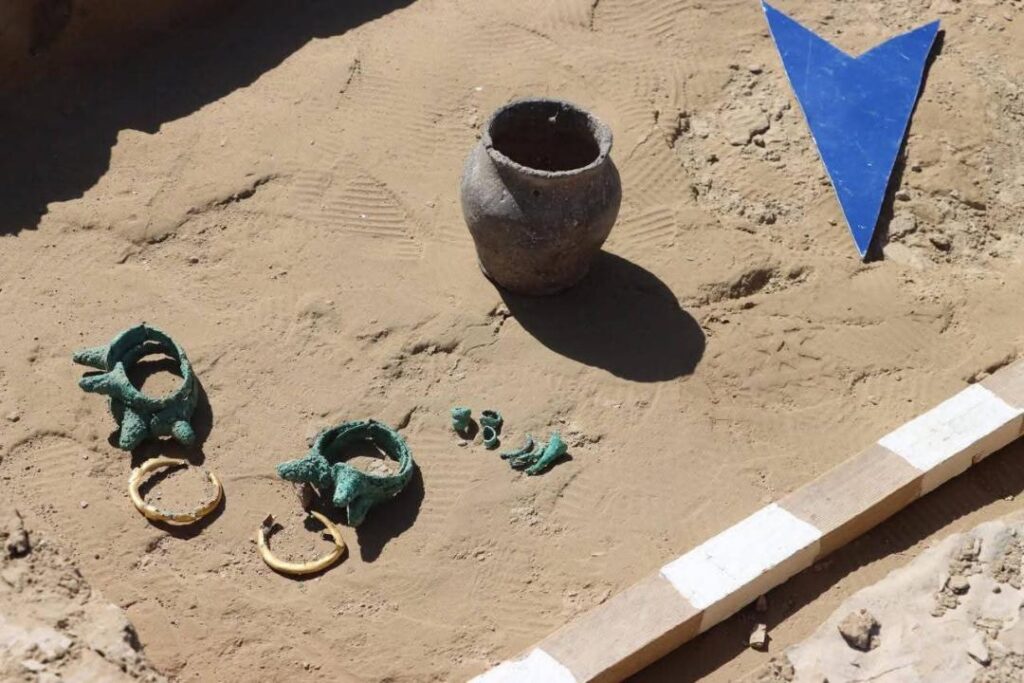
A team of archaeologists from the Zhanibekov University Research Center has uncovered a trove of ancient artifacts at the Bogen Reservoir in the Ordabasy district of Kazakhstan’s Turkestan region. An unusually dry season significantly lowered the water level, revealing archaeological remains hidden for centuries. Paleolithic Tools and Bronze Age Burials Within just one week of surveying, researchers recovered dozens of Late Paleolithic and Mesolithic stone tools, including chalcedony flakes, cores, and cutting plates. Several Bronze Age burial sites were also excavated. While skeletal remains were poorly preserved, the grave goods were remarkable: decorated ceramics, a gold-plated bronze temple ornament, rings, bracelets, earrings, and hundreds of tiny beads likely used in headdresses. A particularly notable discovery was a burial dated to the 1st century BC-1st century AD. It contained three socketed arrowheads, a utility knife, a belt buckle, and a ceramic jug. Experts say such finds affirm the continuous human settlement of the region over millennia. After analysis, the artifacts will be transferred to a local museum. Bronze Knives, a Saka Ring, and a Lost Medieval City Earlier this year, The Times of Central Asia reported that archaeologists from Margulan University had unearthed two bronze knives near Lake Toraygyr. While attributed to the early Saka period, their design reflects stylistic elements of the Early Iron Age, evidence of both advanced metallurgy and cultural connectivity across Central Asia. At another site, researchers from Al-Farabi Kazakh National University discovered a gold ring from the Scythian era, weighing nearly 8 grams and featuring a lion motif. Experts interpret the human-animal hybrid symbolism as representative of the spiritual worldview of Saka elites in the 4th-3rd centuries BC. The burial also contained the remains of a man and a woman, alongside stone, iron, and gold artifacts. In Zhetysu, archaeologists revealed the ruins of a medieval city likely destroyed during the Mongol invasions. Excavations uncovered preserved brickwork, a defensive tower, and evidence of intense fire damage. Experts have drawn comparisons with other UNESCO-listed sites such as Talgar (Talhiz) and Koilyk. Meanwhile, the Saryarka Archaeological Institute has identified 25 historical and cultural sites in the Shet district of central Kazakhstan. These range from the Bronze Age through the Iron Age and into the medieval period. Excavations are pending, awaiting official permits. The “Golden Man” of East Kazakhstan and the Buddhist Crossroads One of the country’s most celebrated discoveries in recent years remains the 2018 unearthing of the so-called “Golden Man of East Kazakhstan” by archaeologist Zeinolla Samashev. More than 3,000 gold artifacts, including earrings, necklaces, and horse harness ornaments, were recovered from a burial dating to the 7th-8th centuries BC. Further south, in the Aiyrandy Gorge of the Merke district, archaeologists uncovered the remains of an ancient Buddhist temple, including a carved stone head of the Buddha. The find underscores the region’s historic role as a crossroads of religions and cultures along the Silk Road. From Paleolithic tools and Saka-era treasures to lost medieval cities and Buddhist sanctuaries, Kazakhstan’s recent archaeological discoveries reveal an extraordinary continuity of settlement...


Recipes for Broken Hearts: Bukhara Hosts Its First Contemporary Art Biennale

The heat of Bukhara’s old city does little to deter the crowds. Tourists squeeze through narrow lanes, pausing in the shade of centuries-old madrasas or beneath towering minarets. This September, the heart of the UNESCO Creative City of Crafts and Folk Art is hosting something new: the inaugural Bukhara Biennale of contemporary art. Running from September 5 to November 20, the biennale is already being hailed as one of Central Asia’s largest and most diverse art initiatives. Its title, Recipes for Broken Hearts, reflects both its ambition and tone, blending art, history, and community in a city long known for its spiritual and cultural heritage.   A Global Effort Rooted in Bukhara The Bukhara Biennale is commissioned by Gayane Umerova, Chairperson of the Uzbekistan Art and Culture Development Foundation, which has played a pivotal role in preserving and promoting the country’s cultural legacy. Artistic director Diana Campbell sees the biennale as a continuation of Bukhara’s historic role as a center of learning and exchange. [caption id="attachment_35919" align="aligncenter" width="900"] Isiriq (wild rue) is a traditional herbal medicine also widely used in purification rituals among Uzbeks. It is often burned or hung in homes to ward off misfortune and evil. In the installation, bunches of isiriq hanging from the roof appear to reflect this age-old custom; image: TCA, Sadokat Jalolova[/caption] “The heart’s creative power comes into view when we look to tenth-century Bukhara, a time and place that offer many ways of mending heartbreaks,” said Campbell. She referenced Bukhara’s legacy as the home of polymath Ibn Sina and a crossroads on the Silk Roads. “For more than a millennium, Bukhara has been a place where people gathered to seek knowledge, healing, and hope. We believe the city holds many extraordinary recipes in its heart.” The biennale unfolds in the newly developed Bukhara Cultural District, where restored monuments are paired with modern design, featuring contributions from architects Wael Al Awar and landscape designer Günther Vogt. From Jeddah to Bukhara: Palm Waste Becomes Structure A highlight of the biennale is the AlMusalla Prize-winning installation, a reimagined musalla, or prayer space, constructed entirely from palm tree waste. Originally built in Jeddah, the structure has been transported to Bukhara as a symbol of sustainability and reuse. [caption id="attachment_35922" align="aligncenter" width="1600"] AlMusalla Prize winning installation; image: TCA, Sadokat Jalolova[/caption] Christopher Blust, engineer at AKT II, explained the origins of the project: “We were inspired by the idea of courtyards as places of gathering. Even the Prophet Muhammad’s house in Medina began with a courtyard for prayer and community.” Equally important, he said, was the material itself. “Palm fronds are discarded and often burned. We asked: Why not return to how these were used centuries ago? We shredded them, pressed them into boards, and created structural timber. This is the world’s first project to use palm waste in this way.” Architect Nicolas Fayad of East Architecture Studio noted that their design was informed by Jeddah’s traditional materials, timber, mud, and stone, reinterpreted through modern technology. “Everything visible in...

Kazakhstan Emerges as Regional Leader in Medical Tourism

Kazakhstan has taken the lead in the post-Soviet space in terms of the rapid development of medical tourism, surpassing its closest regional competitors, according to Kristina Krivets, President of the Kazakhstan Medical Tourism Association. Rapid Growth in Patient Numbers The sector has experienced explosive growth in recent years. In 2022, when the association was first established, just 1,280 medical tourists were recorded. By 2023, that figure had jumped to 8,000 and by 2024, it reached 80,000. “This is a very sharp increase, which shows that Kazakhstan is becoming a notable player in the region,” Krivets said. According to the association, around 90% of foreign patients come from neighboring countries, Kyrgyzstan, Russia, Uzbekistan, plus nearby Tajikistan. The remaining 10% hail from countries such as the United States, Germany, Israel, Austria, and Switzerland. The most in-demand services include reproductive medicine, dentistry, and aesthetic procedures. Kazakhstan offers these treatments at lower costs while maintaining acceptable standards of quality. In parallel, there is growing interest in more complex procedures such as cardiac surgery, neurosurgery, and radiation therapy for cancer. The average bill for a foreign patient is approximately 1.5 million KZT ($2,780) for medical services alone. However, the total spending per patient is roughly ten times higher than that of a typical tourist, once accommodation, transportation, and additional services are factored in, underscoring the sector’s growing economic significance and its multiplier effect on related industries. Meeting International Standards Currently, nine clinics in Kazakhstan hold Joint Commission International (JCI) accreditation, seven in Astana and two in Almaty. While the accreditation process is costly and time-consuming, it is seen as essential for attracting international patients. “Today, Kazakhstan ranks first in medical tourism in Central Asia. Our main competitor is Uzbekistan, but we have every reason to become a medical tourism hub not just for our neighbors, but for a broader international audience,” Krivets stated. To help position Kazakhstan globally, the first international medical tourism exhibition, GlobalMedKZ, will be held in Astana on November 27-28. The event will focus on promoting the sector through information tours, social media campaigns, participation in international exhibitions, and consultations with foreign doctors. “GlobalMedKZ will become a platform for Kazakhstan to be known to the whole world,” Krivets emphasized. Legal Barriers Remain Despite its rapid development, the sector still faces significant legal challenges. Krivets pointed out that medical tourism is not yet defined in Kazakh legislation. “We are working with the Ministry of Health to include a definition in the Law ‘On Health,’ but ideally, a separate law on medical tourism is needed,” she said. Visa access is not a major hurdle, as most citizens from countries in Eurasia can enter Kazakhstan without a visa. However, state medical institutions are currently prohibited from paying commissions to foreign agents, limiting efforts to attract more international patients. Still, Krivets remains optimistic. “Medical tourism is a paid service that, with a well-structured system, can generate substantial revenue for the state. We see successful models in Turkey and South Korea, where it has become one of...

UK Gifts Kazakhstan a Copy of Rare 11th-Century Map

Kazakhstan’s National Center for Manuscripts and Rare Books has received a valuable addition to its historical archive, a facsimile of a unique medieval map of Central Asia, gifted by the British Embassy. The original is held at the Bodleian Library at Oxford University. The map is a reproduction of the only known copy of Kitab al-Garib al-Funun wa Mulakh al-Uyun (The Book of Wonderful Sciences and Delights of the Eye), an anonymous 11th-century manuscript. Scholars believe the original work was produced in Egypt between the late 12th and early 13th centuries. Among the notable features of the map is the depiction of the ancient city of Zhankent, referred to in Arabic sources as “Al-Karia al-Hadisa” (Zhana Qala), located in modern-day Zhetysu, Kazakhstan. Between the 8th and 11th centuries, Zhankent served as the capital of the Oghuz state, a confederation of 24 Turkic tribes. Several other historic cities in southern Kazakhstan are also identified on the map. Digitized in full after its arrival at the Bodleian Library in 2002, the manuscript is now recognized as a valuable resource in the study of Islamic geography and medieval manuscript art. Founded in the 14th century, the Bodleian Library is one of Europe’s oldest and largest academic libraries. It is named after Sir Thomas Bodley (1545-1613), an English diplomat and noted collector of manuscripts. Kazakhstan’s own National Center for Manuscripts and Rare Books continues to expand its holdings. A recent expedition to the Abai region uncovered nearly 1,000 manuscripts from the 19th and 20th centuries, with 27 of those works, ranging from religious texts to early printed books, now integrated into the national collection. Notable additions include a work by Abdullah Rumi in Old Turkic, collections of hadiths, and publications printed in Kazan, Orenburg, and Ufa during the late imperial period. In related cultural developments, The Times of Central Asia previously reported that, in late 2024, the British Library and the John Rylands Library in Manchester transferred more than 100 digitized manuscripts to Central Asian scholars. The collection includes rare works by Eastern luminaries such as Makhtumkuli Fargi, Alisher Navoi, and Fizuli.

Kinship Clans in Modern Kazakhstan: Historical Continuity and New Realities

Ancestral ties are seemingly embedded in the DNA of every Kazakh. This tradition, rooted in antiquity, reflects the clan structure that historically shaped Kazakh society. The notions of zhuz (a set of clans) and ru (clan) largely determined the social organization of the nomadic lifestyle. Kazakh society traditionally consisted of three zhuzes, the Older, Middle, and Younger which in turn united many clans. The zhuzes were large tribal unions, a kind of higher-level “horde” that included dozens or even hundreds of distinct clan groups (ru), while ru referred specifically to a group of close blood relatives. Such clan structures formed the basis of traditional society. Historical Roots: The System of Zhuzes and Shezhire The origin of the three Kazakh zhuzes remains a subject of historical debate. In early written sources from the 17th century, the names of the zhuzes had not yet been formalized. Chronicles described only a geographic custom: those living in the upper reaches of a river were called the “Big zhuz,” those in the middle the “Middle zhuz,” and those in the lower reaches the “Younger zhuz.” The 16th-century work Majmu al-Garaib mentions Kazakhs but notes that the terms Uly zhuz, Orta zhuz, and Kishi zhuz were not yet in use. The classical three-zhuz system only fully formed by the late 17th to early 18th century, during the reign of Tauke Khan (1680-1715), when the Kazakhs united under a single Kazakh Khanate. According to a legend recorded by traveler G. N. Potanin, one ruler gathered 300 warriors and divided them into three groups: the first hundred, Uly zhuz, were settled upstream along the Syr Darya; the second hundred, Orta zhuz, in the middle; and the last hundred, led by the chief Alshin, downstream as Kishi zhuz. These legends provide a cultural explanation for the emergence of the zhuzes, though historians stress there is no single agreed version. Hypotheses range from military-administrative divisions into “wings” to the influence of geography and climate across Semirechye, Saryarka, and Western Kazakhstan. Alongside the zhuz system, clan identity was reinforced through genealogical chronicles, shezhire, in which Kazakhs recorded their ancestors’ names and clan history. Knowledge of seven generations (jeti ata) was obligatory for every Kazakh and was absorbed “with mother’s milk”. These genealogies had practical implications: knowing one’s lineage helped determine kinship laws, including prohibitions on marrying within the same clan. The clan was not just a social structure, but a fundamental part of identity. As publicist Khakim Omar wrote: “The main idea of the shezhire is revealed in the close connection of ancestors’ and descendants’ names, in the continuity of generations,” allowing a person, through genealogy, “to define their place in the world”. Transformation of Tradition in the Soviet Era Under Soviet rule, internationalism and a break from “tribalism” were officially promoted. Yet in practice, the clan system continued to operate informally as a mechanism of social mobility and legitimacy. While divisions into zhuzes and clans were no longer legally recognized, they endured as a way of thinking, a cultural filter...

Cardiff University Opens Campus in Astana

On September 3, Cardiff University in Wales officially inaugurated Cardiff University Kazakhstan in Astana, its first overseas branch campus and the only campus of a Russell Group research university in Central Asia. The event marked a milestone in the growing educational partnership between Kazakhstan and the United Kingdom. At the opening ceremony, Kazakh Minister of Science and Higher Education Sayasat Nurbek emphasized the country’s ambitions: “Kazakhstan is developing as a regional academic hub. This year, more than 31,000 foreign students came to our country. At the initiative of the head of state, a large-scale strategy is being implemented in higher education and science. One of its areas is the opening of branches of leading foreign research universities in our country. Over the past three and a half years, about 40 foreign universities have come to Kazakhstan, five of them have decided to open their campuses.” Cardiff University’s Vice-Chancellor, Professor Wendy Larner, described the launch as a pivotal step in the institution’s global ambitions: “I was delighted to officially open our branch campus in Astana our first international branch campus of Cardiff University. We look forward to welcoming our first cohort of academically excellent students later this month. We are the UK’s first Russell Group university to open a campus in Kazakhstan, marking an important step in our future global ambition.” Beginning in late September, the campus will enroll students in four-year undergraduate programs in computer science, business management, civil engineering, and exploration geology. Courses will be taught in English by faculty from both Cardiff University and its Astana campus, with the branch operating under Cardiff’s direct academic governance to ensure international standards are upheld. The newly appointed British Ambassador to Kazakhstan, Sally Axworthy, also attended the ceremony and welcomed the development: “It is a great honour to be participating in the grand opening of Cardiff University here in Astana as one of my first engagements as British Ambassador to Kazakhstan. The opening marks a new chapter in UK-Kazakhstan educational collaboration, bringing more world-class British academic excellence to Kazakh students and further strengthening the ties between our countries.” The arrival of Cardiff University reflects a broader national initiative to attract world-class institutions. As previously reported by The Times of Central Asia, several other prominent universities are also expanding into Kazakhstan. Russia’s prestigious Moscow State Institute of International Relations (MGIMO) is planning to open a branch in Astana in September 2025. South Korea’s Woosong University is preparing to launch its campus in the Turkestan region this year. Meanwhile, Germany’s Anhalt University of Applied Sciences has already opened a branch in Almaty, and Italy’s Marche Polytechnic University of Ancona has inaugurated its campus at Zhetysu University in Taldykorgan. Looking ahead, France’s Grenoble INP - Phelma, UGA, an elite engineering school, plans to open a branch in Almaty in 2026. In the same year, the United States' Colorado School of Mines is scheduled to launch its first international campus in Zhezkazgan, a key center for Kazakhstan’s geological industry.