• KZT/USD = 0.00210
  • TJS/USD = 0.10800
  • UZS/USD = 0.00008
  • TMT/USD = 0.29850
  • KZT/USD = 0.00210
  • TJS/USD = 0.10800
  • UZS/USD = 0.00008
  • TMT/USD = 0.29850
  • KZT/USD = 0.00210
  • TJS/USD = 0.10800
  • UZS/USD = 0.00008
  • TMT/USD = 0.29850
  • KZT/USD = 0.00210
  • TJS/USD = 0.10800
  • UZS/USD = 0.00008
  • TMT/USD = 0.29850
  • KZT/USD = 0.00210
  • TJS/USD = 0.10800
  • UZS/USD = 0.00008
  • TMT/USD = 0.29850
  • KZT/USD = 0.00210
  • TJS/USD = 0.10800
  • UZS/USD = 0.00008
  • TMT/USD = 0.29850
  • KZT/USD = 0.00210
  • TJS/USD = 0.10800
  • UZS/USD = 0.00008
  • TMT/USD = 0.29850
  • KZT/USD = 0.00210
  • TJS/USD = 0.10800
  • UZS/USD = 0.00008
  • TMT/USD = 0.29850

Viewing results 25 - 30 of 353

Kazakhstan Says Aral Sea Bed Afforestation Has Reached 1.2 Million Hectares

The environmental disaster of the Aral Sea, once the world's fourth-largest lake, remains one of the most serious ecological challenges facing Central Asia. The total area of the dried seabed now covers approximately 6 million hectares, including 2.8 million hectares in Kazakhstan. The Aral Sea once covered about 68,000 square kilometers and supported fishing communities along what is now the Kazakhstan-Uzbekistan border. Its collapse followed decades of Soviet-era irrigation projects that diverted water from the Amu Darya and Syr Darya, a history The Times of Central Asia previously reported. As full restoration of the Aral Sea's water level is no longer considered realistic, large-scale afforestation has become Kazakhstan's primary strategy for preventing further environmental degradation, according to the Ministry of Ecology and Natural Resources. President Kassym-Jomart Tokayev previously ordered the creation of saxaul plantations across 1.1 million hectares of the dried Aral seabed by 2025. The main objective of the vast green shield initiative was to stabilize exposed soil, reduce wind speed, and prevent the spread of toxic salts, dust, and chemical residues into neighboring regions. Kazakhstan has accumulated nearly three decades of experience in combating desertification in the Aral region, having launched afforestation projects in the 1990s. During the first 30 years of the program, from 1990 to 2020, more than 195,000 hectares of protective forest plantations were established in the Kyzylorda Region with support from international donors. Between 2021 and 2025, afforestation efforts expanded to cover an additional 1.117 million hectares. In 2026 alone, forested areas on the former seabed have already increased by another 116,000 hectares. As part of the program, the authorities have sown 3,440 tons of saxaul and halophyte seeds and planted 53.2 million saxaul seedlings. Officials in the Kyzylorda Region have also acknowledged the difficulty of the work. According to Kazinform, scientific assessments put the survival rate of saxaul stands at around 30%, and work is underway to improve seedling adaptation on the dried seabed. Officials say the new plantations are beginning to show ecological results. Saxaul trees develop powerful horizontal root systems extending up to 12 meters, helping to stabilize soil and protect it from wind erosion. A new ecosystem is gradually emerging across the formerly barren seabed, with rodents, reptiles, and birds returning to the area as natural soil formation processes begin to recover. The authorities are also working to increase the economic value of the afforested territories. Seeds of forage plants are now being sown within the saxaul plantations, with the long-term goal of transforming parts of the rehabilitated land into pasture. Kazakhstan also plans to establish the Aral Ormany State Forest Nature Reserve, which would cover more than 1.3 million hectares. The proposed reserve would receive the status of a specially protected natural area, ensuring the long-term preservation of the newly formed ecosystem and supporting continued ecological restoration on the dried seabed of the Aral Sea. Regional environmental cooperation has also become increasingly important. Of particular significance for the Aral region is the Green Shield of Central Asia resolution adopted...

Opinion: Can the Aral Sea Be Saved? Central Asia’s Water Cooperation Test

For most people, the Aral Sea is known through climate documentaries and satellite images as shorthand for ecological disaster. Once the world’s fourth-largest lake, it withered after Soviet planners diverted its two lifelines, the Amu Darya and Syr Darya, to turn Central Asia into a cotton empire. Over almost five decades, as much as three-quarters of the water in these river systems has leaked into desert soils rather than reaching the sea. NASA satellite data show that the blue inland ocean has been replaced by dusty basins. We all know that story. But the more urgent question is different: can the Aral Sea still be “saved” in any meaningful sense, in a century of climate stress and water shortages? Is it still capable of being restored to health? The honest answer is yes, but only if Central Asian states and their international partners stop treating it as a frozen symbol of Soviet failure and begin governing the entire basin as a shared, climate-vulnerable commons. Anything less is nostalgia with good drone footage. From Lake to Warning Signal The Aral Sea once covered about 68,000 square kilometers and supported fishing communities along what is now the Kazakhstan-Uzbekistan border. Before the large-scale Soviet irrigation projects of the 1960s, its level depended mainly on inflow from the Amu Darya and Syr Darya, with smaller contributions from precipitation and groundwater. In the arid climate of the basin, the sea’s stability depended on a fragile balance between river inflow and water loss through evaporation. That balance began to collapse after Soviet planners expanded irrigation for cotton and rice, diverting water from rivers that had fed the sea for centuries. Evaporation continued while river inflow fell, and the sea shrank rapidly. By the early 2000s, time-lapse images published by NASA’s Earth Observatory showed large areas of deep blue water turning into exposed seabed and dust plains within a generation. The consequences went far beyond a retreating shoreline. As the water receded, the exposed seabed became the Aralkum Desert, a source of toxic dust contaminated with salt as well as fertilizer and pesticide residues. Winds carry that dust across farms and towns, degrading soil and crops while exposing residents to serious health risks. The IFAS Agency in Uzbekistan, a working body of the International Fund for Saving the Aral Sea, coordinates projects and programs in the Aral Sea basin. The collapse of fisheries also devastated local livelihoods and food supplies. Researchers have linked the wider Aral Sea crisis to higher rates of respiratory disease and anemia. Some studies have also reported elevated cancer risks. The loss of such a large body of water has changed the local climate. Without the sea’s moderating effect, summers have become hotter and drier, while winters have become colder. These pressures are now compounded by climate change and the retreat of glaciers in the upstream mountains that feed Central Asia’s river systems. The Aral Sea is therefore more than an environmental tragedy. It is a warning of what can happen when political...

From Ancient Aryks to AI: Almaty Student Proposes Digital Water Solution

In Almaty, 10th-grade student Amir Alniyazov has developed an artificial intelligence project called ARYK.AI that aims to help city services respond more quickly to clogged aryk channels, localized flooding, and water overflow after heavy rainfall. At first glance, the issue may appear purely municipal: aryks, trash, leaves, rainwater, and utility workers clearing blocked channels. But the aryk system is tied to a much longer urban history. In Central Asia, an aryk is not simply a ditch. It is a traditional water channel that has helped sustain settlements in dry climates for centuries. Aryks irrigated gardens, cooled streets, supplied water, and made urban life possible in parts of the region where summer heat and limited rainfall shaped daily life. In foothill cities such as Almaty, they also became part of the city’s drainage infrastructure. Almaty’s modern aryk network developed during the Verny period, when the city was under Russian imperial rule. By the late 19th century, aryks had become an important part of urban infrastructure. In 1899, a main aryk was built to help distribute water through the city. During the Soviet period, many aryks were lined with stone or concrete, gradually shifting from simple irrigation channels into a visible part of the city’s stormwater system. But the 21st century has brought new pressures. Almaty has expanded rapidly, traffic has increased, and more of the city has been covered with asphalt. Leaves, garbage, and household debris continue to accumulate in aryks. As a result, a system that once quietly carried water through the city is now also expected to help manage urban flooding. [caption id="attachment_49362" align="aligncenter" width="1200"] From a personal photo archive[/caption] Where residents once monitored aryks through daily observation, modern Almaty faces a more complex problem: heavier traffic, denser construction, more paved surfaces, and faster information flows. Alniyazov’s project attempts to bring one of the city’s oldest water systems into the digital age. That is the idea behind ARYK.AI. The system combines AI, water-level sensors, a Telegram bot, an online monitoring map, and routing technology for municipal services. The concept is straightforward. If water levels in an aryk rise sharply, or if trash, silt, leaves, or fallen branches begin to accumulate, the system is intended to issue an early warning before the problem turns into flooding on city streets. The project has two main components. The first is citizen reporting. Residents and visitors to Almaty can use a Telegram bot based on a “single-window” principle to report flooding, blockages, and other problems. Users can attach photos, videos, and geolocation data. AI then processes the information, identifies the nature of the problem, and assesses how urgently municipal services need to respond. The second component relies on sensor data. Water-level sensors installed above aryks can transmit real-time information to the digital platform. If the water rises to a critical level, the system records an alert and sends it to the monitoring program. This is where the system’s more advanced functionality begins. The AI does not simply collect complaints and sensor readings for later...

Tajikistan and UN to Host Water Crisis Conference in Dushanbe

Tajikistan and the United Nations will co-host the 4th High-Level International Conference on the International Decade for Action "Water for Sustainable Development " 2018-2028 next week, as Central Asia and other regions face increasing water scarcity because of climate change, higher consumption, and other factors. Delegates to the May 25-28 water conference in Dushanbe include government officials, scientists, executives from financial institutions and civil society members from around the world. The goal of creating “sustainable” water resources is especially critical in Central Asia, where there is growing concern that shortages could threaten public health and stir tension between upstream and downstream countries. Kyrgyzstan and Tajikistan, for example, are in mountainous regions and have relatively significant water resources that they share with neighboring countries. However, the resources are under strain. Kazakhstan, Uzbekistan and Turkmenistan, in turn, rely on the cross-border water supply that flows downstream. Central Asian governments have begun joint projects on water infrastructure to avoid the kind of tensions that emerged in the past. The Dushanbe conference is another step in that process, even though the event is global in perspective. Tajik diplomats have held briefings in Azerbaijan, Saudi Arabia and other countries to promote the conference, describing Tajikistan as a leader in “water diplomacy” as the world faces a water crisis that is increasingly evident in floods, droughts, pollution and melting glaciers. Dushanbe has already hosted several international conferences on water. Saidjon Shafizoda, spokesman for Tajikistan’s Ministry of Foreign Affairs, said at a briefing in the Tajik capital on Wednesday that the conference can help accelerate innovation and mobilize funding for the “sustainable and inclusive” management of water, the state Khovar news agency reported. Organizers say more than 2,500 people are expected to participate.

Central Asian Countries Rank Among World’s Highest Water Consumers

Several Central Asian countries rank among the world’s highest consumers of water per person, according to data compiled by the Worldometer portal. The figures, based on statistics from UN agencies including UNESCO and the UN Food and Agriculture Organization (FAO), place Turkmenistan first globally, with Uzbekistan, Tajikistan, and Kyrgyzstan also in the top ten. The figures highlight a long-standing regional challenge: heavy dependence on water-intensive agriculture combined with aging irrigation systems that lose substantial amounts of water before it reaches fields. Turkmenistan leads the global ranking with daily water consumption of 15,445 liters per person. Uzbekistan ranks fourth worldwide at 4,778 liters per capita per day, followed by Tajikistan with 4,460 liters and Kyrgyzstan with 4,153 liters. Kazakhstan recorded the lowest level among Central Asian states, at 3,397 liters per person daily, though that still places it among relatively high-consuming countries internationally. In terms of total annual water use, Uzbekistan consumes the largest volume in the region at 54.56 billion cubic meters a year. It is followed by Turkmenistan with 27.9 billion cubic meters, Kazakhstan with 22.77 billion, Tajikistan with 11.49 billion, and Kyrgyzstan with around 8 billion cubic meters. Experts say agriculture explains much of the region’s high consumption. Globally, farming accounts for about 70% of freshwater use, compared with 20% for industry and 10% for households. In Central Asia, agriculture represents more than 80% of water consumption, while up to 40% of water is estimated to be lost through deteriorating irrigation infrastructure. The problem has become increasingly significant as freshwater demand rises worldwide. According to UN estimates, freshwater withdrawals have tripled over the past 50 years, while global demand continues to grow by around 64 billion cubic meters annually because of population growth, changing consumption patterns, energy production, and biofuel development. Several Central Asian governments have begun introducing reforms aimed at reducing water losses. In Uzbekistan, authorities joined the World Bank’s Water Forward initiative and announced plans to expand water-saving technologies across 4.1 million hectares of irrigated farmland while reducing irrigation losses by 25%. Kazakhstan has also faced recurring shortages. Seasonal water restrictions are regularly introduced in southern regions, and this year the government approved consumption limits because of expected shortages during the agricultural season. The issue is closely linked to energy production in upstream countries. Studies by the Organization for Economic Co-operation and Development (OECD) indicate that more than 80% of electricity generation in Kyrgyzstan and Tajikistan comes from hydropower, creating a close link between irrigation needs and energy supply. Limited coordination over water releases and electricity generation has contributed to summer shortages in some years. The figures show the scale of the challenge for Central Asian governments seeking to reduce water losses and manage shared rivers more effectively.

Kazakhstan Sets Irrigation Limits for Southern Regions and Reduces Water-Intensive Crops

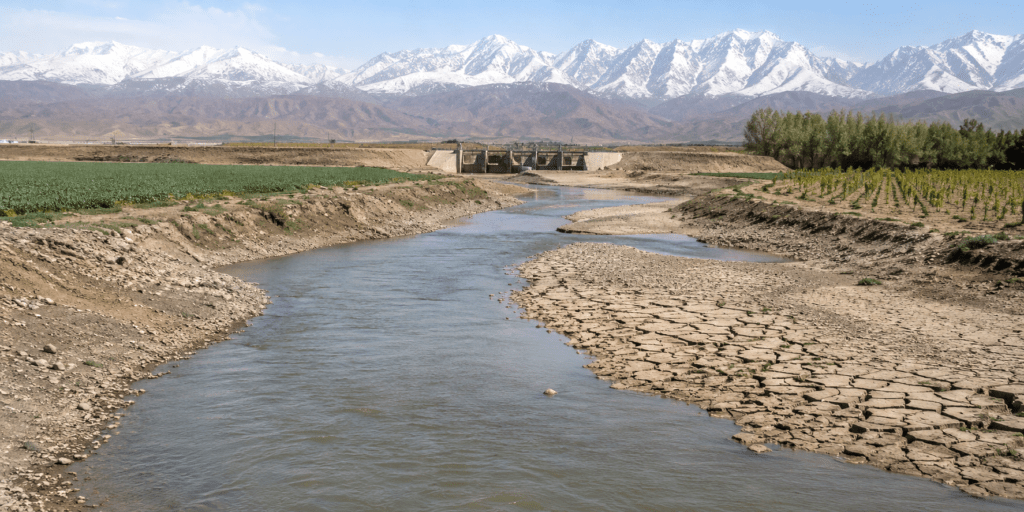
Kazakhstan has introduced limits on irrigation water use in its southern regions and is reducing the cultivation of water-intensive crops as authorities seek to prevent shortages during the 2026 growing season. At a government meeting on May 12, Minister of Water Resources and Irrigation Nurzhan Nurzhigitov said reservoirs in the country’s southern regions had accumulated 26.2 billion cubic meters of water, 500 million cubic meters more than during the same period last year. Agriculture in Kazakhstan’s arid southern regions depends heavily on water collected during the spring snowmelt period, as well as water flowing from upstream Kyrgyzstan. To avoid irrigation shortages, the government established water-consumption limits for the main agricultural regions. The Turkestan region received a limit of 3.8 billion cubic meters, followed by the Kyzylorda region with 3.2 billion cubic meters, the Almaty region with 2.1 billion cubic meters, the Zhetisu region with 1.8 billion cubic meters, and the Zhambyl region with 900 million cubic meters. Authorities said all preparatory work for the irrigation season has been completed. This included mechanized cleaning of 1,840 kilometers of irrigation canals, reconstruction of 680 kilometers of irrigation networks, and repairs to 375 hydraulic facilities. To ensure stable water supplies through the canal system, 181 pumping units have been prepared, while an additional 92 pumps are expected to be purchased. Since the beginning of the year, Kazakhstan has also shifted the process of concluding water-supply contracts with farmers to an electronic format. The new digital system covers the entire water-supply cycle, including applications, contract execution, monitoring of actual water consumption, and payment processing. To date, more than 25,000 electronic contracts have been signed with farmers. “To increase transparency and strengthen operational control over water-resource management, satellite monitoring based on Earth remote sensing is being introduced across all five southern regions of the country. Since the beginning of the year, satellite monitoring has identified 39 cases of water withdrawal without contracts in the Turkestan region, where farmers illegally used approximately 790,000 cubic meters of water,” Nurzhigitov said. At the same government meeting, Deputy Agriculture Minister Azat Sultanov said Kazakhstan plans to sow crops on a total area of 23.8 million hectares this year, 180,000 hectares more than in 2025. Priority is being given to more profitable crops. The area under oilseed cultivation will exceed 4 million hectares, while forage crops will cover 3.3 million hectares. Kazakhstan is also continuing efforts to diversify agricultural production. The area planted with grain crops will be reduced by 127,000 hectares. As part of water-saving measures, the government is cutting back on water-intensive crops such as rice and cotton. Rice cultivation areas have been reduced by 20,200 hectares. At the same time, the area under drip-irrigated cotton has increased by 29,800 hectares, while cotton grown using traditional irrigation methods has been reduced by 12,000 hectares.