• KGS/USD = 0.01144 0%
  • KZT/USD = 0.00214 0%
  • TJS/USD = 0.10508 0.48%
  • UZS/USD = 0.00008 0%
  • TMT/USD = 0.28490 -0.28%
  • KGS/USD = 0.01144 0%
  • KZT/USD = 0.00214 0%
  • TJS/USD = 0.10508 0.48%
  • UZS/USD = 0.00008 0%
  • TMT/USD = 0.28490 -0.28%
  • KGS/USD = 0.01144 0%
  • KZT/USD = 0.00214 0%
  • TJS/USD = 0.10508 0.48%
  • UZS/USD = 0.00008 0%
  • TMT/USD = 0.28490 -0.28%
  • KGS/USD = 0.01144 0%
  • KZT/USD = 0.00214 0%
  • TJS/USD = 0.10508 0.48%
  • UZS/USD = 0.00008 0%
  • TMT/USD = 0.28490 -0.28%
  • KGS/USD = 0.01144 0%
  • KZT/USD = 0.00214 0%
  • TJS/USD = 0.10508 0.48%
  • UZS/USD = 0.00008 0%
  • TMT/USD = 0.28490 -0.28%
  • KGS/USD = 0.01144 0%
  • KZT/USD = 0.00214 0%
  • TJS/USD = 0.10508 0.48%
  • UZS/USD = 0.00008 0%
  • TMT/USD = 0.28490 -0.28%
  • KGS/USD = 0.01144 0%
  • KZT/USD = 0.00214 0%
  • TJS/USD = 0.10508 0.48%
  • UZS/USD = 0.00008 0%
  • TMT/USD = 0.28490 -0.28%
  • KGS/USD = 0.01144 0%
  • KZT/USD = 0.00214 0%
  • TJS/USD = 0.10508 0.48%
  • UZS/USD = 0.00008 0%
  • TMT/USD = 0.28490 -0.28%

Viewing results 403 - 408 of 1474

“A Road Not for the Faint-Hearted”: How Austrian Prisoners of War Built a Tourist Path in East Kazakhstan

A winding mountain road in East Kazakhstan has become a point of fascination not only for tourists but also for historians, filmmakers, and researchers. Known variously as the Old Austrian Road, the Austrian Route, or Irek Zhol (“Winding Road”), this nearly 50-kilometer path connects the Katon-Karagai and Markakol districts, cutting through pristine wilderness in a national park and a state reserve. Today the path is being restored, but the road’s true value lies in a dramatic and little-known past that stretches back over a century. A New Chapter for an Old Road In July 2025, authorities announced the launch of extensive repair work on the Old Austrian Road. With a budget exceeding $1 million from the regional government, the project includes rebuilding a damaged bridge near Katon-Karagai, replacing culverts, reinforcing slopes, and rehabilitating impassable sections. The most challenging terrain lies near Lake Markakol, where the route crosses swampy stretches, sharp switchbacks, and granite outcroppings. Yet these obstacles have not deterred growing numbers of visitors, off-road enthusiasts, cyclists, hikers, and even horse riders, eager to explore the wild beauty of Eastern Kazakhstan. [caption id="attachment_35993" align="aligncenter" width="1280"] Image: TCA/Yulia Chernyavskaya[/caption] The Road’s Origins in War and Captivity Though few know it, this scenic mountain route has deep strategic and historical roots. Long before the 20th century, locals used it as a trail for horses and carts. But by the early 1900s, the Russian Empire decided to formalize the path, partly due to the road’s proximity to the Chinese border. Between 1914 and 1916, the road was reconstructed, largely by Austrian prisoners of war, mainly ethnic Czechs, Slovaks, Hungarians, and Galicians, captured during World War I. According to Vienna-based historian Lana Berndl, who has conducted extensive research on the topic, roughly 800 prisoners were transported from Austria via St. Petersburg and Omsk to the Irtysh River and then forced to march to the village of Altai (now Katon-Karagai). Around 600 reached their destination. Construction began simultaneously from Katon-Karagai and Alekseevka. Despite working only in the warmer months, the prisoners built a road whose difficulty rivals Alpine passes. During the harsh winters, many worked on local farms and integrated into village life. Some even married and remained in Kazakhstan permanently. [caption id="attachment_35994" align="aligncenter" width="1280"] Image: TCA/Yulia Chernyavskaya[/caption] Tragically, several were later repressed during Stalin’s purges. Among them was Ludwig Fritzen, a Hungarian prisoner who stayed, married a local woman, and was executed in 1937 after being accused of espionage. Remnants of this history remain: roughly 30 graves with Gothic-scripted crosses can still be found in old cemeteries throughout the region, silent testimonies to those who built the road under extreme duress. Film Rekindles Forgotten History In 2016, Austrian filmmaker Ruslana Berndl released a documentary titled The Austrian Road, which brought global attention to the forgotten story. She first learned about the road from a brief mention in a German travel guide that described it as “not for the faint-hearted” and built by Austrian POWs. Intrigued, Berndl, then a doctoral student at the University of...

Kazakhstan Labor Ministry Increases Pressure on Employers Paying “Gray” Salaries

Kazakhstan’s Ministry of Labor and Social Protection has drafted legislation aimed at eliminating the widespread practice of paying employees off the books, known locally as “gray” salaries, Minister Svetlana Zhakupova announced this week. According to ministry estimates published earlier this summer, approximately 30% of Kazakhstan’s employed population fails to contribute to the Unified Accumulative Pension Fund (UAPF), a clear indicator that they may be receiving unreported wages. Data from the Bureau of National Statistics shows that in the second quarter of 2025, 9.3 million people were employed across the country. Of these, 7.1 million were salaried employees (76.8%) and 2.2 million were self-employed (23.2%). This suggests that more than 3 million workers may be receiving wages outside the official system, avoiding both income tax and social contributions. Targeting the Shadow Economy The ministry plans to focus first on those who make no contributions at all. “We have cases where highly qualified employees officially receive the minimum wage of 85,000 KZT (about $159),” Zhakupova said. “To avoid taxes, employers declare the minimum wage on paper and pay the rest in cash.” This practice, she added, creates striking wage disparities among employees with the same qualifications and roles. “In some instances, workers in identical positions earn between 229,000 KZT ($426) and 1.2 million KZT ($2,200), depending on the employer,” Zhakupova noted. These discrepancies are particularly acute in Kazakhstan’s mining and metallurgical sector. Digital Oversight and Industry Agreements To address the issue, the ministry is negotiating industry-wide wage agreements and requiring companies to declare their staffing structures. A digital tool for this purpose is available on the enbek.kz platform. “About 20 to 25 major organizations, including several under our jurisdiction, have already submitted their staffing schedules in a pilot project,” said Zhakupova. She believes the initiative will help ensure a more equitable distribution of company profits. “We’ve seen cases where salaries have risen, yet labor productivity has not. That contradicts basic economic logic. Our digital system identifies such ‘red zones’ for inspection,” she explained. Legislative Timeline The draft law is currently under interagency review and has received support from both the government and the presidential administration. It is expected to be submitted to Kazakhstan's parliament, the Mazhilis, for consideration in the near future. In the meantime, the ministry has begun flagging suspicious labor contracts, particularly those listing highly skilled workers, such as mechanical engineers, at or near the minimum wage. More than 1.1 million people in Kazakhstan currently earn wages at or below the legal minimum. “When we see such contracts, it's clear these companies are operating in the shadow economy,” Zhakupova said during a recent government briefing. “Inspectors are now actively working with such employers.” As The Times of Central Asia previously reported, the government has also decided to freeze the minimum wage in 2026, despite earlier pledges to raise it.

Contemporary Art Center Tselinny Opens in Almaty

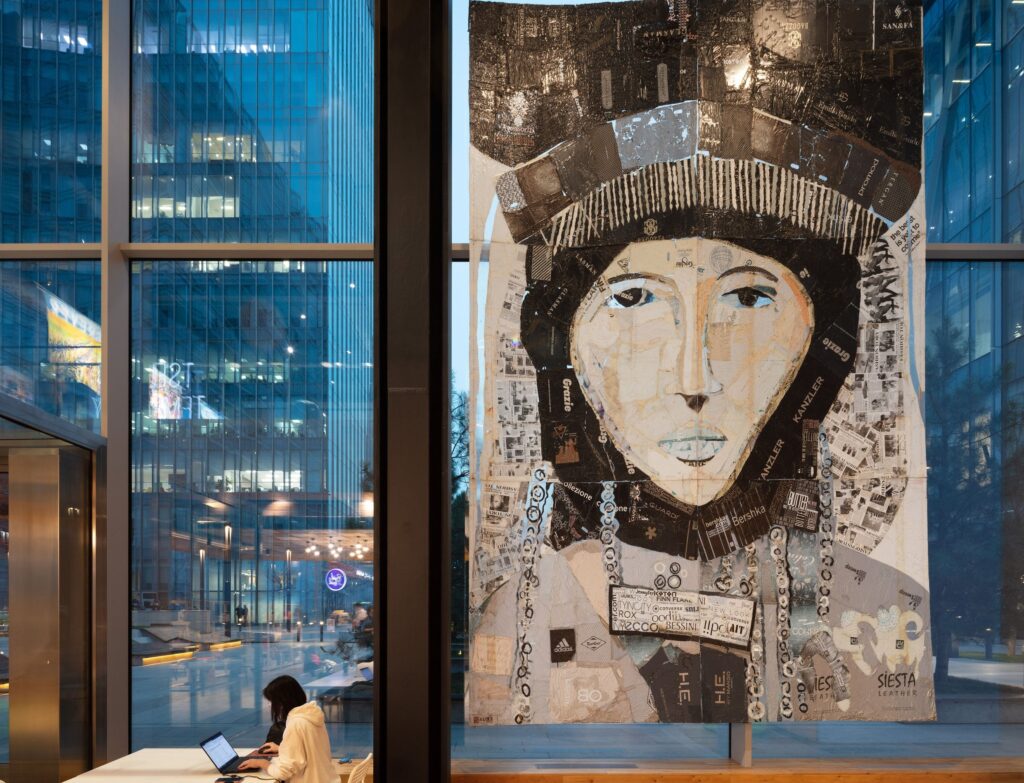
Summer in Almaty was rich with music festivals, concerts, and public projects, and this cultural momentum appears set to continue into fall. The grand opening of the Tselinny Center for Contemporary Culture last Friday marked the start of September with a major cultural milestone for the city. A Historic Space Reimagined At a recent press conference, organizers spotlighted the significance of this new cultural landmark within the evolving discourse of Central Asian contemporary art. Director Jamilya Nurkalieva led a short tour ahead of the official opening, sharing insights into the restoration and rethinking of the historic Tselinny cinema. Reinterpreting Almaty’s first panoramic cinema, an iconic piece of Soviet-era modernist architecture, was, in her words, about creating “an architectural pearl.” She described the new space as embodying “inclusivity and acceptance, the ultimate state of tranquility, almost like a hug.” [caption id="attachment_35968" align="aligncenter" width="960"] Image: TCA[/caption] [caption id="attachment_35950" align="aligncenter" width="8605"] Image: Atelier Cauchemar[/caption] The transformation was a deeply local effort. Nurkalieva emphasized the importance of working with Kazakhstani architects, builders, and craftsmen to ensure authenticity throughout the reconstruction process. Among the most unexpected discoveries during renovation were original works by renowned Soviet graphic artist Yevgeniy Sidorkin, long believed lost. His preserved sgraffito now welcomes visitors at the entrance. “Conceptually, we didn’t want the space to become a monument to Sidorkin alone, this is a place for new artists,” said Nurkalieva. “In some areas, craftsmen recreated panels from his sketches. We chose neutral tones so the sgraffito wouldn’t dominate the space.” [caption id="attachment_35983" align="aligncenter" width="782"] Image: tselinny.org[/caption] In just its first three days, Tselinny welcomed more than 12,000 visitors. The public experienced debut exhibitions, the interdisciplinary performance BARSAKELMES, and the launch of an educational program. The former Soviet cinema, now reimagined by British architect Asif Khan, has been reborn as a cultural hub for Almaty and the wider region. Tselinny will gradually extend its hours and programming over the coming months, with full operations set to begin in January 2026. [caption id="attachment_35966" align="aligncenter" width="1280"] Image: TCA[/caption] Asif Khan’s architectural vision reflects a concept of spatial unity rooted in the Kazakh cosmological balance of Tengri (sky) and Umai (earth), representing power and growth. Drawing inspiration from the steppe landscape, Khan has preserved the spirit of the original building while opening a new horizon for each visitor. Launching a New Dialogue Three exhibition projects opened in parallel with the center itself. These include installations by Gulnur Mukazhanova and Daria Temirkhan as part of BARSAKELMES; the architectural showcase From Sky to Earth: “Tselinny” by Asif Khan (curated by Markus Lahtinenmäki); and the archival project Documentation: Imagining Central Asia on the Map of Contemporary Art (curated by Asel Rashidova). These inaugural exhibitions are intended to initiate long-term dialogue between artists, institutions, and the broader public. A full program is available on Tselinny’s official website. The Return of Tselinny Once the largest cinema in Soviet Central Asia, Tselinny has now been transformed into a multifunctional art center. The revamped complex includes exhibition spaces, workshops, a library, a bookstore,...

Kazakhstan to Launch Internationally Accredited Rare Earth Laboratory

Kazakhstan is set to host an internationally accredited laboratory for rare earth metals, a move expected to bolster the country’s role in global supply chains for critical raw materials. Minister of Industry and Construction Yersayin Nagaspayev announced that agreements have been reached with two leading global laboratory brands, RCI Inspection and PARAGON, to open a geo-analytical facility in Astana under their certification. The site will include core storage and archival repositories. Preparatory work on design and feasibility studies is already underway. The initiative follows President Kassym-Jomart Tokayev’s September 8 address to Parliament, in which he emphasized the strategic importance of rare earth elements (REEs) for Kazakhstan’s long-term economic development. The laboratory will be established under the National Geological Service and is scheduled to open by mid-2026. Tokayev also directed the government to launch at least three high-tech production facilities using rare earth metals within the next three years, citing their growing importance in global trade and technology. “Given global trends, rare earth metals and other critical materials are acquiring particular significance. Kazakhstan has all the capabilities to firmly integrate into global production and trade chains,” Tokayev said. Rare earth metals, a group of 17 elements including scandium, yttrium, and the lanthanides, are essential for manufacturing electronics, batteries, renewable energy equipment, and defense technologies. Despite holding substantial reserves, Kazakhstan has traditionally exported REEs in raw form, a practice that has sparked concern among lawmakers. Nagaspayev outlined four strategic priorities for domestic processing: Battery materials production Recycling, including permanent magnets Heat-resistant alloys for turbine engines Semiconductor materials manufacturing Kazakhstan is building partnerships with the EU, U.S., Japan, South Korea, and China to advance these sectors. Planned projects include: A 15-ton-per-year gallium plant Production of high-purity manganese sulfate and graphite for battery use Nickel-based superalloys for advanced manufacturing Pilot recycling of permanent magnets is scheduled to begin next year at the Zhezkazganredmet and Ulbinsky Metallurgical Plant, in cooperation with European partners. As The Times of Central Asia recently reported, new geological surveys have revealed that Kazakhstan’s rare earth reserves exceed previous estimates, further strengthening its position as a potential global supplier.

Underwater Secrets of the Steppe: Archaeologists Unearth Ancient Artifacts in Kazakhstan’s Bogen Reservoir

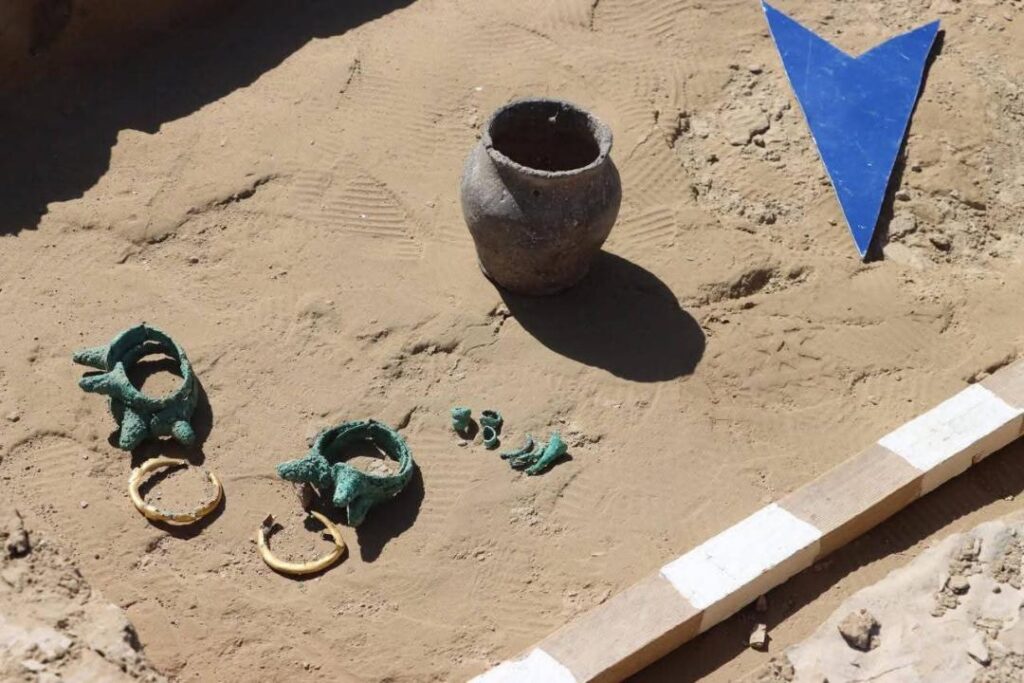
A team of archaeologists from the Zhanibekov University Research Center has uncovered a trove of ancient artifacts at the Bogen Reservoir in the Ordabasy district of Kazakhstan’s Turkestan region. An unusually dry season significantly lowered the water level, revealing archaeological remains hidden for centuries. Paleolithic Tools and Bronze Age Burials Within just one week of surveying, researchers recovered dozens of Late Paleolithic and Mesolithic stone tools, including chalcedony flakes, cores, and cutting plates. Several Bronze Age burial sites were also excavated. While skeletal remains were poorly preserved, the grave goods were remarkable: decorated ceramics, a gold-plated bronze temple ornament, rings, bracelets, earrings, and hundreds of tiny beads likely used in headdresses. A particularly notable discovery was a burial dated to the 1st century BC-1st century AD. It contained three socketed arrowheads, a utility knife, a belt buckle, and a ceramic jug. Experts say such finds affirm the continuous human settlement of the region over millennia. After analysis, the artifacts will be transferred to a local museum. Bronze Knives, a Saka Ring, and a Lost Medieval City Earlier this year, The Times of Central Asia reported that archaeologists from Margulan University had unearthed two bronze knives near Lake Toraygyr. While attributed to the early Saka period, their design reflects stylistic elements of the Early Iron Age, evidence of both advanced metallurgy and cultural connectivity across Central Asia. At another site, researchers from Al-Farabi Kazakh National University discovered a gold ring from the Scythian era, weighing nearly 8 grams and featuring a lion motif. Experts interpret the human-animal hybrid symbolism as representative of the spiritual worldview of Saka elites in the 4th-3rd centuries BC. The burial also contained the remains of a man and a woman, alongside stone, iron, and gold artifacts. In Zhetysu, archaeologists revealed the ruins of a medieval city likely destroyed during the Mongol invasions. Excavations uncovered preserved brickwork, a defensive tower, and evidence of intense fire damage. Experts have drawn comparisons with other UNESCO-listed sites such as Talgar (Talhiz) and Koilyk. Meanwhile, the Saryarka Archaeological Institute has identified 25 historical and cultural sites in the Shet district of central Kazakhstan. These range from the Bronze Age through the Iron Age and into the medieval period. Excavations are pending, awaiting official permits. The “Golden Man” of East Kazakhstan and the Buddhist Crossroads One of the country’s most celebrated discoveries in recent years remains the 2018 unearthing of the so-called “Golden Man of East Kazakhstan” by archaeologist Zeinolla Samashev. More than 3,000 gold artifacts, including earrings, necklaces, and horse harness ornaments, were recovered from a burial dating to the 7th-8th centuries BC. Further south, in the Aiyrandy Gorge of the Merke district, archaeologists uncovered the remains of an ancient Buddhist temple, including a carved stone head of the Buddha. The find underscores the region’s historic role as a crossroads of religions and cultures along the Silk Road. From Paleolithic tools and Saka-era treasures to lost medieval cities and Buddhist sanctuaries, Kazakhstan’s recent archaeological discoveries reveal an extraordinary continuity of settlement...

Kazakhstan, Uzbekistan, Kyrgyzstan Condemn Israel for Attack on Hamas in Qatar

Several countries in Central Asia sharply criticized Israel’s airstrike on a Hamas meeting in Qatar on Tuesday, saying it was a violation of sovereignty and international law.  “Whatever the objective, such actions must not be allowed,” President Kassym-Jomart Tokayev of Kazakhstan said. “This violates the sovereignty of the State of Qatar and contradicts the principles of international law.” Uzbekistan´s Ministry of Foreign Affairs issued a similar statement about the attack, which escalated tensions in the Middle East and threatened to disrupt already fragile talks about a cease-fire in Gaza.  The ministry noted that the attack happened in a residential area of the Qatari capital of Doha and described it as “an encroachment upon the inviolability of borders and security” of the Gulf state. “Such actions are unacceptable and represent a serious disregard for the UN Charter, fundamental norms and principles of international law,” the ministry statement said. “Uzbekistan has consistently opposed any form of use of force in international relations that exacerbates the already complex situation in the Middle East.” President Sadyr Japarov of Kyrgyzstan also condemned the Israeli attacks, according to presidential spokesman Askat Alagozov. Hamas negotiators have a base in Qatar, which has served as a mediator in efforts to reach a cease-fire in Gaza. Israel said the strike in Doha was retaliation for a shooting attack that killed five people in Jerusalem on Monday.  Kazakhstan and other Central Asian countries have been developing more investment projects with Qatar as they diversify their international trading partners.