• KZT/USD = 0.00218
  • TJS/USD = 0.10800
  • UZS/USD = 0.00008
  • TMT/USD = 0.29850
  • KZT/USD = 0.00218
  • TJS/USD = 0.10800
  • UZS/USD = 0.00008
  • TMT/USD = 0.29850
  • KZT/USD = 0.00218
  • TJS/USD = 0.10800
  • UZS/USD = 0.00008
  • TMT/USD = 0.29850
  • KZT/USD = 0.00218
  • TJS/USD = 0.10800
  • UZS/USD = 0.00008
  • TMT/USD = 0.29850
  • KZT/USD = 0.00218
  • TJS/USD = 0.10800
  • UZS/USD = 0.00008
  • TMT/USD = 0.29850
  • KZT/USD = 0.00218
  • TJS/USD = 0.10800
  • UZS/USD = 0.00008
  • TMT/USD = 0.29850
  • KZT/USD = 0.00218
  • TJS/USD = 0.10800
  • UZS/USD = 0.00008
  • TMT/USD = 0.29850
  • KZT/USD = 0.00218
  • TJS/USD = 0.10800
  • UZS/USD = 0.00008
  • TMT/USD = 0.29850
26 November 2026

Viewing results 43 - 48 of 743

Kazakh Lawmaker Proposes Tougher Penalties for Poaching

Kazakh Senator Andrei Lukin has called for tougher penalties for poaching amid a rise in violations, including illegal fish exports and document forgery. In a parliamentary inquiry, he urged a review of existing sanctions, greater transparency in industry subsidies through digital platforms, and stronger independence for relevant scientific organizations. Current legislation provides for fines of up to $27,000 and prison sentences of up to 10 years. However, Lukin argued that these measures are insufficient. According to his data, 84,000 tons of fish were seized from illegal trade between 2022 and 2025. At the same time, stocks of commercially important species are declining. In Lake Zaysan, pikeperch volumes fell from 9,300 to 4,000 tons, while carp has nearly disappeared. The senator also highlighted discrepancies between fishing quotas and export volumes. For example, with quotas set at 16,000 tons for 2022-2024, approximately 32,000 tons of pikeperch were exported, with a total value of around $115 million. He further criticized the effectiveness of the 2021-2030 fisheries development program. Of the $564 million allocated, only $38 million has been used. Cases of embezzlement of budget funds and the repeated use of documents in processing export licenses have also been identified. In response, Lukin proposed tightening export controls, ensuring compliance between quotas and actual catch volumes, and accelerating the rollout of the E-Fish digital system. The E-Fish system, mandatory since August 2025, automates the recording of catches and product turnover. According to the Ministry of Agriculture of Kazakhstan, more than 95% of market participants are registered in the system, which has reduced the shadow market by 2,000 tons. The Times of Central Asia previously reported on the expansion of state support for aquaculture, despite continued growth in fish production.


Air Quality Report Shows Central Asia’s Air Getting Rapidly Worse

Tajikistan ranked as the world’s third most polluted country in 2025, according to the latest World Air Quality Report by IQAir. The report analyzed PM2.5 concentrations across 9,446 cities in 143 countries and territories. PM2.5, fine particulate matter measured in micrograms per cubic meter, is widely used as a key indicator of air pollution. The five most polluted countries in 2025 were Pakistan (67.3 µg/m³), Bangladesh (66.1 µg/m³), Tajikistan (57.3 µg/m³), Chad (53.6 µg/m³), and the Democratic Republic of the Congo (50.2 µg/m³). Only 13 countries and territories met the World Health Organization annual PM2.5 guideline of 5 µg/m³, including Australia, Iceland, and Estonia. Overall, 130 out of 143 countries exceeded the guideline. Kazakhstan records the cleanest air in Central Asia, but still had the 29th worst air globally in 2025, a very significant decline from 71st in 2024. Uzbekistan has the region's dirtiest air, and the 10th worst worldwide, while Kyrgyzstan is only slightly better, in 19th. Like Kazakhstan, both countries have fallen down the rankings since they were last put together in 2024. Kyrgyzstan had been in 41st place, while Uzbekistan has fallen from 19th. Turkmenistan, which was also among the 30 most polluted countries in 2024, was not included in the 2025 report due to a lack of available data. Karaganda in Kazakhstan is Central Asia's most polluted city, ranking 26th globally in 2025. The city recorded an annual PM2.5 level of 72.6 µg/m³, more than ten times the WHO guideline. Other heavily polluted cities in the region included Fergana (30th, 68.8 µg/m³), Dushanbe (51st, 57.3 µg/m³), Guliston (100th), and Tashkent (225th, 39 µg/m³). The report also noted that the world’s 25 most polluted cities in 2025 were all located in India, Pakistan, and China, with India accounting for three of the top four.

Kazakhstan to Launch Digital Schools Project

Kazakhstan will launch a pilot digital schools project, Qazaq Digital Mektebi, in September 2026, aimed at reducing disparities in educational quality between rural and urban schools. The initiative will target under-enrolled schools in seven regions, according to the Ministry of Education. The project provides for the use of AI technologies to support the teaching of natural sciences, mathematics, and humanities. The approach is intended to help students learn more independently while increasing engagement in the learning process. The pilot phase will be implemented in the North Kazakhstan, Kostanay, Akmola, Pavlodar, West Kazakhstan, Aktobe, and East Kazakhstan regions. Authorities are currently assessing schools’ technical readiness and digital infrastructure. Based on the pilot’s results, the government plans to develop a national educational platform offering digital content tailored for rural schools. The ministry is also considering integrating domestic IT solutions, including the Qalan.kz platform, which incorporates gamification and artificial intelligence elements and has more than 800,000 users. The project is a resident of the technology park Astana Hub. The ministry expects the initiative to improve access to quality education in rural areas and to form part of the country’s broader digital transformation strategy. The Times of Central Asia previously reported that Kazakhstan is accelerating the adoption of digital technologies across key sectors, including education.

Kazakhstan’s Central Bank Links Tenge Strengthening to Rising Oil Prices

Governor of the National Bank of Kazakhstan, Timur Suleimenov, has attributed the recent strengthening of the tenge to rising global oil prices, which have increased export revenues and boosted the supply of foreign currency on the domestic market. According to the regulator, the tenge appreciated by 3.9% in March, reaching 478.15 KZT to the dollar. The average daily trading volume on the Kazakhstan Stock Exchange increased from $335 million to $372 million, while total trading volume reached $6.7 billion. Currency sales from the National Fund totaled $400 million, supporting transfers to the state budget. In addition, approximately $391 million was supplied through the mandatory sale of foreign currency earnings by quasi-state sector entities. No foreign exchange interventions were conducted during the period. As a result, the National Fund accounted for about 6% of total trading volume, or roughly $22 million per day. Exporters remained the primary source of foreign currency supply, Suleimenov noted. “Kazakhstan’s main export is oil. Prices are rising, volumes remain unchanged, and accordingly, export revenues and currency supply are increasing,” he said. Preliminary estimates indicate that National Fund currency sales in April will total $300-400 million, broadly in line with March levels. Suleimenov also said the tenge remains stable despite earlier forecasts by some analysts suggesting a potential weakening to 1,000-2,000 KZT to the dollar. At the same time, he warned of inflationary risks linked to rising tariffs. According to him, the government plans to factor inflationary pressures into future adjustments of utility and fuel prices. As of April 1, the moratorium on increases in utility and fuel tariffs in Kazakhstan, introduced in October 2025, has expired. The Times of Central Asia previously reported that economist Aidarkhan Kusainov had suggested the tenge could weaken to 1,000 per dollar or even further, arguing that the national currency is overvalued.

Sindarov Ahead in Candidates, While Asaubayeva Shares Women’s Lead

Javokhir Sindarov of Uzbekistan is leading after four rounds of the FIDE Candidates Tournament, the elite chess contest that will determine the challenger to the world champion. In the women’s competition, Bibisara Asaubayeva of Kazakhstan is tied for first place. Sindarov, winner of the 2025 World Cup in Goa, India, played with the white pieces and defeated Fabiano Caruana on Wednesday for his third win of the candidates tournament at the Cap St Georges Hotel & Resort near Paphos, Cyprus. Sindarov put early pressure on the American and built a sizeable advantage on the clock. The 20-year-old Uzbekistani player faces Hikaru Nakamura of the United States in the fifth round on Friday. Featuring eight players, the 14-round tournament began on March 28 and ends on April 16. The winner will challenge the current world champion, India’s Gukesh Dommaraju, later this year. In an interview with the Lichess platform, Sindarov said preparation was the key to the win over Caruana and he hasn’t been focused on whether other players would catch his early lead in the tournament. He currently has 3.5 points, while Caruana is in second place with 2.5 points. “I don’t think about this a lot,” he said. “I was just playing chess.” Sindarov’s style of play often includes “bold sacrifices, energetic attacks, and creative solutions to difficult positions,” making him an unpredictable competitor in Cyprus, according to the candidates tournament website. It noted his strong results at the elite level, among them a gold medal at the Chess Olympiad in 2022 in Chennai, India, “where Uzbekistan sensationally won ahead of many traditional chess powers.” In the FIDE Women’s Candidates Tournament, Asaubayeva, 22, drew in a game against China’s Tan Zhongyi on Wednesday. The Kazakhstani player and Anna Muzychuk of Ukraine are currently joint tournament leaders with 2.5 points. Asaubayeva plays against Kateryna Lagno of Russia in round five on Friday. The winner of the tournament will challenge the women’s world champion, Ju Wenjun of China. Asaubayeva won the Women’s World Blitz Championship in 2021, 2022 and again in 2025. FIDE, the Switzerland-based governing body of chess, awarded grandmaster status to Asaubayeva last year. “Unlike purely positional grinders, she thrives in active positions where initiative and momentum matter,” says the candidates tournament website, noting the Kazakhstani player’s standout composure in knockout and high-tempo formats.

Literary Competition Showcases Outstanding New Kazakh Novels

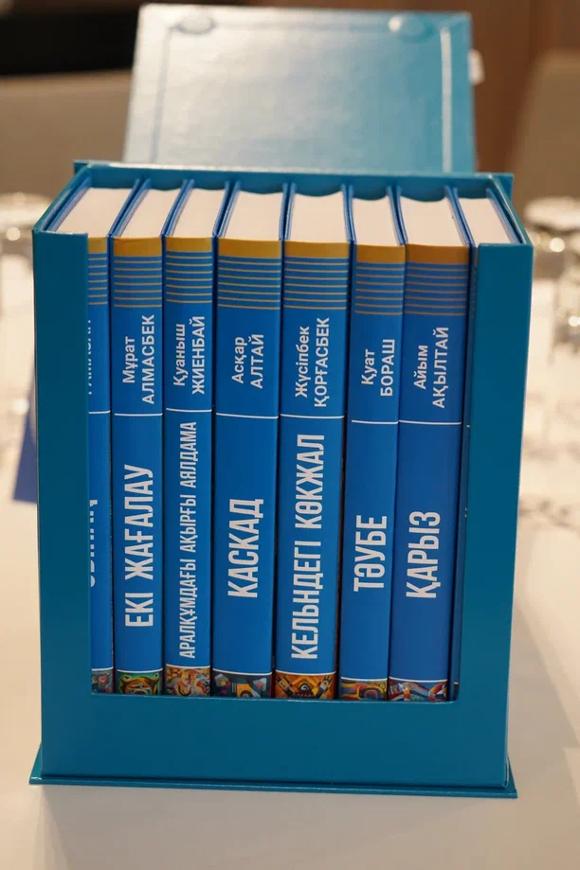
The “Modern Kazakh Novel” competition, with the support of Shukhrat Ibragimov, Chairman of the Board of Directors of Eurasian Resources Group (ERG), was launched last year as a national cultural initiative. The project was designed to stimulate the growth of contemporary Kazakh prose and foster closer ties between authors and readers. With more than 3,000 submissions, the competition highlighted the Kazakh public's interest in literature. Eight authors reached the final stage of the competition. Seven finalists were each awarded 3 million tenge ($6,300), while the winner of the grand prize received 15 million tenge ($31,500). A notable achievement of the initiative was the publication of the shortlisted works. A thousand copies of each novel were printed and officially presented to the public. Of these, 750 copies were transferred to the National Library of the Republic of Kazakhstan, allowing the books to be distributed widely through the national library network. [caption id="attachment_46360" align="aligncenter" width="300"] @ERG[/caption] The finalists were Duman Ramazan (with a novel called Trial), Kuanysh Zhienbay (The Final Stop in Aralkum), Nurzhan Kuantaiuly (Unfaithful Game), Askar Altay (Cascade), Murat Almasbek (Two Shores), Kuat Borash (Repentance), and Aiyum Akyltai (Debt). The grand prize was awarded to Zhusipbek Korgasbek for his novel The Wolf from Cologne. Plans have also been announced to adapt the work into a feature film. In his message to participants, ERG's Chairperson Shukhrat Ibragimov highlighted the value of national literature and expressed confidence in contemporary writers. He stressed that national values remain vital for younger generations, as they connect historical heritage with the demands of a rapidly evolving world shaped by innovation and digital technologies. Ibragimov also noted that one of literature’s key roles is to shape new characters that reflect the realities of each new era. In this context, such competitions create meaningful opportunities for emerging writers and help reinterpret national identity from fresh perspectives. According to jury chair Qaynar Olzhai, the initiative was initially intended to support novels written in the Kazakh language. Over the course of a year, hundreds of applications were received. From 220 promising novel projects reviewed by experts, five finalists were originally planned. However, due to the unexpectedly high quality and quantity of submissions, the sponsor agreed to expand the shortlist by adding two more finalists. [caption id="attachment_46361" align="aligncenter" width="200"] @ERG[/caption] Ultimately, every meaningful achievement is rooted in intellectual and spiritual development. From pilots and mountaineers to global business leaders, many groundbreaking ideas originate from reading and literature. In this sense, the “Modern Kazakh Novel” project is an effort to support the creative community and encourage literary innovation.