• KGS/USD = 0.01144 0%
  • KZT/USD = 0.00205 0%
  • TJS/USD = 0.10784 0%
  • UZS/USD = 0.00008 0%
  • TMT/USD = 0.28490 0%
  • KGS/USD = 0.01144 0%
  • KZT/USD = 0.00205 0%
  • TJS/USD = 0.10784 0%
  • UZS/USD = 0.00008 0%
  • TMT/USD = 0.28490 0%
  • KGS/USD = 0.01144 0%
  • KZT/USD = 0.00205 0%
  • TJS/USD = 0.10784 0%
  • UZS/USD = 0.00008 0%
  • TMT/USD = 0.28490 0%
  • KGS/USD = 0.01144 0%
  • KZT/USD = 0.00205 0%
  • TJS/USD = 0.10784 0%
  • UZS/USD = 0.00008 0%
  • TMT/USD = 0.28490 0%
  • KGS/USD = 0.01144 0%
  • KZT/USD = 0.00205 0%
  • TJS/USD = 0.10784 0%
  • UZS/USD = 0.00008 0%
  • TMT/USD = 0.28490 0%
  • KGS/USD = 0.01144 0%
  • KZT/USD = 0.00205 0%
  • TJS/USD = 0.10784 0%
  • UZS/USD = 0.00008 0%
  • TMT/USD = 0.28490 0%
  • KGS/USD = 0.01144 0%
  • KZT/USD = 0.00205 0%
  • TJS/USD = 0.10784 0%
  • UZS/USD = 0.00008 0%
  • TMT/USD = 0.28490 0%
  • KGS/USD = 0.01144 0%
  • KZT/USD = 0.00205 0%
  • TJS/USD = 0.10784 0%
  • UZS/USD = 0.00008 0%
  • TMT/USD = 0.28490 0%

Viewing results 19 - 24 of 725

Opinion: Eurasia’s New Corridors Are More Than a Transit Race

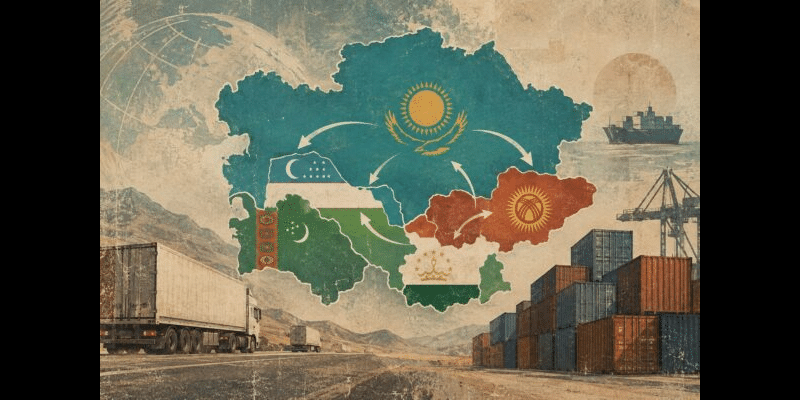
Across Eurasia, new transport corridors are usually described as instruments of rivalry: routes to bypass Russia, ports to outflank competitors, or rail links to shift influence between regions. The conflict around Iran, the rivalry between India and Pakistan, instability in the Afghanistan-Pakistan zone, crises in the Middle East, sanctions, competition over transport routes, and growing struggles for transit influence all reinforce the image of a continent divided by political contradictions. Increasingly, this is the lens through which Eurasia is viewed. The development of transport routes and connectivity is now often explained through the logic of rivalry. Some corridors are described as alternatives to others. Certain ports are positioned against competing ports. Routes are increasingly perceived as tools of competition, circumvention, or geopolitical influence. The continent can also be viewed differently. Alongside political crises, another reality is visible: the continent continues to connect itself through new routes and networks. Railways, ports, energy grids, dry ports, container corridors, digital cables, and trade chains are gradually linking spaces that only recently were seen as separate regions. In many ways, Eurasia has always been a space of movement, exchange, and connectivity. The Silk Road Was a Network, Not a Single Route A recent article by News Central Asia made a simple but important observation: the Silk Road functioned because it belonged to everyone. This idea contains one of the central lessons of Eurasian history. The Silk Road was never a single road. It was not one unified highway built according to a master plan or controlled by a single center. For centuries, the continent was connected by a vast network of caravan routes, maritime pathways, mountain passes, cities, and trade hubs through which goods, people, knowledge, and ideas circulated. Some routes gained importance while others temporarily declined. States, empires, and commercial centers changed. New pathways emerged. Yet the network itself endured. The strength of the Silk Road lay not in one route, but in the multiplicity of connections. When one corridor became unsafe, trade shifted elsewhere. When political conditions changed, commerce adapted to a new geography. The continental network remained flexible and multilayered. This offers an important lesson for today’s Eurasian space as well. Many modern transport corridors did not emerge from nothing. In many respects, they follow historical logic. Railways have replaced caravan paths, dry ports have succeeded old trade hubs, and container routes continue along directions in which goods moved for centuries. Corridors and the Logic of Rivalry Today, most transport and economic corridors are interpreted as competing projects. Nearly every new route is framed through confrontation, alternatives, or attempts to bypass another direction. The Middle Corridor is often described as an alternative to northern routes. The International North-South Transport Corridor is presented as a separate geo-economic axis. Trans-Afghan projects are portrayed as competitors to other links between Central and South Asia. Chabahar and Gwadar are depicted as rival ports. Even the South Caucasus transport hub is increasingly viewed through the prism of struggles over control of routes and flows. Yet historically,...

Tajikistan and Kyrgyzstan Conduct First Cargo Shipments Using eTIR System

Tajikistan and Kyrgyzstan have carried out their first international cargo shipments using the eTIR system, marking a step toward the digitalization of transport and customs procedures in Central Asia The move is part of a wider regional push to reduce paperwork at borders and speed up freight movement across Central Asia’s road transport corridors. The International Road Transport Union announced the development on May 12. According to the organization, the first operations represent an important milestone in the region’s transition toward electronic customs data exchange and digital transit management. One shipment involved the delivery of vehicles from Kyrgyzstan to Tajikistan, while a second operation transported vehicle parts in the opposite direction. Electronic eTIR guarantees were issued by the national international transport associations of both countries: the Association of the International Road Transport Operators of the Kyrgyz Republic, known as AIRTO KR, and the Association of International Road Carriers of Tajikistan, known as ABBAT. Both operations were processed through the eTIR National Application developed by the United Nations Economic Commission for Europe. The system allows countries to connect to digital international transit procedures without having to build complex IT infrastructure from scratch. Before the launch of the pilot shipments, specialists from the IRU and UNECE conducted a series of training seminars for customs officials and representatives of the transport sector. The training sessions were held in Osh, Kyzyl-Bel, and Khujand with support from transport associations and customs authorities in both countries. The IRU emphasized that the successful implementation of the first eTIR operations was the result of close cooperation among customs agencies, transport operators, international road transport associations, and United Nations structures. IRU said it plans to continue working with national authorities and regional partners to expand eTIR use across Central Asia. The traditional TIR system is widely used for international customs transit operations, allowing goods to move across borders in sealed cargo compartments under a unified guarantee and customs control mechanism. The digital eTIR platform is considered the next stage in the system’s development. It is expected to simplify information exchange between customs authorities, transport operators, and guarantee associations, while also accelerating border crossing procedures and reducing paperwork.

Kyrgyzstan Connects to International Alipay+ QR Payment Network

Kyrgyzstan has launched international QR payments through Alipay+, allowing users of the national Elkart payment system to pay for purchases abroad through a mobile app without relying on cash or foreign payment apps. The launch of the project was announced by the Interbank Processing Center, operator of the national payment system Elkart, with support from the National Bank of Kyrgyzstan. According to the payment operator, the system is already functioning in Kazakhstan and Malaysia, while another 57 countries are expected to join the network within the next month. China is also scheduled to connect to the platform on June 15, enabling Kyrgyz users to pay through a unified QR infrastructure at millions of retail locations. “For Kyrgyzstan, this is a historic event and another important step in the development of the country’s digital financial ecosystem,” Elkart said in a statement. National Bank Chairman Almaz Baketaev described the launch of international QR payments as part of a national strategy to digitalize the financial market. “The National Bank of Kyrgyzstan places special emphasis on implementing modern digital solutions that simplify the integration of our financial system into the global space,” Baketaev said during a press conference in Bishkek. Authorities and market participants expect the new system to simplify payments for tourists, labor migrants, and businesses amid Kyrgyzstan’s expanding economic ties with China and other Asian countries. Integration of the payment systems began in September last year. Representatives of the processing center said the technical integration was completed in a relatively short period of time. Over the past five years, Kyrgyzstan has actively developed its digital financial infrastructure. According to the National Bank, more than 114,000 QR codes have already been installed at retail and service businesses across the country. In 2025, approximately 525 million transactions worth around $10.3 billion were processed through the national system, roughly ten times higher in transaction volume than the previous year.

Kyrgyzstan Introduces State Regulation of Fuel Prices

Kyrgyzstan has introduced temporary state regulation of motor fuel prices amid continued increases in the cost of gasoline and diesel, which the country imports largely from Russia. The Cabinet of Ministers adopted a resolution introducing measures to stabilize fuel prices, ensure economic security, maintain uninterrupted fuel supplies, and support businesses. Under the resolution, the government will subsidize imports of gasoline, diesel fuel, and liquefied petroleum gas from May 25 through September 30, 2026. Authorities have established fixed benchmark prices for imported fuel: AI-92 gasoline: $860 per ton; AI-95 gasoline: $940 per ton; diesel fuel: $950 per ton; liquefied petroleum gas: $575 per ton. The difference between market prices and the state-established benchmark prices will be compensated to importers through government subsidies. At the same time, the Ministry of Economy has been instructed to introduce temporary state regulation of retail fuel prices by establishing maximum allowable prices. The Cabinet of Ministers has also temporarily lifted restrictions on fuel imports by road transport, although most fuel deliveries to Kyrgyzstan traditionally arrive by rail from Russia. The decision comes amid mounting pressure on fuel markets across Central Asia. The Times of Central Asia previously reported that by mid-May, Kyrgyzstan’s fuel reserves covered only around one to one and a half months of consumption, while the country’s annual fuel demand is estimated at approximately 1.6 million tons. Analysts link rising fuel prices across the region to higher global oil prices after tensions involving Iran escalated, as well as to lower refining volumes in Russia following Ukrainian drone strikes on refinery infrastructure. Kyrgyzstan consumes around 1.6 million tons of motor fuel annually and imports roughly 1.2 million tons, remaining heavily dependent on external suppliers because of its limited domestic refining capacity.

Central Asia Feels Fuel Strain as Kazakhstan Prices Edge Higher

Kazakhstan's fuel market is moving into a new phase after the end of the government freeze on AI-92 gasoline and diesel. Pump prices have risen by small amounts so far. Retail prices are rising cautiously amid growing pressure from neighbors where fuel costs more. Kazakhstan still has some of the cheapest gasoline in the region, but that advantage creates a risk: cheap fuel attracts cross-border demand and makes it harder to fund the refining capacity the country says it needs. On October 16, 2025, Kazakhstan's government introduced a moratorium on further increases in AI-92 gasoline and diesel as part of a wider anti-inflation package. The decision also put the Energy Ministry, the competition agency, and regional authorities in charge of keeping supplies stable. The measure came after inflation and tariff reforms had raised concerns about household costs. The freeze ended on April 1, 2026, but by mid-April, the Energy Ministry was still trying to calm expectations. Kazinform cited Vice Minister of Energy Kaiyrkhan Tutkyshbayev on April 14 as saying most prices had risen mainly by one tenge after the moratorium was lifted, and that the state would not allow a sharp jump. The tone matched what drivers were seeing: a controlled rise rather than a sudden reset. The memory of January 2022, when an LPG price jump helped spark unrest, still hangs over fuel policy. The end of the freeze also fed into inflation expectations. National Bank Governor Timur Suleimenov warned in April that renewed growth in fuel prices and utility tariffs had to be handled cautiously, because a sharp reset could reverse the slowdown in inflation. The National Bank later said reforms in utility tariffs and fuel prices accounted for 32.9% of household inflation expectations in March. That made the fuel moratorium more than a pump-price measure: it was one of the state’s main tools for containing expectations while inflation remained in double digits. An April 9 check by Tengri Auto found that most filling stations in Almaty and the surrounding area were still selling fuel close to the previous price range. Several major networks, however, had already moved AI-92 toward 240 tenge per liter. AI-95, which was not covered by the main freeze, had risen to 328 tenge at one network. A Kazinform market check published on May 25 showed the same gradual pattern. AI-92 was listed at 238-239 tenge per liter in Astana, 238-241 tenge in Almaty, and 224-227 tenge in Shymkent. Diesel stood at 329 tenge in Astana, 330-337 tenge in Almaty, and 332-335 tenge in Shymkent. The figures point to a market that is moving, but still under close control. Fuel is also feeding into Kazakhstan's broader inflation picture. The Bureau of National Statistics put annual inflation at 10.6% in April 2026. Petrol prices were up 16.1% year-on-year and added 0.53 percentage points to annual price growth. Transport as a category added 1.1 percentage points. Fuel is one of the costs households notice most directly, and its effects spread through freight, food distribution, agriculture, taxis,...

Center for Legal and Safe Labor Migration Opens in Bishkek

Kyrgyzstan’s second Resource Center for Migrants opened in the capital, Bishkek, on May 22. The new center is intended to expand citizens’ access to reliable information on safe, organized, and legal labor migration, as well as raise public awareness of the risks of illegal migration, human trafficking, and other forms of exploitation. The center was established under the EU-funded PROTECT project, a regional initiative implemented by the International Centre for Migration Policy Development in Afghanistan, Kazakhstan, Kyrgyzstan, Pakistan, Tajikistan, and Uzbekistan. Migrant resource centers are intended to serve as first points of contact for people considering employment abroad, particularly those who may otherwise rely on informal recruiters or unverified online information. Such centers typically provide advice on legal migration pathways, employment procedures, documentation, workers’ rights, and the risks associated with irregular migration. According to Kyrgyzstan’s Ministry of Labor, Social Security, and Migration, the Resource Center in Bishkek will conduct outreach activities, organize pre-departure orientation sessions for potential migrants, providing training on safe labor migration. The first Resource Center for Migrants in Kyrgyzstan opened in Osh, the country’s second-largest city, in March 2024. Since then, the center has provided assistance to more than 21,000 people through consultations, information events, and job fairs. The opening of the Bishkek center comes as labor migration continues to play a major role in Kyrgyzstan’s economy. Remittances help support household incomes, particularly in regions where local employment opportunities remain limited. However, dependence on foreign labor markets also leaves migrants vulnerable to rule changes, currency fluctuations, and exploitation by intermediaries. In 2025, remittances to Kyrgyzstan totaled $3.49 billion, according to the National Bank of the Kyrgyz Republic. The vast majority, $3.29 billion, came from the countries of the Commonwealth of Independent States (CIS), while $198 million came from countries outside the CIS. Kyrgyzstan is working to diversify its labor migration destinations. Russia has long been the main destination for Kyrgyz labor migrants, although Bishkek has sought in recent years to expand legal employment channels to other countries, including Turkey, South Korea, Japan, and several European countries.