• KZT/USD = 0.00216
  • TJS/USD = 0.10800
  • UZS/USD = 0.00009
  • TMT/USD = 0.29760
  • KZT/USD = 0.00216
  • TJS/USD = 0.10800
  • UZS/USD = 0.00009
  • TMT/USD = 0.29760
  • KZT/USD = 0.00216
  • TJS/USD = 0.10800
  • UZS/USD = 0.00009
  • TMT/USD = 0.29760
  • KZT/USD = 0.00216
  • TJS/USD = 0.10800
  • UZS/USD = 0.00009
  • TMT/USD = 0.29760
  • KZT/USD = 0.00216
  • TJS/USD = 0.10800
  • UZS/USD = 0.00009
  • TMT/USD = 0.29760
  • KZT/USD = 0.00216
  • TJS/USD = 0.10800
  • UZS/USD = 0.00009
  • TMT/USD = 0.29760
  • KZT/USD = 0.00216
  • TJS/USD = 0.10800
  • UZS/USD = 0.00009
  • TMT/USD = 0.29760
  • KZT/USD = 0.00216
  • TJS/USD = 0.10800
  • UZS/USD = 0.00009
  • TMT/USD = 0.29760
31 August 2026

Viewing results 43 - 48 of 771

Kyrgyzstan Approves Chinese Loan for CKU Railway

Kyrgyzstan’s parliament has approved in the first reading a bill ratifying a preferential loan agreement with the Export-Import Bank of China to help finance the country’s share in the construction of the China-Kyrgyzstan-Uzbekistan (CKU) railway, one of Central Asia’s largest transport infrastructure projects. The CKU railway is a flagship regional connectivity initiative designed to improve trade routes between China, Central Asia, and beyond. Construction officially began on December 27, 2024, in Kyrgyzstan’s Jalal-Abad region. Once completed, the 523-kilometer railway will connect Kashgar in China with Torugart, Makmal, and Jalal-Abad in Kyrgyzstan before continuing to Andijan in Uzbekistan. The route is expected to carry up to 15 million tons of cargo annually. The project is particularly significant because neither Kyrgyzstan nor Uzbekistan currently has a direct rail connection with China. At present, Kazakhstan is the only Central Asian country with such a link. Construction is being managed by China-Kyrgyzstan-Uzbekistan Railway Company LLC, a joint venture established by the three participating countries. The railway is expected to cost $4.7 billion. About half will be financed through a 35-year Chinese loan to the joint project company, which will be responsible for repayment. The remaining $2.3 billion will be contributed as equity, with China holding 51%, while Kyrgyzstan and Uzbekistan will each contribute 24.5%. According to Kyrgyzstan’s Deputy Minister of Transport and Communications Almaz Turgunbaev, Kyrgyzstan will use a $304.5 million preferential loan from the Export-Import Bank of China to finance half of its contribution to the joint company, which will oversee the railway project. Kyrgyzstan’s total share in the project amounts to roughly $609 million, with half funded directly by the state budget and the rest through borrowed funds. The loan has a term of 25 years, including a five-year grace period, with an annual interest rate of 1.5%. According to Kyrgyzstan's Finance Ministry, the grant element of the loan stands at 35.46%. Officials said the funds will be used exclusively to finance Kyrgyzstan’s equity contribution to the joint railway company and cover construction costs. As of January 31, 2026, Kyrgyzstan’s debt to Eximbank stood at about $1.5 billion, making China the country’s largest external creditor. The Kyrgyzstan section of the railway will stretch more than 304 kilometers and is considered the most technically challenging part of the project. It will include 50 bridges and 29 tunnels with a combined length of about 120 kilometers, meaning around 40% of the route inside Kyrgyzstan will consist of tunnels and bridges. The railway is expected to improve regional logistics by creating a shorter trade route between China and Europe via Central Asia, bypassing existing northern corridors.

EU Launches Platform to Mobilize Up to €2 Billion for Europe–Central Asia Connectivity

The European Commission launched a Connectivity Agenda Platform on June 23, 2026, and concluded statements of intent with international financial institutions expected to mobilize up to €2 billion ($2.3 billion) for transport, border-crossing and trade-facilitation projects across the Black Sea region and the South Caucasus. The initiative was unveiled at a high-level ministerial meeting in Brussels, hosted by European Commissioner for Enlargement Marta Kos, Commissioner for International Partnerships Jozef Síkela, and Commissioner for Sustainable Transport Apostolos Tzitzikostas. The meeting brought together transport ministers and senior officials from EU member states, as well as representatives from Armenia, Kazakhstan, Kyrgyzstan, Moldova, Tajikistan, Turkmenistan, Türkiye, Ukraine, and Uzbekistan, alongside international lenders, to advance connectivity projects under the EU’s Global Gateway strategy. The new platform is designed to coordinate investments and policy actions across transport, energy, digital connectivity, and trade. Participants also agreed to improve the operational efficiency of the Trans-Caspian Transport Corridor, a wider framework that includes the Trans-Caspian International Transport Route, or TITR, also known as the Middle Corridor. The route links China and Europe through Central Asia and the South Caucasus, offering an alternative to transport routes crossing Russia. The European Commission said the expected financing would support transport infrastructure, border-crossing modernization, and trade-facilitation projects aimed at improving freight movement across the corridor. “The Trans-Caspian Transport Corridor is becoming a vital bridge between Europe and Asia,” Síkela said, adding that the investments would help make the route faster, more reliable, and better integrated. Tzitzikostas said stronger transport links were critical for economic competitiveness and regional resilience. The platform’s launch came during Kazakh President Kassym-Jomart Tokayev’s official visit to Brussels, where he met with European Council President António Costa and European Commission President Ursula von der Leyen. In an EU–Kazakhstan joint statement, the leaders reaffirmed the strategic importance of the Trans-Caspian corridor and pledged deeper cooperation under the EU’s Global Gateway strategy. They also highlighted the EU’s role as Kazakhstan’s largest trade and investment partner and agreed to deepen cooperation in critical minerals, energy, transport, digitalization, and emerging technologies. Speaking at the Kazakhstan-EU roundtable in Brussels, Tokayev said Kazakhstan was investing heavily in infrastructure to position itself as a regional logistics hub connecting Europe, Central Asia, China, the Caucasus, and the Middle East. According to Tokayev, cargo volumes along the Middle Corridor have risen fivefold over the past six years, from 0.8 million tons to 4.1 million tons annually, with Kazakhstan targeting a capacity of 10 million tons. He said Kazakhstan has invested more than $35 billion in transport and logistics infrastructure over the past 15 years, with the Caspian ports of Aktau and Kuryk serving as major transit gateways. Tokayev also welcomed logistics agreements worth nearly $1 billion signed on June 23 by the Development Bank of Kazakhstan: one with the European Investment Bank, and a separate agreement with a banking syndicate including Commerzbank, JPMorgan Chase, and Standard Chartered, backed by guarantees from the Multilateral Investment Guarantee Agency (MIGA). A day earlier, Kazakhstan and European partners announced four transport-related agreements worth...

Kyrgyzstan to Establish National Taxi Aggregator With Chinese Support

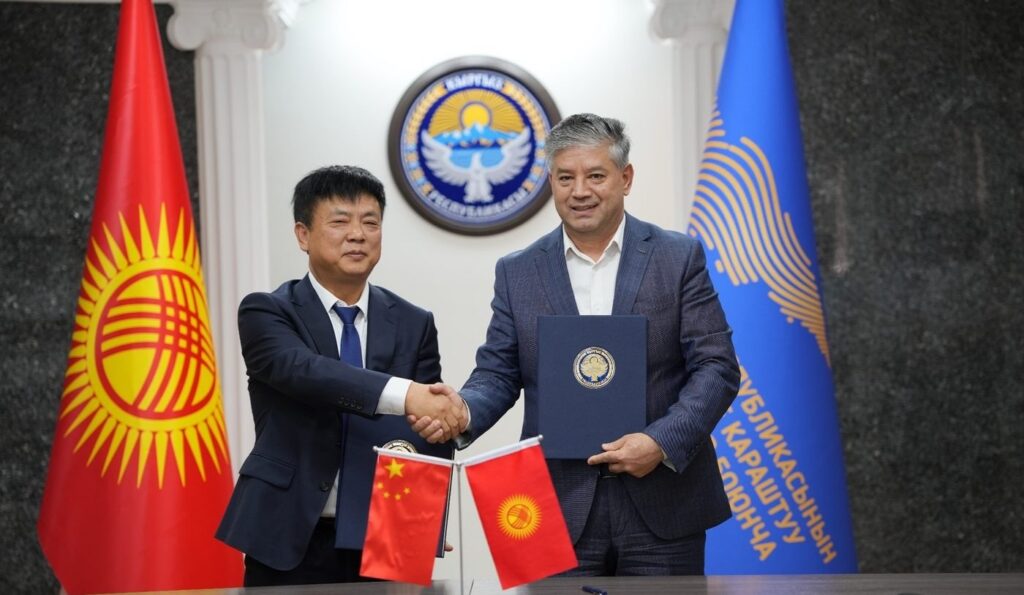
A Chinese company will help Kyrgyzstan establish its own electric vehicle taxi aggregator in a market currently dominated by Russian ride-hailing platforms. The National Investment Fund of the Kyrgyz Republic and China’s Shenzhen Wuyou Technology Co., Ltd. have signed framework agreements on investment projects to establish a national taxi aggregator, a modern electric vehicle fleet, and a network of EV charging stations across Kyrgyzstan, according to the Ministry of Economy and Commerce. At the signing ceremony, Deputy Minister of Economy and Commerce Benazir Nurlanova said Kyrgyzstan attaches particular importance to developing its partnership with China. She said the new projects would contribute to the development of a green economy in Kyrgyzstan, the adoption of modern technologies, and investment cooperation between the two countries. The Chinese side expressed readiness for long-term cooperation, including the exchange of experience and technology, and noted the high potential of joint initiatives in electric transport and digital infrastructure. Kyrgyzstan’s taxi market is currently served through taxi aggregators: ride-hailing platforms that connect passengers with private drivers through a single digital system. The state-backed project involving the Chinese company could become an alternative to existing aggregators, including Russia’s Yandex Taxi, which currently dominates Kyrgyzstan’s taxi market, and Wildberries Taxi, which has entered the local market.

Kyrgyzstan Moves Taxi Licensing Online

Private taxi drivers in Kyrgyzstan can now apply for operating licenses online. The new system removes the need to visit the Main Directorate for Road Traffic Safety (GUOBDD) to submit paperwork and applications in person. Drivers can apply through mobile apps, although long queues for taxi licenses have yet to ease. According to Chairman of the Cabinet of Ministers Adylbek Kasymaliev, the government introduced the digital system to create more transparent and convenient conditions for taxi and minibus drivers. Kasymaliev said the reform frees drivers from paper bureaucracy and simplifies the licensing process. “We have created the most convenient and transparent digital conditions. Now the task is to explain the process to every driver, including mandatory medical and technical inspections. At the same time, transport operators must clearly understand that starting from July 1 this year, taxi drivers working without proper licenses will face strict liability under the law,” he said. The licensing change follows recent moves to tighten passenger transport regulations in Kyrgyzstan. GUOBDD told The Times of Central Asia that around 300 people applied online on the first day of the new system, including 120 in Bishkek. According to Nurdin Sambaev, head of the department for transport activity licensing and technical supervision at GUOBDD, drivers need to register in the app and complete identity verification before applying. “Once the driver enters their taxpayer identification number, the system automatically requests all necessary documents from other state agencies. This includes criminal record certificates, vehicle registration documents, and other paperwork required for licensing,” Sambaev said. Some steps still require a physical visit. Drivers must appear at the department for vehicle inspections. They must also undergo a medical examination to obtain the Form 083 certificate of professional fitness. The results of these checks will be uploaded directly into the government’s Tunduk app, where the license itself will also be displayed. The simplified process has not yet won over all drivers. According to offline licensing officers, queues have remained long since authorities announced that fines would be imposed on drivers without licenses from July 1. Taxi drivers interviewed by The Times of Central Asia said submitting documents in person still feels more reliable and familiar. Many also noted that other drivers can help explain the paperwork if questions arise. Some said they had not yet figured out how to use the app, while others said their online applications had failed, forcing them to return to the traditional method. GUOBDD staff welcomed the change, saying the digital format will reduce paperwork and simplify the processing of applications.

Kyrgyz PM Courts Investors in Tashkent With Call for Shared Regional Future

Tashkent (June 17): Speaking to a packed audience at the opening of the fifth Tashkent International Investment Forum, Kyrgyz Prime Minister Adylbek Kasymaliev, chairman of the Cabinet of Ministers and head of the Presidential Administration, opened his remarks with a sober assessment of the global landscape: "The global economy is undergoing a period of profound transformation: a technological revolution, an energy transition, the reshaping of global supply chains, growing demand for critical minerals, and the need to ensure food security are together creating new conditions of international competition while also opening new opportunities for cooperation." Despite global uncertainty, Kasymaliev argued that success would favor countries willing to cooperate and move quickly: "the countries that benefit most are those that make decisions faster, establish clear rules, and remain open to long-term partnership." In this context, Kasymaliev cast Tashkent as much more than a venue for dialogue. "Today, Tashkent is once again becoming a platform for discussing the common future of the region," he said, noting that mutual benefit offered a better path than zero-sum competition. His remarks rested on the premise that Central Asian states gain more from unity than from going it alone, and that the region's economic trajectory now hinges on its members' willingness to act as partners rather than rivals. Kasymaliev placed Kyrgyzstan's outlook within the National Development Program through 2030, which he said is built around accelerated industrialization, export expansion, digital transformation, and deeper regional integration, with the explicit goal of moving the country into the ranks of upper-middle-income states by decade's end. He cited 2025 GDP growth of 11% as evidence the strategy is already bearing fruit. Kasymaliev then outlined six government priorities for cooperation and investment. The first is critical minerals, with an emphasis on moving beyond raw extraction toward processing and component manufacturing for green energy. The second is energy, where new renewable producers receive a five-year profit tax exemption, and officials are pursuing hydropower, solar, wind, and eventually hydrogen. The third is agribusiness and food security, centered on agro-processing, greenhouse complexes, and cold storage aimed at export markets in Central Asia, the Middle East, South Asia, and China. The fourth is transport and logistics, anchored by the China-Kyrgyzstan-Uzbekistan railway. "As our President has emphasized, it is a strategic bridge between countries and markets," Kasymaliev said, a corridor expected to cut delivery times to as little as ten days. The fifth priority is the digital economy, built around a newly enacted Digital Code and an effort to draw venture capital into the country's startup ecosystem. The sixth is capital markets, including plans to list state-owned enterprises through IPOs and the creation of the Tamchy Special Financial Investment Territory on Lake Issyk-Kul, designed as a regional hub for international capital under its own distinct legal regime. Running through all six priorities was a broader argument about timing: in a period of technological upheaval, energy transition, and shifting supply chains, the states that move fastest and cooperate most openly stand to capture the largest share of...

Kyrgyzstan’s President Urges Citizens to Invest in Government Securities

President Sadyr Japarov has called on citizens of Kyrgyzstan to invest in government securities, describing them as one of the country’s most reliable investment instruments because they are backed by the state. In a statement on his Facebook page, Japarov announced what he described as “an important initiative that will allow every citizen to improve their financial situation while contributing to the development of Kyrgyzstan.” The Cabinet of Ministers has made government securities available to the public with an annual interest rate of 17%, according to Japarov. The securities can be purchased through a mobile app, he said. Invested funds will be repaid in full after two years, with interest payments made every three months. Japarov said returns on government securities would exceed those offered by most bank deposits. Deposit rates at commercial banks in Kyrgyzstan generally range from around 10% to 14% per year for deposits in the national currency, depending on the bank and product. Some microfinance organizations offer higher rates. Two types of government securities are available through the Kyrgyz Stock Exchange: state treasury bills and state treasury bonds. The National Bank of the Kyrgyz Republic also publishes auction results for government securities, with recent state treasury bond yields ranging from 12.86% to 16%, depending on maturity. Government securities are issued to finance national projects, cover budget deficits, and refinance maturing government debt.