• KZT/USD = 0.00223
  • TJS/USD = 0.10820
  • UZS/USD = 0.00009
  • TMT/USD = 0.29760
  • KZT/USD = 0.00223
  • TJS/USD = 0.10820
  • UZS/USD = 0.00009
  • TMT/USD = 0.29760
  • KZT/USD = 0.00223
  • TJS/USD = 0.10820
  • UZS/USD = 0.00009
  • TMT/USD = 0.29760
  • KZT/USD = 0.00223
  • TJS/USD = 0.10820
  • UZS/USD = 0.00009
  • TMT/USD = 0.29760
  • KZT/USD = 0.00223
  • TJS/USD = 0.10820
  • UZS/USD = 0.00009
  • TMT/USD = 0.29760
  • KZT/USD = 0.00223
  • TJS/USD = 0.10820
  • UZS/USD = 0.00009
  • TMT/USD = 0.29760
  • KZT/USD = 0.00223
  • TJS/USD = 0.10820
  • UZS/USD = 0.00009
  • TMT/USD = 0.29760
  • KZT/USD = 0.00223
  • TJS/USD = 0.10820
  • UZS/USD = 0.00009
  • TMT/USD = 0.29760
21 September 2026

Viewing results 37 - 42 of 263

Astana Ecological Summit Turns Regional Climate Pressure Into a Call for Joint Action

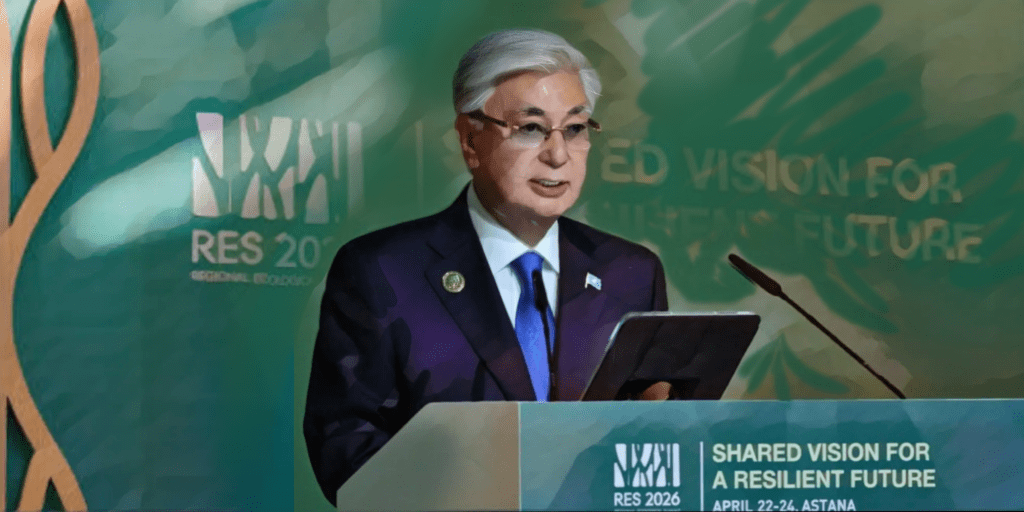
On April 22, 2026, leaders from Central Asia and neighboring states opened the Regional Ecological Summit 2026 in Astana on Earth Day with an urgent and practical message: the region’s environmental crisis is no longer a future risk, but a present constraint on water, food, energy, and economic security. The summit, held under the theme “A Shared Vision for a Sustainable Future,” was organized by Kazakhstan with the United Nations and international partners. Its stated purpose is to develop policy tools for protecting, restoring, and jointly using ecosystems, water and land resources, and conserving biodiversity in Central Asia. The program includes 58 events, consultations on a possible International Water Organization within the UN system, and expected documents, including a Central Asian declaration on environmental solidarity and a 2026–2030 regional action program. [caption id="attachment_47607" align="aligncenter" width="775"] President Tokayev gives his keynote address at the Regional Ecological Summit in Astana; Image: TCA[/caption] Opening the plenary, Kazakhstan’s President Kassym-Jomart Tokayev argued that environmental policy must not become another dividing line in global politics. He called for a fair and balanced green transition, especially for developing economies, and warned that Central Asia’s shared rivers, landscapes, and climate risks demand shared responsibility. Tokayev singled out water scarcity, desertification, glacier melt, air pollution and biodiversity loss as the region’s core challenges. He also highlighted Kazakhstan’s plans to expand renewable energy, protect the Caspian Sea, restore the Northern Aral, and start consultations on a proposed International Water Organization. [video width="720" height="1280" mp4="https://timesca.com/wp-content/uploads/2026/04/no-comments-Reels.mp4"][/video] The water question dominated the speeches. President Sadyr Japarov said that Kyrgyzstan bears a disproportionate burden despite its small contribution to global emissions. He pointed to a sharp increase in mudflows and floods, shrinking glaciers, and the fact that most water formed in Kyrgyzstan flows to neighboring states. His proposal was blunt: downstream users should help co-finance the water infrastructure and ecosystem services that upstream countries maintain. Uzbekistan's President Shavkat Mirziyoyev turned the summit into a platform for concrete regional initiatives. In his official speech, he said that Central Asia is warming twice as fast as the global average, has already lost nearly a third of its glaciers, and faces land degradation across 80 million hectares. He proposed a Clean Air consortium, a regional desertification and drought center, a green trade corridor, a unified climate-investment portfolio, an environmental atlas and a Central Asian Red Book. Tajikistan’s President Emomali Rahmon brought the glacier crisis into sharp relief. Tajikistan supplies much of Central Asia’s water, but its glaciers are retreating, threatening water balance and increasing disaster risks. Rahmon linked the environmental agenda to hydropower, green finance, biodiversity protection, and water diplomacy, and invited partners to continue the discussion at a high-level water conference in Dushanbe. Turkmenistan's President Serdar Berdimuhamedov backed a stronger institutional approach, proposing a UN-supported regional council on water use to align national policies and manage transboundary resources more transparently. He also announced a high-level Caspian Sea ecology meeting in Turkmenistan for October 2026. Heads of state from beyond Central Asia widened the frame. Armenia’s...

Kyrgyzstan to Build Modern Landfill Using Japanese Waste Disposal Technology

A pilot project to construct a modern landfill based on the Fukuoka Method is planned for the city of Kara-Balta in Kyrgyzstan’s northern Chui region, about 60 km west of Bishkek. The project aims to reduce environmental impacts and support the transition to modern waste management standards. The Fukuoka Method is a semi-aerobic landfill waste disposal technology developed jointly by Fukuoka University and the city of Fukuoka in the 1970s. It has since become a standard approach for local governments in Japan. By maximizing the aeration of waste, the method accelerates biodegradation and can reduce greenhouse gas emissions by an estimated 20-50%. The method uses natural ventilation through pipes and leachate collection systems to promote aerobic decomposition of waste. This accelerates stabilization, reduces methane emissions, and improves odor control. It is considered a relatively low-cost solution and is often cited as suitable for developing countries. On April 21, Kyrgyzstan’s Ministry of Natural Resources, Ecology, and Technical Supervision discussed implementation of the project with representatives of the Asian Development Bank and the Japan Foundation, including grant financing, technical support, and the use of the Fukuoka Method. The project is expected to reduce soil and groundwater pollution in the area, improve sanitary conditions for local residents, and provide a basis for wider use of the technology across the country. The transition to modern environmental technologies is seen as important for protecting public health and supporting the country’s sustainable development. Kyrgyzstan has also introduced Chinese technology for municipal solid waste disposal that generates electricity through incineration. In December 2025, Bishkek officially inaugurated Central Asia’s first waste-to-energy plant, located at the city’s primary landfill and constructed by Hunan Junxin Environmental Protection Co. Ltd.

Regional Ecological Summit to Open in Astana Amid Pressure on Water, Trade, and Regional Cooperation

When the Regional Ecological Summit (RES 2026) opens in Astana this Wednesday, the official framing will center on Shared Vision for a Resilient Future, combining practical regional solutions with diplomatic ambitions that include a Joint Declaration and a 2026-2030 Program of Action. Behind that language sits a harder reality. Water and energy officials in Tashkent, Bishkek, and Astana are dealing with a region which is drying out faster than its infrastructure and politics are adapting. That gives the summit a sharper edge than earlier environmental gatherings. Two issues stand out: the management of winter water-sharing arrangements ahead of the irrigation season, and the way the shrinking Caspian could constrain the Middle Corridor. The Toktogul Equation: A Fragile "Winter-for-Summer" Swap The most immediate point of pressure is the Toktogul Reservoir in Kyrgyzstan. In late 2025, an agreement was reached under which Kyrgyzstan would limit winter hydropower generation, preserving water for downstream Kazakh and Uzbek farmers, in exchange for electricity supplies from its neighbors. The arrangement remains in place, but its durability will be tested as summer demand rises. One question hanging over the summit is whether Kazakhstan and Uzbekistan will provide enough power support to help Kyrgyzstan conserve water without reopening old upstream-downstream tensions. For downstream states, that is not only a water issue but an agricultural and political one. The Caspian Emergency: Depth as a Trade Barrier For years, the shallowing of the Caspian was treated as a long-term problem. In 2026, it is becoming an operational one. According to recent reporting, Aktau port is operating at an average depth of 4.5 meters, far below the 6.5 to 7 meters needed for full operations. The summit will also highlight the Integrated Management of Seascapes project. The UNDP-linked initiative is intended to balance the need for dredging and port access with protection of the northern Caspian’s fragile ecosystem. That tension is no longer theoretical. It now touches trade, shipping capacity, and the future of the corridor itself. The Digital Transition One of the summit’s more concrete strands is the National Water Resources Information System. According to the Kazakh government, the system is to enter industrial operation by the end of 2026. The plan is to automate 103 irrigation canals in southern Kazakhstan using $1.15 billion in financing from the Islamic Development Bank. The broader regional test is whether neighboring states will share enough data to support a cross-border water monitoring system, giving officials a clearer view of how shared resources are being managed. The Green Energy Corridor Alongside the water agenda, the Green Energy Corridor remains one of the projects that clearly aligns Kazakhstan, Azerbaijan, and Uzbekistan. The plan is to transmit green electricity to Europe via a subsea cable across the Caspian. CESI is finalizing the feasibility study, pointing to an export model that leans less on hydrocarbons and more on regional infrastructure. It also shows how environmental pressure and economic strategy are starting to overlap. For Central Asian governments, climate policy is no longer only about adaptation. It is...

Water in Central Asia: Between Reality and Alarmism

The Regional Ecological Summit 2026 will take place in Astana on April 22-24. The event is intended to elevate Central Asia’s water and environmental agenda to the level of systemic solutions. Alongside preparations for the summit, however, an increasingly alarmist narrative is gaining traction among some experts. In this framing, water resources in Central Asia are presented as being in crisis, with predictions of shortages, threats to food security, and even potential conflict. Phrases such as “there is not enough water,” “the harvest is at risk,” and “the region is on the brink” are used with growing frequency. Such assessments are typically based on generalized and dramatized claims that fail to differentiate between countries or specific river basins. This creates the impression of a single, simultaneous crisis, whereas in reality the situation is far more complex. Yes, there is a problem, but it is not sudden or one-dimensional. Water scarcity in Central Asia is real. However, it must be interpreted accurately and objectively. According to expert estimates, up to 40% of water in the region is lost through deteriorating irrigation infrastructure, while more than 80% of water consumption is accounted for by agriculture. Current practice supports these figures. In southern Kazakhstan, seasonal water supply restrictions are regularly imposed. This year, for example, the government approved consumption limits for southern regions due to an expected shortage during the growing season. Uzbekistan has said, in joining the World Bank’s Water Forward initiative, that it aims to introduce water-saving technologies across its 4.1 million hectares of irrigated land and reduce irrigation losses by 25%. Equally important are developments in upstream countries, Kyrgyzstan and Tajikistan. According to a study by the Organisation for Economic Co-operation and Development, the region exhibits a structural interdependence between water and energy. More than 80% of electricity in these countries is generated by hydropower, meaning water resources are used simultaneously for energy production and irrigation. This creates systemic interdependencies. At the same time, coordination of water releases and electricity generation remains suboptimal, and the absence of long-term regulatory mechanisms has already led to water shortages during certain summer periods. This is a key point: the issue is not so much an absolute lack of water, but the complexity of coordination between upstream and downstream countries, as well as between sectors within individual states. In other words, water shortages in Central Asia are often driven less by natural conditions than by how water is distributed and managed. Particular attention in alarmist narratives is given to Afghanistan and the Kushtepa Canal. Estimates commonly suggest that the Qosh Tepa Canal could eventually divert around 6-10 km³ of water per year from the Amu Darya, although projections vary and depend on how fully the canal is completed and operated. While the canal is not yet fully operational, regional officials already treat it as a serious medium-term risk, with the precise scale of future withdrawals still under discussion. Countries in the region, especially Uzbekistan, have been pursuing dialogue with Afghanistan over the canal and...

Water Stress: Will the Summer of 2026 Become a Turning Point for Central Asia?

The summer of 2026 is projected to be a critical and potentially decisive period for Central Asia in the context of water stress. The region is entering the growing season with significantly lower water reserves in its main river basins, the Amu Darya and Syr Darya, compared to previous years. The combined impact of climate change and rising consumption is expected to exacerbate irrigation shortages, threatening crop yields and food security. A Region Under Pressure: Water as a Strategic Factor For Kazakhstan, water is taking on an increasing strategic importance in 2026. The southern regions, Kyzylorda, Turkestan, and Zhambyl, have already entered a phase of persistent low water availability. Estimates suggest that the irrigation deficit could reach up to 1 billion cubic meters. The situation in the Syr Darya basin remains critical. Inflows are expected to fall 3.2 billion cubic meters below normal, and by the start of the growing season, total water volume may reach only 1-2 billion cubic meters, far below demand. The Shardara Reservoir, a key regional storage facility, is currently at roughly half of its design capacity. Uzbekistan faces an even more vulnerable position due to its high population density and large agricultural sector. The flow of the Amu Darya is projected to fall to 65% of its historical norm, putting food stability at risk. Tashkent is accelerating investments in canal reconstruction, as water losses during transport reach up to 40%. Against this backdrop, tensions between upstream and downstream countries could become more pronounced. Kyrgyzstan, acting as the region’s “water tower,” faces a difficult trade-off between energy security and its obligations to downstream neighbors. Low accumulation levels in the Toktogul Reservoir have constrained hydropower generation, leading to winter energy shortages and reduced summer water releases, precisely when Kazakhstan and Uzbekistan require them for irrigation. This cyclical dependency turns each growing season into a complex round of “water-for-electricity” negotiations, with diminishing room for maneuver. Tajikistan faces a similar situation in the Amu Darya basin. The Nurek Hydropower Plant is operating under strict conservation principles as reservoir levels remain several meters below previous norms. For Dushanbe, the priority remains fulfilling the Rogun project, which, under low-water conditions, raises justified concerns among downstream states. These tensions are compounded by the accelerated melting of Pamir glaciers, which currently increases water flows but poses a long-term risk of severe depletion. Turkmenistan is also expected to experience acute water stress in 2026. In the Ahal and Mary regions, pasture degradation and limited irrigation are reducing livestock numbers and grain yields. The government is investing in dredging the Karakum Canal and constructing small desalination plants, but these measures only partially offset declining Amu Darya flows. An additional destabilizing factor is Afghanistan’s Qosh-Tepa Canal project. By summer 2026, its impact on the Amu Darya basin is expected to become physically noticeable. Estimates state that unregulated water withdrawals could reduce downstream flows by 15-25%. Afghanistan’s absence from regional water-sharing agreements creates a legal vacuum that existing mechanisms cannot address. As a result, Central Asia is...

Rosatom to Neutralize Hazardous Chemical Waste at Plant in Kyrgyzstan

Rosatom is set to begin work to eliminate hazardous chemicals stockpiled at the Kristall plant in Tash-Kumyr, in Kyrgyzstan’s Jalal-Abad region. The Kristall plant, built in 1989 as a key facility of the Soviet electronics industry to produce polycrystalline silicon, has since become a high-risk environmental site. Hazardous chemical waste accumulated on its premises poses a threat to both the environment and public health. The plant has been bankrupt since 2010. The site contains 49 tanks holding a total of 155 tons of hazardous chemical residues, including trichlorosilane and silicon tetrachloride. In October 2024, Rosatom conducted a technical audit of the facility, revealing the deteriorated condition of the storage tanks. Prolonged inactivity has left the aging infrastructure in poor shape, increasing the risk of structural failure and depressurization. On April 14, in Bishkek, Rosatom and the Kyrgyz Ministry of Emergency Situations discussed technological solutions for neutralizing the chemicals. According to Rosatom, the first phase of the cleanup is scheduled for completion by the end of 2026. This stage will focus on bringing the chemical storage tanks to a safe condition. It also involves the installation of a dual emergency protection system and the introduction of independent environmental monitoring. The proposed neutralization methods have been approved by the Kyrgyz Ministry of Natural Resources, Ecology, and Technical Supervision. By the end of 2026, Rosatom aims to eliminate the risk of leaks and uncontrolled emissions by stabilizing the tanks and ensuring safe conditions for further handling of the hazardous substances. In 2027, the project will enter its second phase, focusing on the on-site neutralization of the chemicals as the preferred solution. Kyrgyz Emergency Situations Minister Kanatbek Chynybayev said the situation at the Kristall plant remains environmentally challenging and requires a comprehensive response. “Our primary objective is to eliminate potential health risks to residents of Tash-Kumyr and lift the state of emergency in the area. Rosatom’s expertise has been engaged to address this issue. As part of this collaboration, a technological strategy has been developed that will allow the threats to be neutralized within the specified timeframe and return the site to a safe condition,” he said.