• KGS/USD = 0.01144 0%
  • KZT/USD = 0.00207 0%
  • TJS/USD = 0.10419 -0.1%
  • UZS/USD = 0.00008 0%
  • TMT/USD = 0.28571 0%
  • KGS/USD = 0.01144 0%
  • KZT/USD = 0.00207 0%
  • TJS/USD = 0.10419 -0.1%
  • UZS/USD = 0.00008 0%
  • TMT/USD = 0.28571 0%
  • KGS/USD = 0.01144 0%
  • KZT/USD = 0.00207 0%
  • TJS/USD = 0.10419 -0.1%
  • UZS/USD = 0.00008 0%
  • TMT/USD = 0.28571 0%
  • KGS/USD = 0.01144 0%
  • KZT/USD = 0.00207 0%
  • TJS/USD = 0.10419 -0.1%
  • UZS/USD = 0.00008 0%
  • TMT/USD = 0.28571 0%
  • KGS/USD = 0.01144 0%
  • KZT/USD = 0.00207 0%
  • TJS/USD = 0.10419 -0.1%
  • UZS/USD = 0.00008 0%
  • TMT/USD = 0.28571 0%
  • KGS/USD = 0.01144 0%
  • KZT/USD = 0.00207 0%
  • TJS/USD = 0.10419 -0.1%
  • UZS/USD = 0.00008 0%
  • TMT/USD = 0.28571 0%
  • KGS/USD = 0.01144 0%
  • KZT/USD = 0.00207 0%
  • TJS/USD = 0.10419 -0.1%
  • UZS/USD = 0.00008 0%
  • TMT/USD = 0.28571 0%
  • KGS/USD = 0.01144 0%
  • KZT/USD = 0.00207 0%
  • TJS/USD = 0.10419 -0.1%
  • UZS/USD = 0.00008 0%
  • TMT/USD = 0.28571 0%

Viewing results 85 - 90 of 710

Leaders of Turkic States Meet in Azerbaijan

The 12th Summit of the Heads of State of the Organization of Turkic States (OTS) convened in Gabala, Azerbaijan, bringing together leaders from Azerbaijan, Kazakhstan, Kyrgyzstan, Turkey, Uzbekistan, Hungary, Turkmenistan, and the Turkish Republic of Northern Cyprus. Discussions focused on regional stability, economic integration, and strengthening fraternal ties among Turkic nations. Aliyev: The OTS Is Becoming a Major Geopolitical Center Opening the summit, Azerbajani President Ilham Aliyev welcomed participants to Gabala and thanked Kyrgyzstan for its prior chairmanship. “Today, the Organization of Turkic States is not merely a platform for cooperation; it is forming as one of the serious geopolitical centers,” Aliyev said. He announced Azerbaijan’s $2 million contribution to support OTS activities and emphasized shared historical roots and cultural values across Turkic nations. Addressing peace and security, Aliyev added, “In light of modern geopolitical challenges, it is crucial that Turkic states act as a unified center of power,” and proposed hosting joint military exercises of OTS member states in 2026. South Caucasus Peace and Economic Connectivity Aliyev highlighted the recent peace agreement initialed between Azerbaijan and Armenia in Washington as a breakthrough for the South Caucasus: “This will turn the region into a space of peace.” He also noted Azerbaijan’s growing role in regional logistics: “Since 2022, cargo volumes along the Middle Corridor have increased by nearly 90%. Our Caspian fleet, the Alat Port, the Baku-Tbilisi-Kars railway, and nine international airports have made Azerbaijan a leading transport hub.” He stressed the importance of the Zangezur Corridor, intended to connect Azerbaijan with Nakhchivan and Central Asia, and cited Azerbaijan’s energy diversification, exporting natural gas to 14 countries and a projected 40% share of renewables in its energy mix by 2030. Unity and Vision from the Turkic Leaders Kyrgyz President Sadyr Japarov praised the summit location and the symbolic timing: “Gabala is an ancient city with a 2,000-year history, and it is no coincidence we gathered here.” He called the joint peace declaration with Armenia a historic step toward trust in the South Caucasus. Kazakh President Kassym-Jomart Tokayev echoed support: “This historic document has ended a conflict that had remained unresolved for more than 30 years.” He quoted poet Bakhtiyar Vagabzade: “A Turk has no right to be hostile to another Turk.” Turkish President Recep Tayyip Erdoğan called for developing a “Common Turkic Language Model” to protect cultural heritage and advance artificial intelligence research. “We once again demonstrate that the Turkic states, driven by solidarity, mutual respect, and brotherhood, are confidently looking to the future,” he said. Uzbek President Shavkat Mirziyoyev credited Aliyev’s leadership: “This peace declaration became possible thanks to your political will and is a common achievement of the Turkic world.” Turkmenistan and Hungary on Brotherhood and Energy Gurbanguly Berdimuhamedov, Chairman of Turkmenistan’s Halk Maslahaty, described the OTS as a unifying platform for brotherly nations with shared culture and language, committed to promoting cooperation at regional and international levels. Hungarian Prime Minister Viktor Orbán underscored Azerbaijan’s value to Europe: “Your incredible achievements, economic development, and investments in renewable energy...

Gabala 2025: What the Turkic World Will Discuss Amid Global Turbulence

On October 7, leaders of the Organization of Turkic States (OTS) will gather in Gabala, Azerbaijan, for the 12th summit under the theme “Regional Peace and Security.” At first glance, it may look like another routine engagement. Yet against the backdrop of overlapping global crises, the forum is increasingly a test of the OTS’s maturity and relevance. The summit unfolds amid a turbulent international landscape. Afghanistan continues to cast a shadow over Central Asia: economic volatility, migration risks, and the activity of extremist groups remain sources of concern for OTS members. The ongoing war in Ukraine, meanwhile, is reshaping Eurasian transit routes, placing the bloc’s states in delicate positions between East and West. At the same time, violence in the Middle East is adding to the pressures on Turkey’s already complex foreign policy environment. The Middle Corridor at the Center A key theme in Gabala will be the advancement of the Middle Corridor, formally known as the Trans-Caspian International Transport Route. This east–west route connects China with Europe via Kazakhstan, the Caspian ports of Aktau and Kuryk, Azerbaijan, Georgia, and Turkey. Investments are moving forward across the chain: Kazakhstan is expanding port and rail capacity, Azerbaijan is modernizing the Port of Baku in Alat, Georgia is upgrading its railway hubs, and Turkey is reinforcing the Baku–Kars line. Once a logistical project, the corridor is evolving into a strategic framework that ties together economic, environmental, and security considerations. Customs harmonization, digital tracking systems, and sustainability standards are now discussed as much as cargo volumes. Security, Coordination, and Soft Power Security will also be on the table, though framed in practical rather than military terms. Issues such as counter-terrorism cooperation, cyber resilience, disaster response, and the safety of emerging transit corridors are likely to feature. In this sense, security is increasingly seen as the foundation for trade and investment rather than a standalone agenda. Beyond infrastructure, OTS continues to develop soft power tools. Educational exchanges, cultural cooperation, green energy initiatives, and water management projects are part of efforts to build intra-regional trust. The recently inaugurated UN Regional Center for the SDGs in Almaty provides another anchor, aligning the Turkic bloc with global sustainability frameworks. A Turning Point for the Turkic Council? Founded in 2009 primarily as a cultural and humanitarian forum, the OTS is now edging toward a broader role. By coordinating infrastructure projects, harmonizing regulations, and cautiously addressing security concerns, it is positioning itself as a relevant player in Eurasian affairs. Much will depend on whether Gabala produces more than communiqués. Concrete steps on the Middle Corridor, digital customs corridors, joint water initiatives, or disaster coordination could demonstrate that the OTS is maturing into a platform for practical solutions. While major breakthroughs are unlikely, even incremental progress would signal that the Turkic Council is becoming a pillar of regional stability and integration.

Afghanistan Absent, Not Forgotten – Central Asia’s UNGA Strategy

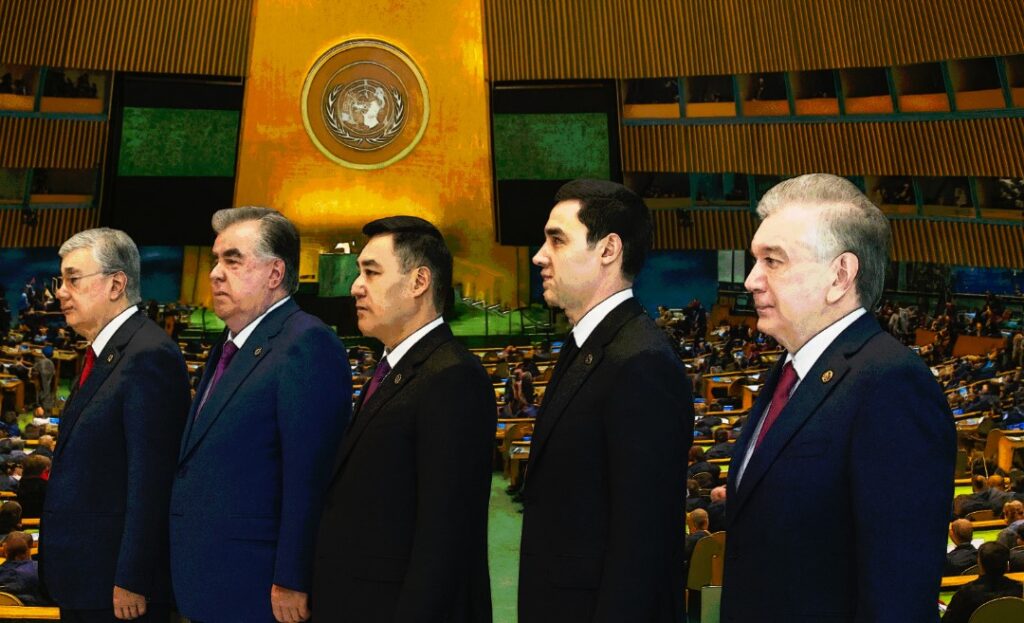
From September 23–29, 2025, the UN General Assembly’s general debate unfolded without an Afghan delegation addressing those assembled amid the unresolved UN seat issue. Yet Afghanistan was hardly absent. Central Asian presidents used their platform to project a collective stance that stopped short of recognition while rejecting isolation. Their message reflected a regional doctrine of managed engagement: keep the neighbor connected enough to limit collapse, through corridors, energy grids, and humanitarian channels. President Shavkat Mirziyoyev of Uzbekistan offered the clearest blueprint, urging the international community to “prevent [Afghanistan’s] isolation,” and calling for support to develop transport and energy corridors across Afghan territory. That language aligns with initiatives already underway: a multilateral framework signed in Kabul on July 17 to move the Trans-Afghan railway toward feasibility, and fresh agreements on the 500 kV Surkhan–Pul-i-Khumri line designed to stabilize Afghanistan’s power supply while linking it to a regional grid. Mirziyoyev’s message was a bid to convert geography into risk management. Kazakhstan struck a technocratic note. Kassym-Jomart Tokayev told the Assembly that “inclusive development in Afghanistan” is the basis for long-term regional peace and stability. This phrasing matches Almaty’s UN-backed hub for the Sustainable Development Goals and Astana’s self-image as the region’s administrative center. The goal is to stabilize the weakest link so trade and transit do not fracture. Kyrgyz President Sadyr Japarov used part of his brief UN address to demand that roughly $9 billion in Afghan central-bank assets frozen in Western jurisdictions be returned to “the Afghan people,” and called isolation “unacceptable.” In a remittance-dependent economy like Kyrgyzstan’s, collapse next door risks hunger, displacement, and crime. His remarks were both moral and practical, and marked the sharpest public challenge to Western policy voiced by any Central Asian leader this week. Traditionally, Tajikistan has taken the hardest line on the Taliban. This time, Emomali Rahmon emphasized humanitarian assistance, citing drought-hit regions and areas devastated by the August 31 eastern Afghanistan earthquake, and said Dushanbe supports peace, stability, and socio-economic development next door. The quake killed more than 2,000 people and destroyed thousands of homes across Kunar, Nangarhar, and Laghman just as aid budgets were shrinking. Turkmenistan took a different approach. President Serdar Berdimuhamedov did not mention Afghanistan, instead promoting Ashgabat’s permanent neutrality as a proposed UN agenda item, “Neutrality for Peace and Security,” along with broad transport and energy initiatives. This approach preserved flexibility on projects like TAPI without committing to specifics in New York. What makes these speeches consequential is how closely they mirror work on the ground. The Trans-Afghan railway, long dismissed as only a plan, now has a political framework and a declared security pledge from Kabul. Whether it moves forward depends on both capital and security, but for Tashkent, a southern outlet to Pakistani ports is the difference between landlocked and land-linked. The Surkhan–Pul-i-Khumri line is more conventional and urgent: a 200-kilometer fix to keep the lights on and the revenues flowing. The long-troubled CASA-1000 power corridor is also inching back into view after being paused post-2021, with...

From Reform to Deals: Central Asia Steps Onto the Global Stage at UNGA-80

Ecology, global instability, and the need for UN reform dominated the speeches of all five Central Asian presidents at the 80th session of the UN General Assembly. Presenting a united front while emphasizing national priorities, the leaders made clear that Central Asia intends to play a pivotal role in shaping the global future. UN Reform Kazakh President Kassym-Jomart Tokayev was the first among the CIS leaders to address the assembly, speaking of a growing crisis of trust in multilateral institutions and calling for sweeping reforms. Tokayev emphasized the need to expand the UN Security Council, arguing that major powers from Asia, Africa, and Latin America must receive rotational representation, and that the influence of middle powers should be strengthened. “We need to create a new group of like-minded states that will professionally and decisively advance concrete proposals for reforming the UN so that it better responds to today’s challenges and tomorrow’s tasks,” he said, proposing Kazakhstan as a platform for these discussions. Uzbek President Shavkat Mirziyoyev echoed these concerns, highlighting the weakening of international institutions and the proliferation of global conflicts. He endorsed UN Secretary-General António Guterres’ UN-80 initiative and voiced support for the Pact for the Future, which sets out commitments to strengthen multilateral cooperation and address global challenges through 2045, the UN’s centenary. Mirziyoyev also advocated for an expanded Security Council to better represent developing countries. In his address, Kyrgyz President Sadyr Japarov called for a more just and representative Security Council, underscoring Africa’s right to greater participation. He also announced Kyrgyzstan’s candidacy for a non-permanent seat on the Security Council for 2027-2028, noting that his country has never before held such a position. Tajik President Emomali Rahmon warned of growing instability, uncertainty, and complexity in world affairs. Rahmon stressed the UN’s role as a platform for dialogue and cooperation and called for equal partnerships between large and small states to restore adherence to international law. Turkmen President Serdar Berdimuhamedov argued that the current global situation requires a "decisive shift toward coordinated interaction among states and international organizations to maintain peace and security.” He proposed declaring 2028 the Year of International Law to strengthen the legal foundations of global cooperation. Ecology and Finance On environmental issues, the Central Asian leaders focused on national and regional concerns. Tokayev addressed the ongoing shallowing of the Caspian Sea, while both he and Mirziyoyev raised the issue of the Aral Sea crisis, often described as "one of the world’s worst environmental disasters." Rahmon highlighted the rapid disappearance of glaciers, a point supported by Japarov, given the critical dependence of Kyrgyzstan and Tajikistan on mountain water resources. Berdimuhamedov, meanwhile, proposed establishing a regional center for combating desertification in Central Asia. Other initiatives included the proposed Caspian Environmental Forum in 2026 and continued advancement of the Caspian Environmental Initiative, originally introduced by Ashgabat. Financial concerns were also prominent. Rahmon called for reforms to international financial mechanisms, citing the continued suffering of vulnerable developing countries from the impacts of economic crises, poverty, disease, natural disasters,...

Central Asian Presidents at UNGA-80: All Five Confirmed

New York, Sept 22, 2025 – Central Asia will have a strong presence at the 80th United Nations General Assembly (UNGA-80), with four of the region’s presidents confirmed to attend in person. One leader’s participation, however, remains unannounced. From Kazakhstan, President Kassym-Jomart Tokayev is scheduled to be in New York from September 21 to 23. The Kazakh presidency confirmed that he will deliver his country’s national statement and meet with other heads of state on the sidelines of the high-level week. Kyrgyzstan’s President Sadyr Japarov is officially confirmed to be in New York from September 22 to September 25, where he is scheduled to deliver a speech in the General Debate. Japarov will also join a UN Security Council discussion on AI and a high-level climate event, while holding bilateral meetings with Secretary-General António Guterres and leaders from multiple regions. In Tajikistan, the presidential press service announced on September 21 that President Emomali Rahmon departed Dushanbe for New York to attend UNGA-80. He is accompanied by senior officials and is expected to speak during the General Debate. From Turkmenistan, President Serdar Berdimuhamedov left Ashgabat on September 21 for a working trip to New York. Turkmen state media confirmed his participation in UNGA-80, marking his direct representation of the country at the session. Uzbekistan’s President Shavkat Mirziyoyev arrived in New York on September 20 for a visit lasting through September 24. His agenda includes addressing the General Debate on its opening day and holding bilateral meetings with UN Secretary-General António Guterres and other world leaders. With the General Debate opening on September 23, Central Asia is set to be represented at the highest level by all five of its nations: Kazakhstan, Kyrgyzstan, Tajikistan, Turkmenistan, and Uzbekistan.

From Hydropower to Human Capital: Japarov Plans Strategic Visit to Japan

Kyrgyz President Sadyr Japarov is preparing for a visit to Japan that underscores growing strategic ties between the two countries. Kyrgyz officials say they plan to sign energy and infrastructure agreements in Tokyo, including support for a training center for the national electric grid and upgrades at the Kurpsai hydropower plant, according to Trend, citing the Kyrgyz Energy Ministry. The same report notes that grant funding from Japan’s international cooperation programs will back grid training and modernization efforts. The timing reflects Tokyo’s recent step-up in activity vis-à-vis Central Asia. As previously reported by The Times of Central Asia, in late August 2025, Japan’s foreign minister undertook a multi-country tour that emphasized long-term engagement and connectivity across the region. Japanese officials framed their approach as trust-building, focused on people-to-people links, infrastructure, and practical cooperation. Energy cooperation is expected to feature prominently during the visit. Kyrgyz officials say the Japan-backed training center is moving through final approval, and modernization of the Kurpsai facility is planned with Japanese grant support. Bishkek has also invited Japanese participation in additional hydropower projects, positioning Japan as a technology and financing partner in Kyrgyzstan’s power sector. Labor mobility and skills are another focus. The authorities in Kyrgyzstan have been working with Japanese counterparts to create safe, legal pathways for Kyrgyz workers. In July, Kyrgyz officials met with Japan’s construction human-resources association to align training standards and prepare workers for job opportunities in Japan, and free Japanese-language courses were launched in Bishkek to improve employability for prospective migrants. Education and cultural exchange underpin the relationship. Over three decades, Japan has funded scholarships, exchanges, and language programs that connect Central Asian students to Japanese universities. An overview of these initiatives highlights how education has become a durable pillar of Japan’s regional engagement, building familiarity with Japanese business practices and technology among Kyrgyz graduates. For Bishkek, the visit is about turning ongoing cooperation into signed projects and new resources. Officials point to the grid training center and Kurpsai upgrades as near-term deliverables, while the broader agenda includes workforce programs and academic ties. The message from both sides is continuity: steady, practical steps rather than headline-grabbing announcements. Regionally, Japan’s approach offers Central Asian countries additional partners for finance, training, and technology. For Kyrgyzstan, deeper ties with Tokyo complement existing relationships while helping diversify investment sources and markets. The outcome to watch is whether the visit locks in concrete funding and timelines for priority energy and skills initiatives outlined by the Kyrgyz side.