• KGS/USD = 0.01144 0%
  • KZT/USD = 0.00210 0%
  • TJS/USD = 0.10617 1.05%
  • UZS/USD = 0.00008 0%
  • TMT/USD = 0.28490 0%
  • KGS/USD = 0.01144 0%
  • KZT/USD = 0.00210 0%
  • TJS/USD = 0.10617 1.05%
  • UZS/USD = 0.00008 0%
  • TMT/USD = 0.28490 0%
  • KGS/USD = 0.01144 0%
  • KZT/USD = 0.00210 0%
  • TJS/USD = 0.10617 1.05%
  • UZS/USD = 0.00008 0%
  • TMT/USD = 0.28490 0%
  • KGS/USD = 0.01144 0%
  • KZT/USD = 0.00210 0%
  • TJS/USD = 0.10617 1.05%
  • UZS/USD = 0.00008 0%
  • TMT/USD = 0.28490 0%
  • KGS/USD = 0.01144 0%
  • KZT/USD = 0.00210 0%
  • TJS/USD = 0.10617 1.05%
  • UZS/USD = 0.00008 0%
  • TMT/USD = 0.28490 0%
  • KGS/USD = 0.01144 0%
  • KZT/USD = 0.00210 0%
  • TJS/USD = 0.10617 1.05%
  • UZS/USD = 0.00008 0%
  • TMT/USD = 0.28490 0%
  • KGS/USD = 0.01144 0%
  • KZT/USD = 0.00210 0%
  • TJS/USD = 0.10617 1.05%
  • UZS/USD = 0.00008 0%
  • TMT/USD = 0.28490 0%
  • KGS/USD = 0.01144 0%
  • KZT/USD = 0.00210 0%
  • TJS/USD = 0.10617 1.05%
  • UZS/USD = 0.00008 0%
  • TMT/USD = 0.28490 0%

Viewing results 115 - 120 of 584

Turkmen Cotton Farmers Frustrated by Mechanized Harvesting Delays and Losses

In Turkmenistan’s Lebap region, tenant farmers are expressing growing frustration over delayed payments and crop losses linked to the government’s push for mechanized cotton harvesting. While the use of combine harvesters is intended to boost efficiency, many farmers say the reality on the ground is causing financial hardship and lower yields. Delayed Payments Compound Financial Pressure In the Chokhbetde village council of Halach district, farmers were told they would not be paid for cotton harvested by combine machines until the entire campaign is complete. All revenues first go to the State Association for Agricultural Technical Services, Turkmenobakhyzmat, which owns the harvesters. Because accounting is based on the season overall rather than by individual field or tenant, farmers are expected to wait for payment. This delay is particularly painful for rural communities that rely on regular cash flow. A tenant farmer from Mashpaya village noted that pickers brought in from urban areas must be paid every ten days, and the payment postponement makes this increasingly difficult. The core complaint, however, is with the quality of mechanized harvesting itself. “Because the combines are poorly adjusted, 10-15% of the cotton ends up on the ground and must be collected by hand,” the Mashpaya farmer said. “Government employees are brought in for this, and they also need to be paid on time.” Beyond the immediate spillage, poorly calibrated machinery damages the plants: drums crush unopened cotton bolls, preventing them from maturing and leading to permanent yield losses. “Two Shifts” and Self-Funded Repairs Concerns about machinery use and maintenance are longstanding. During preparations for the summer grain harvest in Lebap, each combine at local Obahyzmat units was assigned two operators to run in alternating shifts. However, operators were required to fund maintenance and repairs themselves, even for foreign-made equipment such as John Deere and Case combines. The association only supplied tires, promising that repair costs would be reimbursed after the harvest as part of output-based wages and bonuses. In practice, combine crews absorbed heavy expenses. A machine operator from Bayramaly district described frequent technical failures: broken cutter bars, damaged threshing drum pulleys, faulty bearings, and worn connecting rods. “My colleague and I have already borrowed and spent 15,000 manats each, $4,300 at the official exchange rate, or $769 on the black market, just on spare parts,” he said. While some parts are now being produced locally, a repair facility in Turkmenabat has reportedly exceeded production targets for farm machinery components, these improvements have yet to reach most farmers. For now, the burden of keeping equipment running falls largely on the operators and tenant farmers themselves, with financial relief promised only at the end of the harvest season.

Afghanistan Absent, Not Forgotten – Central Asia’s UNGA Strategy

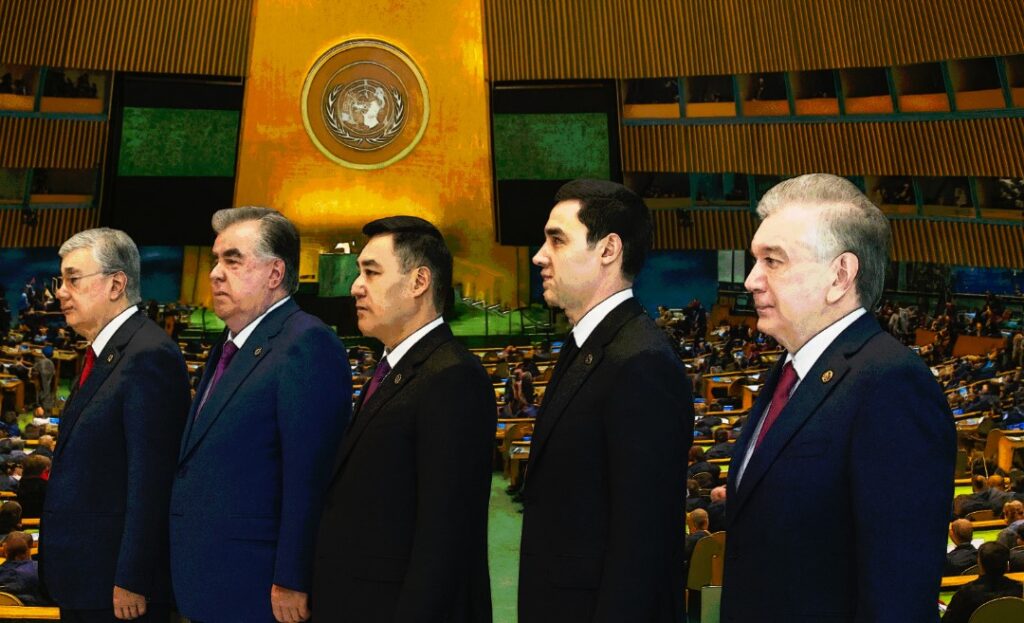
From September 23–29, 2025, the UN General Assembly’s general debate unfolded without an Afghan delegation addressing those assembled amid the unresolved UN seat issue. Yet Afghanistan was hardly absent. Central Asian presidents used their platform to project a collective stance that stopped short of recognition while rejecting isolation. Their message reflected a regional doctrine of managed engagement: keep the neighbor connected enough to limit collapse, through corridors, energy grids, and humanitarian channels. President Shavkat Mirziyoyev of Uzbekistan offered the clearest blueprint, urging the international community to “prevent [Afghanistan’s] isolation,” and calling for support to develop transport and energy corridors across Afghan territory. That language aligns with initiatives already underway: a multilateral framework signed in Kabul on July 17 to move the Trans-Afghan railway toward feasibility, and fresh agreements on the 500 kV Surkhan–Pul-i-Khumri line designed to stabilize Afghanistan’s power supply while linking it to a regional grid. Mirziyoyev’s message was a bid to convert geography into risk management. Kazakhstan struck a technocratic note. Kassym-Jomart Tokayev told the Assembly that “inclusive development in Afghanistan” is the basis for long-term regional peace and stability. This phrasing matches Almaty’s UN-backed hub for the Sustainable Development Goals and Astana’s self-image as the region’s administrative center. The goal is to stabilize the weakest link so trade and transit do not fracture. Kyrgyz President Sadyr Japarov used part of his brief UN address to demand that roughly $9 billion in Afghan central-bank assets frozen in Western jurisdictions be returned to “the Afghan people,” and called isolation “unacceptable.” In a remittance-dependent economy like Kyrgyzstan’s, collapse next door risks hunger, displacement, and crime. His remarks were both moral and practical, and marked the sharpest public challenge to Western policy voiced by any Central Asian leader this week. Traditionally, Tajikistan has taken the hardest line on the Taliban. This time, Emomali Rahmon emphasized humanitarian assistance, citing drought-hit regions and areas devastated by the August 31 eastern Afghanistan earthquake, and said Dushanbe supports peace, stability, and socio-economic development next door. The quake killed more than 2,000 people and destroyed thousands of homes across Kunar, Nangarhar, and Laghman just as aid budgets were shrinking. Turkmenistan took a different approach. President Serdar Berdimuhamedov did not mention Afghanistan, instead promoting Ashgabat’s permanent neutrality as a proposed UN agenda item, “Neutrality for Peace and Security,” along with broad transport and energy initiatives. This approach preserved flexibility on projects like TAPI without committing to specifics in New York. What makes these speeches consequential is how closely they mirror work on the ground. The Trans-Afghan railway, long dismissed as only a plan, now has a political framework and a declared security pledge from Kabul. Whether it moves forward depends on both capital and security, but for Tashkent, a southern outlet to Pakistani ports is the difference between landlocked and land-linked. The Surkhan–Pul-i-Khumri line is more conventional and urgent: a 200-kilometer fix to keep the lights on and the revenues flowing. The long-troubled CASA-1000 power corridor is also inching back into view after being paused post-2021, with...

High Praise, Empty Pockets: Turkmenistan May Scrap Benefit Hikes

It seems that average Turkmen citizens will again have to find ways to ration their spending in 2026, and beyond, thanks to a proposal from a member of the country’s Council of Elders. At a session of the Halk Maslahaty (People’s Council) on September 19, Elders’ Council member Yazmyrat Atamyradov, who, in fairness, probably drew the short straw before the session started, said that socio-economic conditions in Turkmenistan have reached such a high level that there is no longer a need for cost-of-living increases for salaries, pensions, stipends, and other benefits. "You are bestowing such blessings upon our people, Hero Arkadag!” Atamyradov said in his address. “Our sons and daughters, grandchildren, and great-grandchildren go to school and work without a care in the world. A peaceful, carefree life itself is a priceless treasure and a great asset.” Most of Turkmenistan’s people likely would not agree with Atamyradov’s suggestion, but his words were meant for only one person, Halk Maslahaty Chairman Gurbanguly Berdimuhamedov, who was in attendance and thanked Atamyradov for the recommendation. Most of the effusive praise for Turkmenistan’s alleged astounding socio-economic achievements was also directed at Berdimuhamedov, who served as Turkmenistan’s president from late 2006 until March 2022, when he stepped down and his son Serdar took the helm. Changes to Turkmenistan’s constitution in early 2023 made the Halk Maslahaty chairman the highest post in the country. A Deteriorating Economy There is no basis for Atamyratov’s assertion that living conditions are improving in Turkmenistan. The suggestion to cut annual payment increases more likely means the authorities can no longer afford to continue funding cost-of-living increases. Turkmenistan has the fourth largest reserves of natural gas in the world, and in the early years after independence, in late 1991, then-President Saparmurat Niyazov forecast the country would soon become a second Kuwait and everyone would be driving Mercedes. It has not worked out like that at all. Turkmenistan has a lot of gas, but only a few customers. The steep drop in gas prices in 2015 devastated Turkmenistan’s economy, which is about 80% dependent on revenue from gas sales, and has never recovered. The first food shortages independent Turkmenistan had ever seen started in 2016. Flour, cooking oil, sugar, eggs, and other basic goods were often not available at state stores where goods are sold at a subsidized price, but have always been available at privately-owned stores and at bazaars, where the price is two or three times more expensive. Eventually, rationing was introduced on bread. Customers were limited to two and sometimes only one churek (flat, round bread) per person. In some areas, police were tasked with monitoring sales to ensure no one bought more than their allotment. Often, there were more customers than bread, and in many places, including the capital, Ashgabat, lines started forming outside state stores before the sun came up. The authorities responded by telling people to line up behind the store so they could not be seen from the street. Fast forward to 2025, where in...

From Reform to Deals: Central Asia Steps Onto the Global Stage at UNGA-80

Ecology, global instability, and the need for UN reform dominated the speeches of all five Central Asian presidents at the 80th session of the UN General Assembly. Presenting a united front while emphasizing national priorities, the leaders made clear that Central Asia intends to play a pivotal role in shaping the global future. UN Reform Kazakh President Kassym-Jomart Tokayev was the first among the CIS leaders to address the assembly, speaking of a growing crisis of trust in multilateral institutions and calling for sweeping reforms. Tokayev emphasized the need to expand the UN Security Council, arguing that major powers from Asia, Africa, and Latin America must receive rotational representation, and that the influence of middle powers should be strengthened. “We need to create a new group of like-minded states that will professionally and decisively advance concrete proposals for reforming the UN so that it better responds to today’s challenges and tomorrow’s tasks,” he said, proposing Kazakhstan as a platform for these discussions. Uzbek President Shavkat Mirziyoyev echoed these concerns, highlighting the weakening of international institutions and the proliferation of global conflicts. He endorsed UN Secretary-General António Guterres’ UN-80 initiative and voiced support for the Pact for the Future, which sets out commitments to strengthen multilateral cooperation and address global challenges through 2045, the UN’s centenary. Mirziyoyev also advocated for an expanded Security Council to better represent developing countries. In his address, Kyrgyz President Sadyr Japarov called for a more just and representative Security Council, underscoring Africa’s right to greater participation. He also announced Kyrgyzstan’s candidacy for a non-permanent seat on the Security Council for 2027-2028, noting that his country has never before held such a position. Tajik President Emomali Rahmon warned of growing instability, uncertainty, and complexity in world affairs. Rahmon stressed the UN’s role as a platform for dialogue and cooperation and called for equal partnerships between large and small states to restore adherence to international law. Turkmen President Serdar Berdimuhamedov argued that the current global situation requires a "decisive shift toward coordinated interaction among states and international organizations to maintain peace and security.” He proposed declaring 2028 the Year of International Law to strengthen the legal foundations of global cooperation. Ecology and Finance On environmental issues, the Central Asian leaders focused on national and regional concerns. Tokayev addressed the ongoing shallowing of the Caspian Sea, while both he and Mirziyoyev raised the issue of the Aral Sea crisis, often described as "one of the world’s worst environmental disasters." Rahmon highlighted the rapid disappearance of glaciers, a point supported by Japarov, given the critical dependence of Kyrgyzstan and Tajikistan on mountain water resources. Berdimuhamedov, meanwhile, proposed establishing a regional center for combating desertification in Central Asia. Other initiatives included the proposed Caspian Environmental Forum in 2026 and continued advancement of the Caspian Environmental Initiative, originally introduced by Ashgabat. Financial concerns were also prominent. Rahmon called for reforms to international financial mechanisms, citing the continued suffering of vulnerable developing countries from the impacts of economic crises, poverty, disease, natural disasters,...

Central Asian Presidents at UNGA-80: All Five Confirmed

New York, Sept 22, 2025 – Central Asia will have a strong presence at the 80th United Nations General Assembly (UNGA-80), with four of the region’s presidents confirmed to attend in person. One leader’s participation, however, remains unannounced. From Kazakhstan, President Kassym-Jomart Tokayev is scheduled to be in New York from September 21 to 23. The Kazakh presidency confirmed that he will deliver his country’s national statement and meet with other heads of state on the sidelines of the high-level week. Kyrgyzstan’s President Sadyr Japarov is officially confirmed to be in New York from September 22 to September 25, where he is scheduled to deliver a speech in the General Debate. Japarov will also join a UN Security Council discussion on AI and a high-level climate event, while holding bilateral meetings with Secretary-General António Guterres and leaders from multiple regions. In Tajikistan, the presidential press service announced on September 21 that President Emomali Rahmon departed Dushanbe for New York to attend UNGA-80. He is accompanied by senior officials and is expected to speak during the General Debate. From Turkmenistan, President Serdar Berdimuhamedov left Ashgabat on September 21 for a working trip to New York. Turkmen state media confirmed his participation in UNGA-80, marking his direct representation of the country at the session. Uzbekistan’s President Shavkat Mirziyoyev arrived in New York on September 20 for a visit lasting through September 24. His agenda includes addressing the General Debate on its opening day and holding bilateral meetings with UN Secretary-General António Guterres and other world leaders. With the General Debate opening on September 23, Central Asia is set to be represented at the highest level by all five of its nations: Kazakhstan, Kyrgyzstan, Tajikistan, Turkmenistan, and Uzbekistan.

Prestige or Coercion? Turkmen Police Questioned Over Costly Leader Watches

Turkmenistan’s Ministry of Internal Affairs has launched an internal investigation after reports emerged that police officers were purchasing high-priced watches featuring images of President Serdar Berdimuhamedov, his father and former president Gurbanguly Berdimuhamedov, and state symbols. According to an internal directive sent to regional departments, police personnel must submit written explanations detailing whether they bought the watches voluntarily or under pressure from superiors. The ministry also announced inspections of police uniforms to ensure compliance with official standards. The directive reminds officers that wearing rings, medallions, or signet rings, aside from wedding bands, is strictly prohibited while on duty. Internal security units have been tasked with monitoring adherence. Prestige or Coercion? The Times of Central Asia previously reported that such watches have become a status symbol within law enforcement circles. Manufactured by Sagat Turkmenistan, the watches feature silver cases with gold plating, gemstone embellishments, and insignias of state agencies. They retail for between 3,000 and 5,000 TMT ($870-1,450). However, many residents allege the watches are frequently used as informal bribes. “If you are told that a criminal case will be brought against you, it means you need to buy such a watch and go to the investigator. This does not mean that the case will be closed. But it’s the first installment,” said a resident of Bayramali with experience of dealing with the police. Watches with white straps are seen as particularly prestigious. Sources say that investigators often request the strap be replaced, at the giver’s expense, to enhance the watch’s appearance. Mandatory Purchases for Civil Servants This phenomenon extends beyond law enforcement. In May 2024, The Times of Central Asia reported that heads of state institutions in the Balkan region were required to purchase similar watches. Prices ranged from 1,500 to 3,000 TMT ($435-870 at the official rate; $75-150 on the black market). High-end models featured portraits of both Berdimuhamedovs, each in differently colored ties, alongside the Turkmen flag and map. Less expensive variants depicted only the president, or a simplified combination of national symbols. The purchase requirement applied to all budget-funded institutions, including schools, hospitals, and transportation agencies. Different “rates” were imposed based on the official’s seniority: lower-level managers paid 1,500 manats, while higher-level administrators paid up to 3,000. The tradition of producing watches featuring national leaders dates back to the rule of Saparmurat Niyazov, under whom such accessories were distributed to schoolchildren and state employees. Serdar Berdimuhamedov has continued this legacy with his own line of commemorative timepieces.