• KGS/USD = 0.01144 0%
  • KZT/USD = 0.00210 0%
  • TJS/USD = 0.10563 0%
  • UZS/USD = 0.00008 0%
  • TMT/USD = 0.28530 0%
  • KGS/USD = 0.01144 0%
  • KZT/USD = 0.00210 0%
  • TJS/USD = 0.10563 0%
  • UZS/USD = 0.00008 0%
  • TMT/USD = 0.28530 0%
  • KGS/USD = 0.01144 0%
  • KZT/USD = 0.00210 0%
  • TJS/USD = 0.10563 0%
  • UZS/USD = 0.00008 0%
  • TMT/USD = 0.28530 0%
  • KGS/USD = 0.01144 0%
  • KZT/USD = 0.00210 0%
  • TJS/USD = 0.10563 0%
  • UZS/USD = 0.00008 0%
  • TMT/USD = 0.28530 0%
  • KGS/USD = 0.01144 0%
  • KZT/USD = 0.00210 0%
  • TJS/USD = 0.10563 0%
  • UZS/USD = 0.00008 0%
  • TMT/USD = 0.28530 0%
  • KGS/USD = 0.01144 0%
  • KZT/USD = 0.00210 0%
  • TJS/USD = 0.10563 0%
  • UZS/USD = 0.00008 0%
  • TMT/USD = 0.28530 0%
  • KGS/USD = 0.01144 0%
  • KZT/USD = 0.00210 0%
  • TJS/USD = 0.10563 0%
  • UZS/USD = 0.00008 0%
  • TMT/USD = 0.28530 0%
  • KGS/USD = 0.01144 0%
  • KZT/USD = 0.00210 0%
  • TJS/USD = 0.10563 0%
  • UZS/USD = 0.00008 0%
  • TMT/USD = 0.28530 0%

Viewing results 13 - 18 of 2949

Pannier and Hillard’s Spotlight on Central Asia: New Episode Out Now

As Managing Editor of The Times of Central Asia, I’m delighted that, in partnership with the Oxus Society for Central Asian Affairs, from October 19, we are the home of the Spotlight on Central Asia podcast. Chaired by seasoned broadcasters Bruce Pannier of RFE/RL’s long-running Majlis podcast and Michael Hillard of The Red Line, each fortnightly instalment will take you on a deep dive into the latest news, developments, security issues, and social trends across an increasingly pivotal region. This week, we examine a series of significant developments across Central Asia, from the deepening fallout of Kyrgyzstan's political power struggle, with fresh arrests, widening investigations, and reports of military build-ups in one of the country's key districts, to a meeting of the Organisation of Turkic States carrying implications that could reverberate well into the rest of the year. We also look at Kazakhstan's announcement of a new oil discovery so substantial it comes close to rivalling Kashagan, alongside the decision by four of Central Asia's five states to dispatch aid convoys in support of the humanitarian response in Iran, as well as a notable diplomatic development where two neighbouring states are finally moving to establish formal relations for the first time since 2021. Before finally turning to the escalating conflict between Afghanistan and Pakistan, where some of the heaviest fighting in months is raising fresh questions about border stability, regional security, and the risk of wider spillover. Special guest on the show this week: - C. Christine Fair, professor in the Security Studies Program within the Edmund A. Walsh School of Foreign Service at Georgetown University, and an expert in the Pakistani military and Afghan relations.

Central Asia Welcomes Ceasefire, Urges Talks as Energy Risks Persist

Central Asian governments have cautiously welcomed the two-week ceasefire between the United States and Iran, describing it as a necessary pause in a conflict that has already begun to affect regional stability, trade, and energy flows. Across the region, official statements struck a consistent balance: support for the truce, alongside calls to translate it quickly into negotiations rather than allow it to become a temporary pause in hostilities. Kazakhstan’s President Kassym-Jomart Tokayev described the agreement as a “ceasefire and truce” reached through international mediation, including efforts involving Pakistan’s leadership. According to the presidential press service, Tokayev said that “this agreement became possible due to the goodwill and wisdom of the President of the United States, Donald Trump, and the senior leadership of Iran, as well as all countries involved in the military conflict.” Tokayev went on to express his hope that the agreement would prove sustainable and contribute to global trade and economic stability. Uzbekistan’s Foreign Ministry described the ceasefire as an “important step toward de-escalating tensions” and stressed that it should serve as a pathway to a broader political settlement. Tashkent called for “all parties to exercise restraint, [and] refrain from actions that could further escalate the situation, warning that further escalation risks widening the conflict and undermining regional stability. The statement reaffirmed Uzbekistan's “unwavering position on the need to resolve conflicts exclusively by peaceful means in strict accordance with the principles of the Charter of the United Nations.” Tajikistan’s Foreign Ministry also welcomed the agreement, expressing hope that the ceasefire would open the way to a comprehensive and long-term peace. Dushanbe emphasized that the conflict has “no military solution and its continuation will only worsen the already difficult situation in the Middle East and cause colossal damage to all countries in the region.” The statement urged all parties to “abandon the use of force” and use political and diplomatic mechanisms in accordance with international law and the UN Charter. Kyrgyzstan’s Foreign Ministry said it “welcomes the achievement of a ceasefire agreement in the Middle East,” highlighting the role of Pakistan’s mediation efforts in reducing tensions. Bishkek reaffirmed that disputes must be resolved exclusively through political and diplomatic means on the basis of the UN Charter and international law, and expressed its “hope for achieving sustainable and long-term peace in the region.” Turkmenistan had not issued an official public statement on the ceasefire at the time of publication, in line with its longstanding policy of neutrality and cautious approach to external conflicts. Meanwhile, Azerbaijan’s Foreign Ministry also welcomed the “announced ceasefire” and praised the efforts of mediators who helped broker the agreement. Baku called on all parties to “engage in productive dialogue aimed at resolving existing problems and strengthening mutual trust” and signaled its readiness to “support initiatives aimed at strengthening lasting peace, security, and cooperation in the region.” The convergence in tone reflects more than diplomatic routine. The conflict has already spilled into Central Asia’s political and humanitarian agenda, prompting coordination on evacuations, aid deliveries, and contingency planning....

Kyrgyzstan Tests Alternative Transport Route to Russia That Bypasses Kazakhstan

Kyrgyzstan and Russia are advancing plans for an alternative transport route that would bypass Kazakhstan. The proposed Southern Transport Corridor would connect the Russian port of Astrakhan across the Caspian Sea to the Turkmenbashi port in Turkmenistan and then continue overland through Turkmenistan and Uzbekistan to Kyrgyzstan. The first test cargo shipments along this corridor have already been completed, according to Russian media reports citing Kyrgyzstan’s First Deputy Prime Minister Daniyar Amangeldiyev. Amangeldiyev said Kyrgyzstan views the development of this southern route via the Caspian Sea as a promising alternative for trade between the two countries. “We’re working in this direction. We have a strategic partnership in this area and a shared vision. We are currently in negotiations,” he told Russia’s TASS news agency on April 3 on the sidelines of the CIS International Economic Forum in Moscow. Discussions on establishing the new transport corridor date back to October 2024, during the visit of then–prime minister of Kyrgyzstan Akylbek Japarov to Moscow. For Kyrgyzstan, the Southern Transport Corridor offers a way to reduce dependence on transit through Kazakhstan. At present, most cargo traffic between Russia and Kyrgyzstan passes through the territory of Kazakhstan. Trucks from Kyrgyzstan often face delays of several days at the border, creating significant obstacles for cargo transport, particularly for perishable agricultural goods. The new corridor is expected to help alleviate these bottlenecks and provide an alternative route linking Kyrgyzstan with the European part of Russia. Kazakhstan would continue to serve as the primary transit route for trade with Russia’s Siberian, Ural, and Far Eastern regions.

Bukhara Demolitions Resurface as Developer Faces Financial Trouble

Concerns over demolition works linked to the “Eternal Bukhara” tourism project have resurfaced following renewed questions directed at Uzbekistan’s Cultural Heritage Agency, as the project’s main developer faces financial difficulties. In 2024, The Times of Central Asia reported that construction of the large-scale tourism complex near the historic center of Bukhara had drawn criticism from local residents and UNESCO. The project, located in the buffer zone surrounding the ancient city, was seen as a potential threat to the integrity of one of Central Asia’s most significant cultural sites. According to Uzbek outlet Uzdiplomat, the issue was raised again during a recent briefing, where journalists questioned officials about the consequences of last year’s demolitions. The project’s main investor, Enter Engineering, has since encountered financial problems and is reportedly selling assets to repay debts to banks, the government, and employees. While construction has slowed, concerns remain over the damage already caused to the cultural environment. The demolitions carried out in 2024 sparked strong reactions from the public, architects, and international organizations. Several buildings, including administrative and social facilities in central Bukhara, were reportedly demolished as part of preparations for the tourism complex. At the time, international heritage group Alerte Héritage called for a halt to the process, arguing that it could contradict global preservation commitments. Responding to questions, a representative of the Cultural Heritage Agency said the works were conducted outside UNESCO’s core protected area and instead took place in the buffer zone. According to the agency, all required documentation, including a master plan and impact assessments, was submitted, and UNESCO was informed of the process. Officials also addressed criticism over the demolition of buildings that, while not officially listed as cultural heritage, were considered by some to have historical value. Deputy head of the agency Tursunali Kuziyev said the agency can only intervene in cases involving officially registered heritage sites. He added that granting such status requires a formal scientific review and legal procedure. Questions about whether the agency could take a broader stance in defense of the public interest were met with similar responses. Officials reiterated that decisions regarding non-listed buildings fall under the authority of local governments and urban planning bodies.

Opinion: Supply Chains of Power: How Critical Minerals Are Shaping China–U.S. Competition in Central Asia

Central Asia is no longer a distant frontier for global geopolitics. It is developing into a central arena of competition for critical minerals, supply chains, and industrial power, where minerals are no longer simple commodities but have instead become key components of contemporary statecraft. In essence, this transformation highlights a recognition in Washington and other capitals that critical mineral supply chains are fundamental to next-generation energy systems, the development of artificial intelligence (AI), and strategic defense capabilities. Even as the global economy is multipolar, critical mineral supply chains remain highly concentrated and dominated by China. Control of rare earths is increasingly geopolitical, with clear economic, political, and security consequences. The significance of that imbalance is now shaping U.S. foreign policy, Central Asia’s development strategies, and the future of global economics. China’s Strategy: Control the Chain, Not Just the Mine Though many years in the making, China’s critical minerals strategy is still often misunderstood as focused primarily on resource access. However, Beijing’s efforts are far broader and more effective. Not only securing raw materials, the Chinese leadership has also worked to control the entire supply chain—from extraction to processing, refining, and manufacturing. China’s long-term focus and investments began in the 1980s with efforts that culminated in the Made in China 2025 plan for national and overseas manufacturing. In 2023 alone, Chinese firms invested more than $120 billion in overseas mining and processing, targeting key elements used in energy supply chains. Beijing also fed its industrial base by providing over $220 billion for the production of electric vehicles, batteries, and renewable infrastructure. As a result, China now controls approximately 60% of lithium processing, more than 70% of cobalt refining, and over 90% of battery material manufacturing. Strategically, China controls roughly 90% of global rare earth refining and associated technologies. Early investments in supplies enabled Beijing to subsequently concentrate funds into refining capacity to feed its industrial sector. This integrated approach has shifted the power dynamic for global supply chains tied to the critical minerals economy. As evidenced by Beijing’s near monopoly on processing, market control is not just associated with geological supplies but with processing capacity. China’s willingness to weaponize access not only to rare earths but also to processing technology demonstrates Beijing’s market muscle. This distinction is critical. Rare earth elements are not inherently scarce, but they are rarely found in concentrated deposits, making them difficult to extract and refine. Over decades, Beijing developed unique refining capabilities and subsidized an industrial base that disincentivized competition and encouraged processing to shift to China. The Vicious Circle Prohibitive investment costs, long development timelines, and market volatility have discouraged Western investment in alternative supply chains. Each stage (mining, processing, refining, manufacturing) is interdependent: miners won’t invest without buyers and offtake agreements, processors and refiners need secure financing and stable mineral supply, and manufacturers need steady inputs. Such interdependence creates an investment standoff and heightens perceptions of risk. By integrating all stages, Beijing exerts influence across global markets, from pricing to production. This has conditioned global markets...

The American-Uzbek Business Council Launches in Washington

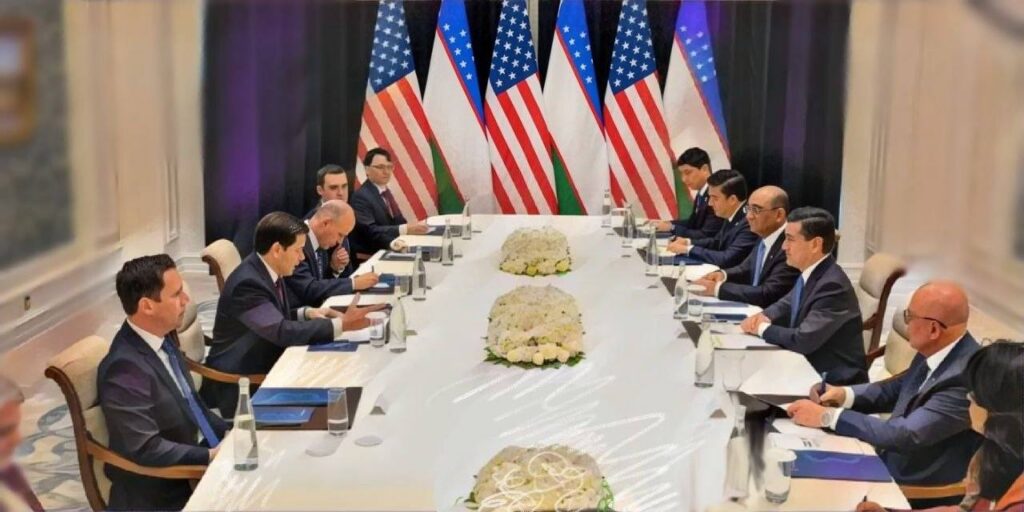
Washington D.C. - At the launch of the American-Uzbek Business and Investment Council in Washington on April 6, the most revealing line came early. Ambassador Sergio Gor, the White House’s special envoy for South and Central Asia, and Co-Chair of the Council, did not begin with trade statistics or a list of deliverables. He began with a blunt assessment of how the region has been treated in Washington. “For too long, this region has not found the attention that it deserves,” he said. That observation is hardly novel to anyone who follows Central Asia. What made it notable was the speaker and the setting. U.S. policy toward the region has often been episodic, driven at different times by Afghanistan, by Russia, by sanctions enforcement, or by concern over Chinese influence rather than sustained by a coherent regional economic strategy. Gor’s remarks suggested an attempt, at least by the current administration, to correct for that pattern. He was equally clear, however, that this was a political opening, not yet a settled doctrine. “Take this opportunity that the next two and a half years present,” he told the room, an unusually candid acknowledgment that Washington’s attention may be real without yet being durable. His other key formulation explained how the administration wants to make that attention count. “Never before in the history of the U.S. government has commercial diplomacy been such a major pillar of U.S. foreign policy,” Gor said. Whatever the phrasing, the intended shift was clear. Washington is signaling that in Central Asia, economic statecraft will not be treated as a side channel to politics, but as a primary instrument of policy. In that sense, the new council is less a ceremonial bilateral upgrade than a mechanism for turning political attention into projects, financing, and institutional follow-through. [caption id="attachment_46673" align="aligncenter" width="1600"] Image: TCA[/caption] Saida Mirziyoyeva, head of Uzbekistan’s presidential administration and the Uzbek co-chair of the council, answered that shift with a line that was just as pointed. “We are no longer at the stage where we speak about potential,” she said. “We are at the stage where we must deliver.” For a government that has spent years presenting Uzbekistan as a reforming economy open to outside capital, that was a significant change of emphasis. The argument is no longer that Uzbekistan deserves credit for opening up but that it now expects to be judged by execution. Her most substantive remarks were about institutions rather than ambition. The council matters, she said, because it should help “solve problems quickly, without unnecessary bureaucracy” and ensure that “no project is lost along the way.” That is a more serious claim than the language of partnership that usually fills these forums. Mirziyoyeva was effectively acknowledging the gap that often opens between political endorsement and project delivery. Uzbekistan’s challenge is no longer simply attracting attention from foreign partners but getting projects through financing, approvals, and implementation without losing momentum inside the state apparatus. That urgency reflects the scale of the opportunity. Uzbekistan, with a...