• KGS/USD = 0.01144 0%
  • KZT/USD = 0.00217 0%
  • TJS/USD = 0.10456 0%
  • UZS/USD = 0.00008 0%
  • TMT/USD = 0.28490 0%
  • KGS/USD = 0.01144 0%
  • KZT/USD = 0.00217 0%
  • TJS/USD = 0.10456 0%
  • UZS/USD = 0.00008 0%
  • TMT/USD = 0.28490 0%
  • KGS/USD = 0.01144 0%
  • KZT/USD = 0.00217 0%
  • TJS/USD = 0.10456 0%
  • UZS/USD = 0.00008 0%
  • TMT/USD = 0.28490 0%
  • KGS/USD = 0.01144 0%
  • KZT/USD = 0.00217 0%
  • TJS/USD = 0.10456 0%
  • UZS/USD = 0.00008 0%
  • TMT/USD = 0.28490 0%
  • KGS/USD = 0.01144 0%
  • KZT/USD = 0.00217 0%
  • TJS/USD = 0.10456 0%
  • UZS/USD = 0.00008 0%
  • TMT/USD = 0.28490 0%
  • KGS/USD = 0.01144 0%
  • KZT/USD = 0.00217 0%
  • TJS/USD = 0.10456 0%
  • UZS/USD = 0.00008 0%
  • TMT/USD = 0.28490 0%
  • KGS/USD = 0.01144 0%
  • KZT/USD = 0.00217 0%
  • TJS/USD = 0.10456 0%
  • UZS/USD = 0.00008 0%
  • TMT/USD = 0.28490 0%
  • KGS/USD = 0.01144 0%
  • KZT/USD = 0.00217 0%
  • TJS/USD = 0.10456 0%
  • UZS/USD = 0.00008 0%
  • TMT/USD = 0.28490 0%

Viewing results 451 - 456 of 2877

Mirziyoyev Secures Spotlight During U.S. Visit

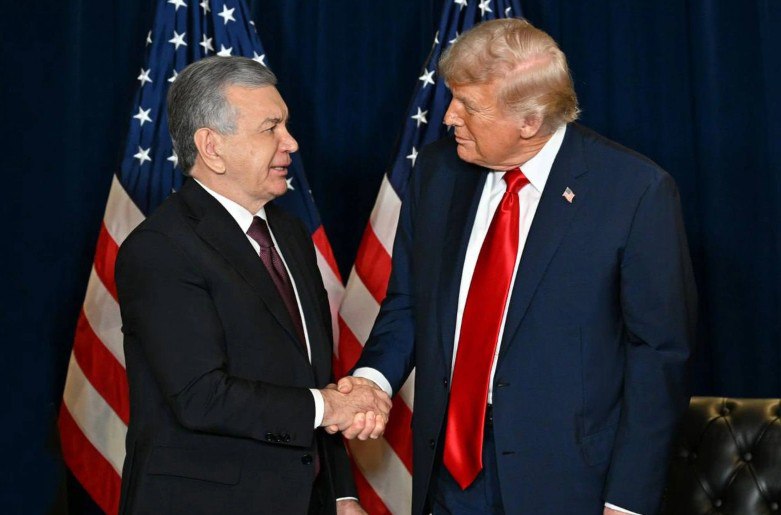
In a significant diplomatic breakthrough, Uzbekistan emerged as a standout player during this year’s United Nations General Assembly events in New York. President Shavkat Mirziyoyev not only secured a high-profile meeting with U.S. President Donald Trump, but also signed a landmark $8 billion deal with Boeing to purchase Dreamliner jets, a move that drew praise from Trump and captured the attention of the international business community. Trump publicly endorsed the agreement on social media, calling Mirziyoyev “a man of his word” and noting the deal would create “over 35,000 jobs” in the United States. Mirziyoyev’s visit included a high-level investment roundtable with executives from leading U.S. corporations and financial institutions. According to Forbes, trade between the two countries has quadrupled under Mirziyoyev’s leadership, with more than 300 American companies now active in Uzbekistan. Strategic sectors such as rare-earth metals and critical minerals took center stage during the discussions. Among the key meetings was one with the vice president of the Colorado School of Mines, who expressed support for establishing a research center in Uzbekistan. Other topics included joint initiatives in banking, information technology, transportation, and energy infrastructure. The scale of the Boeing deal served as a symbolic anchor to broader efforts: positioning Uzbekistan as a key connector between Central Asia and the Western economy. This aligns with a larger strategic pivot that analysts have long advocated. As U.S. engagement in Central Asia expands, countries like Uzbekistan are increasingly looking to diversify away from dependence on Russia and China. Forbes noted that the Trump administration is building on foundations laid by its predecessor by promoting regional initiatives such as the Zangezur Corridor, referred to as the “Trump Corridor”, aimed at linking Central Asia to global markets without passing through Russian territory. Mirziyoyev’s face-to-face meeting with Trump, followed by the public endorsement, also plays into shifting domestic narratives. It signals growing diplomatic credibility and a willingness to operate as an equal on the global stage. The convergence of political recognition and commercial investment may mark a turning point in Uzbekistan’s foreign policy, not just as a recipient of aid, but as a proactive economic actor. With the Boeing order and growing support from U.S. business leaders, Uzbekistan is staking its future on deepening ties with the West. Coupled with ongoing domestic reforms, the country is making a strategic bet that modernization and diversified partnerships will yield long-term dividends.

Silk Road Shipwrecks: Virtual Museum Opens Maritime Section

One of Central Asia’s most engaging new cultural projects took on a new dimension last month. The Silk Road Virtual Museum, an online collection of over 20 exhibitions of pre-16th-century Eurasian life and art, has recently opened a section for the ancient trade route’s maritime history. An initiative by the Institute of Asian Studies at Leiden University in the Netherlands, the site allows visitors to move through themed rooms, just as they would wander through a physical museum. Beginning on a map of the world on the museum’s homepage, visitors click on the Silk Road locations that they wish to discover. Each pin on the map takes them to a video replicating a guided tour of art and artefacts from that place at a certain historical era. Just as in a real museum, each exhibit has an information panel explaining what the object is. Life on the Central Asian parts of the Silk Road is shown in exhibitions to Sogdian traders in Samarkand (6th-8th centuries), with camels often featuring in their ceramic art, and a room dedicated to ancient caravanserais (inns that provided lodging for travellers), including at Tash Rabat in Kyrgyzstan. Launched in 2024, the Silk Road Virtual Museum already displays over 1,300 objects in total. Their geographical reach mainly stretches from Venice to China, as the Silk Road is often imagined today – but there are collections from places as unexpected as Sweden and Indonesia.  With the launch of the maritime section on 16 September, their scope now spans seas as well as deserts. Virtual visitors can travel along the coasts of the Indian Ocean, where there are already seven shipwreck exhibitions, each with its own unique story. The project is managed by VirtualMuseum360 and supported by an international network of scholars, who aim to make the Silk Road’s many eras and strands accessible to people wherever they are in the world. The web pages have two advantages over traditional museums, in that they are free to access and open 24/7.  Leading the Silk Road Virtual Museum (SRVM) is Professor Richard Griffiths, the director of Leiden University’s ‘New Silk Roads’ programme. A distinguished economic historian who has specialised in the history of trade, during a spell teaching in the Chinese city of Chengdu, Griffiths took an interest in China’s Belt and Road Initiative. When he began to trace the policy’s history, he realised that the origins of China’s modern trade with the West can be found in the myths and realities of the ancient Silk Roads. The key to making SRVM work, he says, is collaboration. Griffiths tells The Times of Central Asia: “We’re not replacing real museums – we’re working alongside them. Everything we do depends on the knowledge of academics, archaeologists, and conservators. Together we can make heritage accessible to anyone, anywhere, without losing its depth or integrity.” “Our visitors are a real mix,” he adds. “Often people tell me they use SRVM before a trip, so that when they see objects in a real museum,...

Afghanistan Absent, Not Forgotten – Central Asia’s UNGA Strategy

From September 23–29, 2025, the UN General Assembly’s general debate unfolded without an Afghan delegation addressing those assembled amid the unresolved UN seat issue. Yet Afghanistan was hardly absent. Central Asian presidents used their platform to project a collective stance that stopped short of recognition while rejecting isolation. Their message reflected a regional doctrine of managed engagement: keep the neighbor connected enough to limit collapse, through corridors, energy grids, and humanitarian channels. President Shavkat Mirziyoyev of Uzbekistan offered the clearest blueprint, urging the international community to “prevent [Afghanistan’s] isolation,” and calling for support to develop transport and energy corridors across Afghan territory. That language aligns with initiatives already underway: a multilateral framework signed in Kabul on July 17 to move the Trans-Afghan railway toward feasibility, and fresh agreements on the 500 kV Surkhan–Pul-i-Khumri line designed to stabilize Afghanistan’s power supply while linking it to a regional grid. Mirziyoyev’s message was a bid to convert geography into risk management. Kazakhstan struck a technocratic note. Kassym-Jomart Tokayev told the Assembly that “inclusive development in Afghanistan” is the basis for long-term regional peace and stability. This phrasing matches Almaty’s UN-backed hub for the Sustainable Development Goals and Astana’s self-image as the region’s administrative center. The goal is to stabilize the weakest link so trade and transit do not fracture. Kyrgyz President Sadyr Japarov used part of his brief UN address to demand that roughly $9 billion in Afghan central-bank assets frozen in Western jurisdictions be returned to “the Afghan people,” and called isolation “unacceptable.” In a remittance-dependent economy like Kyrgyzstan’s, collapse next door risks hunger, displacement, and crime. His remarks were both moral and practical, and marked the sharpest public challenge to Western policy voiced by any Central Asian leader this week. Traditionally, Tajikistan has taken the hardest line on the Taliban. This time, Emomali Rahmon emphasized humanitarian assistance, citing drought-hit regions and areas devastated by the August 31 eastern Afghanistan earthquake, and said Dushanbe supports peace, stability, and socio-economic development next door. The quake killed more than 2,000 people and destroyed thousands of homes across Kunar, Nangarhar, and Laghman just as aid budgets were shrinking. Turkmenistan took a different approach. President Serdar Berdimuhamedov did not mention Afghanistan, instead promoting Ashgabat’s permanent neutrality as a proposed UN agenda item, “Neutrality for Peace and Security,” along with broad transport and energy initiatives. This approach preserved flexibility on projects like TAPI without committing to specifics in New York. What makes these speeches consequential is how closely they mirror work on the ground. The Trans-Afghan railway, long dismissed as only a plan, now has a political framework and a declared security pledge from Kabul. Whether it moves forward depends on both capital and security, but for Tashkent, a southern outlet to Pakistani ports is the difference between landlocked and land-linked. The Surkhan–Pul-i-Khumri line is more conventional and urgent: a 200-kilometer fix to keep the lights on and the revenues flowing. The long-troubled CASA-1000 power corridor is also inching back into view after being paused post-2021, with...

Uzbekistan Plans Full Launch of Large Nuclear Power Plant by 2035

Uzbekistan plans to fully launch a high-capacity nuclear power plant by 2035, according to Azim Akhmedkhadjaev, director of the “Uzatom” agency. Speaking on September 25 at World Atomic Week in Moscow, Akhmedkhadjaev said the first small modular reactor is expected to begin operations in 2029 in the Jizzakh region, followed by a second unit six months later. The large-scale plant will see its first reactor come online in 2033, with full capacity expected by 2035. He noted, however, that final timelines depend on the conclusion of outstanding contract agreements. Akhmedkhadjaev confirmed that production of reactor equipment is already underway and that the project is proceeding on schedule. Responding to a question from a Spot correspondent, he reiterated the target dates for the larger reactors and emphasized that the timeline will be refined once contracts are finalized. The announcement aligns with Uzbekistan’s broader nuclear energy strategy. As previously reported by The Times of Central Asia, the country plans to build both small modular and larger reactors at a single integrated nuclear facility. Under a revised agreement with Russia, Uzbekistan intends to construct two large VVER-1000 reactors alongside two smaller RITM-200N units. The initial framework for the project was established in 2018 and updated in 2024. Earlier this year, The Times of Central Asia reported that Rosatom had begun manufacturing reactor components for the smaller units, with the first steel castings for the RITM-200N already produced in Saint Petersburg. Uzbekistan’s pivot to nuclear energy is part of its strategy to meet rapidly increasing electricity demand, which is projected to reach 135 billion kWh by 2035, nearly double current consumption levels. To address this, the government is expanding generation capacity and modernizing the national grid. While the plans are ambitious, challenges remain. As Akhmedkhadjaev acknowledged, the full implementation timeline depends heavily on contract finalization. Nevertheless, Uzbekistan’s dual-track approach, combining scalable small reactors with large base-load units, suggests a strategic commitment to energy security and diversification.

Climbing the Value Chain: Uzbekistan’s Textile Transformation Through Chinese Investment

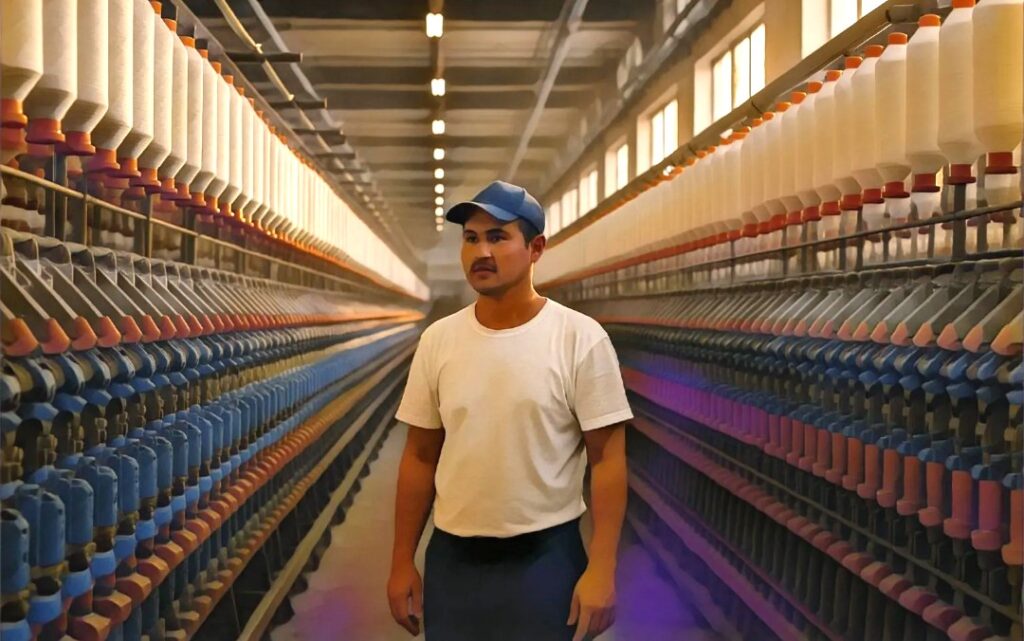
As relations between China and Uzbekistan deepen, cooperation is no longer confined to the traditional pillars of energy and infrastructure. The partnership has begun to branch into new and diverse areas, adding layers of complexity and opportunity to their bilateral ties. Emerging sectors such as pharmaceuticals and waste-to-energy are gaining traction, signaling a shift toward a more multidimensional relationship. At the same time, the textile industry has become an increasingly important bridge between the two countries, offering fresh avenues for collaboration. Recent agreements highlight this momentum. In the upstream segment of Uzbekistan’s textile sector, China Hi-Tech Holding has committed to a major investment in synthetic fiber and viscose yarn production. This move is particularly significant for Uzbekistan, as it reduces reliance on cotton and secures inputs essential for modern mixed-fabric production. Midstream, cooperation is expanding as well. An agreement between Uzbekistan and China’s Fong Group to develop dyeing and finishing facilities for mixed fabrics underscores the practical steps being taken to create a more integrated textile supply chain. These developments also reflect a broader trend of growing Chinese interest in Uzbekistan’s domestic market and its strategic location at the crossroads of the Middle East and Europe. With its young population and export potential, Uzbekistan is increasingly attractive to Chinese textile companies. The Red Dragonfly Group’s plan to establish a manufacturing base in Uzbekistan by 2026 is a clear example of how Chinese firms see the country not only as a production hub but as a gateway to wider regional markets. One of the main reasons Uzbekistan is emerging as a crucial destination for Chinese companies is the shifting incentive structure that encourages the relocation of manufacturing capacity abroad. Rising labor costs in China, particularly in the labor-intensive textile sector, are placing companies under pressure amid fierce domestic competition. In contrast, Uzbekistan offers an appealing alternative where the average monthly wage for a skilled worker is around 200-400 dollars, and energy costs are just 0.04 dollars per kilowatt-hour. Together, these factors significantly lower production costs and make the country highly attractive for firms seeking to maintain competitiveness. Equally important are Uzbekistan’s proactive regulatory policies, which create a favorable business climate for foreign investors. The government has relied heavily on Special Economic Zones and Small Industrial Zones and offers tiered incentive packages that reward higher commitments. Investors contributing between 3 and 5 million dollars receive three years of income tax holidays, while investments of 5 to 15 million dollars are rewarded with a five-year exemption. Those exceeding 15 million dollars benefit from an unprecedented ten-year tax holiday. Moreover, starting in September 2025, the social tax rate for textile companies and clusters will be cut to 1% for three years. At the same time, imports of blended fabrics and raw materials for the leather and sericulture industries will be exempt from customs duties. These measures provide Chinese companies with tangible cost advantages that rival opportunities in Southeast Asia. Another powerful driver is geopolitics. Growing trade tensions between China and the West, particularly the...

From Gas to Gigawatts: Uzbekistan Powers Ahead with Dual Nuclear Deal

Uzbekistan has confirmed it will be building a large nuclear power plant (NPP) with two 1000-megawatt (MW) reactors as the country prepares for a sharp increase in electricity consumption in the coming years. Uzbekistan’s state atomic energy company, Uzatom, posted on September 26 that a new agreement calls for both a large and small NPP to be constructed at the same site in Uzbekistan. The revised plan for NPPs in Uzbekistan combines agreements the country signed with the Russian state nuclear company Rosatom in 2018 and 2024. Uzbek Prime Minister Abdullo Aripov and his Russian counterpart at the time, Dmitri Medvedev, signed a deal in September 2018 for a large NPP with two VVER-1200 reactors.  However, in late May 2024, during Russian President Vladimir Putin’s visit to Uzbekistan, a new agreement was signed for six small reactors, each with a capacity of 55 MW. Preparation work for six RITM-200N reactors started shortly after in the Farish district of Jizzakh Province. In June 2025, Russia’s Ministry of Economic Development said the agreement was restructured. The latest official agreement, signed September 26, 2025, commits to building an integrated NPP with two large VVER-1000 reactors and two small modular RITM-200N units. The Farish facility will be the first to house both a large and a small NPP at the same site. Speaking on the sidelines of the World Nuclear Week conference in Moscow on September 25, Uzatom director Azim Akhmedkhadjaev said, “We are the first in Central Asia to create an innovative solution for the future… (a) project combining advanced small modular reactor technology with time-tested solutions from large-scale nuclear energy.” The new agreement calls for the construction of two VVER-1000 units instead of the original VVER-1200 models. There was no explanation for the change in the type of reactors for the Uzbek facility. Uzbek Deputy Prime Minister Jamshid Khodjaev was also at the conference in Moscow. Hojayev noted Uzbekistan is seeking to increase renewable energy sources so that by 2030, these sources will produce more than 40% of Uzbekistan’s energy. Khodjaev pointed to solar and wind projects in explaining why the small NPPs are necessary. “Large blocks (reactors) provide stable baseload generation, while small blocks cover peak loads and balance the erratic operation of solar and wind farms,” according to Khodjaev. Essentially, the smaller reactors will help ensure a constant flow of electricity into the domestic grid when there is insufficient wind or sun to keep wind farms and solar power stations operating at full capacity. As Much as Possible and More Khodjaev has said that when both the large and small NPPs are operational in 2035, it will add some 15-billion-kilowatt hours (kWh) to Uzbekistan’s power grid. Electricity production in Uzbekistan has risen from some 59 billion kWh in 2016 to about 81.5 billion kWh in 2024. A relatively small percentage of that is exported to neighbors. A recent agreement with Kazakhstan calls for sending some 900 million kWh of Uzbek electricity to its northern neighbor between March and December 2026....