• KGS/USD = 0.01144 0%
  • KZT/USD = 0.00205 0%
  • TJS/USD = 0.10784 0%
  • UZS/USD = 0.00008 0%
  • TMT/USD = 0.28490 0%
  • KGS/USD = 0.01144 0%
  • KZT/USD = 0.00205 0%
  • TJS/USD = 0.10784 0%
  • UZS/USD = 0.00008 0%
  • TMT/USD = 0.28490 0%
  • KGS/USD = 0.01144 0%
  • KZT/USD = 0.00205 0%
  • TJS/USD = 0.10784 0%
  • UZS/USD = 0.00008 0%
  • TMT/USD = 0.28490 0%
  • KGS/USD = 0.01144 0%
  • KZT/USD = 0.00205 0%
  • TJS/USD = 0.10784 0%
  • UZS/USD = 0.00008 0%
  • TMT/USD = 0.28490 0%
  • KGS/USD = 0.01144 0%
  • KZT/USD = 0.00205 0%
  • TJS/USD = 0.10784 0%
  • UZS/USD = 0.00008 0%
  • TMT/USD = 0.28490 0%
  • KGS/USD = 0.01144 0%
  • KZT/USD = 0.00205 0%
  • TJS/USD = 0.10784 0%
  • UZS/USD = 0.00008 0%
  • TMT/USD = 0.28490 0%
  • KGS/USD = 0.01144 0%
  • KZT/USD = 0.00205 0%
  • TJS/USD = 0.10784 0%
  • UZS/USD = 0.00008 0%
  • TMT/USD = 0.28490 0%
  • KGS/USD = 0.01144 0%
  • KZT/USD = 0.00205 0%
  • TJS/USD = 0.10784 0%
  • UZS/USD = 0.00008 0%
  • TMT/USD = 0.28490 0%

Our People > Joe Luc Barnes

Joe Luc Barnes's Avatar

Joe Luc Barnes

Regional Editor and Journalist

Joe Luc Barnes is a British journalist and author who focuses on the countries of the former Soviet Union. He has a Master’s degree in Russian and East European Politics from the University of Oxford. His book, “Farewell to Russia: A Journey Through The Former USSR”, will be published by Elliott and Thompson in Spring 2026.

Articles

Strained Currents: Managing the Syr Darya’s Waters

On both banks of the Syr Darya, apartments are springing up. The embankment itself is undergoing extensive renovation. Trucks crawl along, their weight pounding the freshly lain asphalt into shape. Its acrid whiff rankles in the nose for some distance. Kyzylorda’s new Akim, Nurzhan Akhatov, appointed in August 2024, is determined to make the most of his short term in office, explains Kanat Utegenov, founder of LLP ECO GUARD, an ecological laboratory. This makes the new landscaping important. “There is a lot of construction… it is visually noticeable to the population,” he told The Times of Central Asia. “Unfortunately, the economics of it have not necessarily been calculated.” Utegenov cites a new stadium on the left bank of the river as an example of one of these potential white elephant projects. Worse still, all this landscaping is dependent on one critical factor which is only partly under the control of the Akim, and only partly under the control of Kazakhstan. That issue is water. [caption id="attachment_32630" align="aligncenter" width="1600"] The low-running Syr Darya passing through Kyzylorda, Kazakhstan; image: TCA, Joe Luc Barnes[/caption] In late April, the view that a ritzy new apartment buys you is one of sad, sandy banks. Wading birds plod methodically through the mud, looking for worms. The dirty grey river does not so much flow but keeps up a ponderous momentum, inching its way northwest. Some of this water will reach the North Aral Sea, which is being propped up on life support by the Kokaral Dam. Utegenov attributes the low water level as being partly due to climatic change. “Winter has become milder and almost snowless,” he said, adding that it’s not unusual to see a low river in spring. “This is when the rice is planted; all the water goes to the irrigation canals.” Governments across the region are doubling down on rice production, says Bulat Yessekin, an expert on environmental and water policy in Central Asia. However, he points out that growing rice is incredibly inefficient in this part of the world. “If we take into account the full irrigation cycle, five tons (5,000 liters) of water are used to cultivate just one kilo of rice,” he told TCA. However, Kazakhstan’s government is keen to trumpet successes. The use of laser leveling technology in rice fields has helped save over 200 billion liters of water by distributing it more evenly. According to Kazakh state media, this has meant that the yield from each hectare of rice crop has increased by around 60-70%. This has done little to convince Yessekin, who believes this is little more than a sticking plaster. “There was no such need for technology before as there was enough water. Now, such technology has become necessary because otherwise, they will simply not be able to grow the crop. In countries with much greater precipitation, such as Thailand or India, you can grow it, but here there are no prospects for rice. Sooner or later people need to move to other crops.” Yessekin...

1 year ago

L’Étranger: Paris Hosts the Reclusive Leader of Turkmenistan

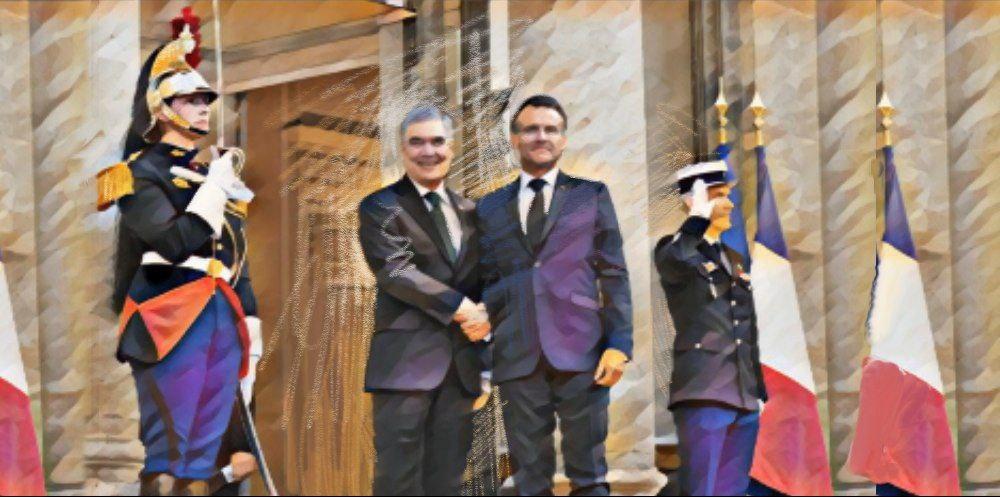
Gurbanguly Berdimuhamedov, Turkmenistan’s longtime ruler, no longer holds the title of president; that has been passed, along with much of the public burden, to his son. He now reigns from the shadows as Hero-Arkadag (“Hero-Protector”), but he retains the ability to open doors. Nearly 14 years after his last official visit, Berdimuhamedov landed at Paris’ Orly airport last Monday. He was in France ostensibly to attend the Franco-Turkmen Economic Forum, but the visit also saw him ushered into the Élysée Palace for an audience with President Emmanuel Macron. Characteristically, his presence in Paris was kept quiet, receiving very little coverage even in the French media. “It was much less discussed than the near-concurrent visit of the Syrian leader, Ahmed Al-Charaa,” Michaël Levystone, co-founder of l'Observatoire de la Nouvelle Eurasie, a Paris think tank told The Times of Central Asia. “You have to understand that Turkmenistan is a country that is virtually unknown to the general public in France – and for good reason: it goes out of its way to remain extremely discreet!” Nevertheless, the visit marks a rare moment of high-level Western diplomacy with one of the world’s most opaque regimes, as well as an extremely uncommon public diplomatic appearance from Berdimuhamedov Senior since ceding formal power in 2022. The questions are why France? And why now? What Was Discussed The two readouts of the encounter were notably different. The Élysée offered a terse summary on its website, noting vaguely that the meeting “provided an opportunity to review the bilateral relationship between Turkmenistan and France as well as regional issues.” Macron then followed this up with an equally laconic post on X, noting that the two had “signed several agreements between Turkmenistan and France in the areas of energy transition, infrastructure, education, and culture. They demonstrate the strengthening of our cooperation. We also took stock of major regional and international crises, including Russia's war of aggression against Ukraine and the situation in the Middle East.” On the other hand, the state-run news service Turkmenistan Today provided what can only be described as a detailed travelogue, noting the many dignitaries who had the pleasure of meeting the Hero-Arkadag on his whistle-stop tour of the City of Lights. According to the Turkmens, the visit yielded a flurry of agreements. A memorandum of understanding was inked between state-owned Türkmengaz and French tech firm Kayrros SAS, while France’s Thales Alenia Space Group signed a framework deal to provide Ashgabat with a second communications satellite. There were further promises of joint work on green energy, education, and archaeological research. A Foot in the Door One French company in particular is responsible for much of the engagement between the two countries. As part of his trip to Paris, Berdimuhamedov met with construction magnate Martin Bouygues, CEO of the firm that bears his family’s name. [caption id="attachment_31644" align="aligncenter" width="2560"] The Presidential Palace and ministries complex, built by the French company Bouygues; image: TCA, Stephen M. Bland[/caption] “Bouygues has built numerous monumental buildings in Ashgabat since Turkmenistan's independence,” Levystone told...

1 year ago

Seismic Cities: Is Central Asia Prepared for a Major Earthquake?

The recent 7.7-magnitude earthquake in Myanmar, which claimed over 3,500 lives and caused structural failures more than 1,000 kilometers away in Bangkok, has once again highlighted the precariousness of life in seismically active regions. “Earthquakes happen on geological faults, which are often sited at the edges of mountain ranges.” Richard Walker, Professor of Tectonics at the University of Oxford told The Times of Central Asia. “Sadly, the edges of mountain ranges are often the best places to live, due to the presence of water and of land for farming.” All Central Asian capitals, except for Kazakhstan’s relocated capital Astana, are located on such terrain. This has historically made them vulnerable. The 1948 earthquake in Ashgabat destroyed almost the entire city; Tashkent suffered a similarly destructive event in 1966, and Almaty was wracked by twin blows in 1887 and 1911. Although no such catastrophic event has occurred in the last half century, the earth beneath the region continues to rumble restlessly. Two quakes in early 2024 left the residents of Almaty unnerved. Last week, on April 14, a 5.9 magnitude earthquake in Tajikistan caused the death of a young boy and damage to around thirty homes near the Chinese border. Though moderate, these tremors serve to remind residents of the active tectonics of the region and raise questions about the structural readiness of buildings and infrastructure should a stronger event occur. Botched Building After the 2023 earthquake on the Turkey-Syria border, which killed over 53,000 people in Turkey alone, authorities launched investigations into over a hundred individuals linked to the construction of buildings that did not withstand the tremors. Such stories were familiar to people who grew up in the Soviet Union. In the 1988 Spitak earthquake in Armenia, tens of thousands died in Leninakan (now Gyumri). Many of the casualties were put down to the collapse of identikit 9-storey tower blocks built in the Brezhnev era. These were designed to withstand a magnitude 7 earthquake; in the event, the 6.8 magnitude quake that struck Leninakan caused 72 out of 78 of these buildings to collapse. In a bitter irony, many older, pre-Soviet structures remained intact. One team of international inspectors blamed “very low construction standards and suspect joint details” in Leninakan for the scale of the disaster. Similar precast tower blocks to those that collapsed in Armenia can be seen across the former USSR. According to the Uzbek media, the Cabinet of Ministers estimated in 2023 that approximately 70% of private housing in the country failed to meet current earthquake resistance standards. “The 2023 earthquake in Turkey was a tragic reminder of the importance of strict compliance with building codes and continuous quality control of construction in seismic regions,” Daulet Sarsenbayev, director of the Kazakhstan’s National Scientific Center for Seismological Observations and Research, told TCA. “Such events provide valuable lessons for all countries, including Kazakhstan, in terms of the need to strengthen the regulatory framework, increase transparency in the construction industry, and invest in resilient infrastructure.” In response to the...

1 year ago

Gas Crunch in Uzbekistan: Industry Falters as Demand Surges

In the first two months of 2025, Uzbekistan's natural gas production declined by 4.2% compared to the same period in 2024, continuing a troubling trend that has seen output fall from 61.59 billion cubic meters in 2018 to 44.59 billion cubic meters in 2024. This persistent decrease raises concerns about the nation’s energy security and economic stability. Once among Central Asia’s energy success stories, Uzbekistan became a net importer of natural gas in 2023, a symbolic turning point for a country whose identity was long intertwined with hydrocarbon abundance. The extent of the strain was demonstrated in December 2024, when gas stations around the country were forced to close during a cold snap as heating systems across the country kicked into action. This led drivers of methane-powered cars, which are common in the country given that it costs about $15 to fill the tank as opposed to $40-50 in a gasoline-powered vehicle, into a desperate hunt for places to fill up. Kilometer-long queues formed, and drivers ferociously competed to be first to the pump. Such scenes have become a familiar sight in the Uzbek winter as gas production has fallen. “Uzbekistan’s gas production is already quite mature,” Anne-Sophie Corbeau of Columbia University’s Center on Global Energy Policy told The Times of Central Asia. “The existing fields are entering a phase of decline. The reserve-to-production ratio was around 18 years based on 2020 data, and the situation is unlikely to be much better now.” Put simply, the country is running out of easy gas. Despite repeated efforts to locate new reserves, particularly in the under-explored Ustyurt region, exploration has so far failed to yield significant breakthroughs. Even if discoveries are made, the timeline to bring new fields online would mean little impact before 2030, at best. In parallel, demand for gas has remained stubbornly high. Corbeau noted that “the country’s energy mix and electricity generation are very dependent on natural gas. And Uzbekistan is one of the countries with the lowest wholesale gas prices in the world.” Those prices have long distorted both domestic consumption and investor interest, keeping demand high while choking off potential upstream capital. [caption id="attachment_30630" align="aligncenter" width="1209"] Image: Wholesale Gas Price Survey 2024 Edition. International Gas Union. https://www.datocms-assets.com/[/caption] This sentiment is echoed by Irina Mironova, Senior Energy Analyst at the New Energy Advancement Hub. “Domestic production is declining faster than consumption,” she said, “and domestic gas pricing is not market-based. It remains below the price of imported gas, which undermines the investment appeal of upstream projects for foreign investors.” The government has undertaken some measures to control demand over the past year, raising the tariffs for electricity and gas by 52.5% and 71% respectively, hitting consumers in the pocket in an attempt to alter the wasteful use of scant resources. On the supply side, the government has declared a bold ambition to raise production to 62 billion cubic meters annually under its Uzbekistan–2030 development strategy, but observers remain skeptical. “They’ve tried to facilitate exploration, especially in the...

1 year ago

Is Beijing’s Educational Diplomacy Turning the Dial on Central Asian Public Opinion?

OSH, KYRGYZSTAN – On the eastern bank of the Ak-Buura River, a mini-Chinatown is developing. At Osh’s old bus station, buses and taxis hawk their services to Kashgar, 300 kilometers away over the Pamir Mountains in China’s Xinjiang Province. Blue-plated SUVs stand by the roadside, sporting the 新 character that also symbolizes their origin in Xinjiang. At the Kelechek Bazaar, hordes of money changers shout the best rates for Dollars, Uzbek Som, and Chinese Yuan. Tucked away from the mêlée behind the Peking Hotel is the five-story Confucius Institute. “The Chinese language is in huge demand right now,” said Ali, a student who has moved to Osh from nearby Uzbekistan to study here. He believes the move will be good for his career. “It’s the best opportunity for anyone in this region,” he told The Times of Central Asia, before enthusing about his plans to study in China next year. [caption id="attachment_30054" align="aligncenter" width="1600"] The Confucius Institute in Osh, Kyrgyzstan; image: Joe Luc Barnes[/caption] “There’s a strong possibility that the younger generation will have a more positive view towards China,” Yunis Sharifli, a non-resident fellow at the China Global South Project told TCA. “This is good for China-Central Asia relations because we know that in the past, anti-China sentiments have hindered cooperation.” Chinese diplomats often refer to win-win diplomacy, where engagement between states can lead to positive outcomes for both sides. This is viewed with understandable cynicism by those who see Beijing’s diplomacy as entirely self-interested, but when it comes to education, even if we avoid the term win-win, the opportunities that it offers young Central Asians are hard to deny. In return, China hopes to create a network of influence and goodwill from people like Ali. Nevertheless, the jury is out on whether it is working. [caption id="attachment_30053" align="aligncenter" width="1600"] China-plated cars are an increasingly common sight in Kyrgyzstan; image: Joe Luc Barnes[/caption] Swelling numbers Given that numerous questions have been asked about the accuracy of China’s own population data, monitoring the number of foreign students in the country can be a fiendish task. The consensus is that the numbers are increasing. Chinese state media outlet Xinhua claimed that student numbers grew from 11,930 to 29,885 between 2010 and 2018, and have recovered since the pandemic. One recent report put the number of Kazakh students alone at “approaching 20,000”. These numbers are unlikely to dethrone Russia as the top destination for Central Asian students any time soon. Moscow claimed in 2023 that 168,000 Central Asians were studying in the country, with around a third of them being funded by the Russian government. However, Sharifli believes that Russia’s luster is beginning to wane. “Moscow State University has historically been very attractive for Central Asian people, particularly in the social science or the technical fields,” said Sharifli. “But since the war [in Ukraine] began there has been a lot of discrimination against Central Asians in Russia.” This was demonstrated in a recent account given to The Times of Central Asia by...

1 year ago

Chevrolet vs China: The Battle for the Future of Uzbekistan’s Auto Industry

ANDIJAN -- Spend long enough in Uzbekistan and you become adept at reading numberplates. While in Paris or Los Angeles, you will generally identify your taxi by its color and its manufacturer; try doing that in Uzbekistan, and you run into a problem: for the past two decades or so, the color and manufacturer have invariably been White and Chevrolet. “Yep, it’s true,” laughed Alisher, as I remarked on this when he collected me from Andijan train station. “90% of the cars are Chevrolets, and 80% of them are white.” But this era of monochrome monopoly may be coming to an end. With the electric vehicle (EV) revolution sweeping the world, Chinese companies have Chevrolet’s kingdom in their sights. A Levy for the Chevy Islam Karimov, Uzbekistan’s first president, was alone among the leaders of former Soviet republics in being a trained economist. Schooled in the planned economy, his powerful state acquired control over key industries and sought to make Uzbekistan self-reliant. It did a deal with South Korean conglomerate Daewoo to open its first factory in Uzbekistan in 1996, while slapping huge tariffs on all cars coming into the country from abroad. Daewoo, caught up in the Asian Financial Crisis in 1998, sold its auto arm to General Motors in 2002. The Detroit giant saw little wrong with the deal they had inherited in Uzbekistan, and so continued to produce Daewoo cars but now under their Chevrolet branding. The partnership transformed streets all across the country, with practically the only other cars to be seen on the roads being old Ladas from the Soviet period. [caption id="attachment_29761" align="aligncenter" width="1600"] A Kia hoarding above, naught but Chevrolet's below; image: Joe Luc Barnes[/caption] This lack of choice nevertheless provided jobs and an industrial base for the country’s auto industry. “I am very proud that Uzbekistan has built such an industry,” said Aziz Shukurov, CEO of A Group, a chain of car dealerships and owner of the nation’s largest network of service stations. “Today, more than one hundred companies operate in the local automotive industry producing parts for the vehicles; a lot of technology has been transferred over the years with tens of thousands of people employed. To my mind, a strong local automotive industry is a substantial asset for any country.” Meeting Mr. Market After Karimov died in 2016, his successor, Shavkat Mirziyoyev, began to embrace the free market. Close to a decade later, Tashkent throughfares are home to ever more foreign brands. Most prominent are South Korea’s Kia and Hyundai and China’s BYD and Changan. “The new president started opening up the country from 2017, giving access to foreign institutions and companies to the Uzbekistan market,” said Farkhodjon Israilov, an expert who specializes in attracting foreign investment into the country. In 2019, the government removed import duties and excise taxes on EVs. Given the growing popularity of EVs since then, the state-owned UzAuto Motors partnered with BYD to open one of only two operational production facilities outside China – the...

1 year ago

Fast Now, Feast Later: The Culinary Traditions of Ramadan in Uzbekistan

You hear the darkness before you see it. As the late winter sky pales over Tashkent, the noise of thousands of motorbike engines, bicycle bells, and apartment buzzers mounts to a crescendo. Those who haven’t ordered in battle their way past the onrushing delivery drivers towards the nearest restaurant. At Xadra, in the city’s Chilonzor district, tables fill rapidly. Dates, walnuts, sweetened milk, and bottles of water await their parched and starved customers. Many eye their watches carefully, waiting for the moment, at precisely 18.17, when they can begin to eat. Ramadan, or ramazon in Uzbek, is the ninth month of the Islamic calendar. From dawn until sunset, Muslims must refrain from eating, drinking, and other physical needs, only breaking their fast at sundown with a meal known as iftar. Though one might imagine a month of fasting would see a lull in activity across Tashkent’s catering sector, on the contrary, Ramadan is a month that is very much about food. [caption id="attachment_29505" align="aligncenter" width="1600"] Dates and milk are a traditional fast-breaking snack for starved stomachs; image: Joe Luc Barnes[/caption] The not-so-strict fast While the vast majority of the population are Muslim, Uzbekistan is a secular country, and there are no laws requiring restaurants or bars to close during daylight hours. Nevertheless, “cafes and restaurants are definitely less crowded; they’re at no more than 30 or 40% capacity during the daytime,” said Saodat Umarova, an economic analyst at the Center for Progressive Reforms. Shavkat, a kebab shop owner, observes a sharp decline in daytime custom. “I’m still open, but it’s certainly a more relaxed pace,” he said, pausing the film on his phone to talk to TCA. While a nearby university provides some business, his regular clients remain committed to their fasts. When asked if he finds it difficult being around food when he himself is fasting, Shavkat says that he does not mind. “On the first day or two, it is difficult, but you get used to it. This year is not such a difficult year.” He is referring to the season: in 2025, Ramadan began on March 1 and will end on March 30; the fasting period is a little over 12 hours, and the weather is mild. “When Ramadan falls in summer, you have long days, and it’s forty-degrees [104F], that’s when you really get tested.” Corporate accommodation The rhythm of business operations also shifts during the holy month. Oybek Shaykhov, Secretary General of the Uzbekistan-European Association for Economic Cooperation, tells TCA that while the economy doesn’t typically slow down, the nature of business meetings changes. “Breakfasts, lunches, and dinners are central to the business community, and during Ramadan, these gatherings shift towards Iftar, which is more of a group engagement rather than bilateral discussions,” he said. “Many companies try to ease workloads for employees, particularly if Ramadan falls during the hotter months, to accommodate fasting” Gulmira, a lawyer at a construction company, echoes this sentiment. “The only real difference is the lunch hour; everyone who is...

1 year ago

Kyrgyzstan’s Rebrand: New Country, or New Distractions?

On January 29, in what became a viral social media post, Seide Ibraimova and her mother drove to the site of VDNKh, the exhibition center built in the Kirghiz SSR to demonstrate the achievements of socialist science and culture. Her mother, wrapped in a white headscarf, reminisced happily about the times she’d spent there, surrounded by poplar trees in the shadow of the mountains. Seide’s father was one of the architectural team who built the main pavilion in 1974. But as they arrived at the site, they found nothing but rubble. The government had bulldozed the pavilion to make way for a new congress hall. “How could they?” said the old lady in a choked whisper. “Your father gave his heart and soul to this, for the people of the republic. The number of delegations who came here… how could they?” In the post’s comments section, an intense debate began. Some lamented the loss of the exhibition center: “Without this historic architecture, Bishkek will be nothing more than a concrete jungle,” said one. Another invoked Chingiz Aitmatov’s famous mankurt metaphor, describing those who had destroyed the site as having “no sense of memory or feelings, without attachment, who do not know who they are or where they come from.” Others were less sentimental, pointing out that VDNKh had been left to rot for two decades, and that those venerating the Soviet relics were the real mankurts, “forgetting your language, preaching the history and ideology of the fascists who invaded and occupied our country.” “You can forget the USSR,” said another. “We live in a sovereign state, the Kyrgyz Republic!” These online spats come at a time when Kyrgyzstan is going through a form of national branding under the government of Sadyr Japarov. But is the country really shedding its Soviet skin, or are the changes mere window dressing? [caption id="attachment_29217" align="aligncenter" width="1600"] The ruins of the VDNKh pavilion, February 2025; image: Joe Luc Barnes[/caption] Around two hundred meters from the wreckage of the pavilion is Yntymak-Ordo, or the “new White House”. This is the newly-constructed official administrative building of Kyrgyzstan’s president – a squat structure with thick columns, topped by a glass dome and surrounded by iron bars and armed guards. Reminiscent of many of the other presidential palaces that have sprung up across Central Asia over the past thirty years, it is an assertion of power. Further along Chinghiz Aitmatov Avenue (which was called Prospekt Mira until 2015) are scores of new high-rise residential buildings. Each month, new approvals are granted for more of these in the city center, contributing to a construction boom. Some see this as a deliberate attempt to erase the Soviet past from the city and replace it with their own idea of a modern Kyrgyz capital. The aesthetic shift is not just architectural. The government recently launched a competition for a new Kyrgyz national anthem. Aspiring composers have been invited to submit their proposals, the commission recently confirming that 23 have been accepted so...

1 year ago

Right Place, Right Time: Central Asia Basks in Russia’s Eastern Energy Pivot

On January 1, with the closure of pipelines through Ukraine, deliveries of Russian gas to Europe came to a virtual standstill. Prices across the continent have ratcheted up in the first six weeks of 2025 and have now hit two-year highs. In Central Asia, the effects of the Russo-European decoupling have also been profound. In 2024, Kyrgyzstan posted a 48% year-on-year increase in Russian gas imports, while Uzbekistan’s inbound gas purchases soared over 142% to $1.68 billion. But while Gazprom’s reorientation has been a boon to Central Asia’s economies, this phenomenon appears to be more than short-term supply dumping due to the war in Ukraine. Rather, it is part of a lasting trend that could define the region’s, and the world’s, energy map. Russia’s Supply Glut In 2018, Russia exported a record 201 billion cubic meters (bcm) of gas to Europe. The closure of the Yamal and Nord Stream pipelines had already brought these supplies down to 49.5 bcm by 2024 and will be further impacted by the cut in supplies via Ukraine. Despite some gas supplied via Turkstream and a steady trade in liquefied natural gas (LNG), Russian gas supplied to Europe is a fraction of what it once was. The Central Asian market offers both short and long-term solutions to this. “Most likely, Gazprom views its expansion into Central Asia as a partial and immediate solution to the challenge of finding new markets for its gas,” said Shaimerden Chikanayev, a partner at GRATA International, a law firm. “While the region cannot fully replace the volumes or profit margins previously achieved in Europe, it offers a readily accessible and stable outlet for Russian gas exports.” Central Asia is accessible due to old Soviet pipelines that link the region to Moscow. These pipelines, known as Central Asia–Center, were originally built to take gas from Turkmenistan, via Uzbekistan and Kazakhstan to Russia. This system has now been engineered to run in reverse. The pipeline has a capacity of around 50 bcm per year, but there are ongoing efforts to increase it. Still, this is only a quarter of what was once supplied to Europe, nor are the revenues as lucrative. In 2023, the average rate charged by Gazprom to Uzbekistan for gas was $160 per thousand cubic meters (tcm), this compares to European prices that fluctuated between $200-400tcm throughout the 2010s. For Stanislav Pritchin, head of the Central Asia sector at the Institute for World Economy and International Relations (IMEMO), Moscow, the price is not a major factor. “Russia of course sells gas to Kazakhstan, Uzbekistan, and Kyrgyzstan lower than the market price. This is a politically motivated decision. And this is not just because it is struggling with [selling to] Eastern Europe. Russia could sell it to Central Asia at market prices, but this is the Russian approach towards its allies in the region,” he said. Central Asian Serendipity For Central Asian states, these new supplies have come at a good time. Countries such as Kyrgyzstan are trying hard to...

1 year ago

Half a World Away: Central Asian Workers on British Farms

Few countries have more patriotic supermarkets than Britain. Whether it’s a sortie through the sausage section, or browsing the fruit aisle, customers are almost guaranteed to be confronted with the red, white and blue of the Union Jack. In a country not famed for its food, it’s perhaps strange to see the national flag given such prominence. The practice is far less common in continental Europe. Nevertheless, over the past decade there has been a push, propelled by an odd alliance of environmentalists and nationalists, to source homegrown food. Retailers have cottoned onto this and seem glad to leave the customer with the warm, bucolic feeling that they have aided embattled farmers, reduced their carbon footprint, and even helped to correct the country’s balance of payments deficit by buying British. “Supermarkets get more than just the profit margin for the [British] fruit they sell,” says Dr Lydia Medland, a research fellow at Bristol University. “We call it farmwashing: they get publicity, they get kudos; they use this ripe, fresh, local image to sell more products.” There’s only one snag. The people who pick the fruit and vegetables which are then packaged up with British flags, are not exactly local. [caption id="attachment_28497" align="aligncenter" width="1600"] British flags adorn food packaging in the country's supermarkets.Images: Yvonne Mould (left); Elke Morgan (center and right)[/caption] Central Asia and Britain: An Unlikely Match Seasonal workers have been traveling to the island of Britain for over a hundred years. In the nineteenth century, farmers would travel across the Irish Sea to help bring in the harvest. However, in the late 1990s, the number of people arriving on seasonal visas began to rise significantly. This was followed in the 2000s by a spike in workers from Europe, taking advantage of visa-free access to Britain’s labor market under the auspices of the European Union. They served as a pool of flexible, cheap workers for a farming industry that was being increasingly squeezed by the buying power of the country’s major supermarket chains. When Britain voted to leave the EU in 2016, the farming industry panicked at the prospect of losing much of this cut-price labor force. They successfully lobbied the government to relaunch the Seasonal Worker Visa program on a trial basis. Originally designed in the 1940s for European students, the scheme was repackaged to empower private recruitment agencies to hire workers from across the world to work in the fields for six months a year. When the visa debuted in 2018, 2,500 people came. By 2021 – the year that freedom of movement between Britain and the EU officially ended – the government had already raised the quota to 30,000. At the other end of Europe, the collapse in the value of the Russian Ruble since the start of 2023, combined with a crackdown on foreign laborers, has seen a mass exodus of Central Asians from Russia. By October 2024, there were around 30% fewer migrants in the country than there were on the eve of the Covid-19...

1 year ago