• KGS/USD = 0.01144 0%
  • KZT/USD = 0.00191 -0%
  • TJS/USD = 0.10840 0.37%
  • UZS/USD = 0.00008 0%
  • TMT/USD = 0.28571 0%
  • KGS/USD = 0.01144 0%
  • KZT/USD = 0.00191 -0%
  • TJS/USD = 0.10840 0.37%
  • UZS/USD = 0.00008 0%
  • TMT/USD = 0.28571 0%
  • KGS/USD = 0.01144 0%
  • KZT/USD = 0.00191 -0%
  • TJS/USD = 0.10840 0.37%
  • UZS/USD = 0.00008 0%
  • TMT/USD = 0.28571 0%
  • KGS/USD = 0.01144 0%
  • KZT/USD = 0.00191 -0%
  • TJS/USD = 0.10840 0.37%
  • UZS/USD = 0.00008 0%
  • TMT/USD = 0.28571 0%
  • KGS/USD = 0.01144 0%
  • KZT/USD = 0.00191 -0%
  • TJS/USD = 0.10840 0.37%
  • UZS/USD = 0.00008 0%
  • TMT/USD = 0.28571 0%
  • KGS/USD = 0.01144 0%
  • KZT/USD = 0.00191 -0%
  • TJS/USD = 0.10840 0.37%
  • UZS/USD = 0.00008 0%
  • TMT/USD = 0.28571 0%
  • KGS/USD = 0.01144 0%
  • KZT/USD = 0.00191 -0%
  • TJS/USD = 0.10840 0.37%
  • UZS/USD = 0.00008 0%
  • TMT/USD = 0.28571 0%
  • KGS/USD = 0.01144 0%
  • KZT/USD = 0.00191 -0%
  • TJS/USD = 0.10840 0.37%
  • UZS/USD = 0.00008 0%
  • TMT/USD = 0.28571 0%
14 November 2025

Our People > Sadokat Jalolova

Sadokat Jalolova's Avatar

Sadokat Jalolova

Journalist

Jalolova has worked as a reporter for some time in local newspapers and websites in Uzbekistan, and has enriched her knowledge in the field of journalism through courses at the University of Michigan, Johns Hopkins University, and the University of Amsterdam on the Coursera platform.

Articles

Uzbekistan and SOCAR Advance $2 Billion Ustyurt Energy Project

Uzbekistan’s Minister of Energy, Jorabek Mirzamahmudov, has outlined the country’s deepening energy cooperation with Azerbaijan’s state oil company SOCAR, highlighting progress on a recently signed Production Sharing Agreement (PSA) for the Ustyurt region and broader plans in petrochemicals and electricity trade. In an interview with Azerbaijani media outlet Report, Mirzamahmudov confirmed that Uzbekistan, SOCAR, and Uzbekneftegaz have already established a joint operating company to oversee the Ustyurt project. Fieldwork is expected to accelerate soon, with seismic surveys covering over 3,000 linear kilometers set to begin before year-end, followed by the drilling of the first exploration well. The PSA structure splits ownership equally between the state and investors, with SOCAR and Uzbekneftegaz as the primary partners. British energy major BP has shown interest and is in preliminary discussions to join the consortium. Azerbaijani President Ilham Aliyev stated in August that SOCAR had commenced work at an Uzbek oil field following the contract signing. He expressed optimism about potential discoveries within the next one to two years. Mirzamahmudov acknowledged that earlier data on Ustyurt had not suggested large hydrocarbon reserves but said that modern interpretation techniques have revealed greater potential. While refraining from early reserve estimates, he said SOCAR specialists are optimistic about promising oil indicators. If confirmed, Uzbekistan plans to build a new refinery. Total investment in the Ustyurt project is projected at around $2 billion. The minister said SOCAR and Uzbekneftegaz would finance the project’s initial stages, with BP possibly joining later. He did not rule out future collaboration with Azerbaijan on major fields like Shah Deniz or Absheron but emphasized that Uzbekistan’s current priority is increasing domestic production. In the long term, joint ventures in third countries are also being considered. Trans-Caspian Energy and Renewables Push Mirzamahmudov also discussed the proposed trans-Caspian high-voltage direct current (HVDC) cable project aimed at exporting renewable energy to Europe. A joint venture involving Azerbaijan, Kazakhstan, and Uzbekistan has already been formed. The Asian Development Bank is assisting in selecting a consultant for the project’s feasibility study. Several countries, including Saudi Arabia, have expressed interest. Uzbekistan currently generates more than 20% of its electricity from renewables and aims to increase that share to 54% by 2030. In the Ustyurt region alone, wind projects totaling over 2.5 GW are under development, with the first 100 MW already operational. The government also plans to deploy hybrid wind-solar-storage systems with a minimum capacity of 5 GW. Localization and Petrochemical Cooperation Mirzamahmudov noted that future oil and gas processing facilities could be localized in special economic zones in Bukhara, Karakalpakstan, and Khorezm, which are currently being evaluated for infrastructure and logistics readiness. A joint venture with SOCAR Trading is already exporting polymer products, and ongoing discussions aim to expand cooperation in fuel production and fertilizer manufacturing.

5 hours ago

Uzbek Consulate Assists Citizen Misled into Russian Army Contract

Uzbekistan’s Consulate General in St. Petersburg has intervened to assist an Uzbek citizen who was allegedly misled into signing a contract to serve in the Russian Armed Forces, the Consulate announced on November 12. According to the Consulate, a citizen identified as K.M. appealed for help after their child, K.R., reportedly signed the contract while held in pre-trial detention in Kolpino, Leningrad Region. K.R. had been taken into custody on charges of intentionally inflicting minor bodily harm on another Uzbek national. K.M. told consular officials that K.R. suffers from serious mental health issues and had been deceived into agreeing to military service while in detention. The parent requested that the Consulate assist in nullifying the agreement. The Consulate stated that it had promptly contacted the relevant Russian authorities, including the Human Rights Commissioner for Leningrad Region, urging a review of the case and protection of the detainee’s legal rights. As a result of these efforts, Russian officials acknowledged K.R.’s objections to military service. The Consulate confirmed that no military contract was finalized and that the detainee was returned to the Kolpino detention center, where the investigation remains ongoing. The Consulate emphasized that it is closely monitoring the case and will continue to safeguard the legal rights and interests of the Uzbek citizen. The Times of Central Asia has previously reported on several instances in which Central Asian migrants have faced pressure to join Russia’s military amid recruitment campaigns targeting foreign nationals, particularly migrant workers.

5 hours ago

Uzbekistan Deepens U.S. Partnership Through New Investment Council and National AI Strategy

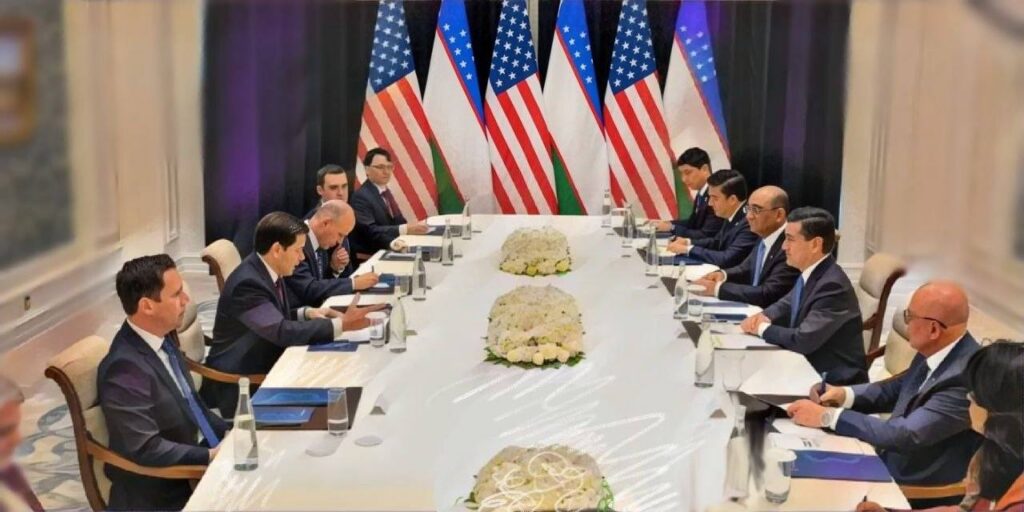
Uzbekistan is advancing a broad effort to strengthen its relationship with the United States through new economic, diplomatic, and technological initiatives. A presidential decree establishing the Uzbekistan–U.S. Business and Investment Council, alongside a major artificial intelligence partnership with NVIDIA, underscores the country’s strategy to draw investment and accelerate digital development. A New Platform for Economic Engagement The creation of the Uzbekistan–U.S. Business and Investment Council follows President Shavkat Mirziyoyev’s recent participation in the C5+1 Summit, where regional connectivity and U.S.–Central Asia cooperation were central topics. The council will be jointly led by the Head of the Presidential Administration and a representative appointed by the U.S. administration, giving both sides a formal mechanism to coordinate investment priorities and oversee major projects. Uzbekistan expects the platform to support initiatives involving institutions such as the U.S. International Development Finance Corporation, the European Bank for Reconstruction and Development, and the Asian Development Bank. Officials have framed the council as part of a longer-term effort to expand trade, encourage U.S. private-sector engagement, and diversify the country’s investment base. Expanding Diplomatic Reach The government is preparing to significantly widen its diplomatic network in the United States. A new Adviser-Envoy will be assigned to the embassy in Washington beginning in 2026 to coordinate investment initiatives linked to the council. Plans are also underway to open additional consulates in Philadelphia, Chicago, Orlando, and Seattle, reflecting both the size of the Uzbek diaspora and growing interest in regional outreach. Uzbekistan’s shift toward deeper engagement includes a visa-free regime for U.S. citizens starting January 1, 2026, which will allow 30-day stays and support increased travel for business and education. Updates on foreign policy and consular matters are regularly published by the Ministry of Foreign Affairs. Expanding the National AI Ecosystem Alongside diplomatic and economic reforms, Uzbekistan is pursuing ambitious plans to grow its artificial intelligence capacity. During a recent visit to the United States, Digital Technologies Minister Sherzod Shermatov held discussions with leaders at NVIDIA on infrastructure development, AI governance, and workforce training. The ministry has positioned the partnership as a key step toward integrating international expertise into Uzbekistan’s digital transformation strategy. The cooperation includes the development of an AI Excellence Center powered by NVIDIA technology and supported by training programs from the company’s Deep Learning Institute. The center will provide training for educators and specialists, while universities begin preparing to introduce AI-focused academic programs and certification pathways. A Nationwide Investment in Digital Infrastructure Uzbekistan plans to deploy two national AI clusters by 2026 with a combined computing capacity of up to one megawatt. One cluster will support academic and research institutions, while the second will focus on public-sector systems and industrial projects, including automation, healthcare analytics, and digital government services. Funding is in place for NVIDIA-powered supercomputers that will be installed at leading universities, with procurement scheduled for late 2025. The government is also creating an Industrial AI Excellence Center backed by a $3 million investment. The facility is expected to begin operating in 2026 and will concentrate on...

1 day ago

Uzbekistan and U.S. to Create Joint Business and Investment Council

Uzbekistan has announced the establishment of the Uzbekistan-U.S. Business and Investment Council, a new institutional platform aimed at deepening trade, investment, and commercial cooperation between the two countries. The initiative was formalized by a presidential decree signed by President Shavkat Mirziyoyev on November 12. The council will be jointly chaired by the Head of the Presidential Administration of Uzbekistan and a representative appointed by the President of the United States. It follows agreements reached during President Mirziyoyev’s official visit to Washington from November 4–6, held within the framework of the “C5+1” summit. The council’s primary objective is to coordinate the development and implementation of strategic business initiatives and major investment and trade projects, while ensuring continuous monitoring of their progress. It will also work to attract new foreign investment through the creation of a dedicated investment fund, with participation expected from institutions including the U.S. International Development Finance Corporation (DFC), the European Bank for Reconstruction and Development (EBRD), and the Asian Development Bank (ADB). Uzbekistan will also expand cooperation in the IT sector by promoting the products and services of companies based in its national IT Park. Broader plans include diversifying the country’s investment portfolio and foreign currency reserves. To further strengthen diplomatic and economic engagement, a new position titled Adviser-Envoy of the Presidential Administration in the United States will be established at Uzbekistan’s Embassy in Washington beginning January 1, 2026. The envoy will oversee strategic investment initiatives and coordinate the work of the Business and Investment Council. The Foreign Ministry has also been instructed to expand Uzbekistan’s diplomatic presence across the United States, with preparations underway to open new consulates in Philadelphia, Chicago, Orlando, and Seattle, cities with significant Uzbek diaspora communities. Oversight of the council’s operations and implementation of the decree will be led by Saida Mirziyoyeva, Head of the Presidential Administration, who will serve as the Uzbek co-chair of the new council. The initiative forms part of Uzbekistan’s broader strategy to deepen cooperation with the United States, expand economic engagement, and build stronger institutional ties ahead of the planned visa-free regime for U.S. citizens in 2026. Uzbekistan currently maintains an embassy in Washington and a Consulate General in New York. As previously reported by The Times of Central Asia, Uzbekistan will introduce a visa-free regime for U.S. citizens starting January 1, 2026, allowing stays of up to 30 days. The change is intended to broaden engagement between the two countries.

1 day ago

Medieval Wall Paintings Discovered at Ancient Kanka Site in Uzbekistan

Archaeologists in Uzbekistan have uncovered rare wall paintings dating back to the 10th-11th centuries at the ancient site of Kanka in the Tashkent region, according to a report by UzA. The excavation is being led by researchers from the Institute of History at the Academy of Sciences of Uzbekistan, with support from the Tashkent regional administration. Dilnoza Jamolova, the institute’s deputy director, stated that the mural fragments were discovered within the remains of a large caravanserai located in the shahristan (inner city) of ancient Kanka. The structure, situated approximately 60 meters south of the city’s southern gate, measures around 100 by 70 meters and is noted for its significant architectural features. Inside one of the caravanserai’s rooms, archaeologists found fragments of wall paintings that had fallen from the walls. The pieces, ranging from 15×20 to 30×35 centimeters, confirm that the building’s interior was once adorned with mural artwork. Experts say the discovery is notable evidence that wall painting, a tradition believed to have declined following the Arab conquest, experienced a revival in the Tashkent region during the 10th and 11th centuries. Similar wall paintings have been identified at other prominent Central Asian archaeological sites, including Samarkand and Ahsikent. The ongoing study, which involves restorers from the Samarkand Archaeological Institute under the Cultural Heritage Agency, also suggests the existence of a distinct mural art tradition in medieval Tashkent. In earlier excavations at Kanka in 2023, researchers discovered murals dating back to the 5th-7th centuries. The latest findings are expected to offer new insights into the cultural and artistic life of the region and to deepen scholarly understanding of Tashkent’s medieval heritage. Previously, The Times of Central Asia reported on another major archaeological discovery in southern Uzbekistan, where scientists found evidence that hunter-gatherer communities were harvesting wild barley as early as 9,200 years ago, challenging long-standing theories about the origins of agriculture in the ancient world.

1 day ago

Central Asia Unites: Evacuations Amid Middle East Turmoil

As hostilities between Israel and Iran escalate in the Middle East, Kazakhstan, Kyrgyzstan,  and Uzbekistan have initiated a comprehensive evacuation of their citizens from high-risk areas, drawing on regional cooperation and humanitarian assistance to ensure their safe return. Regional Support in Evacuation Efforts Azerbaijan and Turkmenistan have stepped in to aid the Central Asian nations' evacuation operations, providing transit routes and logistical support. At the Astara border checkpoint, six Kazakh citizens crossed from Iran into Azerbaijan, where they were offered medical assistance and meals before continuing their journeys. Turkmenistan has also facilitated the safe passage of approximately 120 evacuees, including citizens of Kazakhstan, Kyrgyzstan, Uzbekistan, Tajikistan, and Romania, through its border checkpoints with Iran. Turkmenistan’s Ministry of Foreign Affairs confirmed that foreign diplomats and their families were recently evacuated from Iran through Turkmenistan. The country provided comprehensive humanitarian assistance to the evacuees, offering transportation, food, accommodation, and essential supplies. Turkmenistan’s authorities highlighted that the operation was carried out in close cooperation with foreign embassies and international organizations, reflecting its commitment to humanitarian values, international cooperation, and good neighborly relations, particularly during the “Year of Peace and Trust,” as declared by the United Nations General Assembly at Turkmenistan’s initiative. Uzbekistan has evacuated over 30 citizens of its citizens from Iran via Turkmenistan and Azerbaijan, according to the Ministry of Foreign Affairs. “All necessary measures are being taken to ensure the safety of our citizens. The embassies of Uzbekistan in Iran and Israel are operating around the clock,” the ministry stated. Kyrgyzstan has also successfully evacuated 28 of its citizens from Iran via Azerbaijan. "Currently, the necessary assistance is being provided to facilitate the swift return of the evacuees from Azerbaijan to Kyrgyzstan," a Foreign Ministry official stated. Flight Bans and Alternative Routes Kazakhstan’s Civil Aviation Committee has meanwhile implemented a full ban on flights over or near the airspace of Iran, Iraq, Israel, Jordan, Lebanon, and Syria following intensified airstrikes in the region. This decision disrupted flights for hundreds of Kazakh travelers, particularly those in the United Arab Emirates and other Middle Eastern nations. To address the situation, alternative evacuation routes were established. On June 15, two FlyDubai flights arrived in Almaty, carrying a total of 332 Kazakh citizens. These flights included passengers initially stranded after the airspace ban and others who had been scheduled to depart after the interruption. Following rerouting operations, airlines such as Air Astana and FlyArystan have warned of disruptions to flights to and from the Gulf and North Africa. Passengers have been advised to check schedules in advance and to expect delays. Mirziyoyev Addresses the Conflict’s Impact The conflict between Israel and Iran has raised serious concerns across Central Asia. Speaking during a government meeting held via videoconference, Uzbekistan’s President Mirziyoyev warned that the hostilities could negatively impact newly developing trade and transport routes in the region. The growing conflict will “have an impact not only on the Middle East, but also on our region. If the escalation continues, trade relations and logistics routes that are...

5 months ago

Mystery and Intrigue Behind the Death of Inessa Papernaya

Further details have come to light which shroud the death of Inessa Papernaya in yet more mystery. As reported by TCA yesterday, Papernaya and her companion were found dead in a Tashkent hotel on October 20, along with an Uzbek man in a neighboring room whom media sources initially referred to simply as U.Kh. It has since come to light that this person was Khushnud Udekov, a well-known 48-year-old businessman from the Khorezm region whose private gas company was liquidated. Initially, reports stated that Papernaya was a Russian journalist known for her work with lenta.ru and profile.ru. It was also reported that Papernaya was in Uzbekistan on vacation, and was staying at the Karaman Palace Hotel with her fiancé, Maxim Radchenko, whom she had traveled with in order to meet his relatives. However, Papernaya’s last post for either of these publications came in 2019, since when she had become an employee of the Russian mining company, Norilsk Nickel. According to accounts surrounding the death of Papernaya and Radchenko, hotel staff knocked on the door of their room after the couple, who were supposed to have returned to Moscow, stopped answering the phone. Receiving no response, staff entered the room, where they discovered the bodies of the pair in the bathroom. “When she didn’t answer her phone at 11 PM, I felt something was wrong,” Papernaya’s mother told the media. “I knew something had happened.” The body of Udekov was subsequently found in the room directly below, with some local publications speculating that the businessman may have been the target of a contract killing. Preliminary reports attributed the cause of the deaths to poisoning of “unknown origin,” with early suggestions being made that gas seeped into the room through the ventilation system after the hotel’s pool was cleaned on October 19-20, leading to the incident. The hotel where the incident occurred was also still under construction, and the first floor was stuffed with building materials and furniture. Following the gruesome discovery, authorities sealed off the Karaman Palace Hotel. The Prosecutor General’s Office of Uzbekistan launched an investigation under Article 186 of the Uzbek Criminal Code, which covers the provision of unsafe services, and a forensic examination was ordered to determine the precise causes of death. According to Hayat Shamsutdinov, the press secretary of Uzbekistan's Prosecutor General 's Office, the exact cause of death will be determined after a thorough examination, the results of which are expected in about a month. Forensic expert Alexey Reshetun, however, has stated that it is “extremely difficult to imagine that two adults would die in a single room as a result of gas entering through the ventilation.” Relatives of Radchenko, meanwhile, have disputed what they describe as several different versions of the deaths which have been put forward. Radchenko’s sister stated that the family were initially told “he had an epileptic seizure; she ran up to him, slipped, fell, hit her head and died. This is some kind of TV series: how do you fall? What...

1 year ago

The Fall and Fall of Salim Abduvaliev – Kyrgyz Authorities Place Uzbek “Kingpin” on Wanted List

The State Committee for National Security of Kyrgyzstan (GKNB) has issued an arrest warrant for the already imprisoned 73-year-old Salim Abduvaliev, who for decades was one of Uzbekistan's most prominent individuals. As part of the investigation, evidence was obtained that Abduvaliev had financed the activities of an organized criminal group led by Kamchybek Asanbekovich Kolbaev, an individual linked to heroin trafficking who was wanted by the U.S. Department of State and was a member of the international criminal group, the "Brothers’ Circle," or “Bratva”. Kolbaev was killed in Bishkek in a security operation in October 2023 at the age of 49. In a dramatic fall from grace, in March of this year, Abduvaliev was sentenced to six years in prison in Uzbekistan for “arms trafficking”. Initially a fan of President Mirziyoyev, even being photographed wearing a t-shirt proclaiming “My President” emblazoned with Mirziyoyev’s image, Abduvaliev eventually fell afoul of reforms and a crackdown on corruption. “Whether it is criminal groups… or officials mired in corruption, if someone flouts the law and causes harm to the state and society, we will never be able to stand by and watch it,” Mirziyoyev said in December 2023. “In ‘New Uzbekistan,’ the law must prevail, and punishment for crimes must be inevitable”. Having been hugely influential in CIS countries for decades, Abduvaliev now also stands accused in Kyrgyzstan of establishing illegal channels for transporting narcotics to Europe. According to the GKNB, Abduvaliev regularly provided material support to Kolbaev and helped him to become the leader of the Kyrgyz criminal world and rank among the most influential criminal figures in the region. In their indictment, the GKNB stated that Kolbaev and Abduvaliev had a close relationship; pictures showing Kolbaev’s visits to “celebrations and other events” organized by Abduvaliev in Uzbekistan number among the evidence. Based on the collected materials, Abduvaliev was placed on the interstate and Interpol databases by the Oktyabr District Court of Bishkek. Widely-known as "Salimboy-Boyvaccha" (which can be used to mean “grandfather”, “rich man”, or “dandy”), Abduvaliev previously held the position of Vice President of the National Olympic Committee and President of the Wrestling Association of Uzbekistan. He was also an associate of the mob boss, Gafur Rakhimov, considered to be one of the most prominent drug lords in the CIS. [caption id="attachment_21414" align="alignnone" width="700"] Image: GKNB of the Kyrgyz Republic[/caption] A mainstay of Central Asian crime circles, Abduvaliev was in the aluminum business with the notorious Michael Cherney – declared by the FBI to be an “organized crime figure” - sponsored the participation of Anatoly Bykov – since jailed for murder - in elections in Krasnoyarsk Krai in Russia. A 2012 article in Argumenty I fakty cites an “FBI Organized Crime” report as stating that in 1987, when Mikhail Cherney came to “conquer Moscow,” he came with “recommendation letters [from] respected” Tashkent businessmen known by their nicknames, Gafur and Salim.” A well-connected source who wishes to remain anonymous for their safety told TCA that “in Uzbekistan there was no single business...

1 year ago