• KGS/USD = 0.01144 0%
  • KZT/USD = 0.00204 0%
  • TJS/USD = 0.10608 0%
  • UZS/USD = 0.00008 0%
  • TMT/USD = 0.28571 0%
  • KGS/USD = 0.01144 0%
  • KZT/USD = 0.00204 0%
  • TJS/USD = 0.10608 0%
  • UZS/USD = 0.00008 0%
  • TMT/USD = 0.28571 0%
  • KGS/USD = 0.01144 0%
  • KZT/USD = 0.00204 0%
  • TJS/USD = 0.10608 0%
  • UZS/USD = 0.00008 0%
  • TMT/USD = 0.28571 0%
  • KGS/USD = 0.01144 0%
  • KZT/USD = 0.00204 0%
  • TJS/USD = 0.10608 0%
  • UZS/USD = 0.00008 0%
  • TMT/USD = 0.28571 0%
  • KGS/USD = 0.01144 0%
  • KZT/USD = 0.00204 0%
  • TJS/USD = 0.10608 0%
  • UZS/USD = 0.00008 0%
  • TMT/USD = 0.28571 0%
  • KGS/USD = 0.01144 0%
  • KZT/USD = 0.00204 0%
  • TJS/USD = 0.10608 0%
  • UZS/USD = 0.00008 0%
  • TMT/USD = 0.28571 0%
  • KGS/USD = 0.01144 0%
  • KZT/USD = 0.00204 0%
  • TJS/USD = 0.10608 0%
  • UZS/USD = 0.00008 0%
  • TMT/USD = 0.28571 0%
  • KGS/USD = 0.01144 0%
  • KZT/USD = 0.00204 0%
  • TJS/USD = 0.10608 0%
  • UZS/USD = 0.00008 0%
  • TMT/USD = 0.28571 0%
19 February 2026

Viewing results 1 - 6 of 33

Central Asia and Azerbaijan on Board as the Gaza Peace Effort Gets Underway

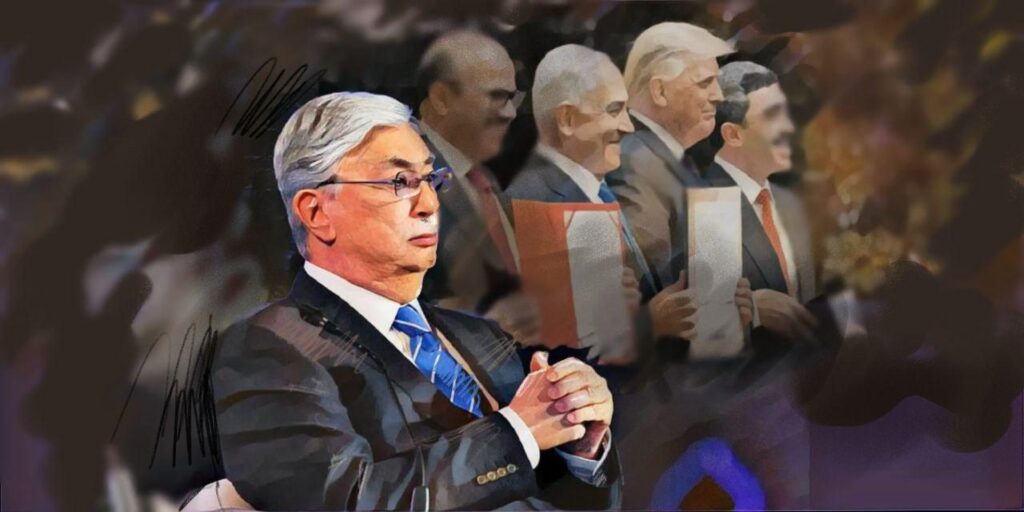
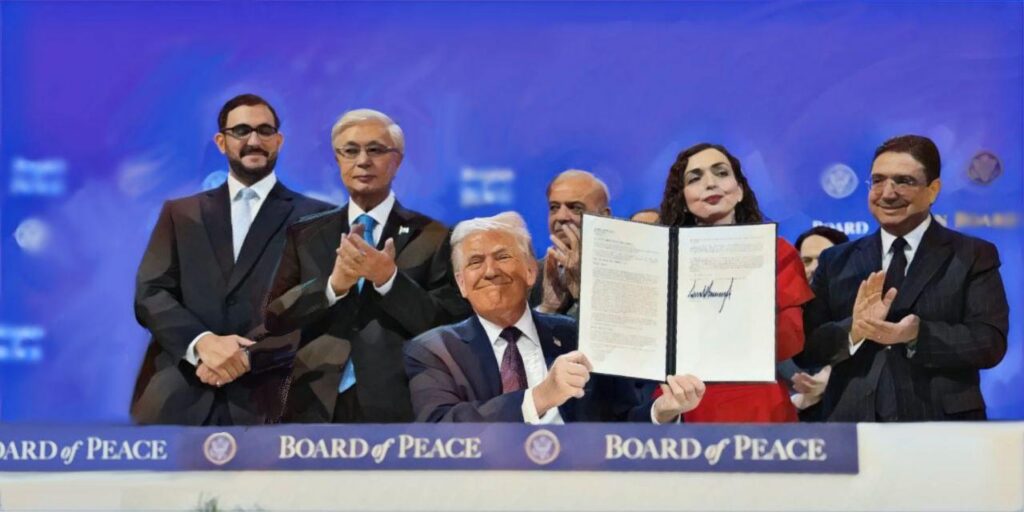
As the Trump Administration is trying to drag the world toward the reconstruction of Gaza, an undertaking fraught with security, political, and economic challenges, a gap is emerging between the “old” Europe, skeptical of Trump, and nation-states seeking to expand cooperation with Washington. Central Asian and Caucasian "middle powers" are among the emerging allies in the Trump Administration's latest diplomatic gambit for peace. Kazakhstan took a leadership position as the first Muslim-majority state outside the Middle East to join the Abraham Accords in November 2025. President Kassym-Jomart Tokayev, an experienced diplomat, former Foreign Minister, and high-level U.N. official, represented his country at the Board of Peace inauguration during the January 2026 session of the World Economic Forum in Davos, Switzerland. So did Ilham Aliev, President of Azerbaijan, and his First Lady and First Vice President, Mehriban, both of whom met with Trump in Davos. The attendance and participation of leaders of other majority-Muslim states outside the Middle East are also noteworthy. President Shavkat Mirziyoyev of Uzbekistan, Prabowo Subianto of Indonesia, Vjosa Osmani-Sadriu of Kosovo, and Prime Minister Mian Muhammad Shehbaz Sharif of Pakistan signed the Charter on behalf of their respective nations. Those who chose not to participate are equally noteworthy. France, the United Kingdom, Belgium, Portugal, Canada, and Australia, which publicly announced or reaffirmed recognition of a State of Palestine around the U.N. General Assembly in September 2025, each determined not to attend the signing ceremony at Davos, despite the fact that the establishment of the Board was officially welcomed by the UN Security Council in November 2025. This underscores the challenges that will arise as Trump’s Comprehensive Plan to End the Gaza Conflict enters its second phase, which foresees Hamas’ disarmament. Similarly, differences in policy toward Israel among the Muslim-majority countries that signed the Charter speak to the complexity of the Board’s task. Kazakhstan, Uzbekistan, and Azerbaijan have longstanding diplomatic and trade relations with Israel. This contrasts with the complex and often hostile stances of Qatar, long ruled by the Al Thani family, and Turkey under Recep Tayyip Erdoğan, both of which support the Muslim Brotherhood and shelter Hamas terrorists. Then there are countries like Indonesia and Pakistan, which have never had diplomatic relations with Israel. Indonesia, under Subianto, continues to condition recognition of Israel on the creation of a Palestinian state. Pakistan has been officially hostile since its founding, and is particularly fearful of Jerusalem’s increasingly close relations with India, though it does have a history of covert information sharing and unofficial cooperation. Once again, navigating the political agendas and moving the reconstruction project forward will require a multi-dimensional chess game. Nevertheless, the Trump White House is working on the Board of Peace's first meeting, set for February 19th. Currently, there is no official word about whether the leaders of Kazakhstan and Uzbekistan will attend, while other leaders plan to, such as President Aliyev, who just signed a Strategic Partnership Charter during a visit by U.S. Vice President J.D. Vance to Azerbaijan, and PM Nikol Pashinyan of...
Tokayev Praises Trump’s ‘Common-Sense’ Governance, Backs U.S.-Led Peace Initiatives

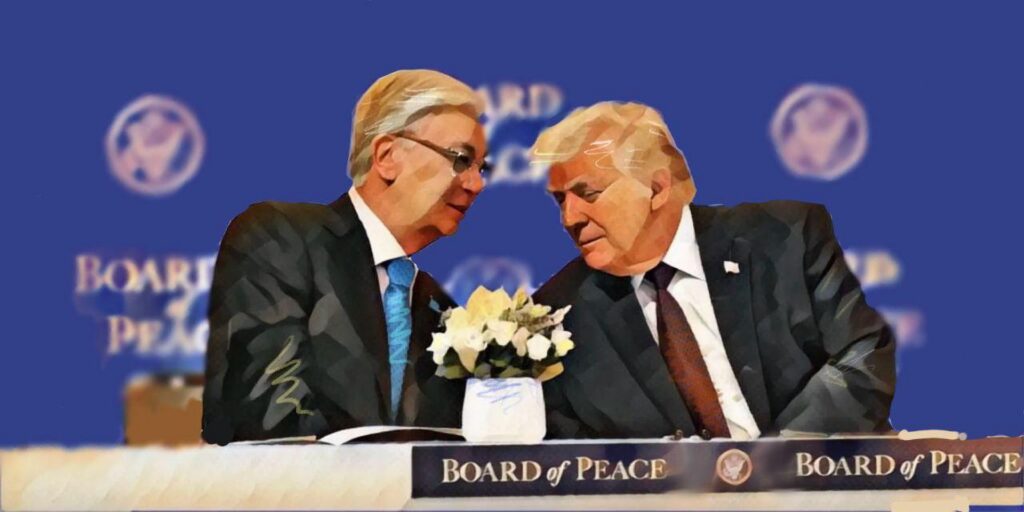
Kazakhstan’s President Kassym-Jomart Tokayev has offered rare and explicit praise for the domestic and foreign policies of U.S. President Donald Trump, describing him as a strong leader whose governance model prioritizes national interests, law and order, and pragmatic diplomacy. In an exclusive interview with The News International during his visit to Islamabad, President Tokayev described President Trump’s leadership as “forward-looking,” pointing to what he characterized as strong economic performance and ongoing transformative reforms in the social sphere in the United States. “President Trump is a strong and forward-looking leader who puts the national interests of his country first,” Tokayev said, pointing to what he described as strong economic performance and transformative reforms in the social sphere. He added that Trump’s emphasis on law and order resonated with Kazakhstan’s own governance philosophy, which prioritizes compliance with the law and respect for state institutions. Tokayev said that in an increasingly complex global environment, governments must ensure internal stability by enforcing the rule of law. “All citizens must comply with the law and respect law-enforcement agencies while avoiding any obstruction,” he noted, drawing a direct parallel between Washington’s and Astana’s domestic policy approaches. Support for the Abraham Accords The Kazakh president also defended his country’s decision to join the Abraham Accords, an initiative launched during Trump’s presidency to normalize relations between Israel and several Muslim-majority countries. Describing the accords as “a truly forward-looking initiative,” Tokayev said Kazakhstan’s participation reflects its long-standing commitment to peace, stability, and international dialogue. He stressed that diplomacy remains the most effective instrument for resolving conflicts and fostering long-term regional and global stability. While reaffirming Kazakhstan’s strong relations with Israel, Tokayev underscored that Astana continues to support the Palestinian people and advocates a two-state solution. From a national interest perspective, he said, joining the Abraham Accords creates opportunities to attract foreign investment, advanced technologies, and concrete economic benefits. He also expressed hope that Kazakhstan’s accession would help broaden Arab–Jewish rapprochement into a wider Muslim–Judaic dialogue. Board of Peace and the UN Framework Addressing criticism surrounding the newly established Board of Peace, which he co-founded with Pakistan’s prime minister, amongst others, Tokayev rejected claims that the initiative seeks to undermine the United Nations. He said President Trump had personally emphasized that the Board of Peace is designed to complement, not replace, the United Nations, which he acknowledged is currently facing institutional strain. Tokayev highlighted that the initiative implements United Nations Security Council Resolution 2803, reinforcing the principle that peace efforts must combine international legitimacy with effective leadership. According to Tokayev, the Board of Peace aims to deliver swift and practical outcomes through flexible mechanisms for conflict resolution, positioning it as a pragmatic addition to existing global peace architectures. Gaza and the Limits of Diplomacy On the prospects for peace in Gaza, Tokayev offered cautious realism. He said proposals put forward by U.S. Special Envoy Steve Witkoff and senior adviser Jared Kushner appeared ambitious, structured, and grounded in development-oriented thinking. However, he warned that no plan can succeed without genuine political...

Kazakhstan and Israel Deepen Cooperation in Astana

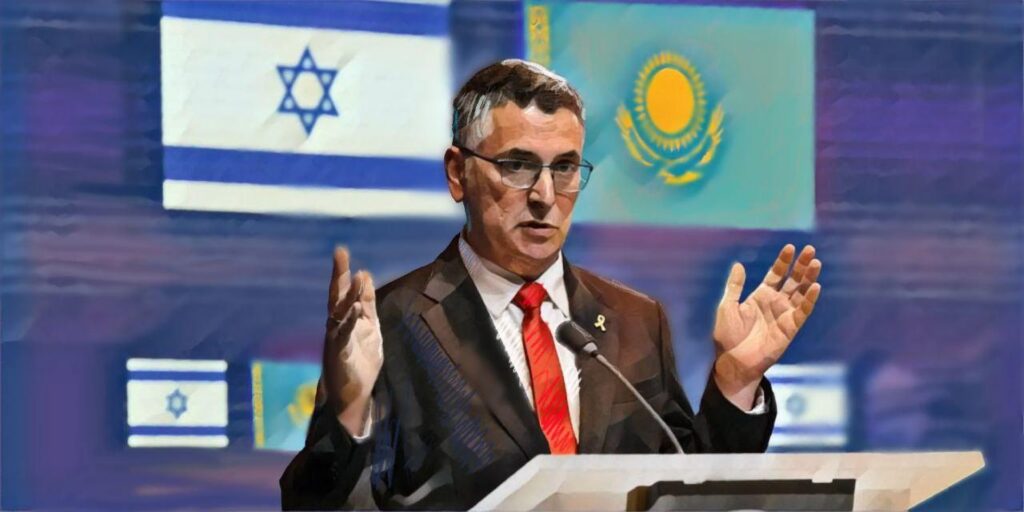
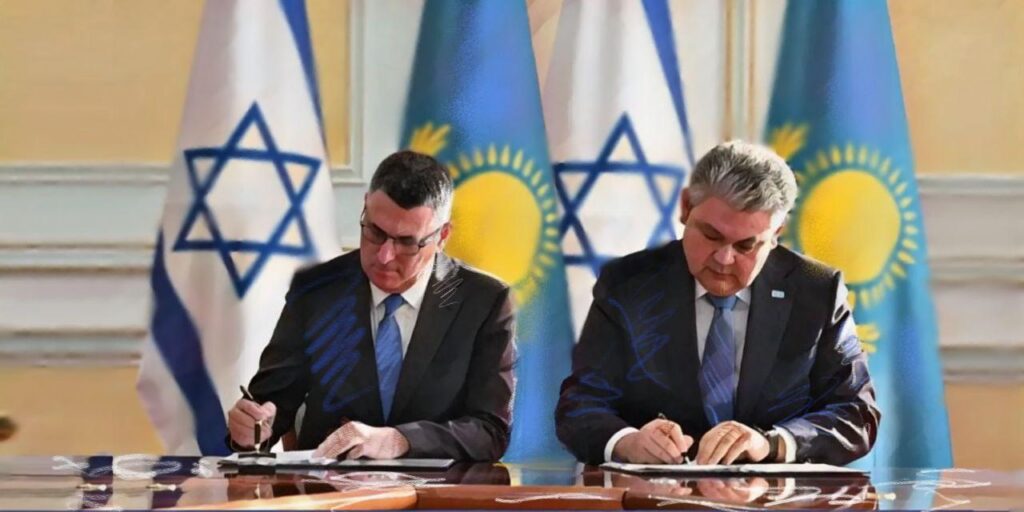
Israeli Foreign Minister Gideon Sa’ar’s official visit to Astana on January 27, 2026, was the first by an Israeli foreign minister to Kazakhstan in 16 years, and it yielded a package of institutional and economic steps. President Kassym-Jomart Tokayev received Sa’ar and Foreign Minister Yermek Kosherbayev, holding talks that both sides framed as elevating cooperation to a new level. The two foreign ministries signed documents on diplomatic training and public diplomacy, and agreed to pursue visa-free travel for holders of ordinary passports. A Kazakhstan–Israel business forum convened in parallel, with January–November 2025 trade of about US$162.4 million cited as the baseline for expansion. The visit’s value lay in its forward-looking measures to deepen cooperation. The sides agreed to convene the Kazakhstan–Israel Joint Economic Commission at a ministerial level. This move creates a regular venue where sector priorities can be translated into specific workstreams. The Kazakhstan–Israel business forum was framed as the practical feeder for that process, as both sides publicly identified a project map running from high-tech agriculture and water-resource management through digital technologies (including artificial intelligence) to infrastructure and logistics, energy efficiency and renewables, and healthcare and pharmaceuticals. In parallel, the two foreign ministries’ political consultations, in their twelfth round, covered wider international and regional agendas, including Middle East confidence-building and peaceful-settlement initiatives. Regularizing Cooperation Channels The documents signed in Astana were narrow-gauge instruments designed to regularize contacts. The memorandum on diplomatic training provides for structured interaction in the preparation of diplomatic personnel. What this means in practice is that exchanges between the two foreign-policy services will be routinized through their training institutions rather than on an ad hoc basis. The memorandum on public diplomacy set a framework for coordinated outreach, providing an agreed approach to presenting their cooperation. Taken together, these instruments are the administrative layer that will operationalize joint political intent. The visa initiative was narrowly framed as a statement of intent to conclude a visa-exemption agreement for holders of ordinary passports, not as an agreement already in force. In practice, such a regime would lead to higher tourism flows and denser business travel. The latter development would widen the base of commercial contacts, which could in turn be carried into ministerial-level economic follow-up. The visa track is thus an enabling measure for the economic agenda. At the leadership level, Sa’ar publicly invited President Tokayev to visit Israel. This move signals an intent to sustain momentum beyond merely ministerial channels. The visit coincided with International Holocaust Remembrance Day in Kazakhstan, and Sa’ar participated in a state ceremony in Astana connected to the commemoration. The ceremony included senior officials and diplomatic representatives, with official messaging from Tokayev to Israel’s president on the occasion. The civic and humanitarian nature of this event complemented a visit that otherwise concentrated on governance mechanisms, economic priorities, and institutionalizing diplomatic follow-through. First Steps Toward Joint Projects Beyond merely listing priority sectors, the business forum also surfaced first-step commercial and quasi-commercial documents providing a basis for follow-through. Kazakhstan’s investment agency reported three signed items:...

Astana–Israel Talks Span Technology, Trade, and Holocaust Remembrance

Kazakh President Kassym-Jomart Tokayev met Israeli Foreign Minister Gideon Sa’ar in Astana on January 27, marking the first official visit by an Israeli foreign minister to Kazakhstan in almost 16 years, and underscoring Astana’s stated interest in deepening economic and technological cooperation with Israel as it continues to recalibrate its foreign policy. According to the Kazakh presidential administration, the talks focused on expanding bilateral relations across trade, investment, science, and technology, with both sides emphasizing practical areas of cooperation. The visit came as Kazakhstan seeks to diversify its economy beyond hydrocarbons and strengthen partnerships with countries at the forefront of applied innovation. Tokayev said the visit demonstrated Israel’s commitment to strengthening comprehensive cooperation with Kazakhstan, while discussions highlighted concrete sectors for collaboration, including artificial intelligence, agrotechnology, water resource management, and digital governance. These areas align closely with Kazakhstan’s national development priorities, particularly its focus on digital transformation, public-sector reform, and productivity-driven growth. Economic cooperation featured prominently throughout the visit. A Kazakh-Israeli business forum was held alongside the high-level talks, aimed at translating diplomatic engagement into commercial outcomes. Kazakhstan’s Foreign Ministry said the forum is expected to support new investment partnerships and initiate joint projects in high-value sectors, with a focus on technology transfer and localized projects. Kazakh officials said bilateral trade reached $162.4 million between January and November 2025, with exports totaling $92.1 million and imports $70.3 million. While modest in absolute terms, the figures were cited as evidence of untapped potential, particularly in non-resource sectors where Israeli companies have global expertise. As part of the discussions, Kazakhstan invited Israeli firms to participate in national digital transformation initiatives, including projects related to e-government, data-driven public services, and digital infrastructure. Officials cited Kazakhstan’s recent progress in digital governance and public-sector innovation as a foundation for expanded cooperation. Kazakhstan and Israel established diplomatic relations in 1992, shortly after Kazakhstan gained independence. Israel opened its embassy in Almaty in 1996, while Kazakhstan inaugurated its embassy in Tel Aviv in 2000, laying the groundwork for steady but largely low-profile bilateral ties. Political relations have traditionally been pragmatic, with cooperation focused on trade, agriculture, healthcare, and education rather than formal alliances. Bilateral trade has remained modest, reflecting limited commercial engagement beyond specific sectors such as agrotechnology, pharmaceuticals, and water management. In recent years, Astana has shown growing interest in Israel’s applied innovation ecosystem, particularly in areas aligned with Kazakhstan’s domestic reform agenda, including digital governance, artificial intelligence, and public-sector modernization. Israeli firms have previously participated in pilot projects and advisory initiatives in Kazakhstan, though large-scale joint ventures have been limited. Kazakhstan has also positioned itself as a neutral diplomatic actor in the Middle East, maintaining relations with Israel while emphasizing interfaith dialogue and mediation. Beyond economic ties, the talks also addressed regional and international issues, including developments in the Middle East and Kazakhstan’s diplomatic positioning in support of the objectives underpinning the Abraham Accords framework. Sa’ar welcomed Kazakhstan’s engagement, describing it as a constructive contribution to dialogue and cooperation between Israel and Muslim-majority countries. Sa’ar...

Kazakh Diplomacy: Why Tokayev Aligned Kazakhstan With the Abraham Accords

On November 6, 2025, President Kassym-Jomart Tokayev confirmed that Kazakhstan had formally acceded to the Abraham Accords, aligning the Central Asian state with the U.S.-brokered diplomatic framework. Launched during Trump’s first presidential term, the Abraham Accords seek to expand diplomatic normalization between Israel and Muslim-majority states. Initially signed in September 2020 by Israel and the United Arab Emirates, and separately by Israel and Bahrain, the Abraham Accords were later expanded to include Morocco and Sudan. Within the broader Abraham Accords framework, Washington continues to seek Saudi Arabia’s participation, a step viewed as diplomatically significant given the kingdom’s custodianship of two of Islam’s holiest sites. However, the process was derailed following the outbreak of the Gaza war in late 2023, triggered by a Hamas attack on Israel. Riyadh has since insisted that normalization can only proceed once there is meaningful progress toward establishing a Palestinian state. Kazakhstan, a secular state with a Muslim-majority population, has maintained diplomatic ties with Israel since April 1992. Embassies were opened in 1996, and bilateral relations have expanded steadily, including in trade, defense, and humanitarian fields. In 2016, Israeli Prime Minister Benjamin Netanyahu visited Kazakhstan, highlighting the strength of this relationship. These longstanding ties help explain why Kazakhstan’s accession did not mark a shift in its bilateral relationship with Israel. Because Kazakhstan established full diplomatic relations with Israel decades ago, several analysts have described the country’s accession to the Abraham Accords as largely symbolic. Uzbek political scientist Kamoliddin Rabbimov argues that the decision was a calculated gesture rather than a shift in Kazakhstan’s geopolitical orientation. “The question arises: is Kazakhstan really ready to weaken its relations with China, Turkey, and Russia in order to join the American-Israeli alliance? I don’t think so,” Rabbimov said. “President Tokayev most likely just formally supported Trump’s initiative by saying ‘yes’ without putting any real geopolitical meaning into it. Nevertheless, even such a ‘yes’ is capable of slightly upsetting the balance in Kazakhstan’s foreign policy.” Giorgio Cafiero, the CEO of Washington-based Gulf State Analytics, views the move as strategic positioning. “Given the Trump administration’s determination to expand the scope of the Abraham Accords, this move by Kazakhstan was a relatively easy way to win the White House’s favor.” German analysts at Kettner Edelmetalle emphasize Kazakhstan’s natural resource wealth as a key factor. “The country has significant deposits of minerals and rare earth elements, resources that are indispensable for modern technologies. By strengthening ties with Washington, Astana apparently hopes to attract more American investment in this strategically important sector.” Eldar Mamedov, non-resident fellow at the Queens Institute and a former senior advisor to the European Parliament, views the development through the lens of geopolitical balancing. “The Abraham Accords are merely a tool in Astana’s deliberate efforts to diversify its geopolitical dependence on Moscow and strengthen its strategic relations with the United States,” he writes. “Perceiving them as the beginning of a new, ideologically defined bloc misinterprets the fundamentally pragmatic and self-interested nature of Kazakhstan’s calculations.” Kazakhstan’s accession to the Abraham Accords reflects...

Opinion: Iranian Unrest Creates Opening for U.S., Partners in Central Asia

As protests in Iran enter their third week, nationwide unrest is exerting political strain and societal pressure on the Islamic Republic. The nation’s current escalation reflects a level of sustained mobilization comparable to Iranian demonstrations that erupted in 2022 following the death of Mahsa Amini. While the outcome of these developments remains uncertain, ongoing unrest in Iran is more likely to impact Central Asia’s existing energy, transit, and security dynamics, rather than alter the broader regional landscape. This moment nonetheless offers the United States and its partners a strategic opportunity to advance long-term objectives in Central Asia while supporting regional resilience at a time when geopolitical alignments are rapidly shifting. Combined with ongoing disruptions caused by Russia’s War in Ukraine, the recent protests in Iran may create a heightened sense of uncertainty or risk perceptions in global energy markets. In particular, the current Iranian unrest may raise concerns regarding potential oil supply disruptions and broader geopolitical tensions. For neighboring producers like Kazakhstan, which maintains an oil-dependent economy, this elevated volatility could translate into higher revenues from existing exports. Increased fiscal flexibility from rising oil revenues may therefore provide Astana with the opportunity to expand its scope for economic cooperation with Western partners. The United States, which maintains long-standing bilateral energy ties with Kazakhstan, could draw on these existing partnerships to deepen its bilateral energy and technical ties. Beyond its impact on energy markets, ongoing instability in Iran may also affect regional connectivity initiatives. For example, disruptions could emerge along the International North-South Transport Corridor (INSTC), a multimodal network connecting India, Iran, and Russia, with branches that involve the Caspian and Central Asia. Although the Kazakhstan-Turkmenistan-Iran railway sits along this route and facilitates the transport of energy resources and critical minerals across the region, the corridor currently plays a more limited role in regional transit across Central Asia. This route nonetheless remains of interest to Central Asia because it offers the region an opportunity to enhance long-term economic diversification through access to new markets in the Persian Gulf. Minor disruptions could therefore underscore the corridor’s growing geopolitical value as a connector for trade and energy transport across multiple countries and regions. This context creates a strategic opening for the United States and its partners to contribute to the region’s long-term trade and connectivity landscape. By supporting Central Asian nations in reducing reliance on Iranian transit, the United States can accelerate investment in alternative routes like the Middle Corridor that bypass both Russia and Iran. During an investors' forum in Tashkent late last year, Europe announced it would increase its investment in the Middle Corridor. However, the United States continues to remain on the periphery of this project. By collaborating with European partners to enhance infrastructure along this route during a critical time, the United States can help Central Asian nations position the Middle Corridor as the region’s most resilient and viable alternative for trade and exports. This would ultimately advance shared interests by enhancing Central Asia’s connectivity and facilitating greater U.S....