• KGS/USD = 0.01144 0%
  • KZT/USD = 0.00213 0%
  • TJS/USD = 0.10714 0.09%
  • UZS/USD = 0.00008 0%
  • TMT/USD = 0.28571 0%
  • KGS/USD = 0.01144 0%
  • KZT/USD = 0.00213 0%
  • TJS/USD = 0.10714 0.09%
  • UZS/USD = 0.00008 0%
  • TMT/USD = 0.28571 0%
  • KGS/USD = 0.01144 0%
  • KZT/USD = 0.00213 0%
  • TJS/USD = 0.10714 0.09%
  • UZS/USD = 0.00008 0%
  • TMT/USD = 0.28571 0%
  • KGS/USD = 0.01144 0%
  • KZT/USD = 0.00213 0%
  • TJS/USD = 0.10714 0.09%
  • UZS/USD = 0.00008 0%
  • TMT/USD = 0.28571 0%
  • KGS/USD = 0.01144 0%
  • KZT/USD = 0.00213 0%
  • TJS/USD = 0.10714 0.09%
  • UZS/USD = 0.00008 0%
  • TMT/USD = 0.28571 0%
  • KGS/USD = 0.01144 0%
  • KZT/USD = 0.00213 0%
  • TJS/USD = 0.10714 0.09%
  • UZS/USD = 0.00008 0%
  • TMT/USD = 0.28571 0%
  • KGS/USD = 0.01144 0%
  • KZT/USD = 0.00213 0%
  • TJS/USD = 0.10714 0.09%
  • UZS/USD = 0.00008 0%
  • TMT/USD = 0.28571 0%
  • KGS/USD = 0.01144 0%
  • KZT/USD = 0.00213 0%
  • TJS/USD = 0.10714 0.09%
  • UZS/USD = 0.00008 0%
  • TMT/USD = 0.28571 0%

Viewing results 1 - 6 of 118

What the U.S. Really Wants in Central Asia: Behind the B5+1 Forums

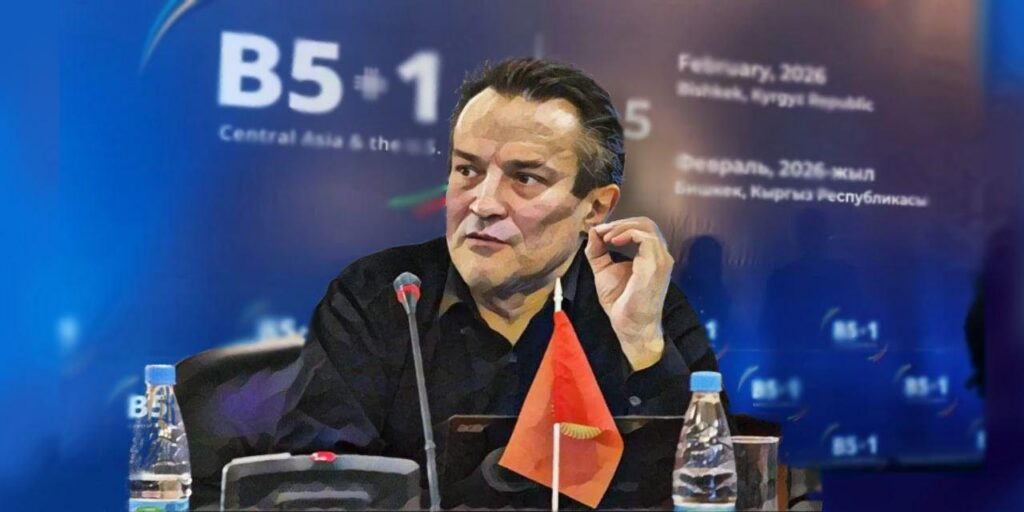
The B5+1 business forum continued in Kyrgyzstan’s capital on February 5, as government officials, regional business leaders, and a sizable U.S. delegation met to discuss trade, investment, and regulatory barriers shaping economic ties between Central Asia and the United States. As Washington signals a more pragmatic, commercially driven approach to the region, questions persist over why U.S. investment has lagged behind political engagement and which markets are truly seen as priorities. The Times of Central Asia spoke with Dmitry Orlov, director of the Strategy: East–West analytical center, about the structural obstacles deterring American capital, the shift in U.S. policy thinking, and how Central Asian states are positioned within Washington’s evolving economic calculus. TCA: What serious U.S. capital investments in Central Asia can we talk about today? ORLOV: It is important to understand the main point. Talk of large investments, the arrival of American business, and long-term economic cooperation only makes sense in one case: if the U.S. repeals the Jackson-Vanik amendment, which was adopted back in the 1970s and extended to all former Soviet republics after the collapse of the USSR. Today, it remains a formal and, in many ways, psychological obstacle to a fully-fledged business partnership. At the same time, it is necessary to establish contacts at a business level right now. This is because if the amendment is repealed - and such statements are regularly heard in Washington - it is difficult to predict which countries in the region will receive investment flows and in what volumes. Recent international forums, including Davos, have shown that Kazakhstan and Uzbekistan are of the greatest interest to the U.S. in Central Asia. Their economies are developing more dynamically, and they can offer large-scale projects and a clear export base. The other countries in the region, Kyrgyzstan, Tajikistan, and Turkmenistan, are still perceived by investors as lower priorities. TCA: Previously, the U.S. actively promoted a political agenda in the region, including human rights and freedom of speech. Now these are rarely mentioned. Why do you think this is the case? ORLOV: The approach has become more pragmatic. The history of U.S. foreign policy shows that strategic and economic interests have always taken precedence. If a territory is attractive in terms of resources or transit routes, a format for cooperation will be found. In Europe, relatively speaking, the rule of law prevails. In Asia, the situation is different, and the Americans understand this perfectly well. Issues of ideology and human rights can move to the background if economic expediency comes first. This is especially true in Central Asia, where many issues are resolved through personal agreements and informal connections. Washington understands this. TCA: What exactly can Central Asia offer the U.S.? ORLOV: In terms of individual countries, Kazakhstan and Uzbekistan are again in the lead. They offer oil, gas, and, no less importantly, control over transit routes. There is currently a lot of discussion about rare earths and critical minerals, but their development is always long and expensive. As a result, interest in...

Bishkek to Host Second B5+1 Forum of Central Asia and the U.S.

Kyrgyzstan is preparing to host the second B5+1 Forum of Central Asia and the United States, scheduled for February 4-5, 2026, in Bishkek. On December 12, Kyrgyzstan’s Ministry of Foreign Affairs and Ministry of Economy and Commerce held a joint briefing for ambassadors from Central Asian countries and the United States to outline preparations for the event. The B5+1 platform serves as the business counterpart to the C5+1 diplomatic initiative, which unites the five countries of Central Asia – Kazakhstan, Kyrgyzstan, Tajikistan, Turkmenistan, and Uzbekistan – with the United States. Launched by the Center for International Private Enterprise (CIPE) under its Improving the Business Environment in Central Asia (IBECA) program, B5+1 is supported by the U.S. Department of State and aims to foster high-level engagement between business leaders and policymakers. The upcoming forum in Bishkek builds on the outcomes of the C5+1 Summit held in Washington on November 6 this year. Its objective is to deepen U.S.-Central Asia economic cooperation and highlight the private sector’s pivotal role in advancing economic reform across the region. The event is co-hosted by CIPE and the Kyrgyz government. According to organizers, the forum’s agenda will focus on key sectors including agriculture, e-commerce, information technology, transport and logistics, tourism, banking, and critical minerals. These thematic areas reflect emerging regional priorities and shared interests in enhancing sustainable growth and economic resilience. The B5+1 Forum aims to create a platform for sustained dialogue between governments and private sector actors, encouraging the development of long-term partnerships and policy coordination. The inaugural B5+1 Forum was held in Almaty in March 2024, and brought together over 250 stakeholders from all five Central Asian countries and the United States. The first event centered on regional cooperation and connectivity, with a strong emphasis on empowering the private sector to support the objectives of the C5+1 Economic and Energy Corridors.

Uzbekistan Gains ASEAN Approval to Join Cooperation Treaty

Uzbekistan’s efforts to strengthen its ties with Southeast Asia advanced significantly this week after all member states of the Association of Southeast Asian Nations (ASEAN) approved Tashkent’s application to join the Treaty of Amity and Cooperation in Southeast Asia (TAC). The decision was made during a meeting of ASEAN foreign ministers chaired by Malaysia in Kuala Lumpur, according to the Dunyo news agency. Signed in Bali in 1976, the TAC outlines core principles for regional cooperation, including peaceful dispute resolution, non-interference, renunciation of force, and respect for sovereignty. ASEAN now comprises 11 countries with a combined population nearing 700 million, forming one of the world’s most dynamic economic regions. Uzbekistan’s accession to the TAC is expected to enhance its political and economic presence in Southeast Asia, facilitate state-to-state cooperation, boost trade and investment, and increase confidence among international companies operating in or considering expansion into Central Asia. Political analyst Jahongir Akramov described the approval as a significant diplomatic achievement for Uzbekistan. Speaking to The Times of Central Asia, he said the move aligns closely with Uzbekistan’s foreign policy principles: “Uzbekistan’s joining this treaty can be seen as a very significant diplomatic success. One of the key reasons is that the core principles of the TAC fully match the principles set out in Article 17 of Uzbekistan’s Constitution, non-use of force, resolving conflicts peacefully, negotiating disputes, and respecting the sovereignty of states.” Akramov noted that since 2016, Uzbekistan’s foreign policy has evolved along three strategic vectors, all of which are reinforced by the TAC: “First, Uzbekistan adopted a multi-vector foreign policy. Second, the country has taken major steps to develop economic diplomacy. Third, we have been deepening regional integration. All three of these trends are fully consistent with joining the TAC.” He emphasized that the timing is especially relevant amid growing geopolitical strains: “Geopolitical tensions have intensified, particularly among the United States, China, and Russia. In this situation, participating in platforms such as ASEAN can help reduce pressure and maintain diplomatic balance.” Akramov also positioned Uzbekistan’s move as part of a broader Global South cooperation trend. “Central Asian and ASEAN countries are both part of the Global South. Building closer relations ensures our interests are better represented in shaping new international norms.” Economically, Akramov pointed to ASEAN’s size and diversity as highly advantageous. “ASEAN includes Indonesia, the world’s most populous Muslim-majority country, Singapore, a global innovation hub, Malaysia, an advanced and diversified economy, and Thailand, a leading tourism destination. Closer ties with these states could expand tourism, improve Uzbekistan’s international image, and boost the competitiveness of Uzbek products.” He added that ASEAN’s extensive experience with regional integration offers a model for Central Asia. “As one of the first Central Asian countries to join the TAC, Uzbekistan could take a leading role in fostering ASEAN-Central Asia cooperation. A regional office or cooperation structure based in Tashkent or Samarkand would be a major diplomatic achievement.” However, Akramov cautioned that the partnership would require careful navigation. “Southeast Asia has its own geopolitical tensions, such...

Tokayev in Moscow: Balancing Friendship and Strategy

Kazakh President Kassym-Jomart Tokayev begins a state visit to Russia in Moscow today, accompanied by a carefully calibrated message of diplomatic continuity. Ahead of his arrival, Tokayev published an article in Rossiyskaya Gazeta affirming Kazakhstan’s “eternal friendship” with Russia, a phrase that has become standard in bilateral rhetoric. While much of the piece reiterates familiar themes of cooperation in energy, trade, and culture, a few notable elements suggest deeper strategic positioning. From the outset, Tokayev appeared intent on striking a personal chord with Vladimir Putin. Mirroring the Russian president’s preference for historical framing, he wrote: “Our peoples have lived side by side for centuries, sharing joys and trials, and together creating a single cultural space in Eurasia. We are united by a common perception of traditional values, similar views on current issues of modern life, and joint work to ensure the well-being of our brotherly peoples.” The Kazakh leader also offered high praise for Putin’s leadership, describing bilateral ties as “mature and stable” and built on “deep trust, respect, and equality.” “All achievements in bilateral cooperation are inextricably linked to the energetic and productive efforts of President Vladimir Vladimirovich Putin,” Tokayev wrote. “In Kazakhstan, he enjoys unwavering respect as a statesman of global stature, and his name is on the lips of politicians and ordinary people in virtually every country in the world.” The visit’s key moment will be the signing of a Declaration elevating Kazakhstan-Russia ties to a “comprehensive strategic partnership and alliance”, a step Tokayev described as ushering in “a new era in bilateral relations.” More intriguing, however, was Tokayev’s commentary on Russia’s global standing, wherein Tokayev referenced recent high-level talks with Chinese President Xi Jinping, U.S. President Donald Trump, and leaders across Europe, Asia, and Africa. “Although many of them are at opposite ends of the geopolitical spectrum, they all recognize the exceptional role of Russia and its leader in resolving key issues in international relations. In other words, it is impossible to overcome the contradictions of the modern world without Moscow's participation,” he stated. While Tokayev has previously dismissed the idea of Kazakhstan acting as a mediator in the Russia-Ukraine conflict, his recent statements suggest Astana may be prepared to play a supporting role in future dialogue. “Kazakhstan is not a mediator in the military conflict between Russia and Ukraine and does not see itself as such,” he said last month. “In my opinion, both sides are capable of conducting dialogue on all contentious issues on a bilateral basis and at different levels. I have always believed and publicly stated that the ‘Ukrainian crisis’ is extremely complex and cannot be simplified.” Nonetheless, Tokayev offered practical insights into what a negotiation process would require, stressing the importance of expert-level preparation and dismissing the idea of hastily organized summits without a ceasefire or clear agenda as “unrealistic.” “If the leaders of Russia and Ukraine are willing to come to Kazakhstan, we will provide all the necessary services to ensure the success of the negotiations,” Tokayev added. He reaffirmed...

“President of Peace” or “President of the World”? Mirziyoyev’s Interpreter Draws Attention During Comments on Trump

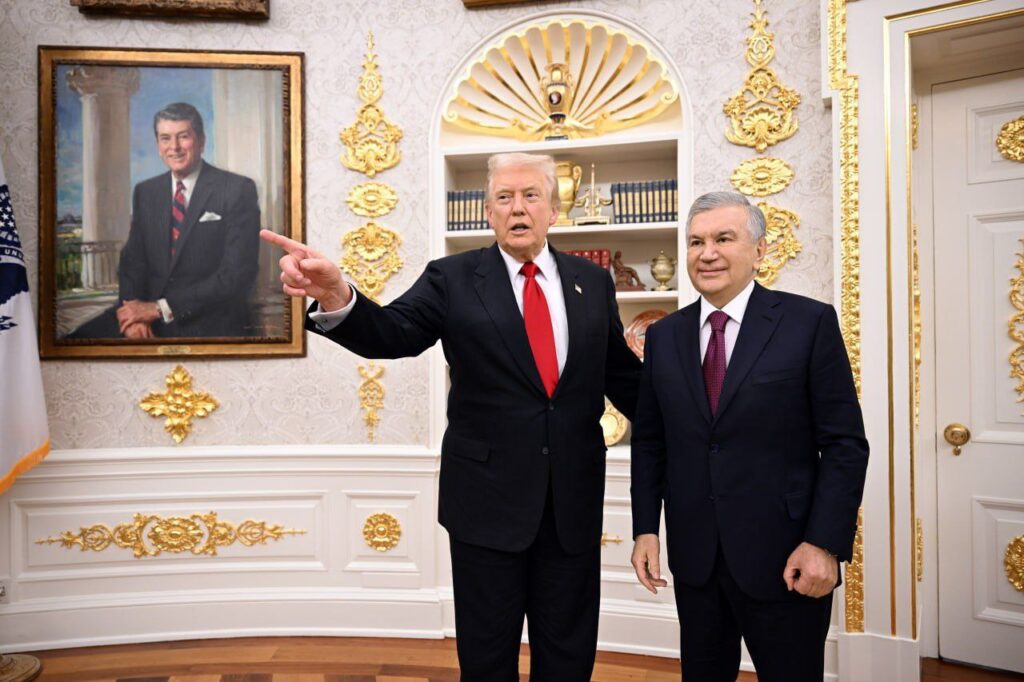
President Shavkat Mirziyoyev’s remarks at the recent C5+1 summit in Washington drew international attention following a translation error reported in several foreign media outlets. According to his press service, Mirziyoyev told U.S. President Donald Trump that people in Uzbekistan refer to him as a “president of peace,” citing what he described as Trump’s role in helping resolve multiple armed conflicts. However, the simultaneous interpreter rendered the phrase as “president of the world,” leading international media, including Reuters, to report that Mirziyoyev had used that expression. The two leaders had previously met on 23 September at the United Nations headquarters. During that meeting, Mirziyoyev congratulated Trump for contributing to the resolution of “seven conflicts,” specifically mentioning the settlement between Azerbaijan and Armenia. The Uzbek news outlet Kun.uz later published a full translation of the conversation in Uzbek. According to that report, Mirziyoyev also stated that Trump was deserving of a Nobel Prize, although this remark was not translated during the meeting. The renewed attention came as Trump announced what he described on Truth Social as an “incredible Trade and Economic Deal” between the United States and Uzbekistan. According to the U.S. president, Uzbekistan has committed to investing and purchasing nearly $35 billion in key American sectors over the next three years, with expected commitments exceeding $100 billion over the next decade. Trump specified that the sectors include critical minerals, aviation, automotive parts, infrastructure, agriculture, energy, chemicals, and information technology. He thanked Mirziyoyev and said Washington looks forward to a “long and productive partnership.” On the same day, Mirziyoyev joined the leaders of Kazakhstan, Kyrgyzstan, Tajikistan, and Turkmenistan at the C5+1 summit held at the White House and chaired by Trump. During the session, the Uzbek president proposed the creation of a permanent C5+1 Secretariat that would rotate among member states, as well as the establishment of a ministerial coordinating council on investment and trade. He also suggested forming a Central Asian Investment Partnership Fund and a special committee on critical minerals. Additional proposals included collaboration on agricultural technologies, coordination on transport corridors linking Central Asia with the South Caucasus and Europe, and the organization of a cultural heritage exhibition in the United States. Uzbekistan also offered to host the next C5+1 summit in Samarkand.

Washington Steps Up Focus on Central Asia Amid Strategic Competition with China

The United States has intensified its interest in Central Asia following China’s decision to restrict exports of rare earth elements. Amid the broader U.S.–China trade rivalry, Washington is seeking to diversify its sources of strategic raw materials and strengthen economic ties with countries in the region. Analysts note that Central Asia is increasingly viewed as a key part of Washington’s strategy to reduce dependence on Chinese supply chains. However, they point to several obstacles, including high logistics costs, underdeveloped export infrastructure, and what they describe as a high-risk investment environment that limits the commercial viability of many projects. Kazakhstan and Uzbekistan: Pillars of U.S. Engagement Among the countries of the region, Kazakhstan and Uzbekistan offer the greatest potential for rare earth element extraction and present favorable conditions for U.S. cooperation. Kazakhstan is strengthening its partnerships with Western investors in the mining sector, while Uzbekistan has implemented market reforms and opened its economy to foreign capital in recent years. Kazakh President Kassym-Jomart Tokayev, currently visiting the U.S., has reiterated his government’s interest in attracting American investment and technology, including through the C5+1 regional format. After his visit to Washington, he is scheduled to travel to Moscow for a meeting with Russian President Vladimir Putin on November 12, reflecting Kazakhstan’s longstanding policy of balancing relations among major powers. Kyrgyzstan Banks on the Digital Economy Lacking major oil and gas reserves, Kyrgyzstan is pursuing a different path by developing partnerships with the U.S. in financial technology and digital assets. During talks with U.S. President Donald Trump in Washington, Kyrgyz President Sadyr Japarov said the country’s most valuable asset is its educated youth, who are increasingly active in the IT sector. Japarov outlined several initiatives, including the introduction of digital financial instruments such as the national stablecoin KGST. He also noted the importance of the U.S. Genius Act, which regulates stablecoin circulation, calling it one of the most progressive in the world. In response, the U.S. expressed its readiness to expand cooperation in digital transformation and fintech development. Tajikistan Prioritizes Energy and Security Tajik President Emomali Rahmon participated in the C5+1 summit in Washington and held separate talks with President Trump. The discussions focused on energy, investment, and regional security. Rahmon said that peace and stability are essential for sustainable development and reaffirmed Tajikistan’s readiness to expand cooperation with the U.S. in green energy and regional electricity transmission projects. At present, more than 70 U.S.-affiliated companies operate in Tajikistan. American investment in mineral extraction and processing is viewed as a promising area for future collaboration. The two sides also discussed joint efforts to combat transnational threats, including terrorism, extremism, and drug trafficking. Turkmenistan Maintains Its Neutral Stance In contrast to the active diplomatic engagements of its neighbors, Turkmenistan continues to adhere to its traditional policy of neutrality. Ashgabat has so far refrained from joining initiatives that could be perceived as aligning with geopolitical blocs. Nonetheless, the U.S. remains interested in Turkmenistan’s energy potential, particularly regarding prospects for diversifying gas exports to Europe through the...