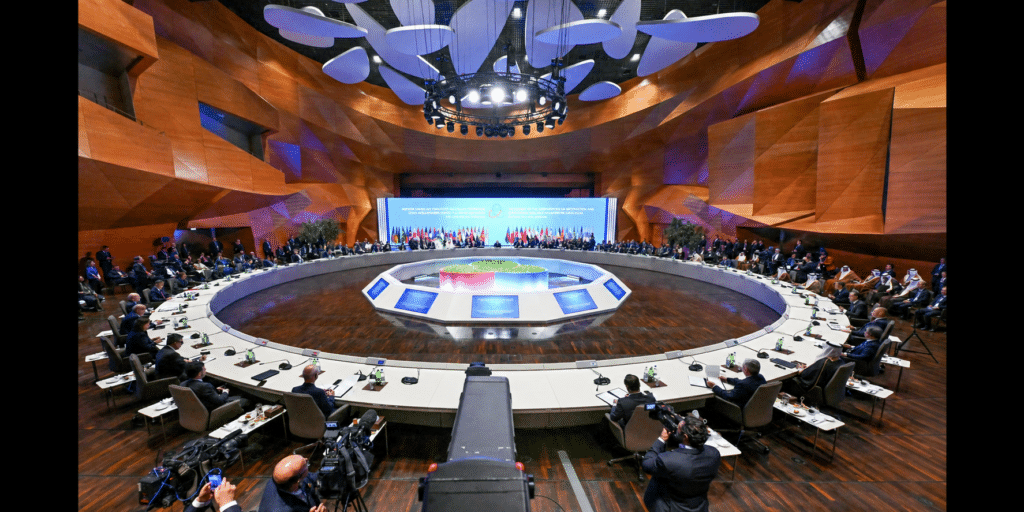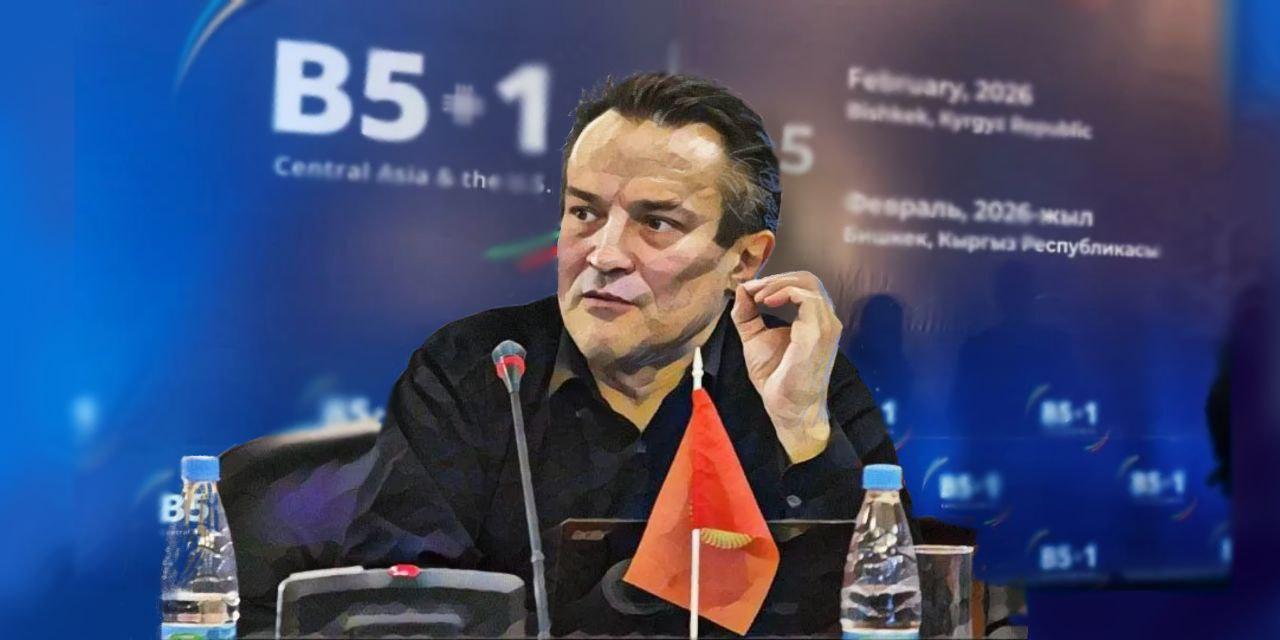
The B5+1 business forum continued in Kyrgyzstan’s capital on February 5, as government officials, regional business leaders, and a sizable U.S. delegation met to discuss trade, investment, and regulatory barriers shaping economic ties between Central Asia and the United States.
As Washington signals a more pragmatic, commercially driven approach to the region, questions persist over why U.S. investment has lagged behind political engagement and which markets are truly seen as priorities. The Times of Central Asia spoke with Dmitry Orlov, director of the Strategy: East–West analytical center, about the structural obstacles deterring American capital, the shift in U.S. policy thinking, and how Central Asian states are positioned within Washington’s evolving economic calculus.
TCA: What serious U.S. capital investments in Central Asia can we talk about today?
ORLOV: It is important to understand the main point. Talk of large investments, the arrival of American business, and long-term economic cooperation only makes sense in one case: if the U.S. repeals the Jackson-Vanik amendment, which was adopted back in the 1970s and extended to all former Soviet republics after the collapse of the USSR. Today, it remains a formal and, in many ways, psychological obstacle to a fully-fledged business partnership.
At the same time, it is necessary to establish contacts at a business level right now. This is because if the amendment is repealed – and such statements are regularly heard in Washington – it is difficult to predict which countries in the region will receive investment flows and in what volumes.
Recent international forums, including Davos, have shown that Kazakhstan and Uzbekistan are of the greatest interest to the U.S. in Central Asia. Their economies are developing more dynamically, and they can offer large-scale projects and a clear export base. The other countries in the region, Kyrgyzstan, Tajikistan, and Turkmenistan, are still perceived by investors as lower priorities.
TCA: Previously, the U.S. actively promoted a political agenda in the region, including human rights and freedom of speech. Now these are rarely mentioned. Why do you think this is the case?
ORLOV: The approach has become more pragmatic. The history of U.S. foreign policy shows that strategic and economic interests have always taken precedence. If a territory is attractive in terms of resources or transit routes, a format for cooperation will be found.
In Europe, relatively speaking, the rule of law prevails. In Asia, the situation is different, and the Americans understand this perfectly well. Issues of ideology and human rights can move to the background if economic expediency comes first. This is especially true in Central Asia, where many issues are resolved through personal agreements and informal connections. Washington understands this.
TCA: What exactly can Central Asia offer the U.S.?
ORLOV: In terms of individual countries, Kazakhstan and Uzbekistan are again in the lead. They offer oil, gas, and, no less importantly, control over transit routes.
There is currently a lot of discussion about rare earths and critical minerals, but their development is always long and expensive. As a result, interest in them is largely political and declarative. First and foremost, it is about signaling presence and intent. It may take decades before such projects actually materialize.
Kyrgyzstan and Tajikistan also have a resource base, but developing deposits there is difficult and costly. Turkmenistan stands apart as a special case. A significant share of its gas volumes has already been contracted by China in exchange for earlier infrastructure loans. At the same time, it has a petrochemical industry, transport arteries, and logistics potential.
TCA: What does Central Asia expect from the U.S.?
ORLOV: Beyond investment and technology, political balance is important for the region. Against the backdrop of talk about possible EU sanctions against Kyrgyzstan, diplomatic activity has intensified. In my view, the key question for the U.S. is what it can offer that Russia and China, already deeply integrated into the region’s economy, cannot.
U.S. trade turnover with Kyrgyzstan, for example, does not even rank in the top ten. Therefore, there is not only economic but also political logic at work, an attempt to strengthen its presence in the region.
Central Asia today is a space where the interests of China, Russia, Iran, and the West intersect. None of these actors has a monopoly on influence. That is why the region remains an area of balance.
American and European companies extract oil in Kazakhstan. Chinese companies do as well. Russian companies are also present. So far, these interests have not come into direct conflict. As a result, we should not expect open confrontation between global players, at least in the near future.
TCA: How realistic is it that repealing the Jackson-Vanik amendment could change the investment landscape in Central Asia?
ORLOV: For now, it is more of a political signal than an economic calculation. Western media have barely discussed potential investment volumes in the event of its repeal. No concrete figures are being cited.
This resembles a situation in which a decision has ostensibly been “made,” but real steps remain distant. The amendment has been discussed since the Clinton administration, yet it has never progressed beyond declarations. In essence, it remains a carrot dangling in front of a donkey.
TCA: Would it be fair to say, then, that regional forums, including the B5+1, are largely symbolic?
ORLOV: Exactly. The first forum in Almaty in 2024 was a stage of familiarization and mutual assessment. The meeting in Bishkek is an attempt to outline the contours of possible cooperation. The key questions for both sides today are extremely pragmatic: what are we being offered, and what can we get in return?
This article forms part of The Times of Central Asia’s special coverage of Central Asia’s expanding role in U.S. critical minerals security.