• KGS/USD = 0.01144 0%
  • KZT/USD = 0.00200 0%
  • TJS/USD = 0.10494 -0.28%
  • UZS/USD = 0.00008 0%
  • TMT/USD = 0.28490 -0.28%
  • KGS/USD = 0.01144 0%
  • KZT/USD = 0.00200 0%
  • TJS/USD = 0.10494 -0.28%
  • UZS/USD = 0.00008 0%
  • TMT/USD = 0.28490 -0.28%
  • KGS/USD = 0.01144 0%
  • KZT/USD = 0.00200 0%
  • TJS/USD = 0.10494 -0.28%
  • UZS/USD = 0.00008 0%
  • TMT/USD = 0.28490 -0.28%
  • KGS/USD = 0.01144 0%
  • KZT/USD = 0.00200 0%
  • TJS/USD = 0.10494 -0.28%
  • UZS/USD = 0.00008 0%
  • TMT/USD = 0.28490 -0.28%
  • KGS/USD = 0.01144 0%
  • KZT/USD = 0.00200 0%
  • TJS/USD = 0.10494 -0.28%
  • UZS/USD = 0.00008 0%
  • TMT/USD = 0.28490 -0.28%
  • KGS/USD = 0.01144 0%
  • KZT/USD = 0.00200 0%
  • TJS/USD = 0.10494 -0.28%
  • UZS/USD = 0.00008 0%
  • TMT/USD = 0.28490 -0.28%
  • KGS/USD = 0.01144 0%
  • KZT/USD = 0.00200 0%
  • TJS/USD = 0.10494 -0.28%
  • UZS/USD = 0.00008 0%
  • TMT/USD = 0.28490 -0.28%
  • KGS/USD = 0.01144 0%
  • KZT/USD = 0.00200 0%
  • TJS/USD = 0.10494 -0.28%
  • UZS/USD = 0.00008 0%
  • TMT/USD = 0.28490 -0.28%

Viewing results 1 - 6 of 16

Taliban Remove Uzbek Language from Samangan University Sign

The Taliban have removed Uzbek and Persian inscriptions from the main signboard of Samangan University in northern Afghanistan, replacing them with a new sign written only in Pashto and English. The move, reported by Afghanistan International, has drawn criticism amid ongoing concerns about the marginalization of non-Pashtun languages and communities since the Taliban’s return to power in 2021. Sources told Afghanistan International that the change followed the appointment of a new university head. The previous sign, which featured the university’s name in four languages, Pashto, Persian, Uzbek, and English, was taken down and replaced approximately four days later with a version that excluded the Persian and Uzbek languages. Samangan province is home to a significant ethnic Uzbek population. The decision has provoked backlash from academics and former officials. Former Faryab governor Naqibullah Faiq condemned the move as “ethno-nationalist,” warning that such actions risk exacerbating ethnic and linguistic tensions in the country. In response, some Uzbek and Persian speakers have publicly called for the reinstatement of their languages on the university sign. Mohibullah Mohib, a lecturer at Samangan University, wrote on Facebook that the sign change coincided with the institution’s transition from an institute of higher education to a full-fledged university. According to Mohib, the Taliban’s Ministry of Higher Education ordered the new sign and formally rejected a request to include Uzbek. He added that the ministry's written response explicitly denied the inclusion of Uzbek alongside the other languages. This is not the first incident of its kind. In October, the Taliban removed Uzbek from the signboard of Jawzjan University, sparking widespread criticism. Following public outcry, Uzbek was later reinstated on that sign. Over the past four years, the Taliban have faced repeated accusations of sidelining minority languages such as Persian, Uzbek, and Turkmen, including by removing Persian-language signage from government buildings and erasing cultural symbols associated with Persian-speaking poets and writers. The latest incident has also drawn attention in Uzbekistan. Foreign Ministry spokesperson Akhror Burkhanov told Qalampir.uz that Tashkent is closely monitoring the situation. He emphasized that any potential restrictions on the Uzbek language are a serious concern for Uzbekistan. Burkhanov stated that Uzbekistan is maintaining an ongoing dialogue with Afghan authorities. According to him, Afghan officials have assured Tashkent that no restrictions on the Uzbek language are currently in place or planned. They have also reiterated their respect for Uzbekistan, the Uzbek language, and the Uzbek people.

Japanese Language Courses Launched to Support Kyrgyz Labor Migration to Japan

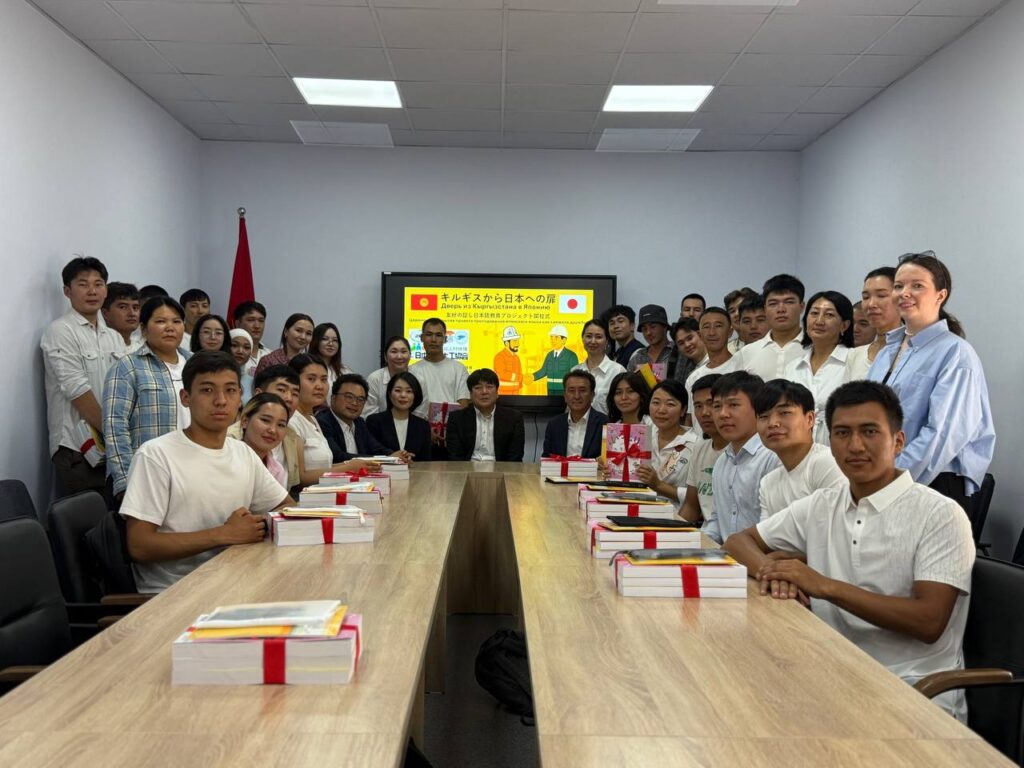
On August 8, the Center for Pre-Departure Orientation and Reintegration of Migrants in Bishkek officially launched an intensive Japanese language course aimed at improving the employability of Kyrgyz job seekers in Japan. The course is a joint initiative of the Kyrgyz Ministry of Labor, Social Security and Migration’s Center for Employment of Citizens Abroad and the Japan Association for Construction Human Resources (JAC). The program is part of ongoing efforts to develop Japan as a new destination for Kyrgyz labor migration, diversifying the country’s overseas employment market. This collaboration follows the signing of a memorandum of cooperation on labor migration between Kyrgyzstan and Japan. The first group of students was 30 mainly young participants from across Kyrgyzstan. Expanding Employment Pathways Kyrgyzstan is deepening labor migration ties with Japan as part of a broader strategy to create safe, legal, and skills-based employment opportunities for its citizens abroad. The Ministry’s Center for Employment of Citizens Abroad is working with JAC, which facilitates the recruitment of specified skilled workers for Japan’s construction industry. Both sides have also discussed plans to establish a specialized training center in Kyrgyzstan to prepare construction professionals according to Japanese industry standards. While Russia remains the main destination for Kyrgyz labor migrants, recent years have seen growing interest in alternative destinations, including Turkey, South Korea, Japan, and several European countries.

English Proficiency Index: Kazakhstan Still Among Least Fluent Countries

Kazakhstan ranks 103rd out of 116 countries in the 2024 EF English Proficiency Index (EF EPI), improving by just one position from the previous year. Despite this slight progress, the country remains in the group of nations with very low English proficiency, according to Ranking.kz analysts. Leading the global rankings was the Netherlands, scoring 636 out of 700 points, followed by Norway, Singapore, Sweden, and Croatia. In the Eurasia region, Belarus and Russia performed best, achieving scores of 539 and 532 respectively, while Kyrgyzstan, Uzbekistan, and Tajikistan showed comparatively low results. Regional and Historical Context In Kazakhstan, the highest proficiency scores were recorded in Almaty (476 points) and the Almaty region (475 points), with Astana, Akmola, Kostanai, and Pavlodar regions also performing relatively well. Since Kazakhstan’s first appearance in the EF EPI rankings in 2011, where it ranked last among 44 participants, little progress has been made. Current scores remain similar to those recorded over a decade ago. Globally, English remains the most widely spoken language, with over 1.5 billion speakers in 2024, according to Ethnologue. The Cost of Learning English in Kazakhstan English education costs in Kazakhstan vary widely depending on the method of instruction: Individual lessons: Average 96,000 KZT ($182) for a course of 12 sessions. Private tutors: Range from 15,300 KZT ($29) to 54,000 KZT ($102) per month. Online tutors: Cost between 48,000 and 96,000 KZT ($91 to $182) monthly. AI-assisted classes: Start at 5,000 KZT ($9.5) and go up to 25,000 KZT ($47), depending on the number of assignments. Group lessons: Range from 36,000 KZT ($68) to 64,000 KZT ($121) for 12 lessons. In major cities, free courses and conversation clubs organized by libraries and language centers provide alternative learning opportunities. The low level of English proficiency in Kazakhstan continues to be a pressing issue, requiring systematic reforms. Analysts emphasize that improving the situation will demand enhanced educational programs, more accessible learning opportunities, and greater public engagement in mastering the language.

AI in Central Asia: Kazakhstan Unveils Multilingual GPT Model

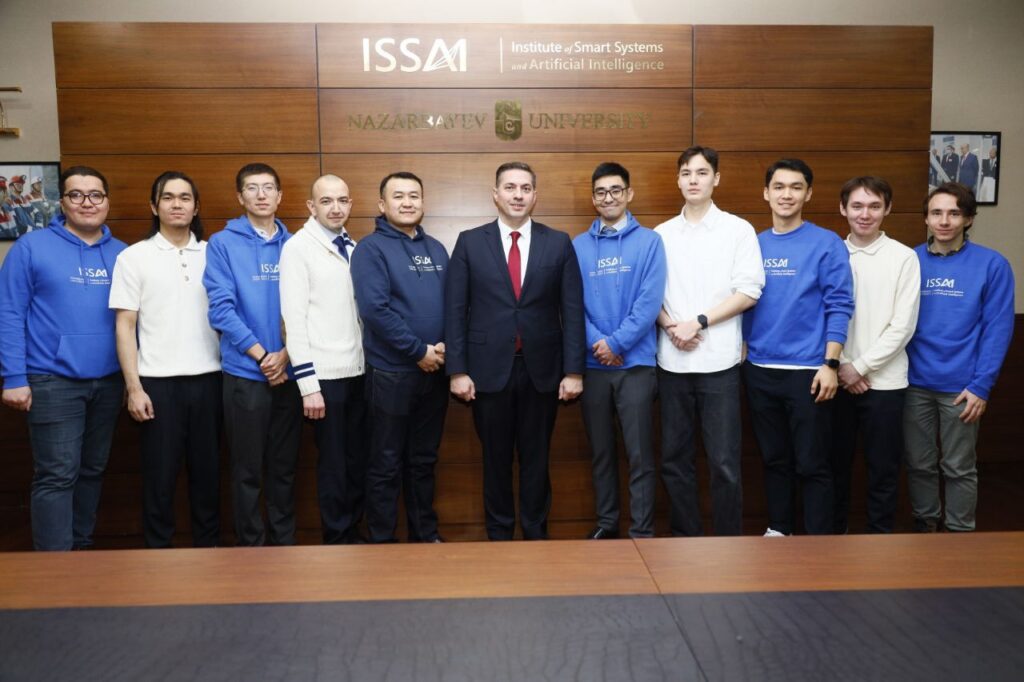
Researchers at the Institute of Intelligent Systems and Artificial Intelligence (ISSAI) at Nazarbayev University in Astana have introduced ISSAI KAZ-LLM, a large language model (LLM) specifically designed for the Kazakh language. Built on advanced neural network technology, the model serves as the foundation for Kazakhstan’s version of a generative AI system similar to GPT. ISSAI KAZ-LLM is tailored to Kazakhstan’s multilingual and multicultural environment, supporting Kazakh, Russian, and English, with additional functionality for Turkish. The model addresses language barriers and advances the field of generative artificial intelligence for resource-limited languages. The development team processed and synthesized over 150 billion tokens to ensure high-performance language capabilities. Beyond creating an AI tool, the project also fostered local expertise, involving Kazakhstani researchers at every stage, from data preparation to model implementation. Collaboration with international institutes enabled the creation of language-specific datasets and comparative analysis tools, utilizing input from linguists and state-of-the-art machine translation techniques. KAZ-LLM has a wide range of applications, including Kazakh language translations, content generation, and bulk text processing. Training data was sourced exclusively from publicly available materials, such as Kazakh websites, news articles, and online libraries, supplemented by contributions from various organizations. ISSAI director, Prof. Hussain Atakan Varol, told The Times of Central Asia: “This model reflects Kazakhstan's commitment to innovation, self-reliance, and the growth of its technology ecosystem. Our team developed two versions of ISSAI KAZ-LLM: one with 8 billion parameters and another with 70 billion parameters. Both are built on the Meta Llama architecture, optimized for use on high-performance systems as well as resource-constrained environments. Released under a CC-BY-NC license, the models are available for non-commercial use on the Hugging Face platform.” The ISSAI team is already exploring next-generation AI systems, including language-vision models, while expanding support for additional Turkic and regional languages. These initiatives aim to strengthen regional ties, promote linguistic integration, and create substantial economic and technological opportunities in Kazakhstan and beyond. Remarkably, this groundbreaking development was accomplished without government funding, with significant contributions from Kazakhstani IT companies. Kazakhstan is also gearing up to launch the International Center for Artificial Intelligence alem.ai. The center is set to become a hub for transforming the country into an AI-driven economy, fostering innovation, attracting investments, and supporting startups. By 2029, the export of Kazakhstani AI solutions is expected to reach $5 billion.

Turkmenistan Unveils New English Textbook for 11th Grade Students

A new English language textbook for 11th-grade students has been introduced in Turkmenistan’s general education schools. According to the Ministry of Education of Turkmenistan, the textbook incorporates modern didactic principles and advanced teaching methods to enhance students' reading, writing, and speaking skills. It aligns with the national curriculum, providing students with improved opportunities to communicate effectively in English. The release of this textbook is part of Turkmenistan’s broader effort to modernize its education system. A key component of this effort is the Concept for Improving Foreign Language Education in Turkmenistan, a policy focused on integrating language learning at all educational stages. Drawing on both domestic and international best practices, the policy aims to elevate language instruction across the country. English language teaching in Turkmenistan has seen significant progress: • In January 2024, the first TESOL conference brought together 250 educators to exchange experiences and explore innovative teaching techniques. • In August 2024, the U.S. Embassy, in collaboration with the Ministry of Education, conducted workshops to enhance the professional skills of English teachers. • In November 2024, Turkmenistan and the UK held discussions on strengthening educational cooperation and improved educational services. Turkmenistan’s focus on advancing English language education reflects its commitment to integrating into the global educational framework and fostering international collaboration. These initiatives aim to equip students and educators with the tools needed to engage in a globalized world.

Turkmenistan and UK Strengthen Cooperation in Education

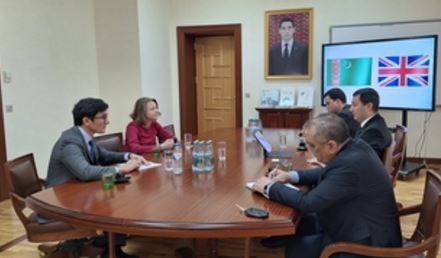
The Ministry of Education of Turkmenistan hosted a meeting between Deputy Minister Azat Ataev and Sarah Chidgey, Regional Export Director for Eastern Europe and Central Asia, to discuss prospects for educational cooperation between Turkmenistan and the UK. Ms. Chidgey shared insights into the UK's experience in delivering quality education, citing successful examples in Kazakhstan and Uzbekistan, where British universities, such as the University of Westminster, have actively sought to expand partnerships. During the meeting, the participants explored opportunities for British universities to offer educational services in Turkmenistan, including the accreditation of academic institutions to enhance secondary and higher education. Chidgey announced plans to hold the Turkmen-British Trade and Industry Council early next year, with educational cooperation set to be a key topic. The British delegation also expressed its readiness for more in-depth discussions at the World Education Forum, held annually in London. Ataev expressed interest in implementing the proposed initiatives and supported organizing webinars for Turkmen specialists. These webinars will focus on introducing Turkmen specialists to British educational standards and accreditation procedures and enhancing education quality. He emphasized that particular attention would be given to studying critical aspects of the British educational system to facilitate their successful adaptation and implementation in Turkmenistan. Both sides expressed confidence that this partnership would contribute to developing Turkmenistan's education system and creating new opportunities for students and teachers. In the long term, it is expected to support their integration into the global educational community. Great Britain actively cooperates with Central Asian countries in the field of education: Kazakhstan has the Kazakh-British Technical University, founded in 2001, which offers programs in partnership with British universities, and British universities are opening branches in Uzbekistan, giving local students access to British education. The British Council also runs the region's English language training and teacher development programs. In 2024, the British Foreign Secretary announced a new initiative to promote English in Central Asia by giving teachers access to online resources with local content.