Viewing results 1 - 6 of 44
Kazakhstan’s National Atomic Company, Kazatomprom, the world's largest producer of uranium, says it has successfully completed the qualification process for the production of AFA 3G TM type A fuel assemblies at the Kazakh-Chinese Joint Venture, Ulba-FA LLP, which produces nuclear fuel for Chinese nuclear power plants. A document confirming the technical compliance of the product with all the mandatory quality requirements, norms and standards was provided by Framatome, the holder of technology. Work on the qualification for fuel assemblies’ production started in March 2023. As a result, the plant successfully received confirmation on the quality of its products. The qualification allows the plant to produce AFA 3G TM type A fuel assemblies, in addition to AFA 3G TM AA fuel assemblies, thus expanding the product line, Kazatomprom said. In 2024, Kazatomprom plans to commission industrial production of AFA 3GTM type A fuel assemblies and supply a batch of fuel assemblies of this type to nuclear power plants in China. The Ulba-FA plant has allowed Kazatomprom to diversify its production, expanding its product line and producing advanced, export-oriented uranium products with a high added value. With a production capacity of 200 tons of uranium in the form of fuel assemblies per year, the Ulba-FA plant has a guaranteed sales market for the next 20 years, Kazatomprom said. The launch of this innovative production has allowed Kazakhstan to enter the limited circle of countries which produce and supply nuclear fuel for nuclear power plants.
DUSHANBE (TCA) — On October 22, the Charge d’affaires of the U.S. Embassy in Tajikistan participated in a ribbon cutting ceremony for the donation of radiation detection equipment to the Dushanbe International Airport. This equipment was donated by the U.S. Department of Energy’s Office of Nuclear Smuggling Detection and Deterrence (NSDD) in partnership with the Nuclear and Radiation Safety Agency of Tajikistan. Continue reading
NUR-SULTAN (TCA) — The capital of Kazakhstan on August 29 hosted the Nazarbayev Prize for a World Without Nuclear Weapons and Global Security award ceremony. The Prize laureates were Lassina Zerbo, Executive Secretary of the Comprehensive Nuclear-Test-Ban Treaty Organization (CTBTO) Preparatory Commission, and former Director General of the International Atomic Energy Agency (IAEA), Yukiya Amano, the Kazakh Foreign Ministry reported. Continue reading
NUR-SULTAN (TCA) — The Ministry of Foreign Affairs of Kazakhstan and the United Nations Office for Disarmament Affairs (UNODA) on August 28 co-organized an international Seminar on Fostering Cooperation Among Nuclear-Weapon-Free Zones (NWFZ) with participation of representatives of all Nuclear-Weapon-Free Zones, experts from relevant international and regional organizations as well as a number of observer-states, the Kazakh Foreign Ministry reported. Continue reading
NUR-SULTAN (TCA) — The Permanent Mission of Kazakhstan on May 3 organized at the UN Headquarters the Nuclear Discussion Forum, this time devoted to the interaction of nuclear-weapon-free zones and the application of their practical experience to create new zones in the future. The main strategic goal of the initiative is to expand the number of nuclear-weapon-free zones on the planet towards achieving a world free of nuclear weapons. This becomes especially relevant in the context of the destruction of the current nuclear deterrence architecture and the growing tendency for a new nuclear arms race in the world, the Kazakh Foreign Ministry reported. Continue reading
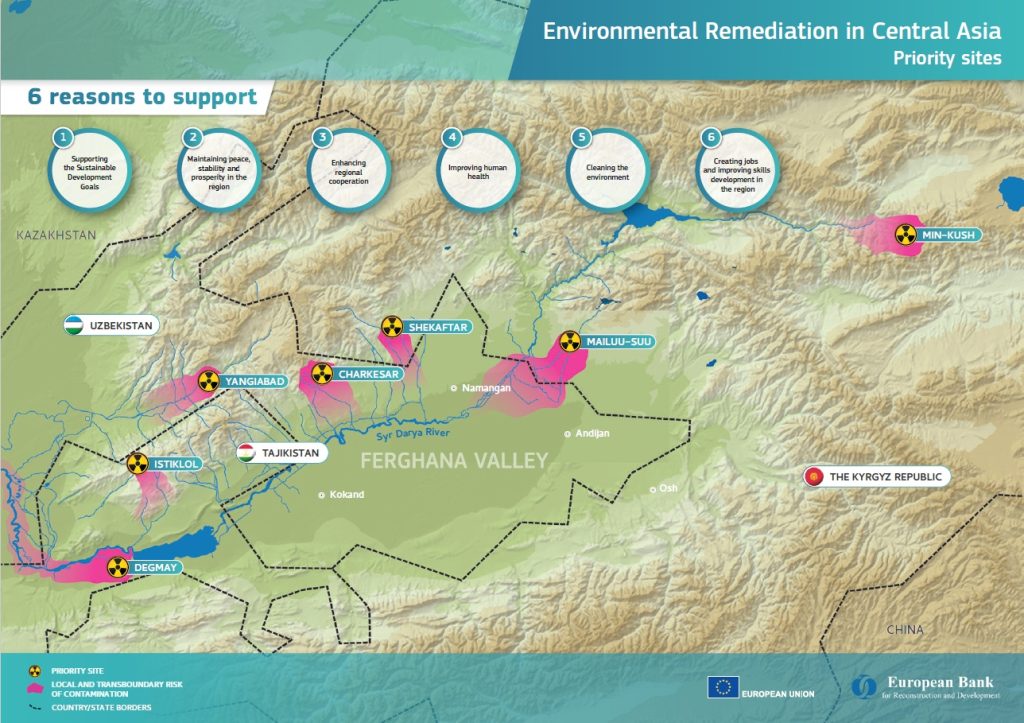
BISHKEK (TCA) — At the international donors’ conference on nuclear remediation in London on November 8, the European Union has announced additional €10 million, in order to support its partners in Central Asia in dealing with toxic and radioactive waste in Kyrgyzstan, Tajikistan and Uzbekistan. This comes on top of the €16 million, which the EU had already contributed to this end. The EU is leading the implementation of the sustainable remediation programme in the region. For more than 10 years it has worked on feasibility studies and environmental impact assessments, with an initial investment of around €14 million. Work has been carried out in close collaboration with the Governments concerned, the International Atomic Energy Agency (IAEA) and the UN Development Program (UNDP). Remediation plans are the next phase. They have been endorsed by the relevant Governments and now require urgent action. The estimated one billion tons of hazardous processing waste abandoned in the region represent a threat to the people and the environment. The programme has identified seven priority sites (see the map) where action must be taken to prevent the pollution of the Fergana valley – the breadbasket of Central Asia - by the Syr Darya river. The international donors’ conference on nuclear remediation in London is an initiative of the Kyrgyz government and was hosted by the European Bank for Reconstruction and Development (EBRD), which manages the account created to finance environmental remediation projects in Central Asia.