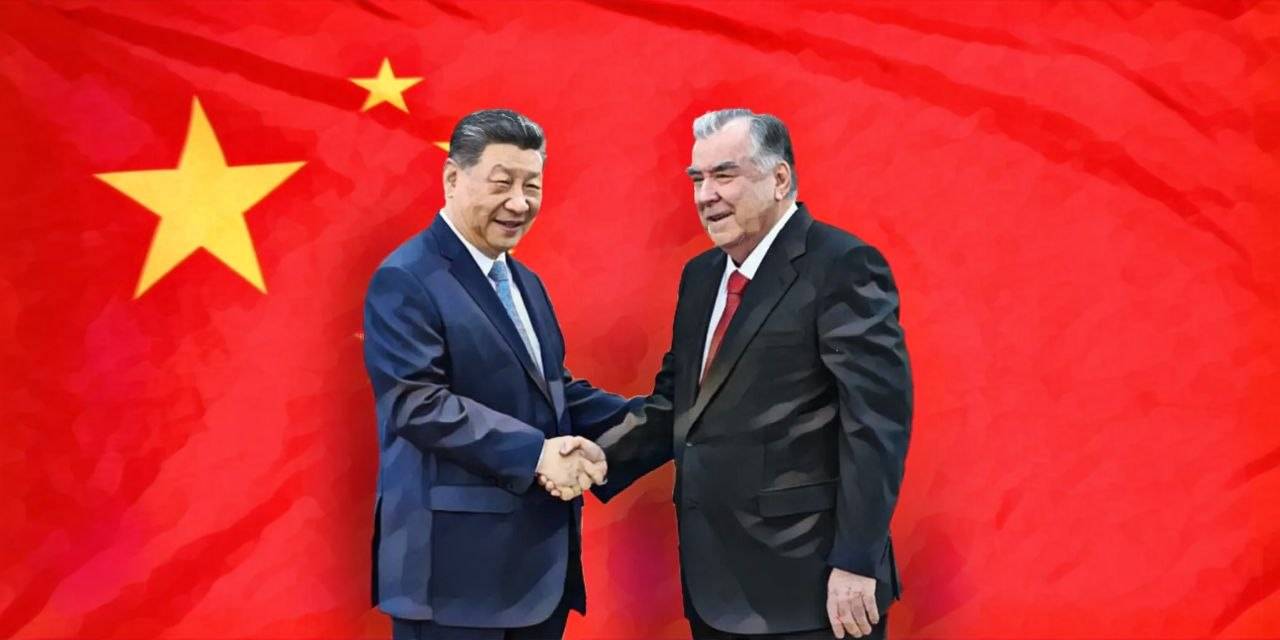
Tajikistan’s President Emomali Rahmon just finished a state visit to China. Rahmon has made trips to China many times during the nearly 34 years he has been in power in Tajikistan, but this visit came during a critical period.
Simply put, Tajikistan is losing the international importance it once had, and China might now be the most dependable friend remaining for Rahmon and his country.
A ‘Sweet’ Start
China established diplomatic ties with all five Central Asian countries at the start of 1992. Just months later, a civil war broke out in Tajikistan that would last until June 1997, but that did not deter China from seeking investment opportunities in Tajikistan.
China funded the construction of a sugar plant in Kurgan-Tepe in 1992, and later helped build confectioneries in large cities and towns in Tajikistan, as well as providing 10,000 tons of feed for livestock and, in 1994, extending a $50-million loan to Tajikistan.
In April 1996, Rahmon and the leaders of China, Russia, Kazakhstan, and Kyrgyzstan met in Shanghai and formed the Shanghai Five, which, after the inclusion of Uzbekistan five years later, would become the Shanghai Cooperation Organization (SCO).
China used the SCO to improve economic ties with all the Central Asian members, but while Chinese investment in Tajikistan was far less than in Kazakhstan or Uzbekistan, it was extremely important for Tajikistan, which was, and remains, the poorest country in Central Asia.
After the terrorist attacks on the United States on September 11, 2001, and the start of the U.S.-led campaign in Afghanistan, China gave equipment and winter uniforms to Tajikistan’s border guards. Later, China also helped fund the construction of Tajik border posts along the frontier with Afghanistan, and Beijing is set to help finance nine more border posts.
Security along Tajikistan’s border with Afghanistan is also in China’s interest. China shares an approximately 475-kilometer border with Tajikistan. Eastern Tajikistan is mountainous, remotely inhabited, and shares a long border with Afghanistan.
China is concerned about the ability of potential enemies to move from Afghanistan through eastern Tajikistan and enter China. That is why, less than ten years ago, China built a small, forward observation military post in eastern Tajikistan, not far from the Chinese border.
Militant groups such as the Eastern Turkestan Islamic Movement, comprised mainly of Uyghurs from China’s Xinjiang Region, and the Islamic State of Khorasan Province, which has explicitly threatened China, are present in northern Afghanistan.
Chinese companies have been building Tajikistan’s infrastructure for some 20 years: roads, power transmission lines, the Dushanbe thermal power plant, hydropower plants, factories, and other objects.
In 2025, China finally surpassed Russia to become Tajikistan’s leading trade partner, and Chinese-Tajik trade turnover in the first three months of 2026 increased by more than 52% compared to Q1 in 2025.
Changing Times
China is likely to remain Tajikistan’s leading trade partner and more for the foreseeable future. The geopolitical situation in Central Asia has changed, and not in Tajikistan’s favor.
The biggest change for Rahmon and his country is the situation in Afghanistan.
Since Tajikistan became independent in late 1991, there have been concerns about instability in Afghanistan spilling across the border into Central Asia, and Tajikistan shares the longest border with Afghanistan of any of the Central Asian states.
During Tajikistan’s civil war, weapons, narcotics, and members of the Tajik opposition fighting government forces frequently crossed the Tajik-Afghan frontier. By the time the Tajik Peace Accord was signed in 1997, the Taliban was seizing territory in areas along the border with Central Asia.
After the U.S.-led operation in Afghanistan dislodged the Taliban from power, there were still militant groups in areas near the Tajik border, notably, fighters from the Islamic Movement of Uzbekistan.
Just several years after the ouster of the Taliban, the number of foreign militants and Taliban fighters in northern Afghanistan gradually started growing.
In a strange way, Tajikistan’s government benefited from the constant security threat from Afghanistan. During the Tajik civil war, Russian border guards were deployed along the Tajik-Afghan frontier, allowing all the Tajik government’s forces to focus on battling their domestic enemy.
Russian border guards stayed in Tajikistan until 2005. By that time, China, several Western countries taking part in the campaign in Afghanistan, and Western organizations were helping prop up Tajikistan’s security along the Afghan frontier. Tajikistan supplied the troops for border duty, but much of the housing, equipment, and weapons these troops required were being provided by Russia, China, and Western countries.
Tajikistan became a bulwark against Islamic extremism and too important to fail for Russia, China, and the West. Money poured in for infrastructure projects aimed at solidifying post-civil war stability in Tajikistan. As long as there was war and instability in Afghanistan, the authorities in Tajikistan could depend on some other country or foreign organization to help with Tajikistan’s security and economy.
Now, the situation in Afghanistan is relatively stable. Many of the countries that once worried about the Taliban are conducting trade with the Taliban government, including Tajikistan’s Central Asian neighbors. These countries remain wary of the Taliban, but have significantly downgraded their view of a Taliban-ruled Afghanistan as representing a threat.
Tajikistan is becoming a more remote corner of Central Asia, and can no longer count on receiving the sort of foreign assistance to which the Tajik government grew accustomed for more than three decades. The Tajik authorities long depended on Russia for security guarantees, and Russia still has a military base in Tajikistan. But Russia is focused on the full-scale war it started in Ukraine and on increasingly hostile relations with Europe.
Russia officially recognized the Taliban government in July 2025, a sign that Moscow is unlikely, and really unable due to the war in Ukraine, to spend money boosting security in Tajikistan outside of some help with counter-terrorism.
Iran, with its historical and cultural affinities to Tajiks, once invested in major Tajik projects such as the Sangtuda-2 hydropower plant and a major road and tunnel connecting north and south Tajikistan. But the conflict with Israel and the United States has left Iran in no position to be a major investor or trade partner with Tajikistan for years to come.
The Obvious, and Maybe Only Choice
One report noted that after this recent trip, Rahmon has made 15 official visits to China since 1996.
This was arguably the most important visit.
The Middle Corridor connecting Europe and China is opening, and all of Tajikistan’s Central Asian neighbors are looking at significant increases in trade and transit fees.
Tajikistan is located in the high mountains of the southeastern corner of Central Asia. It will host a main artery of the Middle Corridor, but presently, it plays only a very small role.
Chinese companies have built a road connecting the capital Dushanbe to the Chinese border, and work to improve and expand this road is currently underway. It is Tajikistan’s only substantial link along the Middle Corridor, and without Chinese help, it would be difficult, if not impossible to realize.
Most countries no longer see Afghanistan as a priority security concern, but China has its own interest in ensuring Tajikistan is able to fend off threats from south of its border.
In November 2025, two separate attacks from Afghanistan into Tajikistan resulted in five Chinese workers being killed. That no doubt played a role in China’s decision to help fund the construction of nine new border posts, reminding Beijing of the potential for militants in Afghanistan to slip through eastern Tajikistan to China.
Some 31 agreements were signed during Rahmon’s May 11-14 visit to Beijing. Chinese companies pledged to invest some $8 billion in Tajikistan, with the Chinese-backed Asian Infrastructure and Investment Bank promising $800 million.
Even if only part of this money reaches Tajikistan, it will still be more than any other country or organization will be willing to spend in Tajikistan in the near future.
Tajikistan has many of the critical minerals the world is currently seeking, but again, only China has shown particular interest.
Tajikistan is already deep in debt to China and will go even further into debt, but there really is no other choice at the moment.
This recent visit by Rahmon was not the usual trip to talk trade and security; it was a journey to secure a lifeline for Tajikistan’s increasingly uncertain future.