• KGS/USD = 0.01144 0%
  • KZT/USD = 0.00205 0%
  • TJS/USD = 0.10784 0%
  • UZS/USD = 0.00008 0%
  • TMT/USD = 0.28490 0%
  • KGS/USD = 0.01144 0%
  • KZT/USD = 0.00205 0%
  • TJS/USD = 0.10784 0%
  • UZS/USD = 0.00008 0%
  • TMT/USD = 0.28490 0%
  • KGS/USD = 0.01144 0%
  • KZT/USD = 0.00205 0%
  • TJS/USD = 0.10784 0%
  • UZS/USD = 0.00008 0%
  • TMT/USD = 0.28490 0%
  • KGS/USD = 0.01144 0%
  • KZT/USD = 0.00205 0%
  • TJS/USD = 0.10784 0%
  • UZS/USD = 0.00008 0%
  • TMT/USD = 0.28490 0%
  • KGS/USD = 0.01144 0%
  • KZT/USD = 0.00205 0%
  • TJS/USD = 0.10784 0%
  • UZS/USD = 0.00008 0%
  • TMT/USD = 0.28490 0%
  • KGS/USD = 0.01144 0%
  • KZT/USD = 0.00205 0%
  • TJS/USD = 0.10784 0%
  • UZS/USD = 0.00008 0%
  • TMT/USD = 0.28490 0%
  • KGS/USD = 0.01144 0%
  • KZT/USD = 0.00205 0%
  • TJS/USD = 0.10784 0%
  • UZS/USD = 0.00008 0%
  • TMT/USD = 0.28490 0%
  • KGS/USD = 0.01144 0%
  • KZT/USD = 0.00205 0%
  • TJS/USD = 0.10784 0%
  • UZS/USD = 0.00008 0%
  • TMT/USD = 0.28490 0%

Viewing results 43 - 48 of 2334

Former Kazakh Nuclear Engineer Helps Federal Agents Bust $20 Million Fentanyl Operation

A routine vehicle delivery across the United States turned into a federal drug operation after a former Kazakh nuclear industry engineer spotted warning signs in the behavior of a customer. Serik Jaxybayev, who now works in logistics in the United States, was transporting a vehicle from Los Angeles to Minneapolis in March 2026 when the intended recipient gave him cause for alarm. According to Jaxybayev, the customer repeatedly demanded location updates, and then insisted on meeting in a parking lot rather than at the address provided for delivery. Instead of ignoring his suspicions, Jaxybayev contacted Trooper Cody Parr of the Kansas Highway Patrol and asked for the vehicle to be stopped and inspected as he passed through Kansas. That decision led to the discovery of a hidden cache of fentanyl with an estimated street value of about $20 million, according to a March 25 letter of appreciation sent to Jaxybayev by the Kansas Highway Patrol. The letter thanked him for his assistance and bravery, and said the operation had involved state and federal agents, including the FBI and the DEA. [video width="848" height="480" mp4="https://timesca.com/wp-content/uploads/2026/06/WhatsApp-Video-2026-06-02-at-19.12.02.mp4"][/video] From Nuclear Engineer to Long-Haul Driver Jaxybayev previously spent 21 years working for Kazatomprom, Kazakhstan’s national atomic company. He holds a degree from Tomsk Polytechnic University, one of Russia’s best-known engineering universities, and moved to the United States in July 2023. He later obtained approval under the U.S. EB-1 immigration category, which is used for people with extraordinary ability, outstanding professors or researchers, and certain multinational executives or managers. He received his green card in October 2024. While rebuilding his career in the U.S., Jaxybayev obtained a commercial driver’s license in the summer of 2024, and began working for Spark Prime Logistics. “I contribute to the U.S. economy,” Jaxybayev told The Times of Central Asia. “Last year, I paid around $13,000 in taxes. In the future, I want to return to working in the nuclear industry.” “My Suspicions Were Immediate” The delivery initially appeared routine. But Jaxybayev said the customer’s behavior changed as the truck approached its destination. The recipient was nervous, called repeatedly, and pressed for precise updates on the truck’s location. The request to meet away from the stated delivery address made him especially uneasy. “My suspicions were immediate,” Jaxybayev told TCA. He contacted Parr, an officer with the Kansas Highway Patrol, and asked whether law enforcement could inspect the vehicle. Parr agreed to meet him as he passed through Kansas. A Controlled Delivery When officers stopped and inspected the vehicle, they found fentanyl hidden inside it. Jaxybayev then continued the journey under instructions from law enforcement so that agents could move against the wider criminal organization. A letter of appreciation from the Kansas Highway Patrol praised Jaxybayev’s “fearlessness and courage in keeping America safe,” and stated that his actions “potentially saved hundreds of lives on the street, or thousands had the suspects chosen to use it for terrorism purposes. Your bravery in assisting State and Federal agents in taking down this criminal organization...

Inside Tajikistan’s Rogun Dam, the Mega-Project Built to Power a Nation

“Building a hydroelectric power plant is a responsibility for our country!” Displayed in Tajik at the entrance to the Rogun construction site, deep in the mountains of Tajikistan, the slogan captures the significance of what has become the most ambitious infrastructure project in the country’s history - and one of the largest hydropower developments in the world. Nearly fifty years after the Soviet authorities launched construction in 1976, the mega-project is finally entering a decisive phase. Long delayed by the collapse of the Soviet Union, the civil war of the 1990s, and the economic struggles of Central Asia’s poorest country, the project has gained renewed momentum over the past decade. After a two-hour drive through the mountains east of Dushanbe, the scale of the site gradually comes into view. Located more than 1,300 meters above sea level, Rogun is far more than a dam. The complex includes dozens of kilometers of tunnels, diversion canals, underground power stations, and an extensive network of technical infrastructure carved into the rock. [caption id="attachment_49947" align="aligncenter" width="1365"] Turbines in the process of being built[/caption] Once completed, according to current project plans, the structure will rise to 335 meters, making it the tallest dam in the world, Tajik officials proudly note. For now, it stands at approximately 140 meters. “This is where the Vakhsh River flows,” says Anvar Rahmonov, Production Director at Rogun HPP, standing on a ridge overlooking the future reservoir. [caption id="attachment_49948" align="aligncenter" width="2048"] Anvar Rahmonov, Production Director at Rogun HPP[/caption] Fed by glaciers in the Pamir Mountains, the river is diverted through underground galleries that currently power two 600-megawatt turbines. Below, dozens of trucks move continuously across the site while workers labor across different sections of the project. The deep blue waters of the future reservoir - designed to hold more than 13 billion cubic meters of water - contrast sharply with the surrounding red-earth mountains and the constant movement of heavy machinery. The project remains far from complete. Four additional turbines are still under construction. Once fully operational, the plant will have a total installed capacity of 3,600 megawatts, according to Tajik project officials, comparable to that of a nuclear power station. Ending Chronic Energy Shortages For a country of just over ten million people that continues to face electricity shortages every winter, the stakes are enormous. Despite possessing one of Central Asia’s largest hydropower potentials, Tajikistan still suffers from a chronic energy deficit. During the winter months, the country lacks roughly a quarter of the electricity needed to meet domestic demand, resulting in rationing and power restrictions across much of rural Tajikistan. “Thanks to this project, Tajikistan will be able to achieve energy independence,” says Andres Ricaldi, an engineer with the Franco-Belgian consultancy Tractebel, which is involved in the project. In the substation, a diagram of the power lines supplying the different regions is shown. [caption id="attachment_49946" align="aligncenter" width="2048"] Substation zone[/caption] Yet Rogun’s ambitions extend well beyond the domestic market. “The meaning of the Rogun Dam has changed,” explains Artemy Kalinovsky,...

Kazakhstan Amnesty Bill Could Free 1,500 Inmates, Excludes Violent Offenders

Kazakhstan’s Mazhilis, the lower house of parliament, has approved in its first reading a draft amnesty law tied to the adoption of the country’s new Constitution. The measure could affect approximately 16,500 people, including around 1,500 inmates who could be released from prisons and other detention facilities. The initiative is notable for its scale and because it combines criminal and administrative amnesty measures for the first time in Kazakhstan’s history. According to lawmakers, the administrative component alone could affect around one million unpaid fines. The proposal has sparked public debate over whether individuals involved in high-profile criminal cases could benefit from the measure. Some lawmakers have also argued that journalists and bloggers convicted under controversial legislation should be included. Who Will Benefit? According to Snezhanna Imasheva, chair of the Mazhilis Committee on Legislation and Judicial and Legal Reform, individuals convicted of minor offenses and criminal misdemeanors would be eligible for full release from punishment. For offenses classified as medium severity, a different approach would apply. Individuals who caused no damage, or who have fully compensated victims, could qualify for complete release. Others could receive reductions in the remaining portions of their sentences. Among the most common offenses covered by the amnesty are theft, livestock theft, and embezzlement or misappropriation of entrusted property. Certain economic crimes may also qualify for partial sentence reductions. In some cases, individuals convicted of fraud could receive reduced sentences, provided the offenses do not involve corruption, particularly large-scale damages, or other exclusions specified in the legislation. Imasheva said that approximately one million unpaid administrative fines totaling nearly $33 million could be written off. The measure would apply to fines for offenses committed before midnight on March 17, 2026, shortly after Kazakhstan’s new Constitution was adopted in a nationwide referendum. Who Will Not Be Released? The draft law excludes crimes against life and health, corruption offenses, terrorism, and extremism. Those convicted of murder, assisting suicide, intentional infliction of serious, moderate, or minor bodily harm, assault, torture, stalking, HIV transmission, and sexual offenses will not be eligible for amnesty. Those convicted of murder, assisting suicide, intentional infliction of bodily harm, assault, torture, stalking, HIV transmission, and sexual offenses will not be eligible for amnesty. The measure also excludes recently criminalized offenses such as acting as a financial “dropper” in fraud schemes and bride kidnapping. High-Profile Convicts Remain Excluded Former minister of national economy Kuandyk Bishimbayev, who was convicted in May 2024 of murdering his common-law wife, Saltanat Nukenova, will neither be released nor receive a sentence reduction. His convictions for murder committed with extreme cruelty and torture fall among the offenses excluded from the amnesty. Another widely publicized defendant, Perizat Kairat, will also be ineligible. Kairat, the founder of the charity Biz Birgemiz Qazaqstan 2030, was convicted in a high-profile fraud case involving funds raised for flood victims and other charitable causes. Lawmakers said her conviction for large-scale fraud falls under offenses excluded from the amnesty. In July 2025, Kairat was sentenced to ten years in prison, while her...

Kyrgyzstan Wins First-Ever Seat on UN Security Council

Kyrgyzstan has been elected to the United Nations Security Council for the 2027–2028 term, securing a non-permanent seat after a closely watched contest for the Asia-Pacific Group’s vacancy. The election marks the first time Kyrgyzstan will serve on the Security Council, the UN’s most powerful body for matters of international peace and security. It also returns Central Asian representation to the Council for the first time in nearly a decade, following Kazakhstan’s 2017–2018 term. Kyrgyzstan defeated the Philippines for the Asia-Pacific seat in the General Assembly vote, joining the incoming class of non-permanent members that will serve two-year terms from January 1, 2027, through December 31, 2028. The 2026 election filled five seats: one for Africa, one for Asia-Pacific, one for Latin America and the Caribbean, and two for the Western European and Others Group. The contest went to four rounds of voting before Kyrgyzstan secured the required two-thirds majority, defeating the Philippines by 142 votes to 49. Austria, Portugal, Trinidad and Tobago, and Zimbabwe were also elected to the Council. Kyrgyzstan will replace Pakistan when the new term begins. The Asia-Pacific race was the only contest involving Central Asia, but the wider election produced a surprise in the Western European and Others Group, where Germany failed to win one of the two available seats. Austria and Portugal were elected instead. For Bishkek, the result represents a major diplomatic breakthrough. Kyrgyz officials had framed the campaign as an opportunity to give greater voice to states that have never served on the Council, particularly landlocked and mountainous countries facing security, development, climate, and connectivity challenges. As of 2027, 59 UN member states will still have never served on the Security Council. President Sadyr Japarov had urged world leaders to support Kyrgyzstan’s bid, framing it as a chance to give small, developing, and landlocked states a stronger voice on the UN Security Council. Foreign Minister Jeenbek Kulubaev also framed the campaign in broader multilateral terms, arguing that smaller states need a greater role in responding to global security challenges. “No single state can address modern-day threats alone; that is why multilateral diplomacy is critical,” he said, speaking before the vote. The victory also carries broader regional significance. Central Asia sits at the intersection of several issues regularly discussed at the Security Council, including Afghanistan, counterterrorism, water security, transnational crime, and regional stability. Kyrgyzstan’s term is expected to give the region a more direct platform in Council deliberations. The seat will not give Kyrgyzstan veto power, which is held only by the five permanent members. But non-permanent members vote on resolutions, sanctions, peacekeeping mandates, and statements, and each member holds the rotating presidency of the Council for one month during its term. For Central Asia, the timing is significant. Afghanistan remains a recurring security concern, while terrorism, border security, narcotics trafficking, and climate-related instability all carry direct regional implications. Kyrgyzstan’s presence will give Bishkek a formal role in debates that often affect the region but are usually shaped by larger powers. The Security...

Washington Links TRIPP and Jackson-Vanik Repeal in Push Toward Central Asia

A notable strategic shift is taking place in U.S. foreign policy, one that could have a long-term impact on the economic architecture of Eurasia. After decades in which Central Asia and the South Caucasus were viewed largely through the lens of security, counterterrorism, and competition with Russia and China, Washington is increasingly emphasizing trade, investment, transport routes, and access to critical minerals. One of the clearest signs of this shift came during a recent hearing before the U.S. Senate Foreign Relations Committee, where Senator Steve Daines and Secretary of State Marco Rubio discussed the implementation of the U.S.-backed Trump Route for International Peace and Prosperity (TRIPP) framework, as well as the need to remove the outdated Jackson-Vanik trade restrictions. At first glance, these may appear to be separate issues: the peace process in the South Caucasus and Cold War-era trade legislation. In reality, however, they are closely connected. Together, they point to a broader U.S. effort to link Central Asia, the South Caucasus, and Western markets through trade, transport, and investment. In recent years, Republican Senator Steve Daines of Montana has emerged as one of the most active advocates of expanding America’s presence in Central Asia. As co-chair of the Senate Central Asia Caucus and one of the leading proponents of legislative efforts to repeal Jackson-Vanik restrictions, Daines has consistently argued for stronger trade and investment ties between the United States and the countries of the region. During the hearing, Daines placed particular emphasis on the importance of the Armenia-Azerbaijan peace process, describing it as one of the most underappreciated diplomatic efforts of recent years. According to the senator, resolving the conflict could open the door to a large-scale economic transformation of the wider region. Particularly noteworthy was his reference to a geopolitical concept associated with former U.S. National Security Advisor Zbigniew Brzezinski. In Daines’ formulation, Central Asia represents the “bottle,” while Azerbaijan serves as its “cork.” Opening transport routes through the South Caucasus, he argued, would allow flows of oil, gas, critical minerals, and other resources to move toward Western markets rather than toward Russia, China, or Iran. Daines said this approach helped address some of the most difficult issues in the Armenia-Azerbaijan settlement process and laid the foundation for what he called a “landmark agreement” after nearly four decades of conflict. Secretary of State Marco Rubio described TRIPP as an initiative capable of fundamentally transforming Armenia’s economic role in the region. According to Rubio, the framework not only addresses the issue of transport access, which had long been a source of disagreement between Baku and Yerevan, but also creates an opportunity for Armenia to become a major trade and logistics hub connecting Europe and Asia. Rubio described TRIPP as central to the Armenia-Azerbaijan settlement framework, emphasizing that the project could generate substantial investment flows and attract U.S. companies to infrastructure and transport projects across the region. Washington’s argument is that trade, transit, investment, and infrastructure can give the political settlement a stronger economic base. Unlike many previous peace...

Kazakhstan’s Middle Power Moment: From Balancer to Regional Organizer

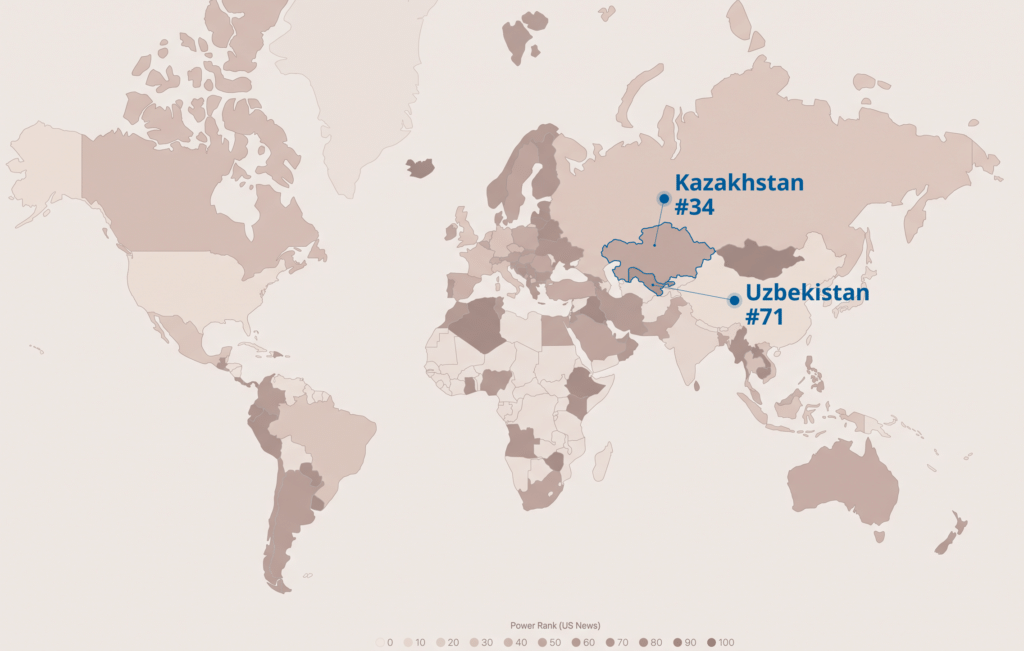
In “What Is the Status of Middle Powers?”, Michel Duclos of the Institut Montaigne presents Kazakhstan as a test case for whether middle powers can still influence outcomes in an era of intensifying great power rivalry. Writing after the Regional Ecological Summit in Astana, which brought together nine heads of state around President Kassym-Jomart Tokayev, Duclos notes that Kazakhstan “plays a leadership role” among states navigating pressures between China and Russia. He also argues that Tokayev, drawing on his experience as a former senior UN official, is seeking to elevate Kazakhstan into an intermediate power on multilateral issues. That is a useful lens for understanding Tokayev’s foreign policy. Rather than treating Kazakhstan’s position between larger powers as a liability, he has sought to turn geography, energy resources, logistics, diplomatic reliability, and convening power into regional agency. The result is an emerging model of middle power leadership rooted not in confrontation, but in coordination, credibility, and practical cooperation. That assessment places Tokayev’s foreign policy in a broader category than traditional balancing. Kazakhstan’s importance does not rest only on its raw assets — uranium, oil, minerals, logistics, or its position along Central Asian land routes. It also rests on how Astana uses those assets: as a convening state, a reliable partner, and a practical organizer of regional cooperation. Under Tokayev, multi-vector diplomacy has become less a defensive posture than an operating strategy, aimed at keeping Kazakhstan open to multiple partners while building platforms others have reason to use. In that sense, Kazakhstan is being presented not simply as a state located between great powers, but as one increasingly able to give structure to the space between them. Moving from “balancer” to “regional organizer” is only possible if Kazakhstan turns geography, resources, and diplomacy into practical systems others have reason to use. The clearest operational evidence of this shift is transport. Kazakhstan’s geography has often been described as a constraint. It is landlocked, vast, and positioned between larger powers. But the growth of the Trans-Caspian International Transport Route, or Middle Corridor, allows Astana to recast that geography as a strategic advantage. In the first quarter of 2026, 125 container trains transited Kazakhstan via the Middle Corridor, a 34.4% increase from the same period in 2025. The Times of Central Asia also reported that freight volumes along the route through Kazakhstan have grown more than fivefold over seven years, from 0.8 million tons to 4.5 million tons annually. These figures show that Kazakhstan is not simply selling potential; it is building operational value into the corridor. This is where the idea of Kazakhstan as a regional organizer becomes concrete. A balancing state tries to avoid overdependence on any single power. An organizing state builds systems that others have a reason to use. If Kazakhstan can make the Middle Corridor faster, more predictable, more digitalized, and more commercially reliable, it is not merely balancing Russia, China, Europe, Türkiye, and the South Caucasus. It is creating connective tissue between them. World Bank analysis suggests that infrastructure...