• KGS/USD = 0.01144 0%
  • KZT/USD = 0.00212 0%
  • TJS/USD = 0.10761 -0.09%
  • UZS/USD = 0.00008 0%
  • TMT/USD = 0.28571 0%
  • KGS/USD = 0.01144 0%
  • KZT/USD = 0.00212 0%
  • TJS/USD = 0.10761 -0.09%
  • UZS/USD = 0.00008 0%
  • TMT/USD = 0.28571 0%
  • KGS/USD = 0.01144 0%
  • KZT/USD = 0.00212 0%
  • TJS/USD = 0.10761 -0.09%
  • UZS/USD = 0.00008 0%
  • TMT/USD = 0.28571 0%
  • KGS/USD = 0.01144 0%
  • KZT/USD = 0.00212 0%
  • TJS/USD = 0.10761 -0.09%
  • UZS/USD = 0.00008 0%
  • TMT/USD = 0.28571 0%
  • KGS/USD = 0.01144 0%
  • KZT/USD = 0.00212 0%
  • TJS/USD = 0.10761 -0.09%
  • UZS/USD = 0.00008 0%
  • TMT/USD = 0.28571 0%
  • KGS/USD = 0.01144 0%
  • KZT/USD = 0.00212 0%
  • TJS/USD = 0.10761 -0.09%
  • UZS/USD = 0.00008 0%
  • TMT/USD = 0.28571 0%
  • KGS/USD = 0.01144 0%
  • KZT/USD = 0.00212 0%
  • TJS/USD = 0.10761 -0.09%
  • UZS/USD = 0.00008 0%
  • TMT/USD = 0.28571 0%
  • KGS/USD = 0.01144 0%
  • KZT/USD = 0.00212 0%
  • TJS/USD = 0.10761 -0.09%
  • UZS/USD = 0.00008 0%
  • TMT/USD = 0.28571 0%

Viewing results 25 - 30 of 2164

Kazakhstan and Uzbekistan Continue to Popularize Rail Tourism

Kazakhstan’s national railway company, Kazakhstan Temir Zholy (KTZ), and Oʻzbekiston temir yoʻllari, also known as Uzbekistan Railways, organized this year’s second Keruen Express train tour from May 1 to 6. More than 130 passengers traveled along the Almaty-Turkestan-Samarkand-Tashkent-Almaty route. Over five days, participants visited major architectural and historical sites in both countries, including the Khoja Ahmed Yasawi Mausoleum in Turkestan, the Gur-e-Amir mausoleum and the Registan in Samarkand, and the Hazrati Imam Complex in Tashkent. The Keruen Express promotes rail tourism and the region’s historical heritage while strengthening cultural ties between Kazakhstan and Uzbekistan. Rail tourism is gaining traction in Central Asia. As previously reported by The Times of Central Asia, KTZ expanded its popular Jibek Joly (Silk Road) tourist train route to include Tajikistan. The updated route now reaches the Tajik capital, Dushanbe, extending the tour beyond Kazakhstan and Uzbekistan. The train-tour projects are part of a regional push to promote Central Asia as a unified tourist destination. Regional leaders have advocated for a shared visa-free regime for foreign visitors, similar to Europe’s Schengen Area, to encourage cross-border travel and boost international tourism. Speaking at the 59th Annual Meeting of the Board of Governors of the Asian Development Bank in Samarkand on May 4, Uzbekistan President Shavkat Mirziyoyev proposed creating a Central Asia Tourism Ring as a unified tourism space connecting the countries of the region. Mirziyoyev called on neighboring countries, the ADB, and other partners to form a portfolio of tourism development projects and jointly finance them. Mirziyoyev also highlighted Central Asia’s tourism potential, noting that amid global instability, millions of tourists are seeking safe destinations, and the region has significant opportunities in pilgrimage, cultural, gastronomic, ethnographic, extreme, and medical tourism.

Academy of Digital Technologies & Artificial Intelligence Inaugurated in Kazakhstan

The Academy of Digital Technologies & Artificial Intelligence (ADT&AI) has opened at Satbayev University in Almaty. The new institution will focus on developing digital solutions and artificial intelligence technologies for training next-generation specialists, as well as creating solutions for the corporate sector. The opening ceremony on May 5 was attended by Presidential Aide Kuanyshbek Yessekeyev, Deputy Minister of Science and Higher Education Dinara Shcheglova, and Vice President of the National Academy of Sciences Askar Dzhumadildayev. According to the Ministry of Science and Higher Education, the new academy will offer online courses, making technical education accessible regardless of students’ location. The academy has also launched professional development programs for employees of Kazakhstani enterprises and supports businesses in implementing digital transformation tools in their operations. Through its own data center, the academy will develop digital services and artificial intelligence-based solutions. The AI Lab will play a central role in the academy’s work by integrating AI algorithms into educational and corporate products. “We are creating not just an educational platform, but a fully-fledged technological environment where education, infrastructure, and artificial intelligence work together. Our goal is to provide students and partners with real tools for working and developing in the digital economy,” said Natalia Kudryavtseva, project manager and business analyst at the AI Lab. ADT&AI was created as part of the AI-Sana national program for the development of artificial intelligence in Kazakhstan. The large-scale government initiative aims to develop AI competencies among students, support startups, and create a next-generation technological environment. The program is being implemented with the support of the Ministry of Science and Higher Education and leading universities, including Satbayev University.

SelectUSA Investment Summit: U.S.-Kazakhstan Trade and Investment Relations on the Rise

Despite global economic headwinds and ongoing conflict in the Middle East, Kazakhstan is doubling down on its efforts to deepen commercial ties with the United States, an ambition on full display at this year’s SelectUSA Investment Summit in National Harbor, Maryland, near Washington, D.C. The annual forum, organized by the U.S. Department of Commerce, serves as the U.S. government’s flagship platform for attracting foreign direct investment. While SelectUSA is designed to attract foreign direct investment into the United States, Kazakhstan’s presence also reflects a broader shift: Kazakhstani companies are increasingly looking for ways to enter and scale in the U.S. market. [caption id="attachment_48403" align="aligncenter" width="1280"] Magzhan Ilyassov, Ambassador of Kazakhstan to the U.S. - image: TCA[/caption] “Kazakhstan views the United States not only as a strategic partner, but as an emerging priority destination for long-term investment and technological collaboration,” said Magzhan Ilyassov, Kazakhstan’s ambassador to the United States. “One of our missions is to facilitate collaboration for Kazakh companies to enter the American market while strengthening bilateral trade and innovation ties.” That vision is being driven in large part by Kazakhstan’s private sector. “We already have a significant number of companies operating in the U.S. market, including in fintech and construction,” said Timur Turlov, founder and CEO of Freedom Holding Corp. “We have learned how to meet international standards, and the products being developed within our ecosystems today are becoming truly global. I genuinely believe that our competitiveness has grown, and our business culture has matured. We are now going to see many more success stories of our companies expanding beyond Kazakhstan.” SelectUSA says its investment summit has helped generate more than $250 billion in new U.S. investment projects, supporting more than 125,000 jobs across the United States and its territories. This year marked a milestone in that evolving relationship. Kazakhstan became the first country from Central Asia and the South Caucasus to host an investment and trade roundtable at SelectUSA. The roundtable, focused on “Strategic Sectors and U.S. Market Entry Opportunities,” brought together government officials, investors, and business leaders, underscoring Kazakhstan’s transition from participant to initiative-taking player within SelectUSA. [caption id="attachment_48401" align="aligncenter" width="833"] U.S. Ambassador to Kazakhstan, Julie Stufft - image: TCA[/caption] U.S. Ambassador to Kazakhstan Julie Stufft said that a delegation of 30 Kazakhstani firms representing various business sectors has come to the U.S. for the summit to pursue trade and investment prospects. "This is a historic event for our relations and for Kazakhstani business - one that truly demonstrates the level of development Kazakhstani companies and investors have achieved, enabling them to enter the world's largest market: the United States," Ambassador Stufft stated. The roundtable highlighted a clear trend: Kazakhstani firms are increasingly looking outward. Companies from sectors including manufacturing, agri-tech, healthcare, food production, and digital platforms presented plans for entering or expanding in the U.S. market, while also outlining the challenges of regulatory compliance, localization, and competition. Support from institutions like SelectUSA and the U.S. Commercial Service remains critical in navigating these complexities. Economic conditions are...

Kazakhstan Recasts Its Nuclear Past

At the United Nations in late April, Robert Floyd, executive secretary of the Preparatory Commission for the Comprehensive Nuclear-Test-Ban Treaty Organization, warned that any renewed nuclear test by Russia, the United States, or another state could draw other nuclear powers back into testing. His remarks followed the re-emergence of nuclear testing as an issue in international political debate. Kazakhstan enters this debate from the opposite side of nuclear history. It is a former Soviet nuclear test ground that now defines its nuclear policy through civilian power, peaceful use, and non-proliferation. Kazakhstan’s nuclear future is shaped by its nuclear past. The country was a Soviet nuclear test ground at Semipalatinsk, now Semey, where late-Soviet public-health concerns helped force nuclear testing into public politics before the site’s closure. After independence, Kazakhstan renounced the Soviet-era nuclear weapons it inherited on its territory. Its present nuclear-energy policy begins from that record. It is not a search for nuclear status, but a civilian program formed by restraint, public memory, and national development. Semipalatinsk is the source of Kazakhstan’s authority on nuclear testing. Between 1949 and 1989, the Soviet Union used the site as one of its principal nuclear testing grounds. In total, 456 nuclear tests were conducted there, including 340 underground and 116 atmospheric tests. Kazakhstan closed the site in 1991. These facts remove the subject from arms-control abstraction. For Kazakhstan, nuclear testing is a territorial, social, public-health, and political inheritance, bound to the eastern steppe and the communities around the former test range. Atomic Lake gives that history a single, physical form. In January 1965, the Soviet Union carried out the Chagan underground nuclear explosion at the Semipalatinsk Test Site. The blast, with a yield of 140 kilotons, was part of a Soviet program for using underground nuclear explosions in civil engineering, including reservoirs and channels in water-scarce regions. It created the crater later known as Atomic Lake. The site remains a physical residue of the Soviet claim that nuclear explosions could serve economic and social development. This is why nuclear technology in Kazakhstan cannot be politically neutral. Independence gave Kazakhstan agency in that history. Kazakhstan transferred Soviet-era nuclear weapons to Russia by April 1995 and took part in cooperative threat reduction, including the sealing of test-site boreholes and tunnels. More recently, it became host to the International Atomic Energy Agency’s Low Enriched Uranium Bank at Ulba, in Oskemen. The bank is an IAEA-owned fuel-assurance reserve for peaceful nuclear power, designed to support access to nuclear fuel without encouraging additional enrichment programs. Kazakhstan’s civilian nuclear claim, therefore, rests on practice: disarmament, threat reduction, and non-proliferation infrastructure. The policy now turns on a practical paradox. Kazakhstan has been the world’s leading uranium producer since 2009 and produced about 40% of the world’s uranium in 2025. Yet it has no operating nuclear power plant. Its Soviet-era BN-350 reactor, near Aktau on the Caspian Sea, was decommissioned in 1999 after decades of electricity generation and desalination. Kazakhstan is central to the global nuclear fuel cycle but has...

Iranian Company to Build Oil Plant and Poultry Farm in Kazakhstan

Iranian companies are increasingly looking to Kazakhstan for investment and production as tensions between the United States and Iran continue. Iran’s Golrang Industrial Group plans to implement two major projects in Kazakhstan: the construction of a sunflower oil production plant and a poultry farm for meat production. Agreements on the projects were reached on May 4 between Kazakhstan’s Deputy Minister of Agriculture Yermek Kenzhekhanuly and Golrang’s leadership, with total investment estimated at approximately $120 million. At the meeting, Golrang Industrial Group expressed strategic interest in developing its business in Kazakhstan and localizing production. According to the Ministry of Agriculture, the first project involves the construction of an oil extraction plant with a processing capacity of up to 3,000 tons of sunflower seeds per day, with direct investment of approximately $70 million. The project is expected to increase the processing depth of Kazakh agricultural raw materials and boost the added value of finished products. Investment in the second project, a poultry meat farm, is estimated at approximately $50 million. The projects come against a backdrop of steadily growing cooperation between Kazakhstan and Iran. In 2025, bilateral agricultural trade increased by 55.8%, exceeding $341 million. Exports of Kazakh products, primarily wheat and barley, have also grown significantly.

Kazakhstan Accelerates AI Push to Build Digital Economy

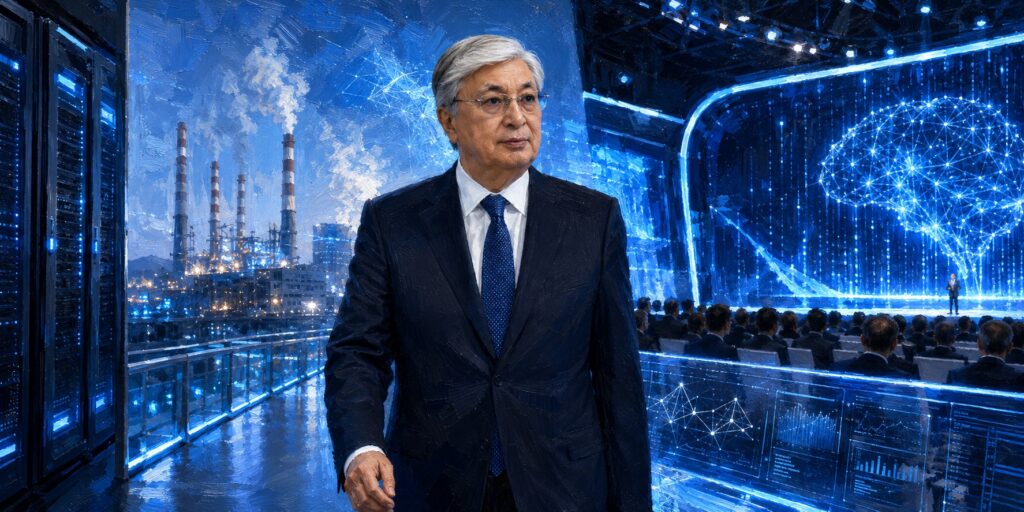
Kazakhstan must accelerate its transition to a digital economy and scale up artificial intelligence if it wants to avoid economic stagnation, President Kassym-Jomart Tokayev has said. Speaking on May 4 at a meeting of the AI Development Council, Tokayev warned that Kazakhstan’s traditional growth drivers, including natural resources and low-cost labor, are nearing exhaustion, while new engines of growth have yet to take shape. According to the president, Kazakhstan is already facing the “middle-income trap.” He said avoiding stagnation requires a shift to a digital economy and the development of platform-based solutions. “Without a unified system of government data, artificial intelligence will remain ineffective,” Tokayev said. He called for public services to become an “invisible but highly efficient operating system” capable of reducing processing times from days to seconds, which he said would accelerate capital turnover across the economy. Kazakhstan has begun testing this approach in customs, tax administration, logistics, and public finance. The KEDEN customs platform has cut declaration processing times to under one minute, while Smart Cargo is being developed as a single digital window for logistics services. The integrated tax administration system has reduced document processing times from one hour to one minute. The Smart Data Finance platform brings together data from 78 sources, including financial transactions and transport activity. Authorities say real-time budget monitoring has helped prevent risky payments worth hundreds of billions of tenge. A public procurement forecasting system, built on a national product catalog with more than 23 million items, is also being developed to reduce budget waste. Tokayev said the digital economy already accounts for more than 15% of global GDP, reflecting a shift in global competition from goods markets to data and standards. He also emphasized the need to develop digital financial instruments, including cryptocurrencies and asset tokenization. “This will increase the country’s attractiveness for global capital and create the conditions for Kazakhstan to become a leading investment and financial hub,” he said. According to Tokayev, Kazakhstan has already established a legal framework for regulating digital assets. The government and the National Bank have been tasked with coordinating a strategy for developing the crypto market. At the same time, Tokayev stressed the need for more precise measurement of digitalization’s contribution to economic growth. “When GDP growth is reported, it is essential to clearly understand what share comes from the real sector and what from innovation,” he said, warning that the absence of a clear methodology could create an illusion of progress while masking underlying challenges. Tokayev also visited the GITEX AI Central Asia & Caucasus exhibition, where projects in AI, logistics, and fintech were showcased. Among them was an AI assistant deployed in Kazakhtelecom’s contact center, where it processes customer requests and helps detect fraudulent calls. Projects aimed at developing a digital asset ecosystem and crypto market infrastructure were also presented, including tokenized financial instruments on the Kazakhstan Stock Exchange. Experts say Kazakhstan is already taking steps to compete in the global technology landscape. According to Rustem Mustafin, head of the Center...