• KGS/USD = 0.01144 0%
  • KZT/USD = 0.00214 0%
  • TJS/USD = 0.10508 0.48%
  • UZS/USD = 0.00008 0%
  • TMT/USD = 0.28490 -0.28%
  • KGS/USD = 0.01144 0%
  • KZT/USD = 0.00214 0%
  • TJS/USD = 0.10508 0.48%
  • UZS/USD = 0.00008 0%
  • TMT/USD = 0.28490 -0.28%
  • KGS/USD = 0.01144 0%
  • KZT/USD = 0.00214 0%
  • TJS/USD = 0.10508 0.48%
  • UZS/USD = 0.00008 0%
  • TMT/USD = 0.28490 -0.28%
  • KGS/USD = 0.01144 0%
  • KZT/USD = 0.00214 0%
  • TJS/USD = 0.10508 0.48%
  • UZS/USD = 0.00008 0%
  • TMT/USD = 0.28490 -0.28%
  • KGS/USD = 0.01144 0%
  • KZT/USD = 0.00214 0%
  • TJS/USD = 0.10508 0.48%
  • UZS/USD = 0.00008 0%
  • TMT/USD = 0.28490 -0.28%
  • KGS/USD = 0.01144 0%
  • KZT/USD = 0.00214 0%
  • TJS/USD = 0.10508 0.48%
  • UZS/USD = 0.00008 0%
  • TMT/USD = 0.28490 -0.28%
  • KGS/USD = 0.01144 0%
  • KZT/USD = 0.00214 0%
  • TJS/USD = 0.10508 0.48%
  • UZS/USD = 0.00008 0%
  • TMT/USD = 0.28490 -0.28%
  • KGS/USD = 0.01144 0%
  • KZT/USD = 0.00214 0%
  • TJS/USD = 0.10508 0.48%
  • UZS/USD = 0.00008 0%
  • TMT/USD = 0.28490 -0.28%

Viewing results 229 - 234 of 1151

Opinion: Ex-U.S. Ambassador Warns Washington Has Ceded Information Space in Central Asia

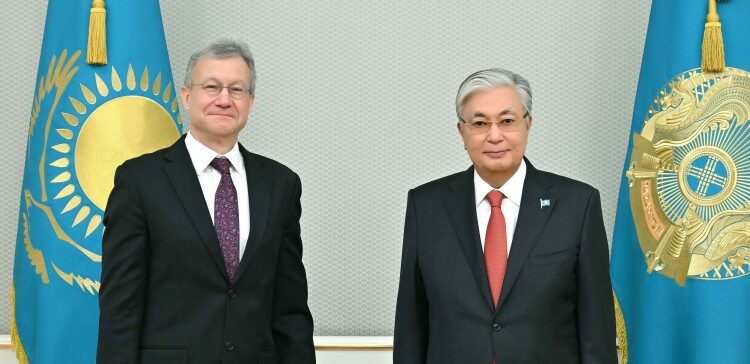
Former U.S. Ambassador to Uzbekistan and Kazakhstan, Daniel Rosenblum, has warned that Washington has “surrendered” its influence in Central Asia’s information sphere, allowing Russia and China to dominate the narrative. His remarks were reported by the Yale Daily News following a lecture at Yale University on September 15. Rosenblum, who served as U.S. ambassador to Uzbekistan from 2019 to 2022 and to Kazakhstan from 2022 to 2025, delivered a speech titled “Battling the Firehose of Falsehood: Confronting Russian Disinformation in Central Asia.” He described how Russian disinformation campaigns frequently portrayed U.S. diplomats as destabilizing actors. In one example from 2023, Russian outlets falsely claimed a NATO base had opened in Kazakhstan. “While it is easy to joke about such an absurd idea,” Rosenblum said, “the intent behind such Russian information operations is deadly serious.” Rosenblum noted that U.S. embassies attempted to counteract these narratives by highlighting tangible achievements, including COVID-19 health initiatives, agricultural partnerships, and academic exchange programs. However, he argued that much of this work has unraveled since 2023, citing the dismissal of over 1,300 State Department personnel, the elimination of USAID programs in the region, and recent cuts to Voice of America and Radio Free Europe/Radio Liberty. “Eight months into the second Trump administration, it seems clear that the information war is over in Central Asia, not because the Russians won. We have simply surrendered,” he said. Rosenblum also emphasized China’s expanding influence through the Belt and Road Initiative, observing that Beijing “was doing a pretty good job of winning friends and influencing people” via infrastructure investment and cultural outreach. In a post-lecture interview, Rosenblum underscored that the challenge is now largely domestic. “The biggest challenge today is ourselves,” he said. “We have to decide as a country, do we want to be engaged in the world or not? If we cut ourselves off from the world, we will ultimately be less secure and less prosperous.” This concern was echoed in earlier analysis for The Times of Central Asia by Arman Amini, a term member of the Council on Foreign Relations and an Atlantic Council Millennium Fellow. “Over the past decade, China has steadily expanded its presence in Central Asia, not through military force, but by building roads, trade corridors, and digital infrastructure,” Amini noted. “As the United States scaled back its regional footprint following its withdrawal from Afghanistan, Beijing moved quickly to fill the void. Today, China has positioned itself as the region’s dominant external power, while the U.S. risks being left on the sidelines.” The lecture was attended by approximately 80 people in person and online. It was organized by the Central Asia Initiative of the MacMillan Center, the Edward J. and Dorothy Clarke Memorial Fund, and Asian Crossroads, a student group dedicated to raising awareness of Central Asia.

Russia’s Crackdown Forces Central Asia to Rethink Labor Migration

The most recent World Bank study on labor migration highlighted the immense scale of the issue, describing it as "an ongoing development challenge in Europe and Central Asia, which is currently home to 100 million migrants," roughly one-third of all migrants globally. Historically, Russia has been the primary destination for Central Asia's mobile labor force. However, since March 2024, Moscow’s increasingly restrictive migration policies have forced Central Asian states to confront a dual challenge: managing displaced workers and rethinking the logistics of cross-border labor flows. As of 2023, more than 80% of labor migrants from Tajikistan and Kyrgyzstan were working in Russia. Migration from Uzbekistan was more diversified, with 57% of migrants heading to Russia, 15% to Kazakhstan, and 10% to Ukraine. For millions across the region, labor migration remains a vital economic lifeline. According to the World Bank report, The Journey Ahead: Supporting Successful Migration in Europe and Central Asia, remittances in 2024 accounted for 45% of Tajikistan’s GDP, the highest ratio globally. In Kyrgyzstan, remittances made up 24% of GDP, while in Uzbekistan the figure was 14%. A 2025 update increased the figure for Tajikistan further still, noting that domestic consumption was "supported by large remittance inflows - peaking at 49% of GDP in 2024." Since the start of the war in Ukraine, rhetoric in the Russian media and among some politicians toward Central Asian migrants has increasingly shifted toward overt hostility. Following the March 2024 terrorist attack at Moscow’s Crocus City Hall, in which Tajik nationals were named among the suspects, Russia began implementing harsher measures. This included widespread street inspections of Kyrgyz, Uzbek, and Tajik citizens, alongside new, more restrictive legal frameworks. While certain steps, such as mandatory biometric data collection, were officially justified by security concerns, other policies have further complicated daily life for foreign nationals. For example, since January 2025, all foreign-owned SIM cards in Russia have been deactivated. Foreign citizens must now register with government agencies to obtain new mobile services, a policy framed as a response to telecom fraud. Another measure, introduced on June 30, requires citizens of visa-free countries to register in the “Gosuslugi RuID” app before entering Russia. They must obtain a digital code to pass border control, effectively instituting a pre-entry surveillance mechanism. Kazakhstan was the first to publicly respond, with Foreign Ministry spokesman Aibek Smadiyarov refusing to rule out reciprocal measures against Russian citizens. “We are studying this issue very carefully. It requires consultations with our government agencies,” Smadiyarov said. Yet, despite these developments, none of the Central Asian countries currently maintains a comprehensive migration strategy equipped to handle these shifting dynamics. In Kazakhstan, the issue came to the fore in 2025 with a noticeable influx of Tajik nationals, the group most affected by Russia’s new rules. At a government meeting in late July, officials noted that Kazakhstan had recorded a positive migration balance for the second consecutive year, as well as a 1.5-fold increase in the number of foreign citizens permanently residing in the country. “The importance...

Book Launch at the U.S. Capitol: New Uzbekistan: The Path of Shavkat Mirziyoyev

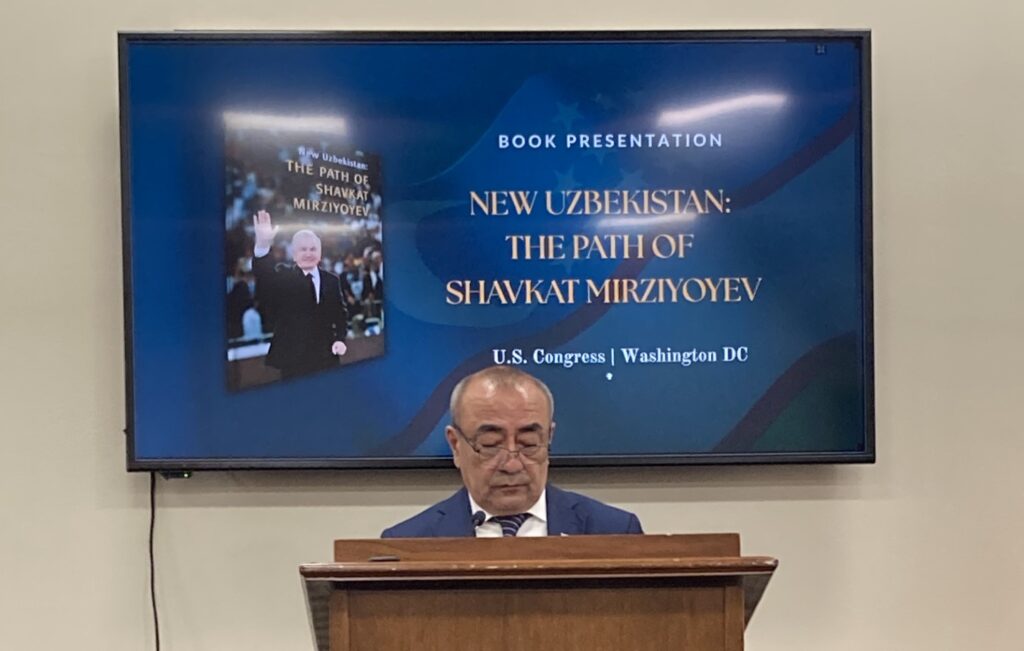
On September 16, the Embassy of Uzbekistan in Washington, D.C., hosted a book launch at the Rayburn Building on Capitol Hill for New Uzbekistan: The Path of Shavkat Mirziyoyev. The event drew diplomats, congressional staff, and representatives from companies such as General Motors and Boeing. The keynote address was delivered by Sodyq Safayev, First Deputy Chairperson of Uzbekistan’s Senate. Other speakers included Husan Ermatov, the book’s Uzbek-language editor and advisor to Uzbekistan’s Ishonch newspaper; Eldor Aripov, Director of the Institute for Strategic and Regional Studies under the President of Uzbekistan; Lisa Choate, President and CEO of American Councils; and Elena Son, Executive Director of the American-Uzbekistan Chamber of Commerce. Speakers highlighted Uzbekistan’s recent trajectory, noting shifts from a state-controlled economy and limited international engagement (1993–2016) to more market-oriented policies and broader foreign relations (2017–present). They also framed today’s Uzbekistan as shaped by historical experiences and cultural development, which some described as an “Uzbek Renaissance.” According to the speakers, President Mirziyoyev has promoted reforms in areas including governance, socio-economic development, and international outreach. Safayev remarked: “this [book signing] is not just about diplomacy but about shared values, mutual understanding, and a common vision of the future. The book before you, authored by Qudratilla Rafiqov, Uzbek scholar and political scientist, is a chronicle of change, resilience, and hope. The most difficult part of this book is a [description of the] transformation of hearts and minds. Its central message is simple and powerful: the history of Uzbekistan is written by people through their interactions and aspirations. And justice lies at the heart of reform.” By justice, he clarified, he meant fairness—ensuring that citizens have opportunities for family stability, safety, and employment. While the book presents Uzbekistan’s current government agenda in a favorable light, it also introduces new readers to the President’s stated priorities: attracting investment, promoting rule of law and fairness, liberalizing the economy, restructuring social policies, contributing to global peace efforts, and maintaining pragmatic security and foreign policy strategies. Aripov emphasized that the book is “not really about reforms, or about a leader who has been able to initiate and implement large-scale transformation in a very short period of time. It is a testimony to a new era into which Uzbekistan is entering. Today, hopes are rising in Uzbekistan, a sense of national pride is strengthened, and ambitions are being achieved that only recently seemed unattainable. These changes are being felt by ordinary citizens. They see how their lives are improving, how opportunities are expanding, and how confidence in the future is becoming a reality. That is why this book is not only a chronicle of, but also a symbol of faith that Uzbekistan can become one of the centers of sustainable development, openness and cooperation in Eurasia and the wider world. Why do I believe this to be the case? Because, under my President, the country has moved from ‘guarded isolation’ to ‘post-purposeful openness,’ from managing risks to exporting stability, and from ad hoc transactions to rules-based cooperation.” The Uzbek Embassy,...

Rail, Water, and Helicopters – Uzbekistan’s “Limited Recognition” of the Taliban

Uzbekistan has spent the middle of September embroiled in an increasingly tetchy press battle over an unusual topic: helicopters. The Taliban, who run the de facto government in Kabul, have long claimed that several dozen military aircraft and helicopters currently residing in Uzbekistan are rightfully theirs. On September 11, a Taliban official announced publicly that Uzbekistan had agreed to hand them back. This was reported widely in the regional media, with the Uzbek foreign ministry slow off the mark in denying these claims. The dispute goes back to the fall of Kabul in August 2021, when a total of 57 aircraft were flown from Afghanistan to Uzbekistan and Tajikistan as Ashraf Ghani’s government collapsed. “The helicopters came from the Afghan territory to Uzbek territory illegally, so actually we had the right to confiscate them,” Islomkhon Gafarov, an Afghanistan expert at the Center for Progressive Reform, a Tashkent think tank, told the Times of Central Asia. However, Gafarov adds that the aircraft were the property of the U.S. military loaned to the previous government of Afghanistan, and therefore, Washington will have a say in their return. This has not stopped the Taliban from continuing to demand the helicopters back for use in “humanitarian operations,” in the words of Foreign Minister Amir Khan Muttaqi. Such wrangling is part of the daily diplomatic in-tray for Tashkent when dealing with a neighbor whose government has not been recognized by almost the entire world. “Afghanistan is our neighbor,” said Gafarov. “According to the geopolitical situation, we have to conduct a dialogue with this government. It’s true, Uzbekistan hasn’t recognized the Taliban government, but de facto, we work with them; we’ve had diplomatic relations with them since 2018.” Tashkent certainly has reasons to work with the Taliban. Helicopters are a mere sideshow compared to two far larger issues that will define their relations for years to come: rail and water. Railway On the positive side of the ledger, the Taliban have brought to Afghanistan a reasonable degree of stability - enough to start contemplating large-scale infrastructure projects. In July, an agreement was struck between Pakistan, Afghanistan, and Uzbekistan to conduct a feasibility study for a trans-Afghanistan railway, with 647 kilometers of new track being laid to link Uzbekistan with Pakistan’s Indian Ocean ports. This railway could bring significant benefits to Uzbekistan, one of only two double-landlocked countries in the world. Currently, sea-bound exports must travel via Turkmenistan to Iran. Other routes almost all rely on going via Kazakhstan. The China-Kyrgyzstan-Uzbekistan railway, currently being constructed, should remove some of the need for sea-bound routes, but the Pakistan route would be faster. “The trans-Afghan route is the shortest way to the seaports of Karachi and Gwadar,” Gafarov told TCA. With a line from Termez, Uzbekistan, to Mazar-i-Sharif in Northern Afghanistan already operational, this only leaves two sections unbuilt - from Mazar to Kabul, and then from Kabul to Peshawar in Pakistan. The teams are still only at the feasibility stage right now, and have, with some chutzpah, predicted...

Opinion: Turning Deserts Into Fields of Hope

Desertification is a global crisis threatening the livelihoods of 3.2 billion people worldwide. From China’s vast green belt along its largest desert to Central Asia’s unified efforts to halt land degradation on arid plains, the fight against encroaching sand continues. These initiatives offer hopeful examples of human endeavor in restoring degraded lands and safeguarding the future of our planet. In the heart of southern Xinjiang lies the Taklamakan Desert, a vast expanse known as the “sea of death” for its extreme arid and inhospitable conditions. Covering 330,000 square kilometers - an area almost the size of Finland - it is China’s largest desert and the world’s second-largest shifting desert. Here, dunes stretch endlessly, and sandstorm days comprise one-third of the year. For generations, the Taklamakan Desert has threatened surrounding villages, farmlands, and transportation routes, squeezing the living space of those who dwell on its edges. Nearly 80% of the desert sands are in constant motion, while seasonal floods from melting snow on the mountains add further instability, leaving homes and livelihoods at risk. The danger is long-term: at one point, the Taklamakan risked merging with the nearby Kumtag Desert, placing even greater pressure on human settlements. How To Contain The Sands Faced with the challenge, China launched an ambitious initiative: building a shield of vegetation to encircle the Taklamakan Desert, planting desert-tolerant species such as desert poplar, red willow, saxaul, and even roses. This massive project took more than 40 years to complete. By the end of 2023, 2,761 kilometers (about 1,716 miles) of the belt had been established. A year later, the final 285 kilometers - the most challenging section - was closed through the dedicated efforts of 600,000 people. On November 28, 2024, in Yutian County on the desert’s southern edge, the last seedlings were planted into the sands, completing a 3,046-kilometer green belt. This vast ecological barrier stabilizes the Taklamakan Desert’s edge, prevents sandstorms, and protects the fragile ecology. In addition, the green belt provides wild animals in the desert with safe conditions for survival, breeding, and migration. A Bold Green Strategy Against Desertification The Taklamakan Desert control project is a part of China's Three-North Shelterbelt Forest Program, or TSFP, the world's largest afforestation program aimed at curbing desertification. Launched in 1978, this ambitious program seeks to slow the progress of desertification and reduce the frequency of sandstorms by planting vast stretches of trees and resilient plant species across the arid and semi-arid regions in northern China, where sandstorms pose a constant threat to local farmlands and residents. Official data shows that forest coverage in areas covered by the TSFP has risen from 5% in 1977 to 13.8% today. More than 60% of regions prone to soil erosion have been effectively controlled, and roughly 30 million hectares of farmland have been safeguarded from desert expansion. Turning Lands of Despair into Fields of Hope: A Shared Mission The challenges faced in northern China echo across the globe. From the Sahel in Africa to the Middle East and Central...

Wheels of Influence: China’s Electric Vehicle Push in Central Asia

As domestic competition intensifies and protectionist barriers rise in Western markets, Chinese electric vehicle (EV) manufacturers are increasingly looking outward. One region emerging as a key destination is Central Asia, where China’s green tech ambitions align with local efforts to modernize and decarbonize transport systems. From affordable passenger cars aimed at private drivers to electric buses transforming public transit, Chinese EVs are quietly gaining traction across Kazakhstan, Uzbekistan, Kyrgyzstan, and Tajikistan. Companies like Yutong are supplying e-buses for urban mobility, while fleets of electric taxis are beginning to appear in Dushanbe’s streets. This growing presence is more than just commercial - it signals a deeper shift in China’s regional engagement strategy, using clean technology as a vehicle for influence in a strategically contested space. There is an upward trend in the import of electric vehicles from China to Central Asia, particularly in Kazakhstan and Uzbekistan. In 2024, Uzbekistan imported over 24,000 EVs, with Chinese manufacturers accounting for a staggering 99.5% of all imports. This marked an increase of more than 8,000 units compared to 2023 - nearly a 1.5-fold growth in just one year. A similar surge is visible in Kazakhstan. In 2023, the country imported around 6,875 Chinese EVs, but by 2024, although official figures are yet to be released, industry reports indicate a 36-fold increase in the sales of Chinese EVs year-on-year. Drivers of Import: Policy and Perception The surge in EV imports into Central Asia is driven by a convergence of motivations from both China and the region’s domestic policies. On the supply side, the rapid influx of Chinese EVs reflects a blend of strategic export redirection by Chinese automakers and receptive policy environments in the region. Faced with mounting trade restrictions and increasing regulatory pressure in Western markets, Chinese EV producers are pivoting toward emerging economies to safeguard growth. Central Asia has become a promising destination due to its untapped consumer base. On the demand side, Central Asian governments are enacting supportive policies to accelerate the green transition, making EV imports more accessible. For example, Uzbekistan has removed both excise taxes and customs duties on imported electric vehicles, while Kazakhstan and Kyrgyzstan benefit from a Eurasian Economic Union ruling that extends duty-free EV imports until the end of 2025, creating a favorable environment for consumers and fleet operators. In addition to these policy frameworks, a growing positive perception of Chinese EVs has emerged across the region. Chinese manufacturers are seen as offering a combination of affordability and quality, a crucial advantage in price-sensitive markets like Central Asia. For consumers and taxi fleet operators, the appeal goes beyond the sticker price - electric vehicles are significantly cheaper to operate. Unlike gasoline-powered cars that require frequent oil changes and filter maintenance, EVs offer lower long-term operating costs, making them a practical and economically attractive choice. Beyond Exports: Assembling a Local Presence However, China’s electric vehicle expansion in Central Asia goes beyond exports - it increasingly involves local production through joint ventures and assembly plants. In Uzbekistan, the state-owned...