Viewing results 1 - 6 of 51
TASHKENT (TCA) — Russia's Rosatom State Atomic Energy Corporation and the Government of Uzbekistan have signed a nuclear cooperation agreement. Rosatom said the agreement was signed by the company’s Director General Alexey Likhachev and Uzbek Deputy Prime Minister Nodir Otazhonov on December 29. “The agreement paves the way for bilateral cooperation between Russia and Uzbekistan in many aspects of civil nuclear energy. The collaboration could include creation and development of infrastructure in Uzbekistan, training, construction of nuclear power plants and research reactors, as well as operational and maintenance support during their life cycle,” Rosatom said in a statement. The Russian company also said the agreement could also cover “exploration and mining of uranium, handling of uranium waste and the production of radioisotopes for use in medicine, agriculture and academic research.” Likhachev said that Rosatom was ready to build a two-unit nuclear power plant in Uzbekistan and has offered to start training Uzbek nuclear experts-to-be at Moscow's expense beginning in September 2018, RFE/RL reported. In early November, during a visit to Tashkent by Russian Prime Minister Dmitry Medvedev, a memorandum on cooperation between Rosatom and Uzbekistan's Academy of Science was signed, along with an agreement on production and provision of nuclear fuel by Uzbekistan for Rosatom.
ASTANA (TCA) — Kazakhstan’s national atomic company Kazatomprom, the world leader in the extraction of natural uranium, and Canada-based Cameco Corporation on December 11 announced the completion of JV Inkai LLP’s restructuring. The CEO of Kazatomprom Galymzhan Pirmatov, and the President and CEO of Cameco, Tim Gitzel, signed the documents at a ceremony in London required to complete the restructuring outlined in the May 2016 Implementation Agreement between Kazatomprom, Cameco and Inkai. Continue reading
ASTANA (TCA) — Kazakhstan’s national atomic company Kazatomprom, the world leader in the extraction of natural uranium, on December 4 announced its intention to reduce planned uranium production by 20% in order to better align its output with demand. Continue reading
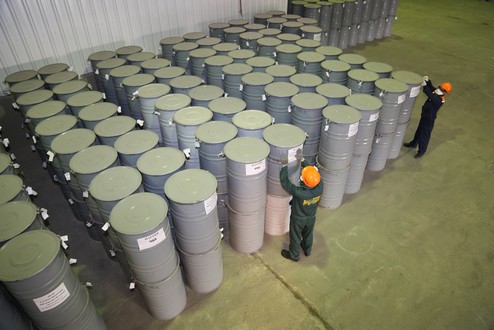
ASTANA (TCA) — International Atomic Energy Agency (IAEA) Director General Yukiya Amano and President of Kazakhstan Nursultan Nazarbayev on August 29 attended a ceremony in the Kazakh capital Astana to mark the official opening of the IAEA Low-Enriched Uranium (LEU) Bank Storage Facility at the Ulba Metallurgical Plant (UMP) in the eastern Kazakh city of Ust-Kamenogorsk. The IAEA LEU Bank will be established once the LEU, the basic ingredient to fabricate nuclear fuel, has been purchased and delivered to the Storage Facility, the IAEA said in a press release. “I am confident that the IAEA LEU Bank will make a valuable contribution to international efforts to ensure the availability of fuel for nuclear power plants,” IAEA Director General Amano told the event which was attended also by representatives of IAEA Member States and donors. The IAEA Board of Governors decided in December 2010 to establish the IAEA LEU Bank as an assurance of supply mechanism of last resort for Member States which experience a supply disruption due to exceptional circumstances, and which are unable to secure nuclear power fuel from the commercial market, State-to-State arrangements or by any other means. Owned and controlled by the IAEA, it will be a physical reserve of up to 90 metric tons of LEU suitable to make fuel for a typical light water reactor, available for eligible countries. Thanking President Nazarbayev and the Government and people of Kazakhstan for volunteering to host the IAEA LEU Bank, Amano added: “Kazakhstan has for many years been a steadfast partner of the IAEA in working to prevent nuclear proliferation and advancing peaceful uses of nuclear energy.” UMP began construction of the Storage Facility – an 880 square metre steel structure with robust security arrangements and enhanced safety features – in September 2016 and it was completed on schedule and on budget. Attending the inauguration at the site, IAEA LEU Bank Project Executive Mark Bassett said it was a special purpose-built facility. “The Storage Facility has been designed and built to provide a high level of safety and security for the LEU Bank,” he added. The establishment and operation of the IAEA LEU Bank are fully funded by voluntary contributions from IAEA Member States and other donors totalling US $150 million – sufficient to cover estimated costs for 20 years of operation. Director General Amano said he was grateful to all donors – including the United States, the European Union, Kuwait, the United Arab Emirates, Norway, the Republic of Kazakhstan and the Nuclear Threat Initiative – “whose generous financial contributions have made this project possible.” He also thanked China and the Russian Federation for their cooperation regarding agreements for the transit through their countries of LEU for the IAEA LEU Bank. Stressing that nuclear energy helps to address the twin challenges of securing sufficient energy for economic growth and mitigating the effects of climate change, Amano said around 30 countries are interested in introducing nuclear power. This is in addition to the same number of countries currently operating...
LONDON (TCA) — The wider Caspian region, which comprises the Caspian littoral states and the lands to their east, is sitting on a vast riches of subsoil resources of which combustibles are made to quench the world’s ever increasing thirst for energy. Those who dedicate their lives and/or cash to such resources hardly ever miss an occasion to stress the need for them, downplaying the growing importance of alternative resources, located not under but on and above the earth’s surface and being infinite. Continue reading
ASTANA (TCA) — Within the framework of the International Exhibition Astana EXPO-2017, in the pavilion The World of Nuclear Energy, Kazakhstan’s national atomic company Kazatomprom on June 12 signed memorandums with Cameco Corporation (Canada), Uranium One Inc., CGN (China), and AREVA (France). All four documents determine the opportunities for cooperation in implementing in Kazatomprom the tasks outlined in the Address of the President of Kazakhstan "Third modernization of Kazakhstan: global competitiveness" and the state program "Digital Kazakhstan". Continue reading