• KZT/USD = 0.00210
  • TJS/USD = 0.10810
  • UZS/USD = 0.00008
  • TMT/USD = 0.29850
  • KZT/USD = 0.00210
  • TJS/USD = 0.10810
  • UZS/USD = 0.00008
  • TMT/USD = 0.29850
  • KZT/USD = 0.00210
  • TJS/USD = 0.10810
  • UZS/USD = 0.00008
  • TMT/USD = 0.29850
  • KZT/USD = 0.00210
  • TJS/USD = 0.10810
  • UZS/USD = 0.00008
  • TMT/USD = 0.29850
  • KZT/USD = 0.00210
  • TJS/USD = 0.10810
  • UZS/USD = 0.00008
  • TMT/USD = 0.29850
  • KZT/USD = 0.00210
  • TJS/USD = 0.10810
  • UZS/USD = 0.00008
  • TMT/USD = 0.29850
  • KZT/USD = 0.00210
  • TJS/USD = 0.10810
  • UZS/USD = 0.00008
  • TMT/USD = 0.29850
  • KZT/USD = 0.00210
  • TJS/USD = 0.10810
  • UZS/USD = 0.00008
  • TMT/USD = 0.29850

Viewing results 1 - 6 of 37

Rubio Meeting Highlights Kazakhstan’s Growing U.S. Agenda

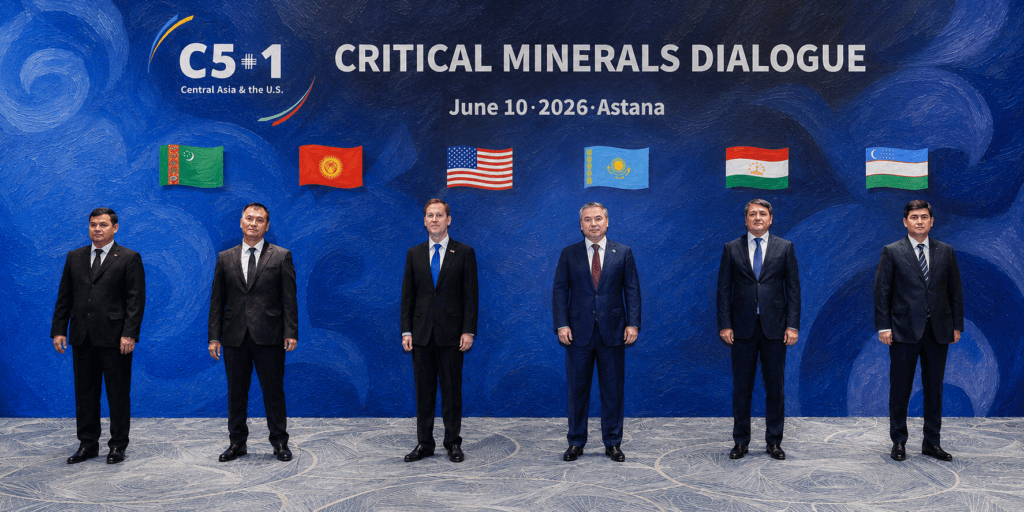
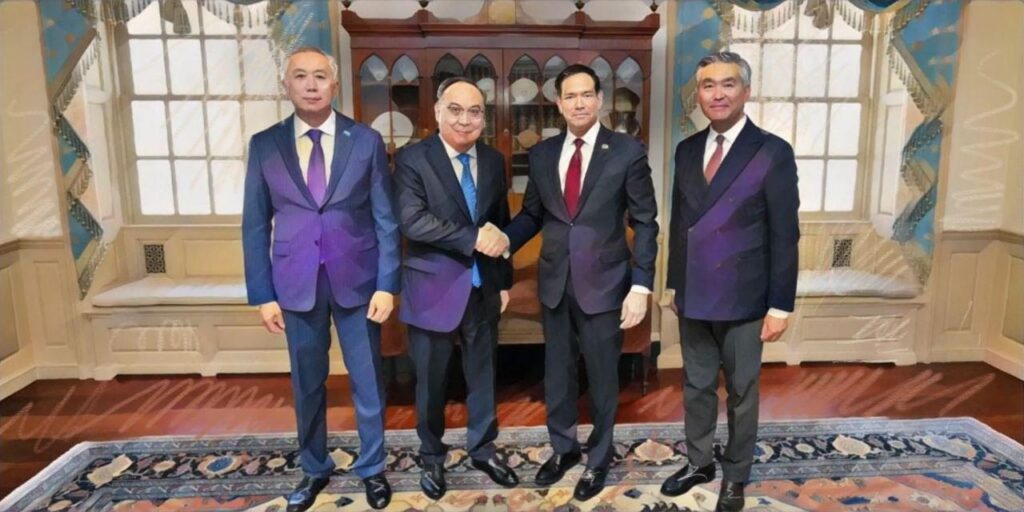
U.S. Secretary of State Marco Rubio’s April 15 meeting with senior Kazakh officials in Washington gave fresh visibility to a relationship that both sides increasingly frame in economic as well as diplomatic terms. At a time when Washington is trying to give its Central Asia policy more practical shape, Kazakhstan is a key U.S. partner in the region. Rubio met President Tokayev’s Special Representative for Negotiations with the United States, Erzhan Kazykhan, and Deputy Prime Minister and Minister of National Economy, Serik Zhumangarin. The talks covered ways to expand economic ties between the United States and Kazakhstan, as well as Kazakhstan’s role in peacemaking and regional initiatives. Rubio also welcomed Kazakhstan’s participation in the C5+1 platform and reaffirmed U.S. support for the country’s “sovereignty, independence, and territorial integrity.” In a post on X, Rubio said the talks focused on strengthening commercial ties and advancing regional cooperation. That language put trade, investment, and regional economic coordination at the center of the meeting. Launched in 2015, the C5+1 began as a diplomatic framework linking the United States and the five Central Asian states. It later broadened into a more structured platform, with working groups on trade, energy, and the environment, and with growing emphasis on logistics, diversification, supply chains, and investment. The rise of the B5+1 reinforced that shift by giving business a more formal place in the relationship. By late 2025, the format placed more emphasis on deliverables, including infrastructure, funding mechanisms, and cooperation on mineral processing and research. That shift has also been visible in Kazakhstan’s own dealings with Washington. During President Kassym-Jomart Tokayev’s visit to the United States in November 2025, the Kazakh delegation signed 29 bilateral agreements worth about $17 billion, including a memorandum on critical minerals cooperation and major commercial deals in aviation, agriculture, and mining. The same visit underlined how closely economic diplomacy and strategic supply concerns are now tied together. Kazakhstan has attracted roughly $100 billion in cumulative U.S. investment since independence, and critical minerals have moved closer to the center of the relationship as Washington looks for secure supply chains beyond China and Russia. Kazakhstan has attracted over $151 billion in net foreign direct investment since independence. Rubio’s talks with Zhumangarin and Kazykhan came after months of stronger U.S.-Kazakhstan economic contact. Kazakhstan has a larger economic profile than any other Central Asian state, and its role in energy, critical minerals, investment, and transit gives it a prominent place in Washington’s regional thinking. That makes Astana a natural focus for any U.S. push to deepen commercial ties in Central Asia. The sovereignty language in the U.S. readout was also not incidental. For Kazakhstan, public backing from Washington on sovereignty, independence, and territorial integrity carries political weight in a region where questions of borders, pressure, and strategic dependence remain sensitive. Astana’s multi-vector foreign policy is built on preserving room for maneuver among larger powers. High-level engagement in Washington supports that strategy and signals that closer U.S. ties can sit alongside Kazakhstan’s broader balancing act. The Washington...

Modernization Without Dependence: Why Uzbekistan Is Deepening Ties with Washington

The recent rise in Uzbekistan-U.S. engagement is often framed as a sudden diplomatic turn, and much of the commentary has focused on what Washington hopes to gain from deeper involvement in Central Asia. Far less attention, however, has been given to what Tashkent is seeking from this relationship. From Uzbekistan’s perspective, this engagement is part of a broader national strategy to expand the country’s foreign policy options at a time when all of the major powers are competing for influence in Central Asia. In November 2025, President Shavkat Mirziyoyev joined the other C5 leaders in Washington for a White House summit focused on economic cooperation, critical minerals, energy, and trade. By February 2026, the relationship had moved beyond talks and into financing and project design, with new agreements involving the U.S. International Development Finance Corporation and EXIM, alongside a new critical minerals framework. From Uzbekistan’s side, the core objective is straightforward. Tashkent wants to modernize rapidly without risking becoming overdependent on any single external investor. That means using U.S. interest as leverage and in tandem with, not as a replacement for ties with Russia or China. Washington is courting the region because it wants access to minerals and supply chains that reduce reliance on China and limit exposure to sanctioned or geopolitically sensitive suppliers. Uzbekistan is well aware of this and is using that demand to strengthen its bargaining position for financing, technology, and industrial upgrading. In other words, Uzbekistan is positioning itself as a strategic production and transit partner. The direction of cooperation is revealing. The February 2026 U.S.-Uzbekistan critical minerals pact prioritizes the full-value chain from exploration and extraction to processing, and even proposes a joint investment holding company. This signals that Tashkent is aiming beyond raw-material exports. It wants to break from the post-Soviet pattern of shipping resources while others capture refining, technology, and margins. If it can secure processing capacity, infrastructure, and long-term financing, the deal becomes an instrument of industrial policy. The second objective is finance and implementation capacity. President Mirziyoyev also held separate bilateral meetings with the U.S. Secretary of Commerce, Howard Lutnick, and other senior U.S. trade officials. The meetings focused on an investment platform, business council coordination, and support for large industrial and infrastructure projects. EXIM also publicly described the new framework as a way to convert earlier commitments into financing solutions for energy, aviation, critical minerals, and advanced technologies. The third objective is trade normalization and market access. A bipartisan Senate effort has introduced legislation to repeal Jackson-Vanik restrictions for Central Asian states, and President Mirziyoyev raised U.S. support for Uzbekistan’s WTO accession and stronger cooperation under the U.S.–Central Asia Trade and Investment Framework Agreement (TIFA). These measures shape the legal and trade environment that ultimately determines investor confidence. Uzbekistan is trying to make the relationship durable by embedding it in institutions. The move also serves a domestic political economy logic. President Mirziyoyev’s government has spent years presenting itself as reformist, investment-friendly, and open for business. Deeper engagement with the United...

Breaking into Project Vault: A U.S. Role for Central Asia’s Strategic Minerals

The Trump Administration has decided to go head-to-head with Beijing to secure an independent supply chain for critical minerals and insulate U.S. industries from supply shocks. Among many initiatives, the United States launched Project Vault on February 2 to establish a U.S. Strategic Critical Minerals Reserve. The public-private stockpile is expected to secure essential minerals and metals for U.S. national security purposes and high-technology industries. The effort formalizes the U.S. strategy to diversify critical mineral supply chains away from rival China and, in the process, harness broader global capacity. As part of this effort, mineral-rich Central Asia is already factoring heavily in U.S. foreign and economic policy thinking. Participating in the front row of the 2026 Critical Minerals Summit, Kazakhstan and Uzbekistan were invited to engage in Washington’s global effort to build resilient global supply chains. But Project Vault is a critical and separate component of the administration’s focus. Formally approved by the Export-Import Bank of the United States (EXIM) on February 2, Project Vault will be backed with up to $10 billion in long-term financing and an additional $2 billion in private sector participation. In sites across the country, the initiative will establish stores of critical minerals and rare earth elements essential for aerospace, defense, semiconductors, advanced manufacturing, renewables, and electric vehicles. The stockpile’s structure will be operated as a public-private partnership that enables manufacturers, trading firms, and private capital providers to jointly participate. Rare earths, copper, lithium, titanium, scandium, gallium, and germanium are all key minerals highlighted by the U.S. Department of the Interior that underpin modern technologies and demonstrate U.S. vulnerability to supply chain disruptions. Why a Strategic Mineral Reserve? The initiative is a direct response to perceived risks posed by China’s relative control of global critical mineral supply chains and markets, as well as Beijing’s use of trade restrictions, protectionism, and the weaponization of access to certain critical minerals. China controls a commanding share of the mining, refining, and processing of rare earths and related materials. Due to years of strategic planning and investment, Beijing has leveraged state subsidies and pricing controls to develop and secure between 80%-100% of rare earth processing capacities that have dominated international markets and disincentivized competitors for decades. Past export controls and export-license restrictions imposed by Beijing have underscored how critical mineral supply can become a tool of geopolitical leverage. China has at times restricted rare earth exports to Japan, Sweden and the United States in what is defined by many as supply-chain protectionism. Such actions can disrupt U.S. production for industries that rely on stable supplies to manufacture semiconductors, defense systems, and clean energy technologies. Project Vault is, therefore, conceived not merely as a reserve but as a mechanism to stabilize U.S. markets, to reduce reliance on China, and to signal a long-term commitment to diversified supply chains. Much like the U.S. Strategic Petroleum Reserve acts to cushion energy price shocks, the mineral reserve is expected to serve as a similar buffer. Operational and Financial Dimensions Project Vault’s financing model expects a...

B5+1 Forum Opens as U.S. Companies Expand Economic Footprint in Central Asia

Business leaders and government officials from Central Asia and the United States gathered in Kyrgyzstan’s capital on February 4 for the start of the second B5+1 Business Forum. Co-organized by the Kyrgyz government and the Center for International Private Enterprise (CIPE), the event is intended to bring together private companies, business associations, officials, and experts interested in expanding U.S.–Central Asia commercial ties. More than 50 U.S. companies are participating in the event. The B5+1 is the business-track counterpart to the C5+1 diplomatic format that links the United States with Kazakhstan, Kyrgyzstan, Tajikistan, Turkmenistan, and Uzbekistan. The B5+1 brings companies and policymakers together to identify barriers to investment and propose cross-border regulatory changes. This week’s meeting in Bishkek follows the inaugural B5+1 forum held in Almaty on March 14–15, 2024, which drew more than 250 stakeholders from across Central Asia and the United States. It produced 21 private-sector recommendations aimed at easing trade, improving regulations, and building regional economic integration. The Bishkek agenda is built around reviewing progress on those recommendations and setting priorities for the next phase of work. Central Asian officials have used the event to signal interest in region-wide coordination rather than country-by-country deals. In comments made in Bishkek, Kazakhstan’s Minister of Industry and Construction, Ersaiyn Nagaspaev, emphasized that foreign investors increasingly assess Central Asia as a single market, reflecting a push to align regulations and investment conditions across borders. Nagaspaev noted that more than 600 U.S. companies currently operate in Kazakhstan. Kyrgyzstan, meanwhile, used the forum to highlight domestic economic performance within that regional context. In a speech at the forum, Kyrgyzstan’s First Deputy Chairman of the Cabinet of Ministers, Daniyar Amangeldiev, said Kyrgyzstan’s economy grew by 11.1% in 2025, which he described as one of the highest growth rates in the region. Addressing the forum, U.S. Special Envoy for South and Central Asia Sergio Gor stated that the United States intends to expand its economic engagement with Central Asia. “The private sector, not intergovernmental agreements, will become the key instrument of interaction," he told those in attendance, identifying electronic commerce, artificial intelligence, critical minerals, agriculture, and transport infrastructure as priority areas. Gor noted that the American companies present at the forum represent the largest and most comprehensive U.S. commercial delegation ever to visit Central Asia. The U.S. recognizes the importance of Central Asia in global trade and connectivity, he stated. "The United States is open for business. We're open for peace. We're opening to strengthen our ties around the world. So that’s why it's fitting that the first C5 event in 2026 is this B5 + 1 forum,” Gor said, linking the Bishkek discussions to economic commitments made at the C5+1 summit in Washington in November 2025. “The Transport Corridor for Peace and Prosperity will provide reliable connectivity from Central Asia through the South Caucasus to global markets,” Gor said. “This is a historic opportunity to strengthen economic integration and long-term prosperity across the region.” During his visit to Bishkek, Gor also met with Kyrgyz President...

The “Central Asia 2030” Roundtable in Astana: From External Interest to Regional Choice

Discussions about Central Asia’s long-term strategic future are increasingly shifting from a focus on external attention to one of growing regional agency. On Monday, Astana International University hosted the first roundtable in the series Central Asia 2030: Strategic Horizons and Regional Choices. Speakers included Andrew D’Anieri, Deputy Director of the Atlantic Council’s Eurasia Center; Yerkin Tukumov, Special Representative of the President of Kazakhstan; Ambassador-at-Large Zulfiya Suleimenova; and Dauren Aben, Deputy Director of the Kazakhstan Institute for Strategic Studies under the President of Kazakhstan. Pragmatism, Regional Choice, and the Logic of the “Grand Bargain” In his remarks, Andrew D’Anieri emphasized that Central Asia is increasingly viewed in the U.S. not as a peripheral zone but as an independent strategic partner. He noted that “environmental, water, and climate issues considered within a regional framework are fully supported by the U.S.” However, he added that “long-term commercial and investment projects are impossible without long-term stability, which in turn requires coordination between neighbors, engagement on sensitive issues, and pragmatic regional cooperation.” D’Anieri also pointed to Afghanistan as “an integral part of regional logic,” and described formats such as C5+1 as evidence of Central Asia’s growing subjectivity. He highlighted the first-ever C5+1 summit at the presidential level in Washington as a landmark event, especially under the administration of Donald Trump, known for its preference for bilateral over multilateral formats. Trump and the Possibility of a Visit: Only with a “Big Deal” When asked whether a visit by President Trump to Central Asia is realistic, D’Anieri offered a candid assessment: “Such a visit is only possible if there is a large, symbolically and economically significant deal.” Whether in aviation, technology, or infrastructure, these high-visibility projects are typically what draw Trump’s engagement. He added that “the region has work to do in developing a package of initiatives that could interest the U.S. president and justify a high-level visit.” Potential areas include mining, transport, and logistics. Reframing Afghanistan’s Role in the Region Special Representative Yerkin Tukumov focused on the importance of reframing the region’s relationship with Afghanistan. For too long, he said, Afghanistan has been viewed primarily “through the prism of security threats,” resulting in a narrow and often misleading approach. Tukumov argued for a broader, more pragmatic view that considers economic, humanitarian, and cross-border dimensions. He described the C5+1 format not as a replacement for bilateral diplomacy, but as “an additional level of coordination where Central Asia can speak with a more consolidated voice without losing national autonomy in foreign policy.” He stressed the need to move beyond “ideological and declarative approaches,” toward practical, interest-based mechanisms of cooperation. Ecology, Water, and the Case for a Global Water Agency Ambassador-at-Large Zulfiya Suleimenova addressed the strategic urgency of regional coordination on water and climate. She emphasized that “water issues are transboundary in nature,” and that efforts to resolve them solely within national frameworks are bound to fall short. “Regional coordination in Central Asia is not a political slogan, but a functional necessity,” she said. Suleimenova argued that jointly promoting...

Kazakhstan’s Banking System and the Logic of Early Enforcement

Kazakhstan’s growth model depends on uninterrupted access to international finance. Because its largest energy and mining projects rely on foreign capital, hard-currency financing, and offshore banking channels, confidence in the integrity of its banking system is not just a regulatory issue; it is a macroeconomic constraint. This reliance is structural. Export revenues are concentrated in globally-priced commodities—especially oil (up to 60% of total exports in recent years), and uranium (40%+ of global output)—linking fiscal stability directly to hard-currency liquidity and correspondent banking access. In that context, correspondent banking is a systemic requirement underpinning international payments and trade. Because international banks incorporate sanctions exposure and AML/CFT risk into their assessments, adverse risk perceptions can trigger de-risking behavior that raises costs and slows flows. Astana is now courting U.S. and European investment in multibillion-dollar initiatives, including the Trans-Caspian/Middle Corridor and projects related to rare earth and critical minerals supply chains. This further increases Kazakhstan’s exposure to Western compliance standards and regulatory scrutiny. With a growth model heavily driven by foreign capital, Kazakhstan understands that perceived weaknesses in banking system compliance would not halt investment outright, but would translate into higher funding costs and reduced appetite in international capital markets. Sanctions Exposure After 2022: Structural, Not Tactical Russia’s full-scale invasion of Ukraine in February 2022 sharply increased Kazakhstan’s exposure to global sanctions enforcement. Geography, membership in the Eurasian Economic Union, and dense trade and infrastructure ties with Russia made Kazakhstan a focal point for concerns over re-exports and sanctions leakage. At the same time, its border with China—an important source of dual-use goods—has added another layer of scrutiny, even as reporting later showed that China-origin cargo bound for Russia was, in documented cases, routed without physically entering Kazakhstan, despite being linked to it in trade flows. Western sanctions reshaped logistics faster than enforcement capacity could adapt. Restrictions on shipping, insurance, and financial services increased reliance on overland transit routes through Central Asia, drawing attention to Kazakhstan, even where violations were difficult to substantiate. Western investigations later showed that EU-origin dual-use goods continued to reach Russia through intermediary channels, underscoring enforcement gaps beyond Kazakhstan itself. For Kazakhstan, however, heightened scrutiny translated directly into financial risk, regardless of intent. In the logic of global compliance, perception can be as consequential as proof. Early Intervention as Risk Management Since 2022, Kazakhstan’s response has evolved from declaratory neutrality to early, containment-oriented enforcement. This shift has been driven less by foreign-policy alignment than by a calculation that even isolated violations can carry disproportionate financial consequences. President Kassym-Jomart Tokayev has repeatedly emphasized that sanctions violations carry direct economic consequences for Kazakhstan, warning in public remarks that non-compliance could expose the country to secondary sanctions affecting trade, finance, and investment flows. By framing compliance as a matter of macroeconomic risk management rather than geopolitical positioning, the government signaled that enforcement would prioritize financial stability over short-term commercial convenience. That logic has translated into practice. When Western sanctions were imposed on Sberbank in 2022, Kazakhstan approved the sale and restructuring of...