• KZT/USD = 0.00211
  • TJS/USD = 0.10810
  • UZS/USD = 0.00008
  • TMT/USD = 0.29760
  • KZT/USD = 0.00211
  • TJS/USD = 0.10810
  • UZS/USD = 0.00008
  • TMT/USD = 0.29760
  • KZT/USD = 0.00211
  • TJS/USD = 0.10810
  • UZS/USD = 0.00008
  • TMT/USD = 0.29760
  • KZT/USD = 0.00211
  • TJS/USD = 0.10810
  • UZS/USD = 0.00008
  • TMT/USD = 0.29760
  • KZT/USD = 0.00211
  • TJS/USD = 0.10810
  • UZS/USD = 0.00008
  • TMT/USD = 0.29760
  • KZT/USD = 0.00211
  • TJS/USD = 0.10810
  • UZS/USD = 0.00008
  • TMT/USD = 0.29760
  • KZT/USD = 0.00211
  • TJS/USD = 0.10810
  • UZS/USD = 0.00008
  • TMT/USD = 0.29760
  • KZT/USD = 0.00211
  • TJS/USD = 0.10810
  • UZS/USD = 0.00008
  • TMT/USD = 0.29760
02 August 2026

Viewing results 1 - 6 of 16

Uzbekistan’s Heritage Did Not Stop With the Silk Road

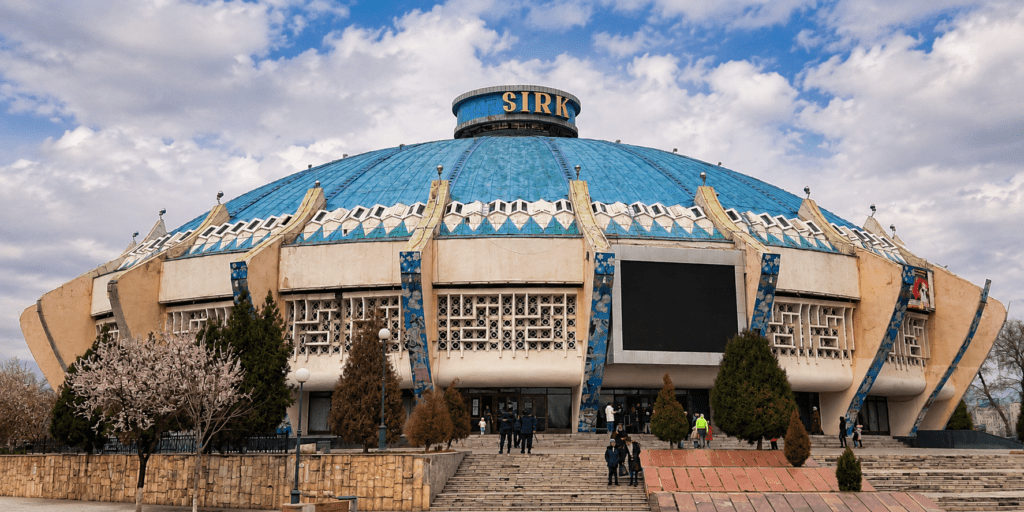
When people think of Uzbekistan’s architectural heritage, the images are familiar: the turquoise domes of Samarkand, the madrasas of Bukhara, Khiva’s walled city, and the monuments of Shakhrisabz. But Uzbekistan’s history did not stop with the Silk Road. At its 48th session in July, UNESCO inscribed “Tashkent Modernist Architecture. Modernity and Tradition in Central Asia” on the World Heritage List. The new site brings together ten buildings and urban complexes constructed between the 1960s and the early 1990s, during the period in which Tashkent was dramatically rebuilt following the 1966 earthquake. The inscription deserves to be celebrated. More importantly, it expands the definition of what Uzbek heritage can be. [caption id="attachment_52926" align="aligncenter" width="1774"] Kosmonavtlar Metro Station, Tashkent; photo: Mathieu Lemoine[/caption] These buildings do not belong to the world of caravanserais and Timurid courts. They represent another layer of the country’s history: the ambitious and highly creative transformation of Soviet-era Tashkent. For decades, Central Asian heritage has often been viewed through a chronological hierarchy. The older a monument, the easier it is to recognize as heritage. Timurid architecture is obviously precious. A concrete building from the 1970s can appear more expendable. Tashkent shows why that distinction is too simple. UNESCO notes that the architecture developed after the earthquake combined industrialized construction and seismic engineering with local climatic, cultural and material conditions. The result was not simply Soviet modernism transplanted to Central Asia, but a distinct architectural language adapted to Tashkent. This broader understanding of heritage comes at an important moment. Uzbekistan is modernizing rapidly. Its cities are growing, tourism is expanding, infrastructure is improving and redevelopment is transforming urban space. Much of this change is necessary and welcome. Historic neighborhoods cannot be expected to function as open-air museums. Residents need reliable drinking water, sewage systems, heating, electricity, internet access, waste collection, accessibility, safe streets and comfortable housing. A leaking pipe is not “authenticity.” The more difficult question is how modernization takes place. [caption id="attachment_52925" align="aligncenter" width="1774"] Tashkent Modernist State Museum of History; photo: Mathieu Lemoine[/caption] Uzbekistan has already experienced how delicate that balance can be. In Shakhrisabz, large-scale redevelopment substantially altered the historic urban fabric. The historic center was placed on UNESCO’s List of World Heritage in Danger in 2016 and remains there today. The experience offers an important lesson: preserving monuments is not necessarily the same as preserving a city. A city can retain its most famous madrasa, mosque or mausoleum while losing part of its heritage if the streets, neighborhoods, businesses and communities surrounding them disappear. The pressure is not only architectural. As tourism grows and historic centers become more desirable, economic incentives change. Houses can become hotels and restaurants. Businesses serving residents can give way to businesses serving visitors. Traditional workshops can struggle with higher costs. Redevelopment can create pressure on residents to relocate. Bukhara illustrates why this is important. Its identity rests not only on monumental architecture but on a living economy of craftsmanship. Gold embroidery, ceramics, jewelry, woodwork and other trades remain sources of employment as well as cultural identity....
Petropavl – A City of Two Tales

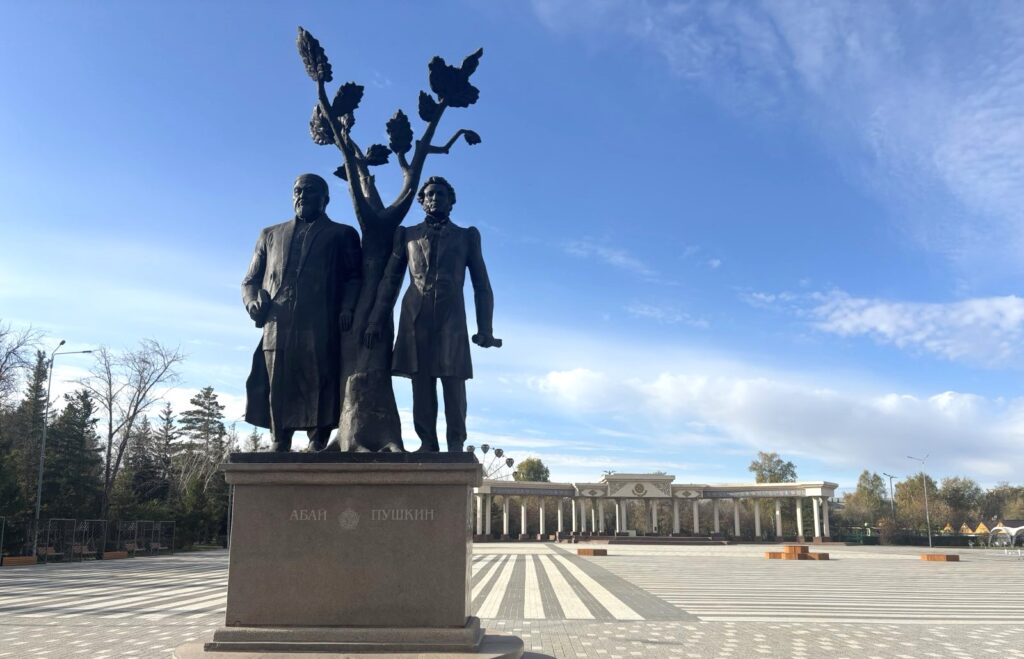
No one seems to like the name Petropavl. The city, situated in northern Kazakhstan in a peninsula of territory that juts into Russian Siberia, has long lived between two worlds. From monuments to manhole covers, there have long been conflicting stories about who belongs here. In the Russian telling, the city was founded as a fortress on “empty steppe” in 1752 by Tsarist troops, named for Saints Peter and Paul – in Russian, Petropavlovsk. For over a century, it remained a frontier post that guarded the empire’s edge before the push into Central Asia in the mid-nineteenth century. Yet for Kazakhs, this place was never empty: long before the Cossacks came, nomadic Kazakhs from the Middle Zhuz grazed their herds here along the Ishim River, calling the place Qyzyljar – “the red ridge”. [caption id="attachment_38326" align="aligncenter" width="1600"] Manhole covers imprinted with Qyzyljar; image: TCA, Joe Luc Barnes[/caption] Since independence, Kazakhstan has restored the names of thousands of cities, towns, and villages across the country in order to give the land a more Kazakh stamp. But Qyzyljar has not returned. Instead, the authorities’ immediate solution has been to Kazakh-ify the Russian name, leaving us with Petropavl. It’s a fudge that satisfies no one, and the official name is rarely heard on the city streets. In this overwhelmingly Russian-speaking city, most continue to call it “Petropavlovsk,” or even “Piter,” echoing Saint Petersburg’s nickname. Ethnic Russians Ethnic Russians now make up just under half the population of the North Kazakhstan region. In individual cities such as Petropavl, the proportion is far higher, although official information is hard to come by. The boundaries of Kazakhstan’s provinces, or oblasts, were gerrymandered in 1997 to soften perceptions of Russian dominance, but a mere walk around the city makes it clear that about two-thirds of the population is not Kazakh. These numbers and the region’s proximity to Russia have long made it a focus of uneasy attention. When Moscow annexed Crimea in 2014, President Vladimir Putin remarked that Kazakhstan had “never had statehood” before Nursultan Nazarbayev, and Dmitri Medvedev called it an “artificial state” in 2022 (although he subsequently claimed to have been hacked). Other Russian lawmakers have called northern Kazakhstan “a gift from Russia,” while nationalist commentators as far back as Solzhenitsyn have called for Northern Kazakhstan to be “reunited” with Russia. Dr. Petr Oskolkov, affiliated researcher at the Begin-Sadat Center for Strategic Studies, was part of a team that undertook research on the ethnic Russian population in Kazakhstan in 2020-21, and believes that these fears are overblown. “Initially, there was a lack of public trust in the prospects of Kazakhstani statehood, especially among Russian-speakers. Nowadays, these doubts are absent,” he told The Times of Central Asia. “Moreover, the overall level of the identification with Kazakhstan, and the quality of life, have both grown significantly since the 1990s, so the idea [of separatism] has lost its main appeal.” [caption id="attachment_38320" align="aligncenter" width="1200"] Soviet mosaic; image: TCA, Joe Luc Barnes[/caption] Nevertheless, doom-mongers in Astana worry that Petropavlovsk...

Rediscovering Mustafa Shokay: A Fragment of Kazakh History in an American Bookstore

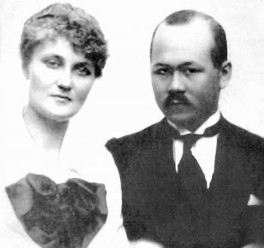
While studying in the United States, I have spent my free hours chasing traces of home — fragments of Kazakh history scattered across libraries, archives, and private collections. Much of our past lies far from the steppe, carried off by the tides of empire and exile. My purpose has been simple: to return those fragments, in words and images, to our people. One afternoon in Washington, D.C., I wandered into an old bookstore. The two floors seemed to contain the intellectual wealth of the world — every shelf whispering stories of vanished nations and stubborn identities. I made straight for the section on Central Asia, where the spines of a few rare volumes caught my eye. As I turned the pages of one yellowed book, something stopped me cold: a photograph of Mustafa Shokay, the Kazakh statesman and intellectual who devoted his life to the cause of Turkestan’s autonomy. [caption id="attachment_37511" align="aligncenter" width="596"] Mustafa Shokay in his student days[/caption] A Visionary in Exile Born in 1890 in what is now southern Kazakhstan, Mustafa Shokay emerged as one of the most eloquent voices for Central Asian self-determination during the revolutionary upheavals of 1917. When the Russian Empire collapsed, he helped lead the short-lived Kokand (Turkestan) Autonomy, which sought to build a government based on equality and Muslim representation. Within weeks, the Bolsheviks crushed the movement. Forced into exile, Shokay continued his work from abroad — first in Turkey, then in France — editing journals and writing tirelessly about the rights and dignity of Turkic peoples. His story embodies the tragedy of a generation of intellectuals who dreamed of independence decades before it arrived. During World War II, Shokay’s moral integrity was tested once again. Arrested by Nazi forces after the invasion of France, he was asked to lead the “Turkestan Legion” — a military formation of Soviet prisoners of war. Shokay refused, condemning the brutal treatment of the prisoners and rejecting any collaboration with the Nazi regime. He died in captivity in 1941, but his name endures as a symbol of conscience and courage in Kazakhstan. Richard Pipes and the Rediscovery of Forgotten Nations The photograph I found was printed in The Formation of the Soviet Union: Communism and Nationalism, 1917–1923, a classic study by Richard Pipes, the Harvard historian who helped introduce Western audiences to the complexity of the early Soviet era. Pipes’s research explored how the Bolsheviks built a multiethnic empire from the ruins of tsarist Russia, often manipulating national aspirations for political ends. Crucially, he paid special attention to the Muslim and Turkic regions — to the Caucasus, the Volga, and Central Asia — and recognized that their quest for self-determination represented the “Achilles’ heel” of the Soviet system. His work anticipated the eventual collapse of the USSR and the independence of states like Kazakhstan, Uzbekistan, and Azerbaijan. In one recollection, Pipes described visiting Almaty in the 1950s and watching a May Day parade. As Kazakhs marched silently past portraits of Stalin, he turned to a Russian colleague...

Almosi Valley in Tajikistan Recognized as Global Agricultural Heritage Site

The Almosi mountain valley in Tajikistan’s Gissar district has been designated as a Globally Important Agricultural Heritage System (GIAHS) by the Food and Agriculture Organization (FAO) of the United Nations. The decision was announced on July 8 during a meeting of the FAO’s Scientific Advisory Group. A Milestone for Central Asia Tajikistan is now the first country in the post-Soviet space to have one of its agricultural landscapes recognized by the GIAHS program. Until now, only 12 agroecosystems across five European nations, Austria, Spain, Italy, Portugal, and Andorra, had received such recognition. Tajikistan’s inclusion marks a significant acknowledgment of Central Asia’s rich agricultural legacy and its global relevance. GIAHS sites are selected not only for their scenic beauty but also for their enduring agricultural practices and deep-rooted human-nature interaction. According to FAO materials, these systems demonstrate high levels of agrobiodiversity, sustainable production, centuries-old agricultural knowledge, and strong community ties to the environment. Almosi exemplifies these values. In its mountainous terrain, farmers engage in transhumant sheep herding and the cultivation of crops such as wheat, barley, vegetables, and the prized pink Taifi grape, used for raisins, syrups, juice, and wine. The valley is also home to the Gissar sheep breed, developed for resilience in high-altitude conditions. Preserving Tradition and Biodiversity Agriculture in Almosi relies on traditional techniques, including contour planting, organic fertilization, and irrigation through ancient canal systems. Farmers monitor natural indicators to optimize water use and adapt to climatic shifts, ensuring both productivity and environmental preservation. Community organization is another hallmark of the Almosi model. Farming is managed through mahalla committees, cooperatives, family farms, and even remnants of collective farming structures. This supports intergenerational knowledge transfer, shared resource management, and social cohesion. GIAHS designation not only affirms Almosi’s global agricultural significance but also opens avenues for sustainable development. Opportunities include eco-tourism, enhanced agricultural investment, and broader recognition of Tajikistan’s rural heritage. With new entries from Tajikistan, South Korea, and Portugal, the GIAHS network now includes 99 recognized systems in 29 countries. Almosi stands as the first in the Commonwealth of Independent States (CIS), a testament to the region’s enduring agricultural traditions and its capacity for innovation grounded in history.

Mukhamedzhan Tynyshpaev: Pioneer, Patriot, and Kazakh Visionary

Mukhamedzhan Tynyshpaev, a Kazakh scholar, politician, and visionary, has returned to the spotlight with the publication of his book The History of the Kazakh People in Kazakhstan. This book, originally written in Russian in 1925 under the title Materials on the History of the Kyrgyz-Kazakh People, was republished in Kazakh in 2023 by AmalBooks. The work explores the origins of the Kazakh tribes, the development of Kazakh statehood, and the nation’s rich history. Tynyshpaev was a towering figure in Kazakh history. Born on May 12, 1879, in the Lepsinsky district of Semirechyenskaya Oblast, he rose to prominence as one of the founders of the Alash movement. Beyond his roles as a historian and scholar, he was Kazakhstan’s first railway engineer, a deputy in the Second State Duma of the Russian Empire, and a leading contributor to the construction of the Turkestan-Siberian Railway. He also served briefly as deputy chairman of the Alash Autonomy government. The Central State Archive of Kazakhstan preserves three unique photographs that capture moments from Tynyshpaev’s extraordinary life. The first photograph, dated around 1900, shows a young Tynyshpaev as a student of the Imperial Institute of Railway Engineers in St. Petersburg, where he studied from 1900 to 1905. This image, taken at the Leibin and Sons photo studio in Verny (now Almaty), reflects his early academic promise. In the second photograph, Tynyshpaev is seen among representatives of the Kazakh student intelligentsia studying at universities in St. Petersburg (he is seated third from the left). The archive dates the document between 1903 and 1909 and includes the following caption: "Dosmukhamedov Kh. (third row, third from the left) - student of the Imperial Military Medical Academy of St. Petersburg; Tynyshpaev M. (second row, second from the right) - student of the Imperial Institute of Railway Engineers named after Alexander I with fellow countrymen." Upon studying this document, we identified Zhansey (Zhihansha) Alimuratovich Seydalin — a student of the Faculty of Law at St. Petersburg University (third row, second from the left). He later became a public figure, lawyer, and member of the national Alash party. Also present in the photograph is the first Kazakh woman to receive higher education at St. Petersburg universities — Gulsum Asfendiyarova (second row, left). Today, Gulsum Asfendiyarova is known as the first Kazakh female doctor with a higher education, an organizer of the healthcare system in the Turkestan region, a medical educator, and the elder sister of Sanjar Asfendiyarov — a renowned doctor, political figure, scholar, and professor, after whom the medical university in Almaty is now named. Mukhamedzhan Tynyshpaev studied at the Imperial Institute of Railway Engineers in St. Petersburg from 1900 to 1905. Kh. Dosmukhamedov studied at the Imperial Military Medical Academy in St. Petersburg from 1903 to 1909. Zh. Seydalin studied at St. Petersburg University from 1900 to 1904. Asfendiyarova studied at the Women’s Medical Institute in St. Petersburg from 1902 to 1908. Based on these facts, it can be assumed that the photograph was taken in 1903 or 1904 when all the mentioned...

Kyrgyz MP Urges Parliament to Preserve Lenin Monument in Bishkek

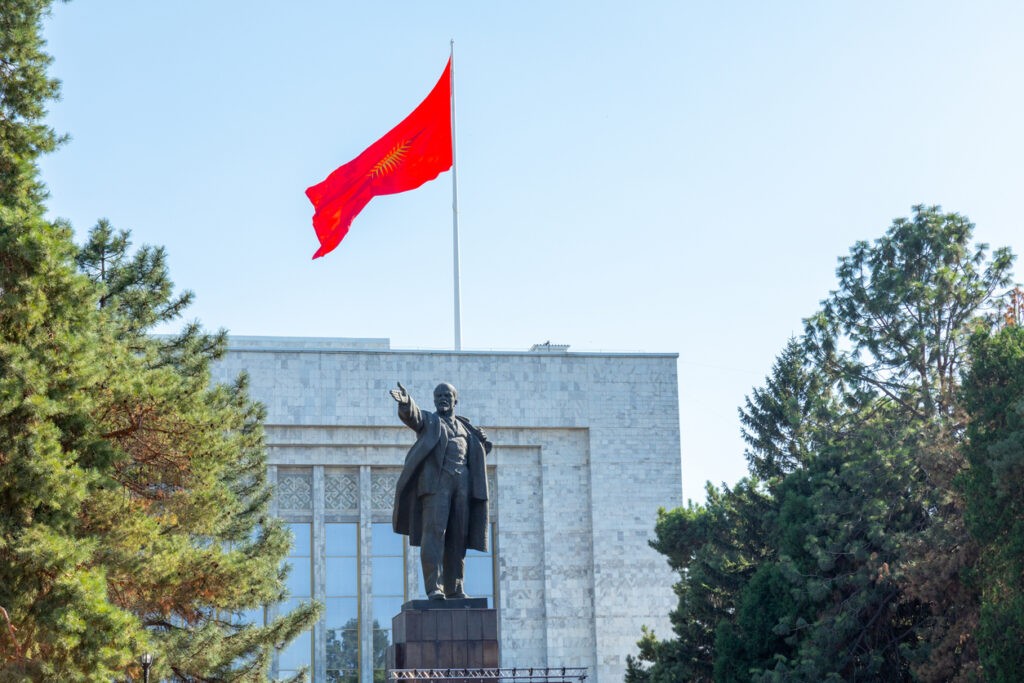
Kyrgyz parliamentary deputy Iskhak Masaliyev has called on his fellow parliamentarians to refrain from debating the removal of the Vladimir Lenin monument in Bishkek’s Old Square. Speaking during a parliamentary session, Masaliyev emphasized that the proposal to dismantle the statue is both untimely and dismissive of Lenin's historical contribution to the formation of Kyrgyz statehood. Masaliyev reminded lawmakers that while the collapse of the Soviet Union granted independence to many nations, Soviet governance played a pivotal role in establishing the foundations of statehood for certain republics, including Kyrgyzstan. He outlined the historical context of the early 20th century, noting that the territory of modern Kyrgyzstan was then divided - part of it belonging to the Russian Empire and the other to the Kokand Khanate. According to the MP, the October Revolution was instrumental in creating the Kara-Kyrgyz Autonomous Oblast, which later evolved into the Kyrgyz Autonomous Soviet Socialist Republic and, eventually, an independent Kyrgyz state. “Many nations of the world still do not have their own territory. We, on the other hand, have a state with clearly defined borders, and Vladimir Lenin’s role in this is significant. I say this not as a politician, but as a historian,” Masaliyev declared. The MP expressed concern about modern society’s increasing disregard for history, noting that a substantial portion of the Kyrgyz population - around 30 to 40 percent - lived during the Soviet era and were shaped by its values. Erasing the memory of that period, he argued, is both impractical and disrespectful to the past. Masaliyev also pointed out the proximity of Lenin’s monument to a statue of Turdakun Usubaliyev, a prominent Soviet-era statesman and reformer. He argued that commemorating Usubaliyev and other notable figures from the Soviet period while removing Lenin’s monument would be inconsistent, as all were part of the same ideological framework underpinned by Lenin’s leadership. “We must understand that we cannot simultaneously honor some of them while rejecting the memory of others,” Masaliyev stressed. In closing, Masaliyev urged his colleagues to shelve the debate over the Lenin monument, suggesting that the parliament’s focus should instead be directed toward more pressing national issues. The discussion surrounding the Lenin statue gained momentum after parliament deputy speaker Nurbek Sydygaliyev proposed its removal, arguing that the square is named after Turdakun Usubaliyev and should honor his legacy exclusively.