• KGS/USD = 0.01143 0%
  • KZT/USD = 0.00202 0%
  • TJS/USD = 0.10433 0%
  • UZS/USD = 0.00008 0%
  • TMT/USD = 0.28575 0%
  • KGS/USD = 0.01143 0%
  • KZT/USD = 0.00202 0%
  • TJS/USD = 0.10433 0%
  • UZS/USD = 0.00008 0%
  • TMT/USD = 0.28575 0%
  • KGS/USD = 0.01143 0%
  • KZT/USD = 0.00202 0%
  • TJS/USD = 0.10433 0%
  • UZS/USD = 0.00008 0%
  • TMT/USD = 0.28575 0%
  • KGS/USD = 0.01143 0%
  • KZT/USD = 0.00202 0%
  • TJS/USD = 0.10433 0%
  • UZS/USD = 0.00008 0%
  • TMT/USD = 0.28575 0%
  • KGS/USD = 0.01143 0%
  • KZT/USD = 0.00202 0%
  • TJS/USD = 0.10433 0%
  • UZS/USD = 0.00008 0%
  • TMT/USD = 0.28575 0%
  • KGS/USD = 0.01143 0%
  • KZT/USD = 0.00202 0%
  • TJS/USD = 0.10433 0%
  • UZS/USD = 0.00008 0%
  • TMT/USD = 0.28575 0%
  • KGS/USD = 0.01143 0%
  • KZT/USD = 0.00202 0%
  • TJS/USD = 0.10433 0%
  • UZS/USD = 0.00008 0%
  • TMT/USD = 0.28575 0%
  • KGS/USD = 0.01143 0%
  • KZT/USD = 0.00202 0%
  • TJS/USD = 0.10433 0%
  • UZS/USD = 0.00008 0%
  • TMT/USD = 0.28575 0%

Viewing results 1 - 6 of 12

Kazakh-Spanish Film La Tregua to Premiere on Netflix

Following its premiere at the San Sebastian International Film Festival this fall, where it received a special award, the Kazakh-Spanish film La Tregua (The Truce) has been released in cinemas in Spain and Kazakhstan. It is now set to become the first Spanish-language film featuring Kazakhstan to appear on Netflix. “Although critics say the film is not for popcorn viewing, given its focus on little-known and tragic chapters in the histories of Kazakhstan and Spain, its release has generated strong emotional responses in both countries,” said Yerlan Bekhozhin, a prominent Kazakh journalist and co-producer of the film, in an interview with The Times of Central Asia. “It speaks to the timeless struggle of human confrontation.” The film presents a Kazakh narrative about Spaniards caught on opposing sides of ideological conflict. “It is a story from the last century, yet it addresses the present day,” Bekhozhin said. “When we look at today’s world, it’s clear that people lack the ability to engage in dialogue. The main message of the film is: There is always a way to negotiate.” Netflix is expected to stream the film in 2026. Distribution discussions are also underway for theatrical releases in Mexico and other Spanish-speaking countries in Latin America. [caption id="attachment_41648" align="aligncenter" width="2560"] Still from La Tregua[/caption] From Karaganda to the Screen The story is rooted in the history of Karlag, the Karaganda labor camp that operated in Kazakhstan from 1937 to 1959. Victims of Stalinist repression from across the Soviet Union, including foreign nationals, were imprisoned there for dissent, free expression, or as victims of denunciations. The idea for the film came from Spanish producer César Benítez, inspired by an event from over 30 years ago. During the Soviet era, the identities of Spanish citizens imprisoned in Karlag were kept secret. After Kazakhstan gained independence, its government handed the list of repressed Spaniards to the King of Spain, a gesture that sparked widespread attention in Spain, allowing many families to finally discover the fate of their relatives. Years earlier, the Spanish documentary, The Forgotten in Karaganda, had drawn significant attention to the subject. Now, Benítez has transformed the story into a feature film. “The title The Truce is deeply relevant today, at a time when peace requires people to sit at the same table,” said Bekhozhin. [caption id="attachment_41650" align="aligncenter" width="2560"] Still from La Tregua[/caption] Kazakh Identity on a Global Stage Bekhozhin also emphasized the film’s role in portraying Kazakh identity. “Its global release will introduce the world to the law of the steppe, the law of hospitality,” he said. “Kazakhs have long demonstrated empathy forged under harsh conditions. It’s part of our national character to welcome others, regardless of nationality or faith.” One scene in the film shows a Kazakh family near the camp inviting Spanish prisoners into their home and setting a traditional dastarkhan, a generous table of lamb-based dishes. The prisoners are seated in the place of honor, or torge, in keeping with Kazakh custom. “In the film, the hostess explains that when...

Turkmenistan and Spain Eye Regional Center to Combat Desertification in Central Asia

Turkmenistan and Spain have discussed closer cooperation to address desertification in Central Asia, including the possible creation of a regional center focused on land degradation. The talks took place in Ashgabat during a meeting between Turkmenistan’s Minister of Environmental Protection and Spain’s ambassador to Russia, Ricardo Martínez Vázquez, who is also accredited in Turkmenistan. The discussions followed Turkmen President Serdar Berdimuhamedov’s proposal at the United Nations General Assembly to establish a specialized regional center to combat desertification in Central Asia. The initiative is intended to strengthen cooperation among regional states and attract international expertise and funding. [caption id="attachment_41076" align="aligncenter" width="1000"] Image: mineco.gov.tm[/caption] Desertification is a growing concern across Central Asia, a region where arid and semi-arid landscapes dominate much of the territory. The United Nations Convention to Combat Desertification defines desertification as land degradation in dry areas caused by climatic variations and human activities. According to the UNCCD, more than 20% of land in Central Asia is already degraded, affecting around 30% of the population. Much of this damage is linked to unsustainable water use, intensive agriculture, overgrazing, and the long-term effects of climate change. Spain’s interest in desertification in Turkmenistan is rooted in their shared status as nations on the front lines of climate change. As one of the European countries most vulnerable to soil degradation, Spain co-launched the International Drought Resilience Alliance (IDRA) to export its expertise in "dryland" management and water conservation, which is directly applicable to the arid landscapes of Central Asia. This common challenge has fostered a diplomatic partnership focused on the United Nations Convention to Combat Desertification (UNCCD), where countries exchange strategies for land restoration and drought resilience. Beyond environmental solidarity, Spain views Turkmenistan as a critical emerging market for its advanced engineering and agricultural sectors. Major Spanish firms, such as TYPSA, are already active in the region, providing technical assistance for massive infrastructure projects, such as desalination plants on the Caspian Sea, and modernizing irrigation systems for thousands of hectares of farmland. This commercial engagement is bolstered by Spain's support for Turkmenistan’s proposal to host a Regional Center for Climate Change Technologies, which would serve as a hub for Spanish green tech in Central Asia. The bilateral relationship also aligns with the broader EU Strategy for Central Asia, which prioritizes environmental stability as a means of ensuring regional security. By helping Turkmenistan manage its dwindling water resources and combat the encroaching Karakum Desert, Spain contributes to the EU for a Green Turkmenistan initiative. This cooperation helps prevent resource-driven migration and instability, and strengthens trade ties in a region that is becoming increasingly vital for global energy and logistics. One of the most visible examples of desertification in the region is the collapse of the Aral Sea. Once the world’s fourth-largest inland lake, the Aral Sea began shrinking rapidly in the 1960s after its feeder rivers were diverted for large-scale irrigation projects. By the early 2000s, the sea had lost roughly 90% of its volume. [caption id="attachment_13621" align="aligncenter" width="2560"] Desert ships on the former...

La Tregua: A Bridge Across Wars and Worlds – An Interview with Director Miguel Ángel Vivas

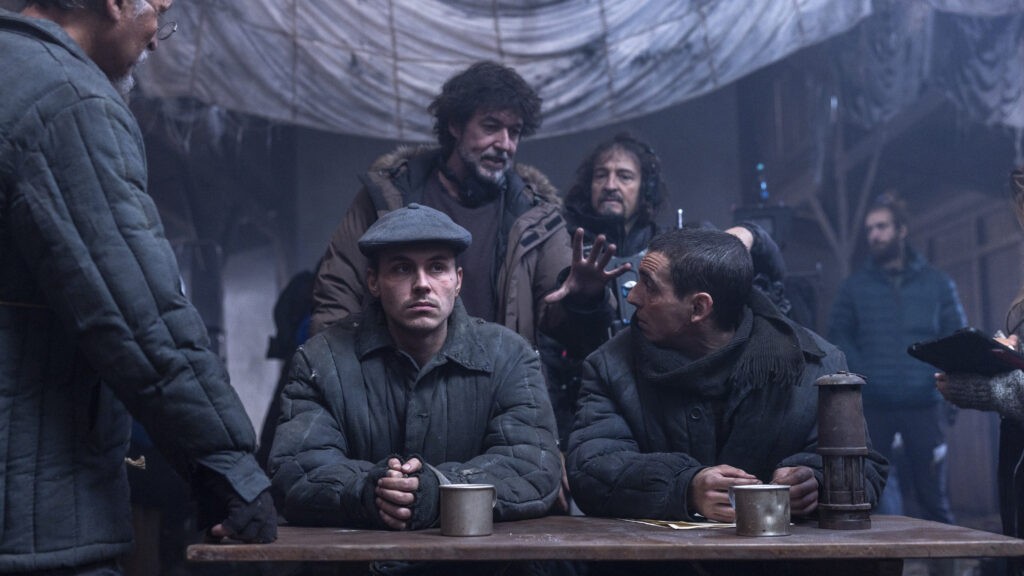
In the misty green heart of Bizkaia, where mountains rise like ancient sentinels and the air carries the scent of rain and earth, a remarkable filmmaking journey unfurled. This is where director Miguel Ángel Vivas Moreno, known for Money Heist (La Casa de Papel), Cicatriz, Desaparecidos, and Secuestrados, reconstructed one of the most haunting landscapes of the twentieth century: a Soviet gulag on the distant Kazakh steppe. His new film, La Tregua (The Truce), invites viewers into a story based on actual events that unfolded far from Spain, but holds deep ties to its history. It traces the ordeal of Spanish prisoners during World War II who fell into Soviet hands and were compelled to endure the harsh, frozen conditions of a labor camp. Their struggle becomes a bridge between past and present, between countries and cultures, and between two men who must learn to recognize each other beyond the uniforms that once made them enemies. [caption id="attachment_40358" align="aligncenter" width="2560"] All images courtesy of the production[/caption] The project is an unprecedented Spanish-Kazakh co-production from Spassk 99, AIE, Amanat Capital, LTD, and Umaifilm, LLP. This partnership gives the film a reach that feels genuinely cross-continental. It is a motion picture passport that opens a window onto a forgotten corner of global history. At the center of the story are Miguel Herrán and Arón Piper, who step into the roles of Reyes and Salgado. The characters appear as ideological enemies; having fought on opposing sides during the Spanish Civil War, both carry heavy psychological baggage. Inside the camp, their former certainties fall away. What begins as uneasy coexistence becomes an inward journey shaped by hunger, fear, and the starkness of their new reality. Executive producer César Benítez recalls searching for two actors capable of expressing both the physical exhaustion of imprisonment and the spark of hope that keeps a person standing. He says that the moment he saw Miguel and Arón together, he recognized that rare blend of fragility and fire. Miguel Ángel Vivas talked to TCA to break down the challenges and highlights behind the production. [caption id="attachment_40356" align="aligncenter" width="2560"] All images courtesy of the production[/caption] TCA: The story is fictional, but it is based on real events in Kazakhstan. Can you explain the historical context and how it inspired La Tregua? Miguel: The story begins with a documentary about Spaniards in the Soviet gulags. That’s where we discovered that republicans and fascists shared the same prison two years after the Spanish Civil War ended. It struck us as a fascinating starting point for a human story about the relationships that formed between them. [caption id="attachment_40357" align="aligncenter" width="2560"] All images courtesy of the production[/caption] TCA: The premise is intriguing: how two fighters on opposite sides of the Spanish Civil War end up in a gulag in Kazakhstan. In an increasingly polarized world, is there a lesson in the film to help heal the wounds that divide Spain, or even the world in general? Miguel: That was the idea! In such a...

Shared Values, Shared Voices: An Interview With Spain’s Ambassador to Kazakhstan

In recent years, cultural cooperation between Spain and Kazakhstan has gained new momentum. Although the two countries are separated by a vast geographical distance, their cultural ties are growing closer through shared values. The Embassy of Spain in Kazakhstan has implemented a number of major projects in this regard. TCA spoke with the Ambassador of Spain to Kazakhstan, Luis Martínez Montes. TCA: It’s been several months since you became the Ambassador to Kazakhstan. What aspects of our culture do you enjoy? LMM: In fact, this is my second diplomatic posting to Kazakhstan. The first was from 1999 to 2002, when Spain opened its embassy in Almaty before moving to Astana. Twenty-five years later, I’ve returned as Ambassador to a country I consider my second home. There are so many things I love about Kazakhstan, including its nature and its gastronomy, that it’s hard to choose. But if I had to pick one, it would be the people, especially the younger generations. I spend much of my time visiting schools and universities, where I see a tremendous energy and thirst for knowledge among Kazakh students. I organize weekly lectures, debate clubs, and informal lunches at my residence with students and Kazakh intellectuals. Their conversations enrich me and help me better understand the direction this country is taking. TCA: You once mentioned that you visited the Mausoleum of Khoja Ahmed Yasawi. What impression did it leave on you? LMM: I visited Turkistan in 1999, and I have a memorable anecdote from that trip. While visiting the mausoleum, the local guide found out I was from Spain and enthusiastically mentioned Ibn Arabi, the great Sufi poet from Al-Andalus [the name for Spain during its Islamic period]. She spoke of him as a near-contemporary of Ahmed Yasawi. I’m grateful for that moment because it was through this cultivated Kazakh woman who could recite at length poems by both Sufi sages that I developed my lifelong admiration for Ibn Arabi. I found it truly fascinating that two poets, Ibn Arabi and Khoja Ahmed Yasawi, living at opposite ends of the Eurasian continent, could produce such profound and beautiful poetry, inspired by the same spiritual quest for God. TCA: Abai Kunanbayuly, like Cervantes, elevated a nation’s literature and culture. We translated Cervantes into Kazakh many years ago, and Don Quixote has been reprinted many times. We also heard that Abai’s works have been translated into Spanish. How has the Spanish readership received him? LMM: As you know, the late Pope Francis, who was from Argentina, quoted Abai more than a dozen times at the opening of the Seventh Congress of Leaders of World and Traditional Religions in 2022. Some works by Abai were translated into Spanish in 2020 by María Sánchez Puig, who received the Order of Dostyk for her work in bringing Kazakh literature closer to Spanish-speaking audiences. Another project is currently underway to translate selections from Abai’s Book of Words into Spanish this year. We’re also developing the first Kazakh-Spanish dictionary to make it...

Spanish Manufacturer to Relocate from Russia to Kazakhstan

Following the recent closure of its production facilities in Russia, where it was the country’s largest manufacturer of sanitary ware, Spanish company Roca is to open a plant in Kazakhstan. The announcement was made following a meeting on 10 April between company representatives and Asel Suankulova, Deputy Director of the Department for Attracting Investments and Marketing of JSC National Company Kazakh Invest. Roca, which annually sells 500 units of products throughout Central Asia, has already established an office in Almaty and plans to open a new logistics centre to export its products to nearby countries. The Spanish company has been assured of Kazakhstan’s support through investment initiatives including access to local raw materials, such as kaolin and quartz to produce its ceramic wares.

Kazakhstan and Spain set up business council

ASTANA (TCA) — A Kazakh-Spanish business forum was organized in Astana as part of the official visit of Spanish Minister of Foreign Affairs and Cooperation Jose Manuel Garcia-Margalit to Kazakhstan, the Atameken National Chamber of Entrepreneurs of Kazakhstan reported on April 26. Continue reading