U.S. Convenes Critical Minerals Dialogue with Central Asian Officials in Kazakhstan
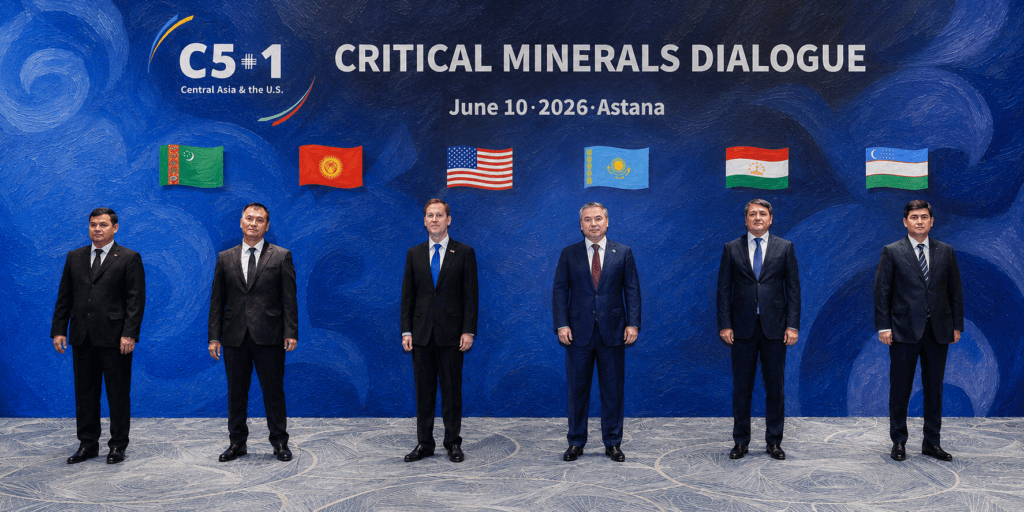
ASTANA — The United States opened a new round of high-level critical minerals talks with Central Asian governments in Astana on June 10, with U.S. Special Envoy for South and Central Asian Affairs Sergio Gor saying Washington is placing new emphasis on a region it sees as central to global commerce, connectivity, and secure supply chains. Speaking at the C5+1 Critical Minerals Dialogue, Gor said Central Asia “has not gotten the attention it deserves from the United States,” and that the Trump administration had decided to change that. “We care about this region, we want to be involved with this region, we want to identify win-win situations for the United States and your nations,” Gor said. The meeting, held at The Ritz-Carlton in Astana, brought together officials from Kazakhstan, Kyrgyzstan, Tajikistan, Turkmenistan, Uzbekistan, and the United States. The program included sessions on geological exploration, surveying and mapping, mining and processing, and global value and supply chains, followed by a government-business networking reception. Gor thanked Kazakhstan for hosting what he described as the first in-person C5+1 Critical Minerals Dialogue and said he had met with President Kassym-Jomart Tokayev shortly before the session. Kazakhstan’s Foreign Ministry said that ahead of the dialogue, Gor and Kazakh Foreign Minister Yermek Kosherbayev had discussed economic and investment partnerships, innovation, artificial intelligence, education, transport, logistics, and critical minerals. The ministry also said the sides discussed the implementation of agreements reached between Tokayev and U.S. President Donald Trump at the White House in November 2025. Gor framed the Astana meeting as part of a broader increase in U.S. engagement with Central Asia following the C5+1 leaders’ meeting in Washington last year. He said critical minerals are now a central part of that engagement because they are essential to infrastructure, advanced technologies, industry, and national defense. “Our economic security depends on our ability to diversify our access to critical minerals,” Gor said. “Ensuring reliable access to these materials requires not only expanding production, but also building resilient, transparent, and market-driven supply chains in close partnership with trusted partners.” He added that the Central Asian states represented at the table were exactly the partners Washington wants to work with. “There’s a reason we’re sitting at this table and not at another table around the world,” Gor said. “It’s because this is where we want to work. This is where we have identified trusted partners.” Gor highlighted the role of U.S. commercial and development-finance tools in supporting investment, saying Washington is prepared to back American companies working in the region. “The United States government stands behind American companies,” Gor said. “There is no such thing as a deal too small.” Gor also pointed to the U.S. International Development Finance Corporation, saying it was preparing to “invest and build” in the region and saw potential in critical minerals, telecommunications, and Trans-Caspian infrastructure. He said DFC saw “potential to transform the region’s rich deposits of critical minerals into the foundation of a new wave of industrialization.” “President Trump understands the importance of...