• KGS/USD = 0.01144 0%
  • KZT/USD = 0.00198 -0%
  • TJS/USD = 0.10879 -0%
  • UZS/USD = 0.00008 0%
  • TMT/USD = 0.28571 0%
  • KGS/USD = 0.01144 0%
  • KZT/USD = 0.00198 -0%
  • TJS/USD = 0.10879 -0%
  • UZS/USD = 0.00008 0%
  • TMT/USD = 0.28571 0%
  • KGS/USD = 0.01144 0%
  • KZT/USD = 0.00198 -0%
  • TJS/USD = 0.10879 -0%
  • UZS/USD = 0.00008 0%
  • TMT/USD = 0.28571 0%
  • KGS/USD = 0.01144 0%
  • KZT/USD = 0.00198 -0%
  • TJS/USD = 0.10879 -0%
  • UZS/USD = 0.00008 0%
  • TMT/USD = 0.28571 0%
  • KGS/USD = 0.01144 0%
  • KZT/USD = 0.00198 -0%
  • TJS/USD = 0.10879 -0%
  • UZS/USD = 0.00008 0%
  • TMT/USD = 0.28571 0%
  • KGS/USD = 0.01144 0%
  • KZT/USD = 0.00198 -0%
  • TJS/USD = 0.10879 -0%
  • UZS/USD = 0.00008 0%
  • TMT/USD = 0.28571 0%
  • KGS/USD = 0.01144 0%
  • KZT/USD = 0.00198 -0%
  • TJS/USD = 0.10879 -0%
  • UZS/USD = 0.00008 0%
  • TMT/USD = 0.28571 0%
  • KGS/USD = 0.01144 0%
  • KZT/USD = 0.00198 -0%
  • TJS/USD = 0.10879 -0%
  • UZS/USD = 0.00008 0%
  • TMT/USD = 0.28571 0%
04 December 2025

Viewing results 1 - 6 of 20

AIIB Provides $500 Million to Support Uzbekistan’s Green Economy Reforms

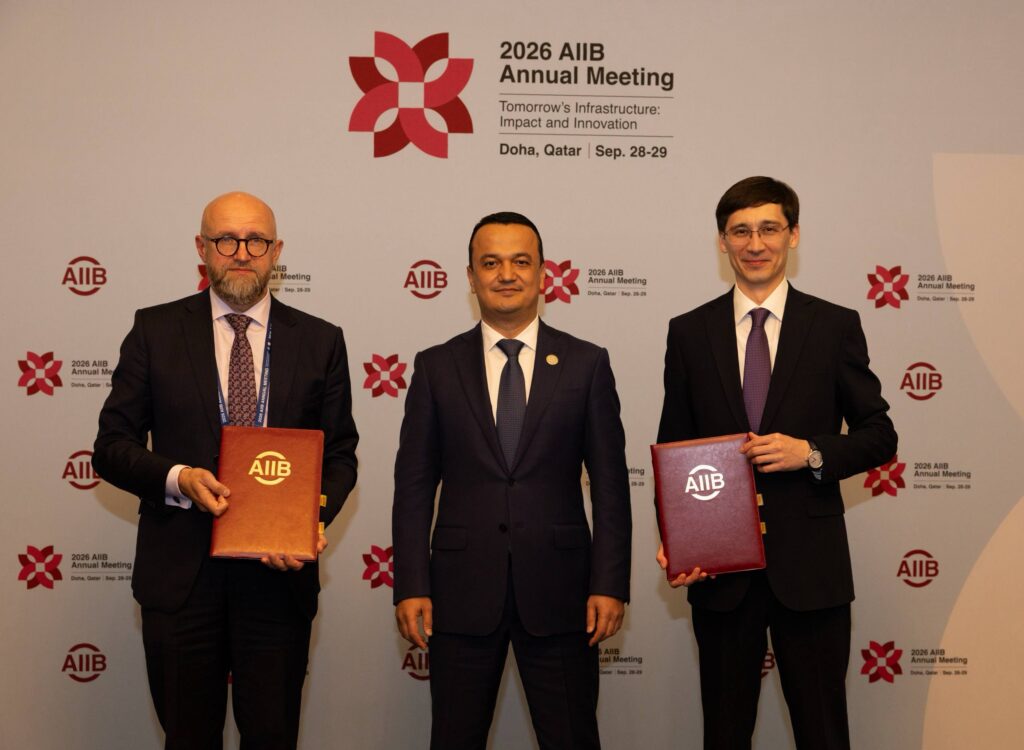
The Asian Infrastructure Investment Bank (AIIB) and the Government of Uzbekistan have signed a $500 million financing agreement to support the country’s Green and Resilient Market Economy Program, the Bank announced on November 28. The initiative is designed to accelerate Uzbekistan’s transition toward a greener, more resilient, and market-oriented economy through a comprehensive package of policy and institutional reforms. According to AIIB, the funding will assist the Uzbek government in strengthening the policy and governance frameworks necessary for low-carbon development, improved public-sector efficiency, and greater resilience to climate-related risks. The initiative falls under AIIB’s Climate-Focused Policy-Based Financing approach, which supports systemic reforms that have economy-wide climate impacts. The reforms backed by the new financing include measures to enhance efficiency and governance in the energy sector and state-owned enterprises, expand climate-responsive public procurement, and establish transparent systems for carbon-credit development and trading. The program also highlights the development of a robust Measurement, Reporting, and Verification (MRV) system to attract greater private capital for climate investments. “This operation reflects AIIB’s commitment to supporting Uzbekistan’s reform agenda through measures that can deliver lasting climate and economic gains,” said Konstantin Limitovskiy, AIIB’s Chief Investment Officer for Region 2 and Project and Corporate Finance Clients. He noted that the program is expected to foster conditions conducive to increased climate finance and stronger private-sector engagement in Uzbekistan’s green transition. The program is co-financed by the World Bank Group and is aligned with several national strategies, including Uzbekistan’s Strategy for Transition to a Green Economy for 2019-2030, its second Nationally Determined Contribution under the Paris Agreement, and the broader Uzbekistan-2030 development strategy. These frameworks stress clean energy, resource efficiency, and long-term economic resilience. AIIB projects that the reforms will generate substantial environmental and social benefits over time. More efficient resource use, the scaling up of clean energy solutions, and improved climate regulation are expected to reduce greenhouse gas emissions, enhance air quality, and strengthen the country’s capacity to withstand climate shocks. The adoption of cleaner technologies could also lower energy costs and improve living conditions, particularly for vulnerable communities. In a separate agreement earlier this year, AIIB provided a $71.1 million loan to Uzbekistan to modernize rural roads in Khorezm and Karakalpakstan. That project aims to enhance climate resilience and improve access to markets and public services for rural populations.

Financing for Tajikistan’s Rogun Project Rises to $500 Million

The Asian Infrastructure Investment Bank (AIIB) has confirmed its decision to increase financing for the construction of Tajikistan’s flagship energy project, the Rogun Hydroelectric Power Plant (HPP), to $500 million. New Agreements on Energy, Water, and Transport According to the Tajik president’s press service, the agreement was reached on September 1 in Tianjin during talks between President Emomali Rahmon and AIIB President Jin Liqun. The meeting took place on the sidelines of the Shanghai Cooperation Organization (SCO) Council of Heads of State summit. President Rahmon thanked the AIIB for supporting Tajikistan’s infrastructure development and noted that the bank is already involved in four national projects totaling over $430 million. These include the Rogun HPP and the construction of a 920-meter-long road bridge in the Nurabad district. “The parties discussed broad opportunities for cooperation in the field of green energy, including the construction and modernization of power plants of various capacities, as well as the commissioning of solar and wind installations,” the press service stated. Discussions also focused on water resource management, disaster risk reduction, and the deployment of modern monitoring technologies. Other priorities included transport integration, municipal infrastructure renewal, and innovative mechanisms to attract investment. Expanding private sector participation and utilizing innovative financing instruments were also identified as promising areas. Previously Signed Agreements In December 2024, Tajikistan and the AIIB signed a $270 million (1.92 billion yuan) agreement for the first phase of the Rogun development program. According to the Ministry of Finance, the bank’s total commitment now stands at $500 million, to be disbursed in two tranches. During a visit to Rogun on August 27, Rahmon stated that loan negotiations with the AIIB are in their final stages. In total, Tajikistan has secured commitments exceeding $2 billion from development partners and is negotiating an additional $1.7 billion. However, Standard & Poor's (S&P) Global Ratings has noted delays in funding from some international partners, including the World Bank, citing unmet conditions. The agency estimates the total cost of completing Rogun at $6.4 billion. According to S&P, the Tajik government plans to finance half of the project through a consortium of international partners, with the remainder coming from the national budget and project revenues. The proposed financing includes $1.5 billion in non-concessional loans, $850 million in grants, and $550 million in concessional loans. Part of the grant support is contingent on Tajikistan’s classification as a “least developed country,” a status that may be reconsidered in 2026. Rogun: Central Asia’s Largest Hydropower Project Since the start of 2025, 4.3 billion somoni (approximately $451 million) has been allocated from Tajikistan’s state budget for Rogun. In total, over 48.1 billion somoni (roughly $5.04 billion) has been invested in the project since 2008 from both public and external sources. The Rogun Hydropower Plant is poised to become the largest in Central Asia. Once completed, it will have an installed capacity of 3,780 MW and is expected to generate over 14.5 billion kWh annually. Six 630 MW turbines are planned, with full commissioning expected by 2029....

Uzbekistan, Azerbaijan, and Kazakhstan Launch Joint Venture for Green Energy Corridor

Energy companies from Uzbekistan, Azerbaijan, and Kazakhstan have launched a joint venture to support the development of the Caspian Green Energy Corridor, according to the press service of National Electric Networks of Uzbekistan. The new company, “Green Corridor Alliance,” was officially established on July 1 in Baku. It brings together three national power operators: Azerbaijan’s Azerenerji, Kazakhstan’s KEGOC, and Uzbekistan’s National Electric Networks. The joint venture is expected to play a pivotal role in exporting green electricity to Europe while bolstering long-term energy security across the region. Officials have highlighted the corridor’s strategic importance in advancing sustainability goals. “This initiative is important for our energy security and green growth,” the Uzbek side stated. As previously reported by The Times of Central Asia, the Caspian Green Energy Corridor is supported by the Asian Development Bank (ADB) and the Asian Infrastructure Investment Bank (AIIB). In April, the three countries signed a Memorandum of Understanding with both institutions in Baku to initiate a feasibility study. The corridor aims to enhance cross-border electricity trade and promote renewable energy use throughout Central Asia and the Caspian region. The long-term objective is to integrate the power grids of Uzbekistan, Kazakhstan, and Azerbaijan, creating a streamlined route for clean energy exports to Europe. The agreement builds on a strategic partnership formalized by the presidents of the three countries during the COP-29 climate summit held in Baku in November 2024.

AIIB and Uzbekistan Finalize $71.1 Million Loan for Climate-Resilient Rural Roads

Uzbekistan and the Asian Infrastructure Investment Bank (AIIB) have concluded a $71.1 million loan agreement to upgrade rural roads in the Khorezm and Karakalpakstan regions. The deal was finalized during the AIIB’s 10th Annual Meeting in Beijing. The loan will finance the first phase of the Karakalpakstan and Khorezm Local Roads Network Reconstruction Project, which aims to modernize rural road infrastructure to improve climate resilience and community accessibility. The project is expected to facilitate better access to markets and essential public services for rural populations. The total cost of the project is projected at $173.4 million, with a second loan tranche planned to cover the remaining amount. The initial phase will prioritize road improvements in Khorezm, while the second tranche will address road upgrades in the Republic of Karakalpakstan. According to the AIIB, a phased approach will allow Uzbekistan to better manage its fiscal resources and enhance project planning and execution. This method also enables the bank to provide tailored technical assistance and integrate lessons learned from earlier phases into subsequent work. This initiative builds on a broader partnership between Uzbekistan and the AIIB. In 2024, the bank approved a $250 million program to support the country's transition to a greener economy. That package includes measures to reduce greenhouse gas emissions, reform climate-related policies, and promote sustainable land and water management, as well as low-carbon transportation and energy solutions. The AIIB also backs Uzbekistan’s efforts to boost energy efficiency, expand renewable energy capacity, promote e-mobility, and encourage state-owned enterprises to adopt climate risk reporting practices. The rural roads project aligns with Uzbekistan’s wider development agenda, which includes modernizing infrastructure, revitalizing underserved regions, and fostering long-term sustainability.

AIIB Commits $500 Million to Tajikistan’s Rogun Hydropower Project

The Beijing-based Asian Infrastructure Investment Bank (AIIB) has approved a multiphase program totaling $500 million, including an initial Phase 1 loan of $270 million, to support Tajikistan’s flagship Rogun Hydropower Plant (HPP) project. The announcement was made on January 6, following the financing approval on December 19, 2024. The Rogun HPP, located on the Vakhsh River — a tributary of the Amu Darya River — lies 110 kilometers from Dushanbe, Tajikistan’s capital. With a designed generation capacity of 3,780 MW, a 335-meter-high dam, and a reservoir spanning 170 square kilometers, the Rogun HPP is expected to deliver improved electricity access to around 10 million people. It aims to address Tajikistan’s chronic winter power shortages and position the country as a key regional energy supplier. The project is co-financed with the World Bank, with potential contributions from a global consortium of donors. It seeks to enhance the supply of clean, affordable, and climate-resilient hydropower, with the potential to export electricity to neighboring Central Asian countries. As Central Asia’s energy demand is projected to grow by 40% by 2030 and triple by 2050, the Rogun HPP will play a pivotal role in increasing reliability and reducing the cost of electricity supply across the region. Konstantin Limitovskiy, AIIB Chief Investment Officer, commented on the significance of the project, stating: "This project will significantly contribute to the green energy transition and energy security of Central Asia. Investing in sustainable energy infrastructure is not merely about meeting today’s demands, but about empowering future generations with clean, reliable power that drives transformative growth, strengthens resilience, and unlocks the full potential of the region." Tajikistan ranks eighth globally in hydropower potential, yet only about 4% of this capacity is currently utilized. The Rogun HPP is set to play a critical role in decarbonizing electricity grids across Central Asia, supporting the region’s ambitious Nationally Determined Contributions (NDCs) under the Paris Agreement.

AIIB Forwards Construction of Strategic Bridge in Tajikistan

The Asian Infrastructure Investment Bank (AIIB) has approved a loan equivalent to US $75.5 million to Tajikistan for the construction of a 920-meter-long bridge and approach routes on the Obigarm-Nurobod section of M41 International Highway. The bridge is the first of such magnitude in Tajikistan and a critical component of the county’s road network. Linking Corridors 2, 3 and 5 of the Central Asia Regional Economic Cooperation Program, it will provide essential connections between Tajikistan’s landlocked terrain and neighbouring regional markets. Designed to withstand all weathers, the bridge will connect over 350,000 residents of the northeast region of Tajikistan to the capital Dushanbe, as well as the border of Kyrgyzstan. To align with Tajikistan’s National Development Strategy, the government has prioritized its timely completion and construction of the 75-kilometer Obigarm-Nurobod section has been divided into three phases to ensure synchronized implementation. Illustrative of a collaborative approach to advancing sustainable development and enhancing connectivity in Tajikistan, AIIB has fostered close coordination with other financiers, including the Asian Development Bank, OPEC Fund for International Development and European Bank for Reconstruction and Development. Lauding the initiative, Konstantin Limitovskiy, AIIB’s Vice President for Investment Operations in Region 2, commented: “The project aligns with two core thematic priorities of AIIB. First, it contributes to cross-border connectivity by establishing vital cross-border links with improved road safety along Tajikistan's essential corridor and ensuring connectivity between regions. Secondly, it embraces green-finance principles by integrating environmentally and socially responsible practices and promoting resilient sustainable mechanisms in the road infrastructure development.”