• KZT/USD = 0.00210
  • TJS/USD = 0.10810
  • UZS/USD = 0.00008
  • TMT/USD = 0.29850
  • KZT/USD = 0.00210
  • TJS/USD = 0.10810
  • UZS/USD = 0.00008
  • TMT/USD = 0.29850
  • KZT/USD = 0.00210
  • TJS/USD = 0.10810
  • UZS/USD = 0.00008
  • TMT/USD = 0.29850
  • KZT/USD = 0.00210
  • TJS/USD = 0.10810
  • UZS/USD = 0.00008
  • TMT/USD = 0.29850
  • KZT/USD = 0.00210
  • TJS/USD = 0.10810
  • UZS/USD = 0.00008
  • TMT/USD = 0.29850
  • KZT/USD = 0.00210
  • TJS/USD = 0.10810
  • UZS/USD = 0.00008
  • TMT/USD = 0.29850
  • KZT/USD = 0.00210
  • TJS/USD = 0.10810
  • UZS/USD = 0.00008
  • TMT/USD = 0.29850
  • KZT/USD = 0.00210
  • TJS/USD = 0.10810
  • UZS/USD = 0.00008
  • TMT/USD = 0.29850

Viewing results 1 - 6 of 21

Kazakhstan to Develop Maritime Component of Trans-Caspian Transport Route

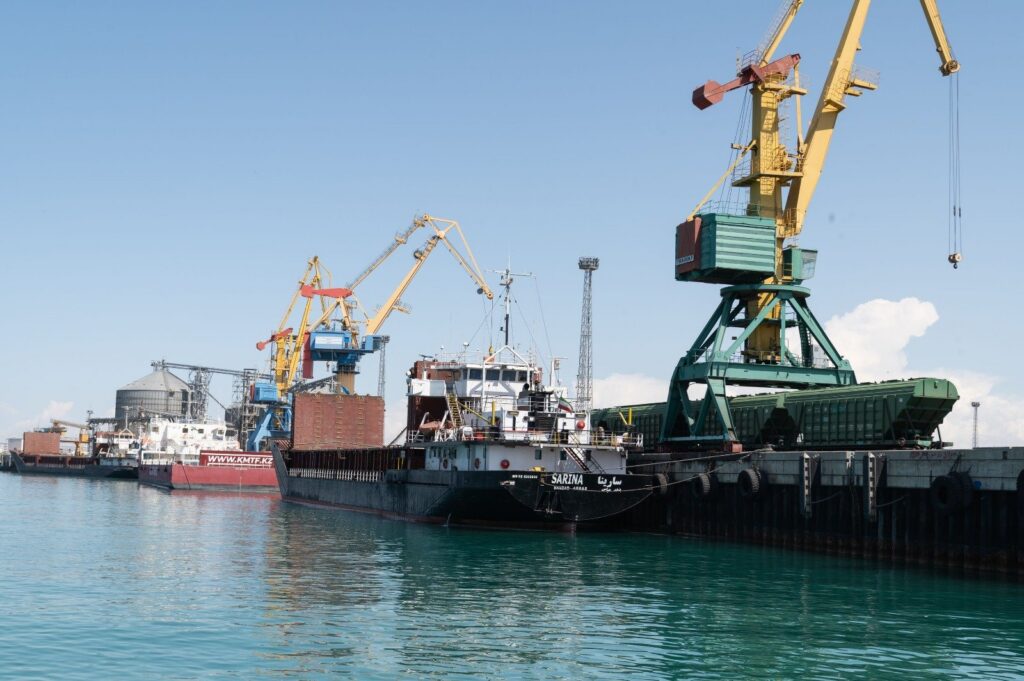
Kazakhstan’s national railway operator, Kazakhstan Temir Zholy (KTZ), is moving to build its own maritime fleet to expand the Trans-Caspian International Transport Route (TITR). Also known as the Middle Corridor, the TITR is a multimodal transport corridor linking China and Europe through Central Asia and the South Caucasus, offering an alternative to routes that pass through Russia. KTZ Express Shipping, a subsidiary of KTZ, has signed contracts for the construction of six general-purpose dry cargo container ships. Agreements have been concluded with China’s Jiangsu Haizhongzhou Shipping Industry Co., Ltd. for the construction of four vessels and with Azerbaijan’s Baku Shipyard for the construction of two. The vessels will be river-sea ships with a deadweight of up to 9,900 tons and a capacity of up to 537 TEUs, adapted for operations on both the Caspian and Black Sea routes. This is expected to support the integration of the maritime segment into the TITR’s multimodal logistics chain. The ships will be equipped with modern navigation systems in line with international requirements and environmental standards. Their safety, reliability, and environmental performance are expected to enhance their suitability for international routes and increase confidence among global shippers. The project is intended to give Kazakhstan a larger role in the TITR by establishing a sustainable maritime component of the route. Kazakhstan’s maritime transport sector has recorded steady growth in recent years. In 2025, maritime cargo volumes reached 8 million tons, a 7% increase compared to 2024. Container traffic through Kazakh seaports rose by 29% to 90,637 TEUs, while cargo volumes transported along the TITR increased by 36%. Under the country’s comprehensive maritime infrastructure development plan for 2024-2028, Kazakhstan intends to establish a major transport and logistics cluster based on the ports of Aktau and Kuryk. The plan includes expanding container handling capacity, developing cargo terminals and international shipping logistics, and reducing administrative barriers. By 2028, total cargo throughput at the ports is expected to increase by 50%, while container handling volumes are projected to triple. Plans are also in place to increase container traffic along the TITR, including the transit of 600 container trains from China through Kazakhstan this year. As previously reported by The Times of Central Asia, freight volumes transported along the Middle Corridor through Kazakhstan have grown more than five times over the past seven years, increasing from 0.8 million tonnes to 4.5 million tonnes annually.

EBRD Invests $125 Million in Kazakhstan Railway Operator Eurobond

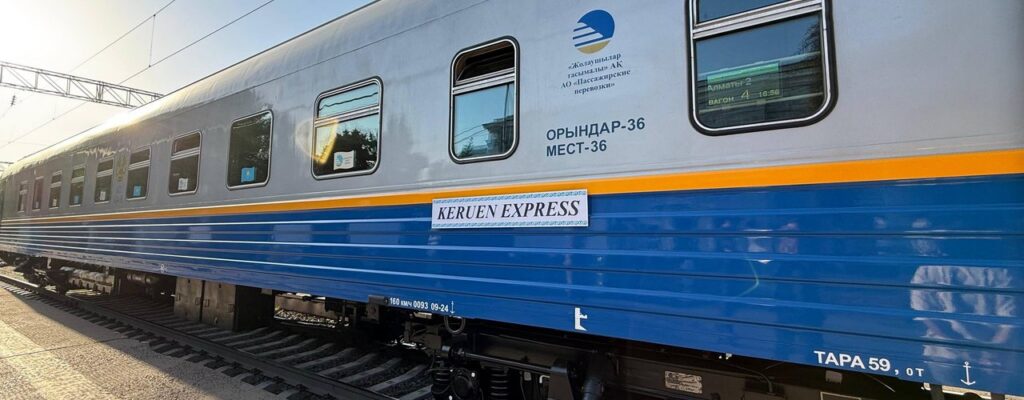
The European Bank for Reconstruction and Development is investing up to $125 million in a Eurobond issue by Kazakhstan’s national railway operator, Kazakhstan Temir Zholy (KTZ). The bond, with a total value of up to $1 billion, was listed on the London Stock Exchange, Kazakhstan Stock Exchange, and Astana International Exchange. The EBRD’s investment will help modernize passenger stations across Kazakhstan, supporting improvements in safety and operational performance. The upgraded stations are expected to offer higher throughput capacity, modern lighting, and significant enhancements for passengers with disabilities. According to the Kazakh Ministry of Transport, a large-scale reconstruction and modernization program covering 124 railway stations nationwide began in 2025. The initiative aims to improve convenience and accessibility for all passengers, including those with disabilities, and to bring Kazakhstan’s railway infrastructure in line with international quality and safety standards. Additional infrastructure upgrades financed by the bond will take place along the Trans-Caspian Corridor and are expected to support more sustainable rail transportation between Europe and Asia. The EBRD will also mobilize technical cooperation funds to help KTZ adopt international standards in passenger rail services, including measures to strengthen cybersecurity. KTZ owns and operates a 16,400-kilometer railway network and manages more than 1,700 locomotives, 46,800 freight cars, and 2,300 passenger cars. In the first quarter of 2026, KTZ transported approximately 3.2 million passengers. KTZ also transported 64.5 million tons of cargo in the first quarter of 2026, an increase of 360,000 tons compared to the same period last year. Domestic shipments accounted for 40.8 million tons, while exports totaled 23.7 million tons, up 2.2%.

Kazakhstan Boosts Container Train Traffic Along Middle Corridor

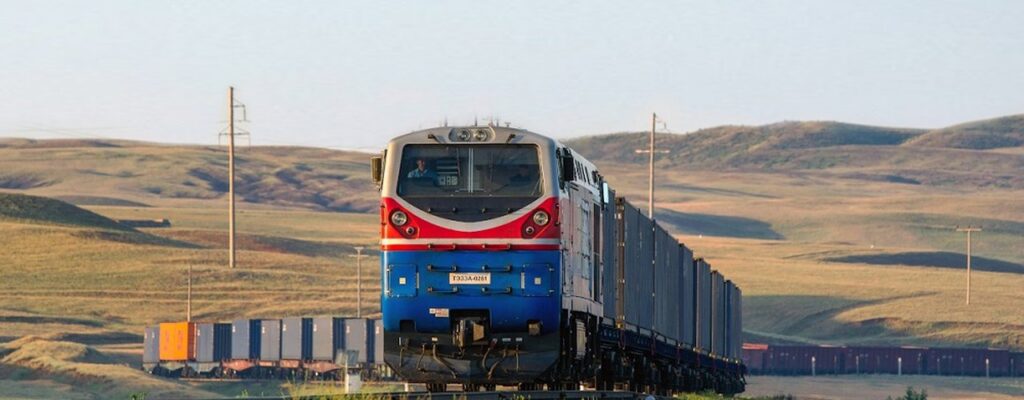
In the first quarter of 2026 Kazakhstan recorded a significant increase in container train traffic along the Trans-Caspian International Transport Route (TITR), also known as the Middle Corridor, underscoring the country’s growing role in Eurasian logistics. One hundred and twenty-five container trains transited through Kazakhstan via the TITR, marking a 34.4% increase compared to the same period in 2025. The growth was largely driven by a new logistics approach introduced by national railway operator Kazakhstan Temir Zholy (KTZ) aimed at accelerating container transportation. Since January 2026, KTZ has implemented a synchronized model for forming container trains that aligns rail and maritime transport schedules. This system enables container trains to be assembled directly for shiploads, eliminating the need for additional cargo accumulation and significantly reducing handling times. The new model has already been applied to 28 container trains bound for key logistics hubs, including: Absheron, Azerbaijan; Poti and Tbilisi, Georgia; and Mersin and Izmit, Turkey. The TITR is a multimodal corridor linking China and Europe through Central Asia and the South Caucasus, providing an alternative to routes that pass through Russia. The geography of cargo origins has also broadened. While the Chinese city of Xi’an accounted for roughly 50% of all shipments in 2025, additional industrial centers have now joined the route, including Zhengzhou, Yiwu, Hefei, Wuhan, Tianjin, Shenzhen, and Guangzhou. This diversification is expected to further strengthen the corridor’s resilience and capacity. KTZ plans to scale up the synchronized transportation model throughout 2026, enhancing the efficiency and competitiveness of the TITR. As previously reported by The Times of Central Asia, freight volumes transported along the Middle Corridor through Kazakhstan have grown more than fivefold over the past seven years, increasing from 0.8 million tons to 4.5 million tons annually. Container transportation has emerged as one of the fastest-growing segments of the route. In 2025, approximately 77,000 TEUs were transported along the TITR, and Kazakhstan aims to increase this figure to 300,000 TEUs by 2029, reflecting its ambition to position the corridor as a key artery for Eurasian trade.

The World Bank Backs Kazakhstan’s Rail Shortcut

On February 19, 2026, the World Bank Board approved an $846 million IBRD guarantee to help the state-owned railway company Kazakhstan Temir Zholy (KTZ) mobilize $1.41 billion in long-term commercial financing. The financing is linked to a KTZ reform program under the umbrella “Transforming Rail Connectivity in Kazakhstan (Middle Corridor Development)” initiative. The purpose is to expand rail connectivity and upgrade logistics on Kazakhstan’s segment of the Trans-Caspian International Transport Route (TITR, Middle Corridor). The Asian Infrastructure Investment Bank (AIIB) will add a $564 million co-guarantee that shifts the financing away from a classic sovereign-loan model and toward private credit backed by multilateral risk coverage. The Multilateral Investment Guarantee Agency (MIGA) presents this operation as part of a wider World Bank Group approach that pairs corridor capital expenditure with steps to strengthen the operator’s financial sustainability and commercial viability. The operation is structured as a two-part package. First, it finances a new 322.3-kilometer railway on a new segment between Mointy and Kyzylzhar in central Kazakhstan. This segment is meant to remove a major network detour, shorten the TITR route within Kazakhstan by 149 kilometers, ease congestion on heavily used sections, and support double-stack container operations. The line is planned with modern signaling and telecommunications, plus design provisions for later expansion and electrification. Second, it ties the construction to a reform program at KTZ, including tariff reform, exploration of alternative financing mechanisms, stronger financial and environmental management, and preparatory work for a potential initial public offering. The World Bank is structuring delivery through a Multi-Phase Programmatic Approach with the stated aim of tripling freight volumes and halving end-to-end transit times on Kazakhstan’s Middle Corridor segment by 2030. Why This Segment Matters for the Middle Corridor Inside Kazakhstan, the Mointy–Kyzylzhar line is a central connector in the Trans-Kazakhstan east–west trunk carrying traffic from the China-facing gateways at Dostyk and Khorgos toward the Caspian outlets at Aktau and Kuryk. Mointy itself is a pivotal junction where train paths, locomotives, and crews are redistributed across multiple directions; as a result, any congestion there propagates quickly into corridor-wide delays. In early 2025, President Kassym-Jomart Tokayev directed acceleration of the Trans-Kazakhstan corridor. KTZ says the expected benefits include decreased pressure on heavily used central segments, fewer locomotive changeovers at key junction points, and, on some routings, the potential to cut more than a day from transit time between the Chinese border and Aktau. The World Bank’s 2023 Middle Corridor study stressed that the corridor’s most durable growth driver is regional trade among the core corridor economies: China–Europe movements remain important, but they compete with multiple alternatives, above all maritime shipping. An infrastructure upgrade adds economic value only if it reduces variability at the handoff points where delays accumulate, including rail-to-port interfaces, Caspian coordination, and national borders. Relieving the domestic bottleneck in Kazakhstan is economically meaningful only insofar as it stabilizes arrival times to Caspian terminals, creates more room for dispatching, and helps logistics providers offer shippers more predictable end-to-end service along the TITR. The emphasis is...

AIIB Supports Almaty Railway Bypass with $150 Million Loan

The Asian Infrastructure Investment Bank (AIIB) has signed a landmark $150 million loan agreement to finance the Almaty Railway Bypass Project in Kazakhstan. The funding will be provided to Kazakhstan Temir Zholy (KTZ), the national railway operator, under a non-sovereign loan structure. The AIIB loan forms part of a broader international financing package of up to $300 million, denominated in Swiss francs. The package is jointly arranged by the International Finance Corporation (IFC), AIIB, and the Multilateral Investment Guarantee Agency (MIGA), with IFC and AIIB providing investment and MIGA offering risk guarantees. According to AIIB, the structure reflects robust international confidence in Kazakhstan’s transport modernization efforts and in KTZ’s strategic role in national infrastructure. The project will support the construction of a new single-track, electrified freight railway bypass along the northern perimeter of Almaty, Kazakhstan’s largest city. The bypass will extend approximately 75 kilometers, connecting Zhetygen station in the east with Kazybek Bek station in the west. Its primary objective is to redirect freight traffic away from Almaty’s city center by establishing a dedicated cargo corridor. The scope also includes new stations, bridges, overpasses, and upgrades at both terminal points. According to AIIB, the bypass is expected to alleviate congestion on Almaty’s current rail network, enhance passenger service efficiency, and reduce freight delays. By separating passenger and cargo rail lines, the project aims to lower emissions caused by congestion and improve operational safety. AIIB emphasized the project’s role in strengthening Kazakhstan’s position as a regional transit hub by boosting rail efficiency along key Eurasian corridors, including the Middle Corridor. “Strengthening Kazakhstan’s transport backbone is essential for supporting the country’s long-term growth and its role as a key connectivity hub across Eurasia,” said Konstantin Limitovskiy, AIIB’s Chief Investment Officer. He noted that the Almaty bypass addresses a major bottleneck in the national rail system, enabling “faster, cleaner, and more reliable freight movement.” IFC also underscored the regional significance of the initiative. “By addressing key bottlenecks and improving network reliability, the project is expected to generate positive spillovers for trade facilitation, private sector competitiveness, and the overall logistics ecosystem,” said Laura Vecvagare, IFC’s Regional Head of Industry for Infrastructure and Natural Resources. Kazakhstan, a founding member of AIIB, is one of the bank’s most active clients in Central Asia. AIIB stated that the project aligns with its strategic focus on connectivity and regional cooperation. Implementation will be led by Kazakhstan Temir Zholy, with construction set to begin following the conclusion of final procurement procedures. In July of last year, Kazakhstan Temir Zholy secured a separate syndicated loan of up to 480 million Swiss francs (approximately $540 million) for a three-year term. Arranged by Abu Dhabi Commercial Bank and Deutsche Bank, the loan supports infrastructure development along the Trans-Kazakhstan Railway Corridor.

Kazakhstan Accelerates Development of Trans-Kazakhstan Railway Corridor

With a closed domestic railway network now fully in place, Kazakhstan has shifted focus toward developing new routes aimed at enhancing export and transit cargo delivery. In early 2025, President Kassym-Jomart Tokayev ordered the acceleration of the Trans-Kazakhstan railway corridor, an essential component of the Trans-Caspian International Transport Route. Central to this effort is the construction of the Mointy-Kyzylzhar railway line. Rail transport remains a vital sector of Kazakhstan’s economy, shaping both domestic commodity markets and the country’s strategic transit potential. In the face of shifting geopolitical dynamics and rising demand for freight transport, Kazakhstan has gained fresh opportunities to expand its international logistics capabilities. However, aging infrastructure, bottlenecks, and missing links continue to restrict this potential and hinder trade growth. In response, Kazakhstan has launched a series of major infrastructure projects, including the Mointy-Kyzylzhar line, an extension of the existing Dostyk-Mointy branch. According to JSC “NC “KTZ”, the project will expand the nation’s transit capacity, ease congestion on the Mointy-Zharyk segment, remove key bottlenecks, and reduce delivery times through route optimization. It is also expected to stimulate economic activity in the Karaganda and Ulytau regions by strengthening export logistics and creating new jobs. The direct link between Mointy and Kyzylzhar stations will shorten the Trans-Caspian corridor and reduce traffic on overburdened parts of the network. In an interview with The Times of Central Asia, Saken Rakhmetov, Managing Director of the Mainline Network Directorate at KTZ, noted that the project will shorten delivery distances and eliminate locomotive changeovers at Mointy and Zharyk. This, he said, could reduce shipping times from the Chinese border to the port of Aktau by more than a day, depending on the route. The project entails constructing over 390 kilometers of rail infrastructure, including single-track lines, stations, two overpasses, 35 bridges, 21 cattle crossings, 108 culverts, 16 passing loops, and five stations. Topographic, geodetic, geological, and hydrological surveys have been completed. More than 96% of the planned 12.9 million cubic meters of roadbed has been filled. Installation of culverts is underway, with 11 already completed and 14 in progress. More than half of the rail-sleeper grid, 165 kilometers out of 323, has been assembled, with track laying initiated at both ends. According to the approved timeline, construction of pipes, bridges, and overpasses, along with power and communication systems and related infrastructure, is scheduled for completion in 2026. A notable feature of the project is the use of jointless track technology, which employs long continuous welded rails rather than standard 25-meter links. This design reduces dynamic stress on the track, cuts wear and tear on infrastructure and rolling stock, improves energy efficiency, and allows higher train speeds. At the height of construction during July-August, approximately 550 pieces of machinery and up to 1,150 workers were deployed. Upon completion, the line is expected to create at least 700 permanent jobs. According to KTZ, about 80% of the goods, services, and labor used in the project are sourced locally, with final figures to be confirmed after a state review...