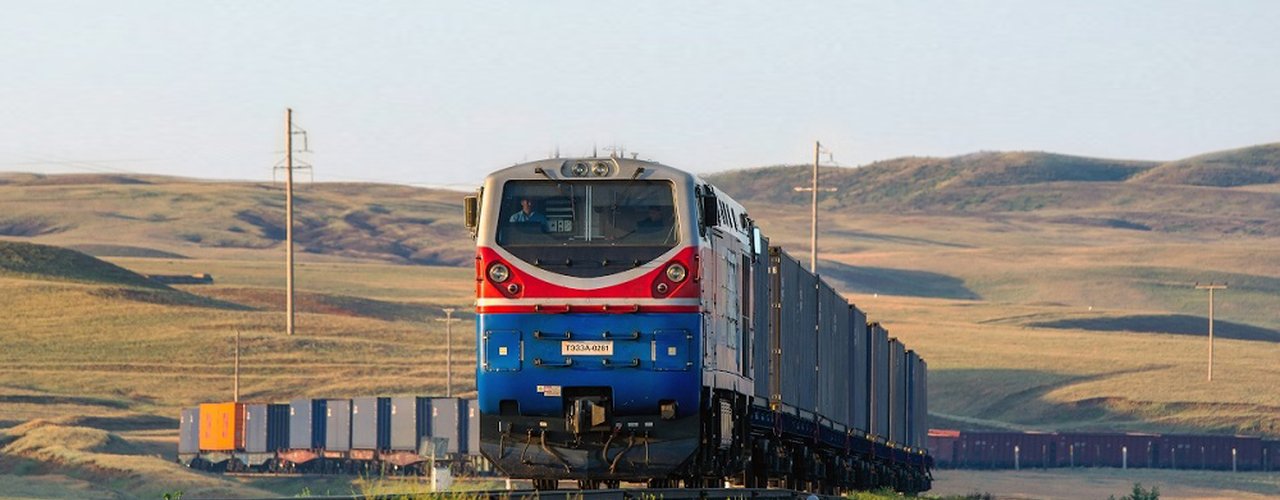
In the first quarter of 2026 Kazakhstan recorded a significant increase in container train traffic along the Trans-Caspian International Transport Route (TITR), also known as the Middle Corridor, underscoring the country’s growing role in Eurasian logistics. One hundred and twenty-five container trains transited through Kazakhstan via the TITR, marking a 34.4% increase compared to the same period in 2025.
The growth was largely driven by a new logistics approach introduced by national railway operator Kazakhstan Temir Zholy (KTZ) aimed at accelerating container transportation.
Since January 2026, KTZ has implemented a synchronized model for forming container trains that aligns rail and maritime transport schedules. This system enables container trains to be assembled directly for shiploads, eliminating the need for additional cargo accumulation and significantly reducing handling times.
The new model has already been applied to 28 container trains bound for key logistics hubs, including:
- Absheron, Azerbaijan;
- Poti and Tbilisi, Georgia; and
- Mersin and Izmit, Turkey.
The TITR is a multimodal corridor linking China and Europe through Central Asia and the South Caucasus, providing an alternative to routes that pass through Russia.
The geography of cargo origins has also broadened. While the Chinese city of Xi’an accounted for roughly 50% of all shipments in 2025, additional industrial centers have now joined the route, including Zhengzhou, Yiwu, Hefei, Wuhan, Tianjin, Shenzhen, and Guangzhou. This diversification is expected to further strengthen the corridor’s resilience and capacity.
KTZ plans to scale up the synchronized transportation model throughout 2026, enhancing the efficiency and competitiveness of the TITR.
As previously reported by The Times of Central Asia, freight volumes transported along the Middle Corridor through Kazakhstan have grown more than fivefold over the past seven years, increasing from 0.8 million tons to 4.5 million tons annually.
Container transportation has emerged as one of the fastest-growing segments of the route. In 2025, approximately 77,000 TEUs were transported along the TITR, and Kazakhstan aims to increase this figure to 300,000 TEUs by 2029, reflecting its ambition to position the corridor as a key artery for Eurasian trade.