• KGS/USD = 0.01144 0%
  • KZT/USD = 0.00205 0%
  • TJS/USD = 0.10771 0%
  • UZS/USD = 0.00009 0%
  • TMT/USD = 0.28571 0.28%
  • KGS/USD = 0.01144 0%
  • KZT/USD = 0.00205 0%
  • TJS/USD = 0.10771 0%
  • UZS/USD = 0.00009 0%
  • TMT/USD = 0.28571 0.28%
  • KGS/USD = 0.01144 0%
  • KZT/USD = 0.00205 0%
  • TJS/USD = 0.10771 0%
  • UZS/USD = 0.00009 0%
  • TMT/USD = 0.28571 0.28%
  • KGS/USD = 0.01144 0%
  • KZT/USD = 0.00205 0%
  • TJS/USD = 0.10771 0%
  • UZS/USD = 0.00009 0%
  • TMT/USD = 0.28571 0.28%
  • KGS/USD = 0.01144 0%
  • KZT/USD = 0.00205 0%
  • TJS/USD = 0.10771 0%
  • UZS/USD = 0.00009 0%
  • TMT/USD = 0.28571 0.28%
  • KGS/USD = 0.01144 0%
  • KZT/USD = 0.00205 0%
  • TJS/USD = 0.10771 0%
  • UZS/USD = 0.00009 0%
  • TMT/USD = 0.28571 0.28%
  • KGS/USD = 0.01144 0%
  • KZT/USD = 0.00205 0%
  • TJS/USD = 0.10771 0%
  • UZS/USD = 0.00009 0%
  • TMT/USD = 0.28571 0.28%
  • KGS/USD = 0.01144 0%
  • KZT/USD = 0.00205 0%
  • TJS/USD = 0.10771 0%
  • UZS/USD = 0.00009 0%
  • TMT/USD = 0.28571 0.28%

Viewing results 1 - 6 of 1033

Robust Economic Growth in EDB Member States

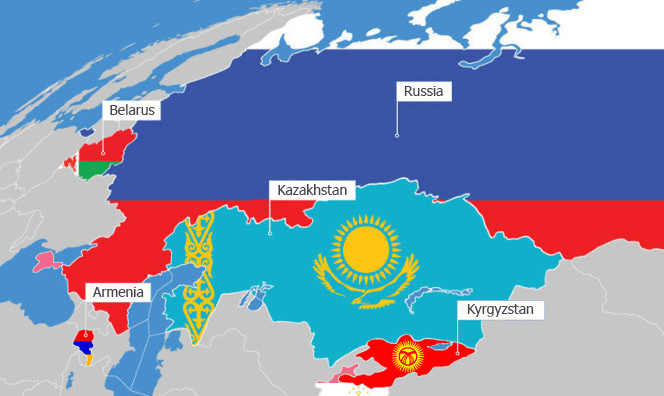
The latest Macroeconomic Review for the EDB’s six member states — Armenia, Belarus, Kazakhstan, Kyrgyzstan, Russia, and Tajikistan – was released by the Eurasian Development Bank on April 12th. Despite the challenging external economic environment, the report illustrates robust economic growth amongst all its members in January-February this year and according to short-term economic activity indicators, high GDP growth is set to continue. Fuelled by capital investment, Kazakhstan’s economy expanded by 4.2%, and Kyrgyzstan experienced a GDP surge of 8.6%, largely due to intensified investment activity, which spiked to 55%. Propelled by a dynamic increase in industrial output, economic activity in Armenia rose by 13.6%, and Belarus’s economy grew by 4% during the same period, boosted by manufacturing and retailing industries. In Russia, industrial production remains the prime driver of economic growth, raising the nation’s GDP by 6.0%, and Tajikistan’s high growth rates are maintained by consumption and investment sectors. In conclusion, the EDB reports that domestic demand within its represented countries is propelled by national projects, including increased public investment in Armenia, import substitution programs in Belarus and Russia, and the development of mechanical engineering in Kazakhstan and energy sectors in Kyrgyzstan and Tajikistan.

ADB Forecasts Faltering Economic Growth

The People's Republic of China (PRC) will remain the engine of growth for the world economy, even despite some slowdown. That forecast has been made by the Asian Development Bank (ADB) specialists in their report, Asian Development Outlook. Inflation is expected to decline in 2024 and 2025 after the increase in food prices in many countries over the past two years - and developing economies in the Asia-Pacific region will grow by an average of 4.9%, according to the ADB. Experts predict the highest economic growth for India: where the economy will grow by 7% this year and 7.2% next year. As for China, experts are more reserved in their forecasts: China's growth will slow to 4.8% this year and 4.5% next year. "Obviously, China will play an important role for some time to come. It still accounts for almost half of the GDP [gross domestic product] in the Asia-Pacific region," said ADB chief economist ,Albert Park. At the same time, economists also warned of possible risks: supply chain disruptions, uncertainty over U.S. monetary policy, the effects of extreme weather, and volatility in the PRC's real estate market. Inflation in developing Asia-Pacific economies is expected to fall to 3.2% this year and 3% next year as global price pressures ease and monetary policy remains tight in many countries. However, inflation in the region, with the exception of China, is still higher than before the COVID-19 pandemic. According to the bank's forecasts, economic growth in Uzbekistan will slow this year and grow slightly next year. This is because higher state-regulated prices will limit the growth of real household incomes, thus reducing demand. Economists expect a lower growth in services and agriculture. Lower remittances, fiscal space constraints, and lower global demand for Tajikistan's main exports will cause Tajikistan's economic growth to slow slightly in 2024 and 2025, the ADB said. "Tajikistan faces serious climate challenges and risks that could lead to irreversible economic, social, and environmental damage," said the ADB 's resident representative in Tajikistan, Shanny Campbell. The ADB says developing a green economy is key to the country's sustainable growth. As for its nearest neighbor, Kazakhstan, the ADB has lowered its GDP growth forecast for 2024 to 3.8%, down from 4.3% in the previous review. In 2025, the figure is expected to be 5.3%. Actual GDP growth at the end of 2023 was at 5.1%. "The growth rate of Kazakhstan's economy in 2024 will decrease against the background of slowdown in industrial growth due to stagnation in oil production and then recover in 2025 due to the growth of resource extraction at the Tengiz field and investments. Prospects for Kazakhstan's economic growth in the medium term look positive," ADB analysts said. As for developed economies globally, their growth will slow down this year: GDP growth in the U.S. will fall to 1.9% from last year's 2.5%, and in Japan, GDP will grow by 0.6% compared to 1.9% in 2023.

Tajik Institute Hosts Conference on Furthering Cooperation With Uzbekistan

An international conference called Uzbekistan and Tajikistan: New Perspectives of Strategic Partnership and Alliance is being held in Dushanbe on April 12, in cooperation with the International Institute of Central Asia and the Center for Strategic Studies under the President of the Republic of Tajikistan, according to a report by UzA. According to this report, current relations between Uzbekistan and Tajikistan have reached a stage of rapid development. Mutually beneficial cooperation in the political, trade-economic spheres, and cultural-humanitarian connections are expanding. The amount of cross-border bilateral trade has increased more than threefold since 2017, and in the coming years is expected to reach $1 billion annually. The main goal of the ongoing conference is to discuss the prospects for further development of the bilateral partnership, as well as to develop practical proposals for expanding cooperation in the fields of trade and industry, transport, ecology and water use, agriculture, and education. Participants include representatives from the two country’s top research and analytical centers, and from ministries and agencies. Additionally, as part of the Uzbek delegation’s visit to Dushanbe, bilateral meetings are scheduled at the Ministry of Foreign Affairs, the Institute of Economics and Demography of the Institute for the Study of the Problems of Asian and European Countries of the National Academy of Sciences of Tajikistan, and the Center for Strategic Studies under the President of the Republic of Tajikistan.

As Bishimbayev Case Continues, Kazakhstan Toughens Domestic Violence Laws

While a court in Astana tries former economy minister Kuandyk Bishimbayev for murdering his wife Saltanat Nukenova, the Kazakhstani Senate has passed a law strengthening protections for women and children against domestic violence. The new law, if properly implemented, can hand out much harsher punishments to those who abuse those closest to them. In particular, a term of life imprisonment has been introduced for the murder of a minor child.   In the Face of Widespread Indifference The trial of Bishimbayev – and his relative Bakhytzhan Baizhanov, who is accused of failing to report the murder - has uncovered an uncomfortable truth. Many people already knew that Bishimbayev beat his wife, who died last November. Relatives and close acquaintances of the victim recounted details in court about bruises on Nukenova's face. On the day of her death, a number of witnesses saw Bishimbayev arguing with, and possibly beating, Nukenova. Many of these witnesses are employees of the restaurant where the alleged murder took place. Baizhanov admitted under interrogation that he saw blood as Nukenova was laying motionless, but, on the orders of Bishimbayev, had the restaurant's surveillance tapes deleted, and then drove Nukenova's phone around the city, so that it would seem later that she was still alive at the time. According to Baizhanov, he "did not know and did not realize" that Nukenova was dying. However, a forensics expert testified in court that the nature of Nukenova's injuries indicated serious beatings, not "light slaps and falls," as Bishimbayev had previously claimed. Examinations confirmed that Nukenova died of multiple brain injuries and a lack of oxygen, likely as a result of asphyxiation.   Will the New Law Help Stop Violence?  Kazakhstanis are closely following the legal proceedings that have resulted from Nukenova's death, and are organizing viral online actions and rallies in her memory in cities across Europe. Human rights activists and ordinary Kazakhstanis fought long and hard for domestic violence to be criminalized. Under the new law, criminal liability will be applied to any intentional infliction of harm to health, however minor. The Code "On marriage (matrimony) and family" establishes the legal status of family support centers and the functions they perform, and establishes helplines for information and psychological assistance relating to women's and children's rights. The law also contains many measures aimed at protecting children in public and online. Activists are still cautious about the new law, and argue that much will depend on its practical application and the amount of funds allocated to it. Support centers for victims of violence receive many calls per day, and physically cannot provide assistance to all those in need.   Central Asia's Changing Attitudes to Domestic Violence The other countries in Central Asia face a similar, and perhaps more difficult, situation. Uzbekistan, for example, adopted a law last year to give women and children more protection against domestic violence. Domestic violence in Uzbekistan is subject to administrative and criminal liability, and harassment has been made a crime. The sentences for sexual...

Flowers Laid at Tajikistan’s Monument to Kazakh Soldiers

On April 11, a wreath-laying ceremony was held at the monument to the Kazakh soldiers who died on April 7, 1995, while guarding the external borders of the Commonwealth of Independent States (CIS) on the Tajik-Afghan border, according to a report from Avesta. Officials taking part in the ceremony included Kazakhstan's Ambassador Extraordinary and Plenipotentiary to Tajikistan, Valikhon Turekhanov, representatives of the Union of Honorary Internationalists of Tajikistan, veterans of the Border Service, and active military personnel from Tajik armed forces. The participants at the event noted that the Kazakh soldiers had performed their military duty at the cost of their lives, whilst all the while remaining faithful to the military oath. The monument commemorating the bravery of the Kazakh soldiers was opened on December 15, 2007, in the Firdavsi recreation park in Dushanbe. In 2021, the park was renovated and restored with the support of the Embassy of Kazakhstan in Tajikistan, the Ministry of Defense and National Guard of the Republic of Kazakhstan, and other public organizations. On April 7, 1995, the seventh joint company of the Kazakh military was attacked by mujaheddin in a gorge at Pshikharv Mountain on the Tajikistan-Afghanistan border. The militants were defeated in the ensuing battle.

Tajik Islamic State Member Ilhomi Sayrahmanzoda Captured in Italy

Italian police have arrested a Tajik member of the Islamic State (IS) terrorist group, according to a report by the ANSA news agency. According to police in Rome, 32-year-old Ilhomi Sayrahmanzoda was arrested at the city's Leonardo da Vinci–Fiumicino Airport after arriving on a flight from the Dutch city of Eindhoven. He had been wanted internationally since 2014 for fighting for IS in the war in Syria. Italian police established that Sayrahmanzoda was still an active member of IS, and had been using various aliases, connected with passports of Uzbekistan, Kyrgyzstan and Ukraine, to hide from law enforcement agencies. €2,000 in cash was confiscated from him, as well as a mobile phone, with which investigators are planning to identify whether Sayrahmanzoda had any connections in Italy. “His arrival in Rome raises troubling questions: did he have anything planned here? Has he hired anyone before? Were they waiting for him? His citizenship was a key factor in his arrest on March 22 amid heightened tensions surrounding the Crocus City Hall bombing. However, so far, there are no elements that indicate his involvement in this movement,” the ANSA report said. Italy is currently considering Tajikistan's request to extradite Sayrahmanzoda. Italian interior minister Matteo Piantedosi said the arrest was “a very important result, the result of an effective preventive action against the threat of terrorism.”