• KGS/USD = 0.01143 0%
  • KZT/USD = 0.00216 0%
  • TJS/USD = 0.10633 -0.28%
  • UZS/USD = 0.00008 0%
  • TMT/USD = 0.28571 0%
  • KGS/USD = 0.01143 0%
  • KZT/USD = 0.00216 0%
  • TJS/USD = 0.10633 -0.28%
  • UZS/USD = 0.00008 0%
  • TMT/USD = 0.28571 0%
  • KGS/USD = 0.01143 0%
  • KZT/USD = 0.00216 0%
  • TJS/USD = 0.10633 -0.28%
  • UZS/USD = 0.00008 0%
  • TMT/USD = 0.28571 0%
  • KGS/USD = 0.01143 0%
  • KZT/USD = 0.00216 0%
  • TJS/USD = 0.10633 -0.28%
  • UZS/USD = 0.00008 0%
  • TMT/USD = 0.28571 0%
  • KGS/USD = 0.01143 0%
  • KZT/USD = 0.00216 0%
  • TJS/USD = 0.10633 -0.28%
  • UZS/USD = 0.00008 0%
  • TMT/USD = 0.28571 0%
  • KGS/USD = 0.01143 0%
  • KZT/USD = 0.00216 0%
  • TJS/USD = 0.10633 -0.28%
  • UZS/USD = 0.00008 0%
  • TMT/USD = 0.28571 0%
  • KGS/USD = 0.01143 0%
  • KZT/USD = 0.00216 0%
  • TJS/USD = 0.10633 -0.28%
  • UZS/USD = 0.00008 0%
  • TMT/USD = 0.28571 0%
  • KGS/USD = 0.01143 0%
  • KZT/USD = 0.00216 0%
  • TJS/USD = 0.10633 -0.28%
  • UZS/USD = 0.00008 0%
  • TMT/USD = 0.28571 0%

Viewing results 13 - 18 of 648

Water Stress: Will the Summer of 2026 Become a Turning Point for Central Asia?

The summer of 2026 is projected to be a critical and potentially decisive period for Central Asia in the context of water stress. The region is entering the growing season with significantly lower water reserves in its main river basins, the Amu Darya and Syr Darya, compared to previous years. The combined impact of climate change and rising consumption is expected to exacerbate irrigation shortages, threatening crop yields and food security. A Region Under Pressure: Water as a Strategic Factor For Kazakhstan, water is taking on an increasing strategic importance in 2026. The southern regions, Kyzylorda, Turkestan, and Zhambyl, have already entered a phase of persistent low water availability. Estimates suggest that the irrigation deficit could reach up to 1 billion cubic meters. The situation in the Syr Darya basin remains critical. Inflows are expected to fall 3.2 billion cubic meters below normal, and by the start of the growing season, total water volume may reach only 1-2 billion cubic meters, far below demand. The Shardara Reservoir, a key regional storage facility, is currently at roughly half of its design capacity. Uzbekistan faces an even more vulnerable position due to its high population density and large agricultural sector. The flow of the Amu Darya is projected to fall to 65% of its historical norm, putting food stability at risk. Tashkent is accelerating investments in canal reconstruction, as water losses during transport reach up to 40%. Against this backdrop, tensions between upstream and downstream countries could become more pronounced. Kyrgyzstan, acting as the region’s “water tower,” faces a difficult trade-off between energy security and its obligations to downstream neighbors. Low accumulation levels in the Toktogul Reservoir have constrained hydropower generation, leading to winter energy shortages and reduced summer water releases, precisely when Kazakhstan and Uzbekistan require them for irrigation. This cyclical dependency turns each growing season into a complex round of “water-for-electricity” negotiations, with diminishing room for maneuver. Tajikistan faces a similar situation in the Amu Darya basin. The Nurek Hydropower Plant is operating under strict conservation principles as reservoir levels remain several meters below previous norms. For Dushanbe, the priority remains fulfilling the Rogun project, which, under low-water conditions, raises justified concerns among downstream states. These tensions are compounded by the accelerated melting of Pamir glaciers, which currently increases water flows but poses a long-term risk of severe depletion. Turkmenistan is also expected to experience acute water stress in 2026. In the Ahal and Mary regions, pasture degradation and limited irrigation are reducing livestock numbers and grain yields. The government is investing in dredging the Karakum Canal and constructing small desalination plants, but these measures only partially offset declining Amu Darya flows. An additional destabilizing factor is Afghanistan’s Qosh-Tepa Canal project. By summer 2026, its impact on the Amu Darya basin is expected to become physically noticeable. Estimates state that unregulated water withdrawals could reduce downstream flows by 15-25%. Afghanistan’s absence from regional water-sharing agreements creates a legal vacuum that existing mechanisms cannot address. As a result, Central Asia is...

Welcome to Turkmenistan? President Says He Wants International Tourists to Visit

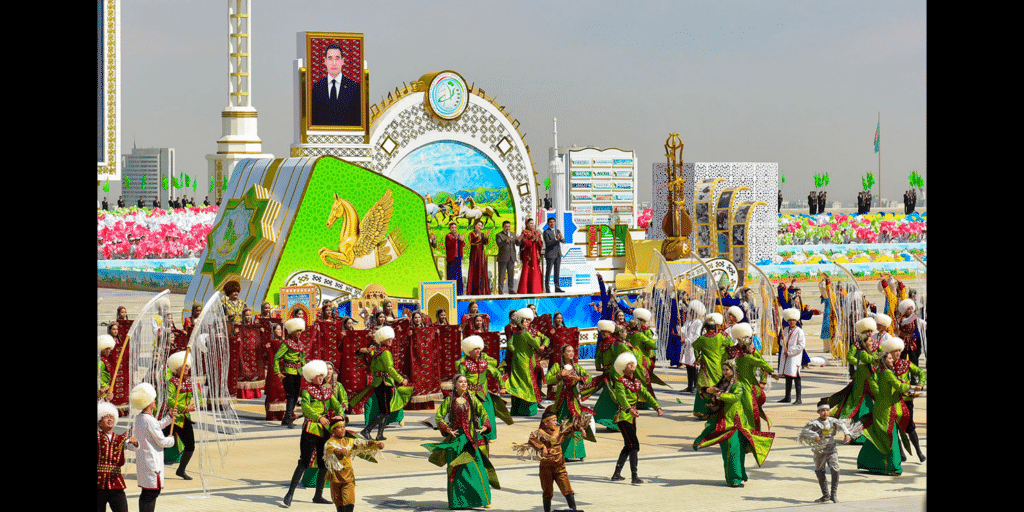
Turkmenistan, one of the world’s most closed countries, is hosting an international tourism conference this week. The “TurkmenTravel – 2026” event in the capital of Ashgabat aims to attract foreign visitors to a country that is generally difficult to visit because of tight controls, including required letters of invitation and the need to have licensed guides. While some travel agencies aim to address those challenges for tourists, Turkmenistan remains a little-understood country and lags far behind regional countries such as neighboring Uzbekistan in terms of infrastructure and accessibility for travelers. But the three-day tourism conference, which ends on Thursday, could be a tentative sign that Turkmenistan wants to open up, selectively, and within the limits of a tightly controlled system that restricts the internet and other sources of information for its citizens. [caption id="attachment_13432" align="aligncenter" width="1920"] Ashgabat Arch of Neutrality; image: Stephen M. Bland[/caption] Across Central Asia, governments increasingly treat tourism as both an economic sector and a tool of international image-building. Turkmenistan now appears to want some of that attention, but on its own carefully managed terms. The event was a priority for Turkmenistan’s government. President Serdar Berdimuhamedov delivered a message of encouragement to the participants and said tourism was growing in the Central Asian country whose stated policy is one of neutrality in international affairs. Statistics on tourism growth and other metrics are hard to come by in Turkmenistan, however. That makes the message from Ashgabat especially striking: a state known less for openness than for control is publicly promoting tourism growth while offering little transparent data to show how far that growth has actually come. [caption id="attachment_47157" align="aligncenter" width="2560"] Kunya-Urgench- The ancient Nejameddin Kubra and Sultan Ali Mausoleums; image: Stephen M. Bland[/caption] “Permanently neutral, Turkmenistan places great importance on expanding international cooperation in this area,” the president said. He noted collaboration with the U.N. World Tourism Organization and other international institutions. For years, Turkmenistan’s image abroad has rested less on mass tourism than on mystery: the white-marble capital, vast desert landscapes, major Silk Road sites, and a political system that has often kept outsiders at a distance. In Ashgabat, that mystery is part of the experience from the start. White marble towers rise in regimented lines, fountains splash into largely empty spaces, and broad avenues can feel strangely still. The city is visually extravagant but tightly controlled, with an atmosphere that can leave visitors unsure whether they are in a showcase capital, a stage set, or both. Berdimuhamedov listed some of Turkmenistan’s attractions: Ancient Merv, Nisa, and Kunya-Urgench, the Bereketli Garagum and Gaplaňgyr nature reserves, desert ecosystems, and the elaborate architecture in Ashgabat. [caption id="attachment_27727" align="aligncenter" width="2560"] Ashgabat - A row of marble towers in the Berzengi district; image: Stephen M. Bland[/caption] Cordula Wohlmuther, regional director for Europe of U.N. Tourism, was one of the listed speakers at the tourism conference. The agenda for the event included a session titled “How to promote Central Asian culture on the world stage.” One company, Asia Odyssey Travel, portrays Turkmenistan...

Why Strong Economic Growth in Central Asia Masks Underlying Risks

Central Asian countries are significantly outperforming the global average in GDP growth, largely due to differing economic models across the region. However, rapid expansion does not remove deep structural vulnerabilities. As early as March, data showed that the combined economies of Central Asian countries grew by nearly 7% in 2025 compared to the previous year. The World Bank estimates regional growth at 6.2%, while the Eurasian Development Bank (EDB) places it at 6.6%. These calculations include Kazakhstan, Uzbekistan, Kyrgyzstan, and Tajikistan; Turkmenistan is excluded due to limited statistical transparency. By comparison, growth rates in advanced economies are much lower. The EDB expects around 1.6% growth in the U.S. and approximately 1.1% in the eurozone in 2026, while China’s economy is projected to expand by about 4.6%. Nevertheless, experts note that the region’s economic outlook remains complicated by high inflation, income inequality, and continued dependence on external factors. Investment activity and domestic demand have been the key drivers of growth, according to the EDB. Kazakhstan recorded its highest growth in 13 years (6.5%), with industry leading the expansion: mining grew by 9.4% and manufacturing by 6.4%. In 2026, the non-resource sector is expected to play a greater role. Kyrgyzstan has led the region in GDP growth for the third consecutive year: GDP grew by 11.1% in 2025 and by 9% in January 2026. In Uzbekistan, GDP increased by 7.7% in 2025 (up from 6.7% a year earlier), supported by investment, trade, services, and construction. Tajikistan’s GDP rose by 8.4% in 2025, matching the previous year’s performance. Growth continues to be driven by expanding industrial production and strong domestic demand. Early 2026 data suggest this momentum is holding. Uzbekistan’s Record In April, the World Bank highlighted Uzbekistan’s resilience to external challenges and strong growth dynamics. According to its updated report, the country’s 2025 GDP growth was revised upward by 1.5 percentage points to 7.7%. The outlook is 6.4% for 2026 and 6.7% for 2027. Key drivers include high global gold prices, investment inflows, expanded lending, and ongoing structural reforms. Rising household incomes have also played an important role, supported by remittances, which increased by 37% last year to reach $18.9 billion. By the end of 2025, Uzbekistan ranked among the fastest-growing economies in developing countries in Europe and Central Asia, alongside Kyrgyzstan and Tajikistan. The region as a whole is experiencing its highest growth rates in 14 years. At the same time, analysts point to persistent structural constraints, including a large public sector and the dominance of state-owned enterprises, which hinder private sector development. External risks, including geopolitical instability and potential disruptions in energy and fertilizer supplies, remain significant. In 2025, Uzbekistan’s GDP exceeded €133 billion, compared to approximately €56 billion nine years earlier. Over the same period, GDP per capita rose from about €1,750 to around €3,220, nearly doubling average income levels. Investment in fixed capital increased by more than 15% year-on-year in 2025, while export value grew by over 33%. Persistently high global gold prices played a major role: export...

Beyond the Belt and Road: China’s New Playbook in Central Asia

In the Kyzylorda Region, near the town of Shieli, the silos and conveyor belts of a Chinese-backed plant rise out of the fine brown dust that dominates the landscape. It is the kind of project the Belt and Road was supposed to deliver in Central Asia: heavy industry, fixed capital, and a visible mark on the landscape. But it is also a reminder that China’s role in the region has become narrower, more contested, and less sweeping than the old rhetoric suggested. In photographs, the Gezhouba Cement Plant looks like a self-contained industrial island on the steppe. For nearby villagers, it became something else: a source of jobs and local prestige for some, but also of years of complaints about dust clouds and whether the state was quicker to defend a flagship Chinese-backed project than the people living beside it. Projects like the plant in Shieli also help explain why views of China across Central Asia remain mixed. Beijing is seen as a source of trade, investment, and technology, but that promise is tempered in some places by concerns over transparency, environmental costs, and who really benefits when a project arrives. China has become Central Asia’s dominant trading partner, but investment has not kept pace with the surge in commerce. The gap says a lot about how Beijing now works in the region: with a sharper focus on sectors that matter to its long-term influence. In 2025, trade in goods between China and the five Central Asian states reached $106.3 billion, up 12% year on year. Chinese exports to the region totaled $71.2 billion, while imports from Central Asia reached $35.1 billion. Trade has grown fast enough to reshape the region’s external balance, but long-term investment has been far more selective. Over 2005–2025, the five Central Asian states accounted for about 3% of China’s global overseas investment and construction total. The picture changes once direct investment is separated from trade and construction contracts. China’s FDI stock in the five Central Asian states stood at about $36 billion by mid-2025. Roughly 90% was concentrated in Kazakhstan, Uzbekistan, and Turkmenistan. The structure of that capital has also changed. Extractive industries still accounted for 46% of the portfolio, but manufacturing and energy together made up more than one third, and greenfield projects rose from 43% to 60%. China has not poured money into Central Asia on the scale once implied by early Belt and Road rhetoric. Instead, it has invested in sectors that strengthen its industrial position. Kazakhstan remains at the center of this relationship. It is China’s biggest commercial partner in Central Asia, and the main destination for Chinese capital in the region. Kazakhstan-China trade reached $43.8 billion in 2024. The country’s portfolio of projects with Chinese participation includes 224 ventures worth about $66.4 billion. Some are still at the planning stage, but the range of projects is telling. Recent developments have included a hydrogen energy technology innovation center in Almaty and a large wind farm with electricity storage. Kazakhstan still sells...

Central Asia’s Climate Risks Could Cost Up to 130% of GDP by 2080

By 2080, climate change is expected to have a profound impact on the economies of Central Asian countries, with potential losses ranging from 20% to 130% of GDP. The most severe effects are projected for mountainous nations. These estimates were presented at a CAREC technology forum by Iskandar Abdullaev, a senior research fellow at the International Water Management Institute in Uzbekistan. According to Abdullaev, climate change is no longer solely an environmental issue but an increasingly significant economic factor. Key risks include droughts and water scarcity, floods, heatwaves, and glacier melt. The projected economic impact varies across the region. Tajikistan could face losses of between 80% and 130% of GDP, Kyrgyzstan 70% to 120%, Kazakhstan 40% to 80%, Uzbekistan 30% to 45%, and Turkmenistan 20% to 60%. Abdullaev emphasized that mountainous countries – Tajikistan and Kyrgyzstan – are particularly vulnerable, as climate change directly affects water resources. Glacier melt reduces river flows, creating challenges for both energy production and water supply. Droughts and extreme heat are already placing pressure on agriculture, with declining crop yields and reduced pasture productivity. Without adaptation measures, the region’s long-term sustainability could be at risk. Experts stress that mitigation and adaptation efforts are essential to reduce these risks. These include modernizing irrigation systems, adopting climate-resilient agricultural technologies, and expanding renewable energy capacity. This is not the only warning. According to the World Bank, natural disasters are already causing significant economic damage in Central Asia.  Losses from extreme events, including floods and earthquakes, can reach up to 6% of GDP, with earthquakes alone accounting for up to $2 billion in damages. At the same time, countries in the region face substantial financing gaps following major disasters. In Tajikistan, this gap could reach up to $1.5 billion. Experts warn that climate change is likely to intensify these risks, further increasing the economic burden on the region.

Hungary’s Political Shift Puts Central Asia Partnerships Under Scrutiny

Hungary’s political transition following the defeat of Viktor Orbán’s party and his resignation as prime minister is drawing attention not only in the EU and the United States, but also in Central Asia, where Budapest has built growing energy and investment ties. The key question is whether the policy of cooperation with Central Asia developed under Orbán will continue under the new leadership. In recent years, under Orbán, Budapest has actively developed its Central Asian foreign policy, primarily driven by the desire to find alternatives to Russian energy supplies. That push reflects Hungary’s long-standing reliance on Russian oil and gas, which has shaped its search for alternative suppliers beyond Europe. Resource-rich Kazakhstan, Uzbekistan, and Turkmenistan became natural partners for diplomatic engagement. Orbán succeeded in building trust-based relationships with the presidents of the Central Asian republics, grounded in what Hungary’s Minister of Foreign Affairs, Péter Szijjártó, described as “sincere friendship” in an interview with Uzbek media. “In Hungary, we have always viewed Central Asia as one of the fastest-growing regions in the world, with enormous potential. Our efforts to build these relations did not begin today, but decades ago,” he said. Hungary became the first Central European country to sign a strategic partnership with Kazakhstan in 2014. Currently, the Kazakhstan-Hungary Business Council is in operation, along with a joint agricultural direct investment fund. In 2024, bilateral trade approached $200 million, and from January to August 2025, it grew by another 22.1%, exceeding $164.6 million. Hungarian investments in Kazakhstan’s economy have surpassed $370 million, while the current investment portfolio includes 16 projects worth about $700 million in engineering, agriculture, and logistics. These links also intersect with wider efforts to expand east–west transport routes through the Caspian region, offering Hungary indirect access to Central Asian energy and trade flows. In May 2025, Uzbekistan’s President Shavkat Mirziyoyev held talks with Orbán in Budapest, where both sides highlighted rising trade volumes and a joint investment portfolio of about $500 million. Hungary’s OTP Bank entered into Uzbekistan’s financial market in 2023, acquiring a 73.71% stake in Ipoteka Bank, becoming its principal owner and the majority shareholder of the country’s fifth-largest bank. As early as 2019, Hungary had intensified cooperation with Turkmenistan. After talks at the Turkmen Foreign Ministry, Szijjártó told the media that Hungary views Turkmenistan as an important country from the perspective of European security. “We very much hope that Turkmenistan’s gas resources will be integrated into the overall energy flow of Central Europe,” he said. However, uncertainty remains over whether this policy direction will continue under Orbán’s successor, Péter Magyar. Oil and gas analyst Oleg Chervinsky has suggested that political changes in Hungary could affect cooperation with Kazakhstan’s national company KazMunayGas (KMG). Chervinsky notes that, having secured a constitutional majority in parliament, Magyar has a mandate to “implement reforms in both foreign and domestic policy [which could] reshape the constitutional structure of the right-wing populist authoritarian system built around Orbán.” The analyst points to Hungary’s oil and gas company MOL Group, which in recent...